

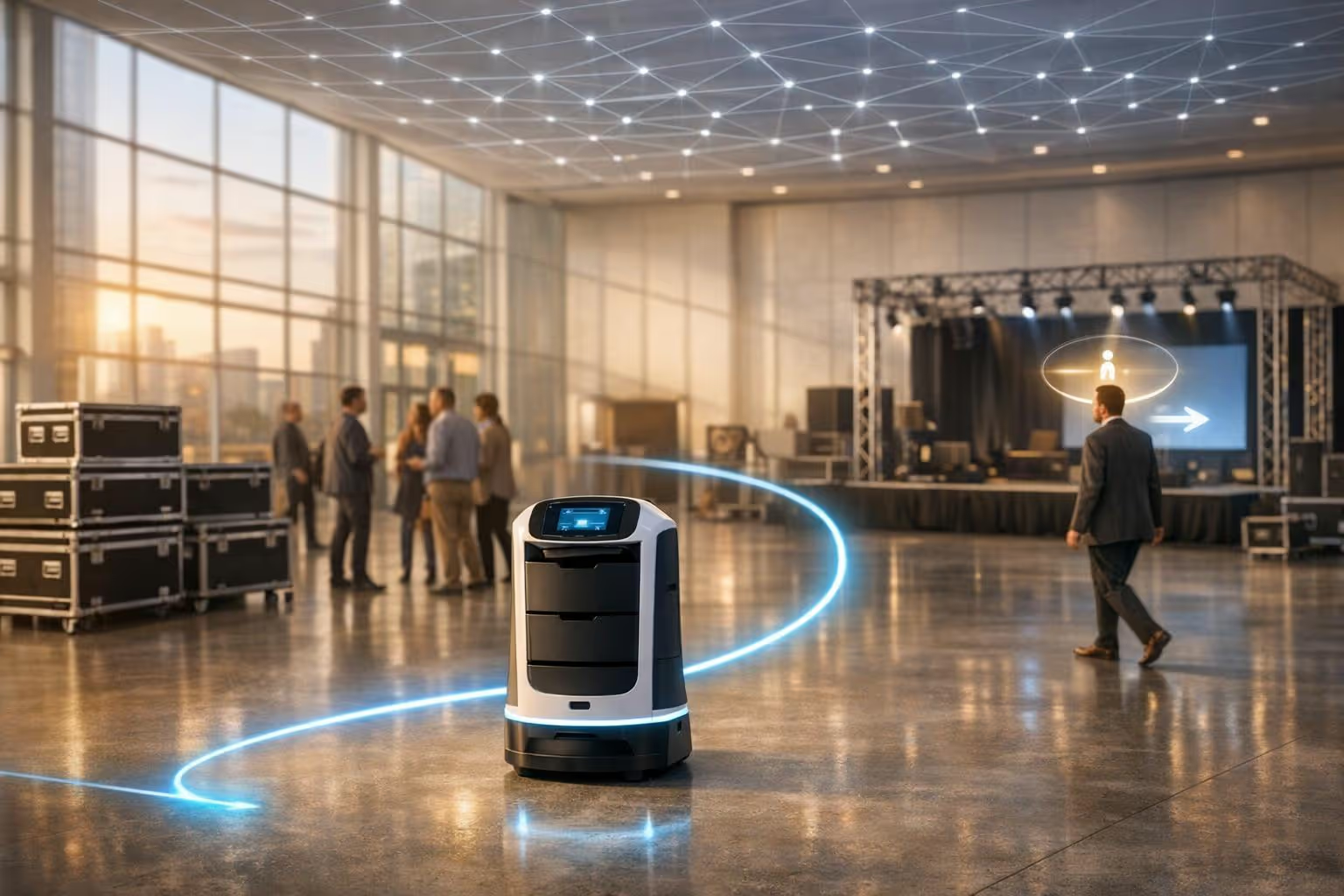
Robotics, AI, and smart infrastructure are transforming the events industry. These technologies are automating setups, improving logistics, and creating tailored experiences for attendees. Here's how:
- Robotics: Autonomous robots handle tasks like floor marking, equipment transport, and booth construction with precision. For example, a robot marked 25,000 m² of exhibition space overnight, cutting setup time by over 50%.
- Smart Infrastructure: AI-powered systems manage energy use, crowd flow, and equipment maintenance. Venues now adjust lighting and climate control dynamically, saving resources and improving safety.
- AI Personalization: AI tools match attendees, recommend sessions, and adjust events in real time. Networking apps have doubled connection success rates and boosted attendee satisfaction by 20%.
Events like the RAISE Summit 2026 in Paris are showcasing these innovations, hosting over 9,000 leaders with robotics, AI, and advanced infrastructure at their core. Organizers can start small, test technologies, and ensure reliable connectivity to integrate these tools effectively.
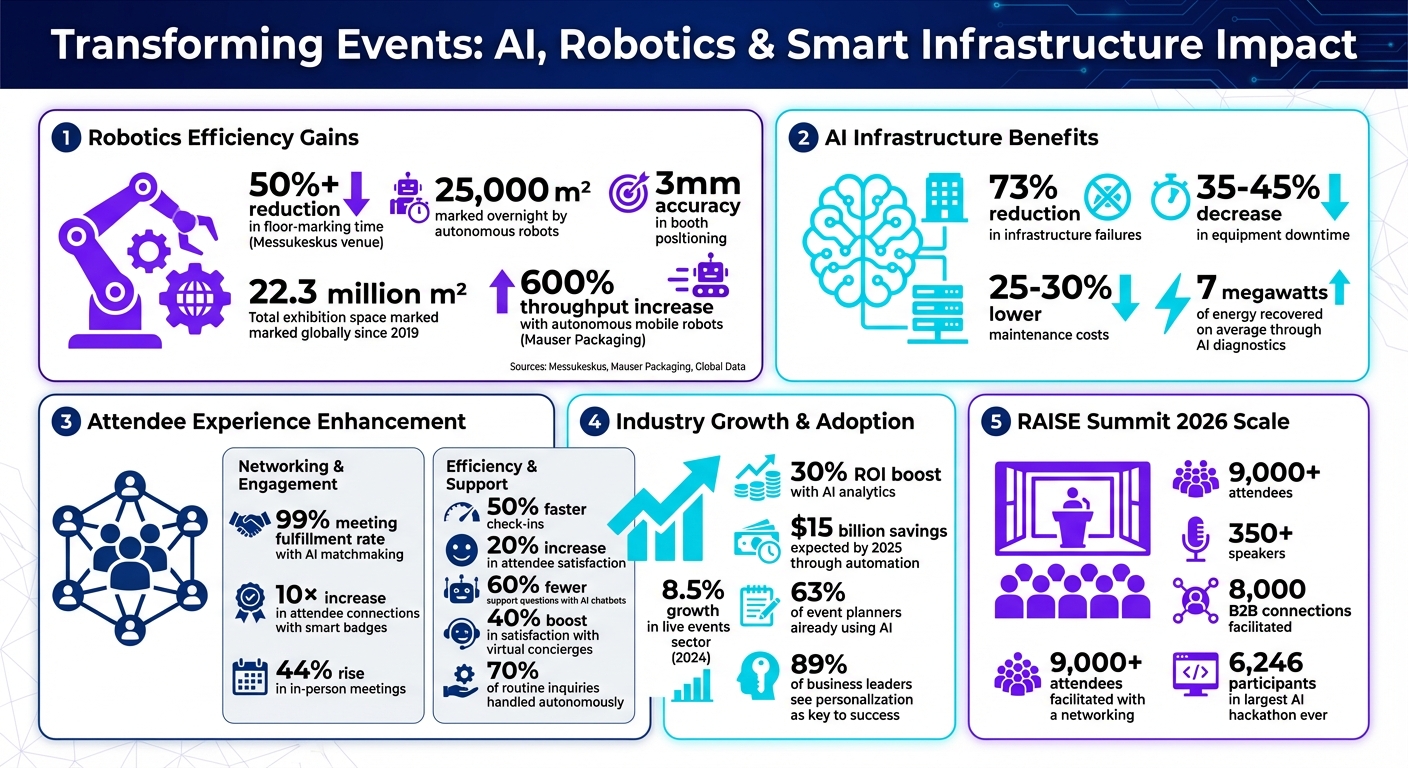
Impact of AI and Robotics on Event Management: Key Statistics and Benefits
Top 5 AI-Driven Tools Changing the Events Industry
sbb-itb-e314c3b
Robotics: Improving Event Setup and Logistics
Robotics are transforming the way events are prepared, tackling tasks like floor marking, equipment transport, and booth construction with unparalleled precision.
Autonomous Robots for Setup Tasks
Floor-marking robots have become a game-changer for exhibition halls across Europe. A notable example is August Robotics' "Lionel" robots, which were deployed at Messe Düsseldorf in January 2024. In a single night, these robots marked 25,000 m² of exhibition space using CAD plans to pinpoint booth corners, rigging points, and service connections with an accuracy of 3 mm (1/8 inch). Alex Wyatt, CEO of August Robotics, highlighted their impact:
"Lionel is helping save hours on every show build, reducing stress and fatigue for show builders and eliminating rework thanks to its amazing marking precision." [5]
Beyond speed, the precision of these robots has proven transformative. For instance, a complex circular booth layout in Las Vegas - traditionally requiring several days of manual effort - was completed by a single robot in just 5 hours[5]. Since their launch in 2019, Lionel robots have marked over 22.3 million m² (240 million square feet) of exhibition space globally[8]. Finnish venue Messukeskus reported cutting floor-marking time by over 50% after adopting autonomous robots[8].
Agentic AI also plays a role in improving event setups by combining artificial intelligence with robotics to manage real-time exceptions during complex tasks. For example, in 2026, the City of Seattle used an Agentic Process Automation system from Automation Anywhere to clear a backlog of 6,000 utility discount requests, processing 40,000 documents in just 14 days - a task that would have taken nine years manually[6].
With these innovations in setup, robotics are also reshaping how equipment is transported and logistics are handled.
Automated Transport and Logistics
Robotics have expanded their influence from setup precision to on-site logistics. Unlike older Automated Guided Vehicles (AGVs) that rely on fixed paths, modern Autonomous Mobile Robots (AMRs) use sensors to navigate obstacles in real time, making them ideal for dynamic event environments[3][7].
Just as precise marking accelerates event preparation, autonomous transport systems streamline the movement of equipment across large venues. For instance, Mauser Packaging Solutions replaced its traditional AGV system with OTTO 1500 AMRs from OTTO Motors in 2022. This upgrade allowed the company to reassign three employees to higher-value tasks, reduced manual forklift traffic to improve safety, and boosted throughput by 600% at one facility[3]. These self-driving forklifts operate continuously with swappable batteries, moving heavy pallets overnight to ensure assemblies can begin immediately the next morning[8].
French companies are also embracing these robotic advancements. Alliora, a box manufacturer in Fougères, adopted the Robotiq AX Series Palletising Solution to handle boxes weighing between 5 kg and 12 kg. Antoine Bruno, President of Alliora, explained the motivation behind automating this task:
"Why automate palletising first? The boxes are between 5 kg and 12 kg. It is very repetitive, it is very heavy, and it is very physical. People don't like doing the palletising task." [9]
The results speak for themselves: Alliora achieved a full return on investment within 18 months and reduced the need for temporary workers by two positions during peak seasons[9].
AI-Enhanced Infrastructure: Smarter Event Management
The integration of AI into venue operations is reshaping how events are managed, focusing on three key areas: energy efficiency, crowd safety, and equipment reliability. These advancements allow venues to adapt dynamically to real-time conditions, improving both functionality and sustainability.
Smart Venue Systems for Resource Management
Traditional HVAC systems often operate inefficiently, sticking to rigid schedules that don't account for actual needs. AI-powered systems, however, adjust dynamically based on factors like weather conditions, occupancy levels, and energy tariffs[10]. For instance, large conference centres in Paris can now activate lighting and climate control only in areas currently in use. These systems also monitor air quality - tracking CO₂ levels and humidity - to maintain health standards without wasting energy[10].
A standout example of this technology in action is Metroscope, a startup founded by former EDF R&D engineers Aurélien Schwartz, Julien Lagarde, and Joel Bentolila. In February 2025, they launched an AI diagnostics platform that monitors 95 plants across 12 countries. Using digital twin technology, the system identifies inefficiencies in real time, helping operators recover an average of 7 megawatts of energy that would otherwise be lost[11]. While this example focuses on power generation, the same principles apply to energy-intensive event venues. In France, the upcoming European AI Campus in the Paris region, with a planned capacity of 1.4 GW, highlights the scale of infrastructure being developed to support such intelligent systems[12].
Managing Crowd Flow and Safety
AI's role extends beyond resource management to improving crowd flow and safety. Modern systems predict congestion points before they occur, reducing bottlenecks and enhancing attendee experiences. Instead of relying solely on manual CCTV monitoring, these systems use IoT sensors - such as motion detectors, pressure sensors, and Bluetooth beacons - to track crowd density and movement patterns in real time[13]. When an area nears 85% capacity, automated alerts can redirect foot traffic to less crowded zones[13].
For example, Levi's Stadium in California has installed around 1,700 Bluetooth Low Energy beacons to provide precise indoor navigation for fans[13]. Similarly, Croke Park in Dublin, with its 82,000-person capacity, uses real-time noise monitoring to ensure compliance with local regulations while maintaining good relations with the surrounding community[13]. In France, such technology is particularly beneficial for multi-day events, where attendees frequently move between exhibition spaces, breakout rooms, and dining areas.
Predictive Maintenance for Event Equipment
AI doesn't just enhance energy use and crowd management - it also keeps event equipment running smoothly through predictive maintenance. By monitoring key performance indicators like vibration levels, temperature changes, and pressure readings, AI can forecast equipment failures weeks in advance[14]. This proactive approach replaces inefficient reactive repairs and eliminates unnecessary servicing of functional components[14][15].
The benefits are significant: predictive maintenance reduces infrastructure failures by 73%, cuts equipment downtime by 35–45%, and lowers maintenance costs by 25–30%[14][15]. For event organisers, this ensures that essential systems like HVAC units, lighting rigs, and elevators remain operational throughout the event. Additionally, by identifying issues like excessive power consumption caused by internal wear, these systems contribute to overall energy efficiency[14].
Personalized Experiences with Applied AI
Thanks to advancements in applied AI, events are shifting from generic, one-size-fits-all gatherings to highly tailored experiences. By merging registration details with behavioral cues - like app usage, badge scans, and session check-ins - AI systems create dynamic attendee profiles that evolve as the event progresses. This approach aligns with current trends: 89% of business leaders believe personalisation is key to success in the next three years, and 70% of consumers now expect interactions to cater to their specific needs[16][18].
AI-Powered Networking Recommendations
AI-driven matchmaking tools are transforming how attendees connect. These platforms analyze both stated preferences and on-site behavior, combining targeted questions (e.g., whether someone is seeking or offering investment) with job role and industry data. This dual approach has been shown to double matchmaking success rates on average[16].
Recent events showcase how powerful this technology can be. At one gathering, over 3,500 participants formed more than 19,000 connections in a single day, with a 99% meeting fulfillment rate. This success was powered by an AI matchmaking tool that assigned predictive quality scores to scheduled meetings[17]. Additionally, Bluetooth-enabled smart badges have led to a 10× increase in attendee connections compared to traditional methods[17]. For organizers, encouraging attendees to engage with AI tools early - by responding to even a few "yes" or "no" prompts - can significantly improve recommendation accuracy[16].
Real-Time Analytics for Event Adjustments
AI doesn't just personalise experiences beforehand - it also empowers event organizers to make real-time adjustments. By monitoring crowd density, social media feedback, and session attendance, AI systems can notify attendees when sessions are full and trigger logistical changes. This has led to a 44% rise in in-person meetings, 50% faster check-ins, and a 20% increase in attendee satisfaction[20].
These systems can also handle logistics autonomously. For instance, they alert catering staff 45 minutes before a food item runs out or adjust staffing levels based on predicted peak times[20][21]. Gartner predicts that by 2026, 40% of enterprise applications will feature autonomous AI agents capable of making decisions independently[20].
Interactive AI Tools for Better Engagement
AI-powered tools like virtual concierges and chatbots are becoming indispensable at events. Systems like Sena engage with attendees before the event to understand their goals, then provide real-time navigation and session suggestions. This has resulted in 60% fewer support questions and a 40% boost in attendee satisfaction[19]. These tools autonomously handle 70% of routine attendee inquiries, allowing human staff to focus on more complex tasks[20].
Platforms are also using sentiment analysis to measure the "emotional temperature" of events. By analyzing text feedback, social media posts, and even facial expressions, AI can detect when attendees are fatigued and suggest quieter spaces or breaks[18]. Additionally, AI-enhanced navigation offers personalised routes that consider an individual’s schedule, location, and accessibility needs, while avoiding crowded areas[18]. This level of personalization ensures every attendee gets the most out of their experience, tailored specifically to their goals and preferences.
RAISE Summit Case Study: Robotics, Infrastructure, and AI in Action
The RAISE Summit is where cutting-edge technology meets real-world application. Hosted at the iconic Carrousel du Louvre in Paris, this event brings together over 9,000 attendees and more than 350 speakers, managing logistics on a scale that traditional methods simply can't handle[1]. It offers a practical guide for organisers aiming to integrate robotics, smart infrastructure, and AI into their events.
Robotics in Expo and Stage Preparation
The MACHINA Summit, a key component of RAISE, focuses on showcasing robotics in action. Through live demonstrations, attendees witness how physical AI can be applied at scale to boost productivity in real-world scenarios[2]. The summit highlights "Industrial Autonomy", where robotics are used to automate essential tasks and deliver measurable ROI[2]. This practical approach shows how robotics can simplify complex event setups, making it easier to manage large-scale gatherings. These demonstrations naturally lead into discussions about AI-powered management systems, which play a crucial role during the event.
AI-Driven Infrastructure for Large-Scale Events
In July 2025, RAISE Summit introduced QR-based attendance tracking, allowing organisers to monitor entry points, session participation, and manage the flow of 6,500 attendees in real time[25]. This data-driven approach enabled instant adjustments to room allocations and staffing needs. Additionally, the summit relied on Vultr’s AI-native cloud infrastructure to handle the event's demanding workloads[24].
A standout moment was the "RAISE Your Hack" hackathon, the largest AI hackathon ever, with 6,246 participants. During the event, the team Axiom Prime developed an AI-powered platform that could monitor infrastructure and automatically diagnose issues[24]. These tools allowed organisers to shift their focus from routine logistics to more meaningful, high-value interactions with attendees.
Personalised Attendee Tools Using AI
On top of these technological innovations, RAISE Summit uses AI to enhance the attendee experience. The RAISE Networking App offers personalised recommendations, session planning tools, and professional connection suggestions[49, 50]. In 2025, this ecosystem facilitated 8,000 B2B connections[23].
For VIP and VIP MAX ticket holders, the app provides advanced features, such as access to exclusive startup pitch decks and developer profiles, streamlining high-level deal-making[27]. With 80% of attendees holding C-level or founder roles[26], the app’s ability to match participants based on their goals - whether they’re seeking investments, partnerships, or technical expertise - turns networking into a targeted and effective process. As Jonathan Ross, CEO & Founder of Groq, remarked:
"RAISE is where everyone in AI is going."[1]
Future Trends and Practical Advice for Event Organizers
Agentic AI for Event Automation
Agentic AI systems are changing the game for event management by responding autonomously to real-time conditions like crowd density or infrastructure issues[21]. By 2026, the role of event managers will shift toward becoming "experience strategists." This means focusing on meaningful engagement while letting AI handle repetitive, time-consuming tasks[21]. As Thomas Martens puts it:
"AI is not replacing event professionals. It's creating the conditions for better events."[28]
However, for this level of AI autonomy to work effectively, events will need infrastructure that's both robust and scalable.
Building Scalable Infrastructure for 2026 and Beyond
Strong and reliable connectivity is non-negotiable. AI and robotics rely on stable Wi-Fi and uninterrupted power sources to function seamlessly[4]. For instance, Tomorrowland 2024 in Belgium used LiDAR-based 3D sensors alongside AI software to track crowd density in real time. This setup created a live 3D map that helped reduce queue times and congestion through targeted notifications[29]. Similarly, during the FIFA World Cup in Qatar, AI-powered command centres monitored thousands of CCTV feeds to spot bottlenecks and redirect fans, preventing potentially dangerous situations[29].
Another example is AWS re:Invent, which used an AI recommendation engine to personalise schedules for over 1,500 sessions. This not only improved attendance but also increased overall satisfaction among participants[29].
With such systems in place, event organizers can turn their attention to strategic ways of adopting these technologies.
Steps to Implement These Technologies
To make the most of autonomous systems and smart infrastructure, a thoughtful approach to implementation is key. Start small with pilot programmes to measure ROI. Testing technologies like robotic delivery systems or AI-driven scheduling in controlled areas helps uncover potential issues early on[4][29]. Mapping out workflows can also highlight which repetitive tasks are ideal for automation[28]. Amber Dobbelaere from Wintercircus highlights this point:
"Every hour spent on repetitive questions is an hour lost to our real goal."[28]
Consider a hybrid staffing model where robotics handle repetitive tasks with precision, while human staff focus on hospitality and problem-solving. For example, autonomous kiosks can allow one staff member to oversee 2–3 units, each capable of assisting around 30 people per minute[4].
Always have manual backup systems - like handheld scanners or offline attendee lists - ready to step in if network issues arise[4][29]. Transparency is also critical. Use clear signage to inform attendees about technologies like drones or facial recognition, ensuring a balance between security and privacy concerns[4][22].
Conclusion: Adopting New Technologies for Better Events
The developments outlined above highlight how technology is reshaping the event industry. Robotics, smart infrastructure, and applied AI now form the backbone of event planning and execution, revolutionizing the entire lifecycle of events. For instance, autonomous kiosks have slashed badge pick-up times by more than 50% [4], while AI-driven crowd monitoring systems are helping prevent dangerous bottlenecks [22]. These innovations are not just operational upgrades - they’re redefining the attendee experience.
The live events sector experienced an 8.5% growth in 2024, largely fueled by these technological leaps [30]. For organizers, adopting these tools isn't just about keeping up; it's about achieving tangible results. AI analytics, for example, can boost event ROI by up to 30% [31], and automation is expected to save the industry over $15 billion (approximately €13.5 billion) by 2025 [31]. Additionally, 63% of event planners are already using AI to enhance attendee engagement [31], proving the growing reliance on technology to deliver better outcomes.
The shift is unmistakable: events are no longer just about attendance but about delivering meaningful results [32]. AI enables event professionals to focus on metrics like intent, lead quality, and engagement depth instead of merely tracking headcounts. As Thomas Martens aptly puts it:
"AI is not replacing event professionals. It's creating the conditions for better events." [28]
To get started, consider rolling out pilot programs and analyzing your workflows to pinpoint repetitive tasks that consume valuable time [4][28]. Make sure solid Wi-Fi networks and backup power systems are in place to support these technologies [4]. By combining robotics, smart infrastructure, and AI for precision and efficiency, your team can concentrate on delivering exceptional hospitality and strategic insights [4][28].
These tools don’t just simplify operations - they elevate the entire event experience. The real question is no longer whether to adopt these technologies, but how quickly they can be implemented to stay ahead and meet the growing expectations of today’s attendees.
Häufig gestellte Fragen
What’s the easiest way to start using robotics and AI at an event?
To get started, a practical approach is to look into existing solutions and participate in industry events that highlight robotics and AI applications. These events provide a chance to interact directly with technologies like humanoid robots and automation systems. You can also take small steps by incorporating AI-powered tools into your operations - think facial recognition for smoother check-ins or chatbots to assist attendees. These tools can streamline processes and elevate the experience for everyone involved.
What infrastructure (Wi‑Fi, power, sensors) is needed for these systems to work reliably?
To support these systems, having reliable infrastructure is non-negotiable. This includes high-speed Wi-Fi, a stable power supply, and an interconnected network of sensors. Together, these elements enable smooth operations and real-time data processing - both critical for efficiently handling large-scale events.
How can organisers use AI personalisation without risking attendee privacy?
Organisers can leverage AI to personalise experiences while safeguarding attendee privacy by prioritising data minimisation and transparency. This means gathering only the information that is strictly necessary, ensuring it is anonymised or pseudonymised whenever possible. Attendees should also have clear and accessible options to opt in or out of data collection.
To keep data secure, focus on privacy-by-design approaches. These include using encryption, secure storage solutions, and limiting access to sensitive information. Additionally, being open about how data is used fosters trust. When handled responsibly, personalisation can elevate the attendee experience without compromising their privacy.