

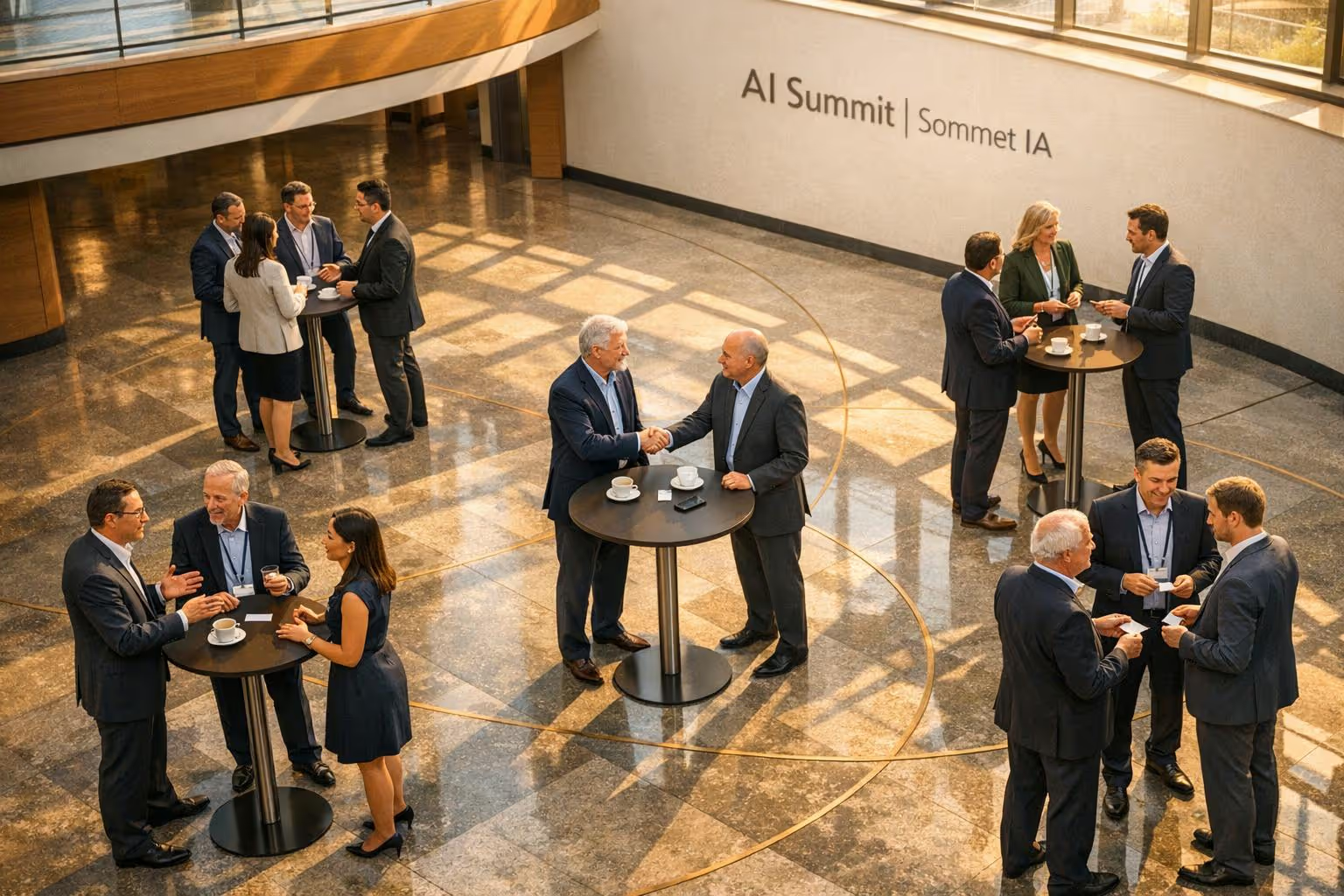
AI events have grown into massive hubs where technology, business, and policy intersect. These gatherings aren't just about discussing trends - they're where decisions are made, funding is secured, and partnerships are formed. For instance, the RAISE Summit 2025 in Paris attracted over 40,000 attendees, including 40+ heads of state and top companies like Meta and OpenAI. French President Emmanuel Macron even announced a €109 billion AI investment, highlighting the strategic importance of these events.
Key takeaways from the article:
- AI Events Are Business-Driven: Over 80% of attendees are executives, investors, and policymakers, making these events critical for decision-making and funding.
- France as an AI Hub: With €2.6 billion raised by French startups in a year and 5.8 GW secured for data centers, France has become a key player in AI.
- Specialized Formats: Events like "RAISE Week" offer tailored programs for developers, executives, and investors, including hackathons, startup competitions, and exclusive summits.
- Global Impact: These events influence global AI strategies, from technology adoption to shaping governance policies.
AI events now drive the industry's growth, connecting innovation with investment and policy, while positioning regions like France as global leaders.
Explore High-Growth AI Opportunities From Data Centers to Breakthrough Use Cases
Industry Trends: The Expansion of AI Conferences
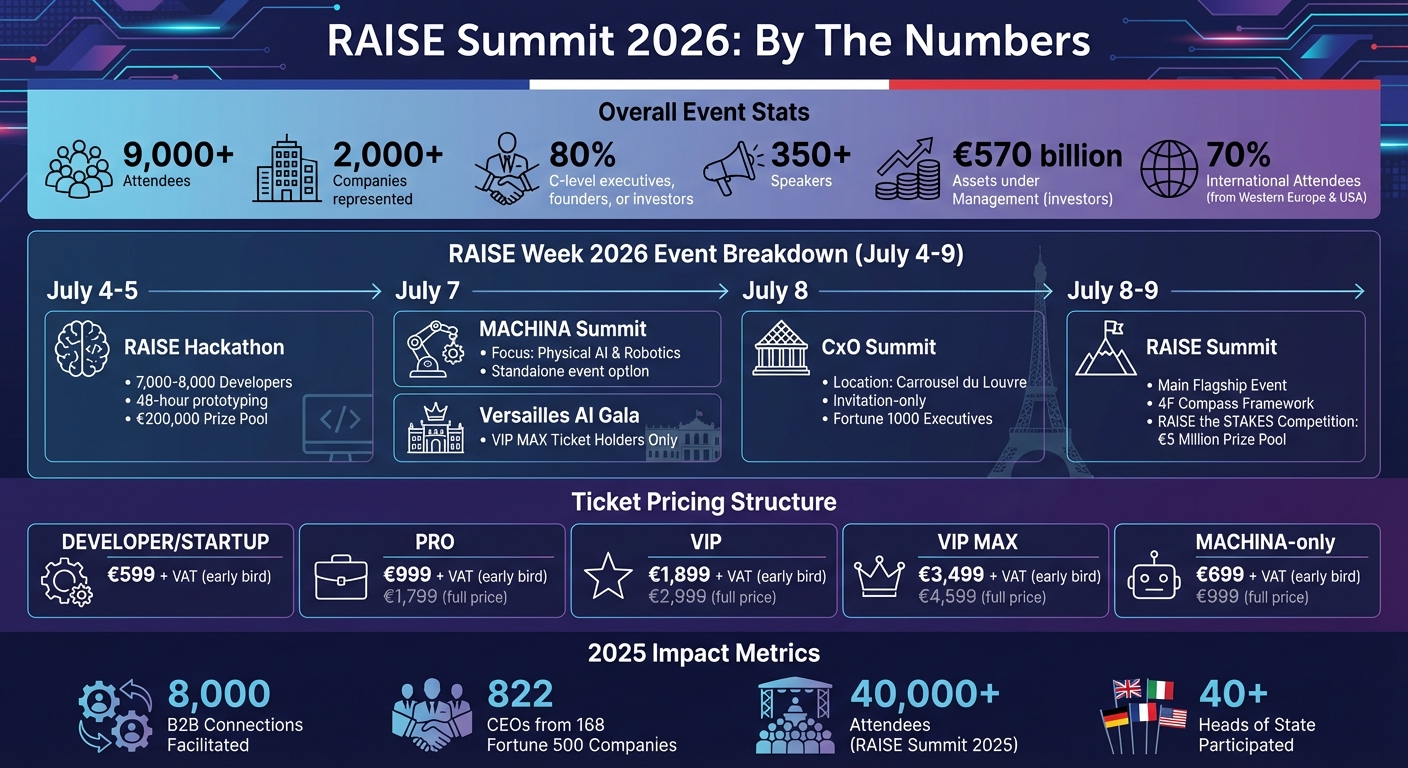
RAISE Summit 2026 Key Statistics and Event Breakdown
The Numbers Behind AI Event Growth
AI conferences have grown far beyond their academic roots, evolving into a dynamic ecosystem that caters to a wide range of audiences. Paris has become a central hub for these events, as reflected in the robust 2026 event calendar.
Take the RAISE Summit as an example. The 2026 edition is set to welcome over 9,000 attendees from more than 2,000 companies. Around 80% of these participants are expected to be C-level executives, founders, or investors [4][1]. Among them, investors collectively manage over €570 billion in assets [1]. These figures highlight how AI events have transformed into high-stakes platforms, driving innovation and fostering influential connections.
Different Event Formats and Target Audiences
The growth of AI conferences isn’t just about bigger attendance numbers; it's also about the increasing variety and specialisation in event formats. A concept like "AI Week" is a perfect example of this evolution, turning entire cities into interconnected hubs of activity. RAISE Week 2026, scheduled for 4–9 July in Paris, perfectly embodies this idea, offering tailored programming for technical experts, enterprise professionals, and venture capitalists [5].
These events now cater to distinct stakeholder groups with specialised formats. For instance:
- The RAISE Hackathon (4–5 July) draws 7,000 to 8,000 developers for 48 hours of intense prototyping, offering a €200,000 prize pool [4].
- MACHINA (7 July) focuses solely on Physical AI and robotics, examining the fusion of intelligence and hardware [5].
- The invitation-only CxO Summit (8 July) at the Louvre provides Fortune 1000 executives with a private, strategic setting for forming partnerships [5].
- The flagship RAISE Summit (8–9 July) serves as the centrepiece of the week, alongside the RAISE the STAKES startup competition, which boasts a €5 million prize pool [4][5].
This level of segmentation reflects a shift in how the AI industry approaches collaboration and knowledge-sharing. Events are now designed to meet highly specific needs, whether they involve technical innovation, enterprise adoption, or investment opportunities. This tailored approach ensures that participants can engage meaningfully, no matter their focus or goals.
RAISE Summit: How a Major Event Reflects Industry Development
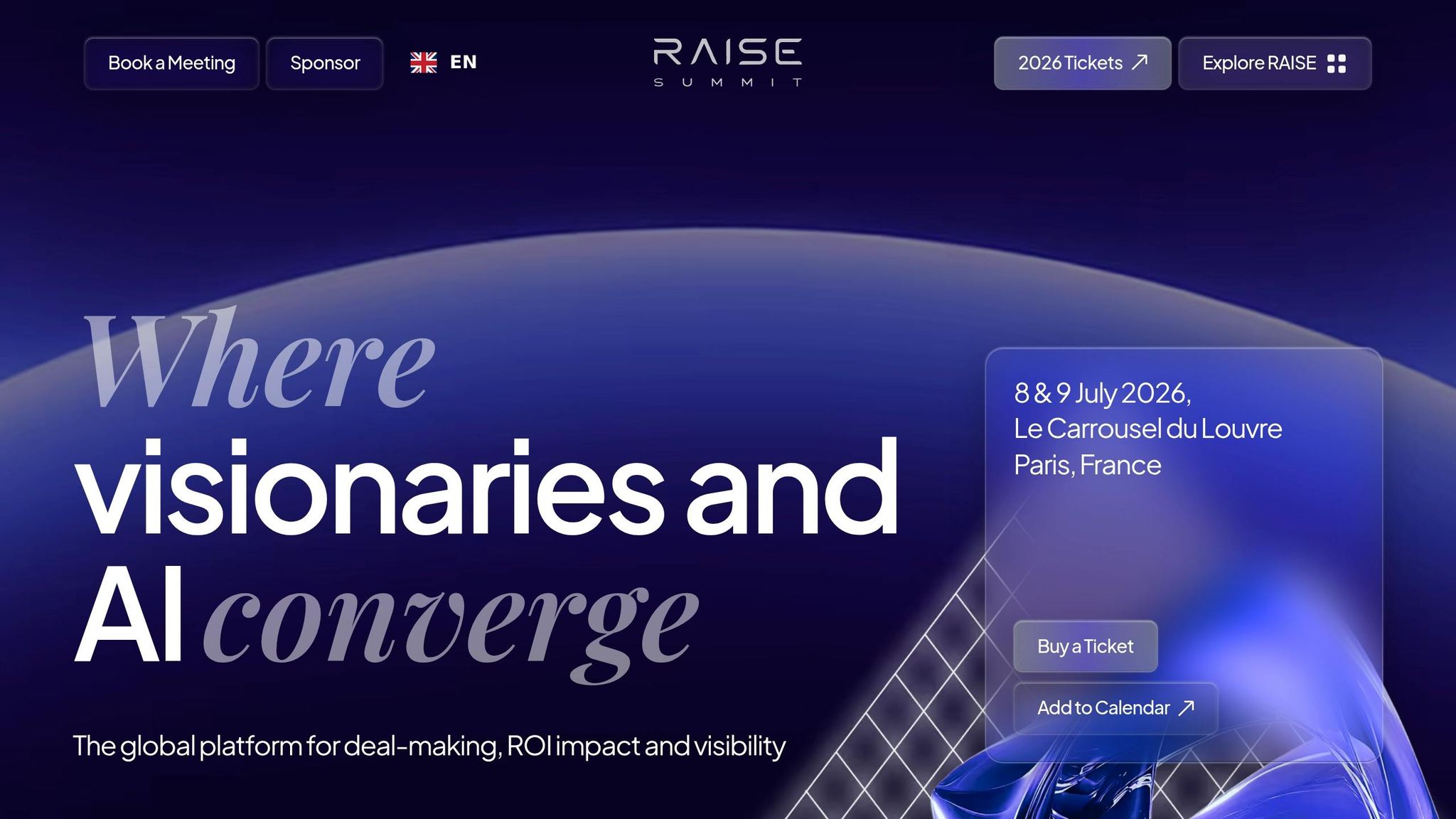
Main Features and Programme Elements
The RAISE Summit, described by co-founder Hadrien de Cournon as a "Global Board Meeting", is built around its 4F Compass Framework. This framework tackles four key areas: Foundation (infrastructure and capital), Frontier (transformative applications), Friction (governance and ROI challenges), and Future (AGI and sustainability) [4][6]. The event focuses on actionable results, reflecting the growing emphasis on AI events as drivers of industry progress.
With over 350 speakers and representatives from more than 2,000 companies [4], the summit prioritizes real-world outcomes over theoretical discussions. A standout feature is the CxO Summit, an exclusive gathering at Le Carrousel du Louvre on 8 July. This invitation-only event gives Fortune 1000 executives a chance to benchmark strategies and secure concrete partnerships. As Hadrien de Cournon puts it:
"The CxO Summit exists so companies don't just talk about AI, they leave RAISE with real partnerships, pilots, and signed deals" [1].
The RAISE the STAKES competition also plays a pivotal role in fostering innovation. In July 2025, Hirundo.io won for its machine unlearning platform, which reduced AI hallucinations by 55% and biases by 70% [8]. For 2026, the competition offers a €5 million prize pool [4][8], giving early-stage companies the chance to pitch directly to Tier 1 investors. This setup transforms the summit into a dynamic marketplace where innovation meets investment.
Pricing Structure and Ticket Options
The summit's tiered ticketing system caters to professionals with varying needs and budgets. The PRO ticket (999 € + VAT early bird, 1,799 € full price) includes access to the exhibition, workshops, networking app, and the official party [7]. For senior professionals, the VIP ticket (1,899 € + VAT early bird, 2,999 € full price) adds perks like VIP lounge access, MACHINA Summit inclusion, and trend reports [7]. The VIP MAX tier (3,499 € + VAT early bird, 4,599 € full price) goes further, offering entry to the Versailles AI Gala on 7 July [7].
For developers and startups, the summit provides discounted DEVELOPER and STARTUP tickets at 599 € + VAT for validated applicants [7]. Those focused on Physical AI can choose MACHINA-only access for 699 € + VAT early bird (999 € full price), which grants entry solely to the Physical AI programme [7]. This structured pricing not only makes the event accessible but also fosters meaningful collaborations across the industry.
Effects on the AI Community
The summit's influence extends well beyond the event itself. The 2025 edition facilitated 8,000 B2B connections and hosted 822 CEOs from 168 Fortune 500 companies [1][8]. These interactions led to numerous partnerships and pilot programmes, delivering tangible business results during and after the summit.
It also serves as a launchpad for breakthrough technologies. In July 2025, Cerebras Systems showcased Qwen3-235B on its inference cloud, achieving cutting-edge performance at a fraction of the cost of closed-source models. Meanwhile, H Company open-sourced SurferH, a web-native agent for browser automation, which achieved a 92.2% success rate on the WebVoyager benchmark, while operating at 5.5× lower cost compared to leading alternatives [8]. These examples highlight the summit's role in pushing technological boundaries.
For Paris, the summit strengthens its status as a global hub for AI. With about 70% of attendees coming from abroad - mainly Western Europe and the United States [9] - the event connects French innovation with international capital. Former Google CEO Eric Schmidt summed up the event’s importance:
"the fastest-growing AI tech conference in Europe, and maybe in history" [4].
This international recognition not only boosts France’s visibility but also positions it as a key player in shaping the future of AI development and adoption. The summit’s ability to drive these outcomes cements its role as a catalyst for industry-wide transformation.
sbb-itb-e314c3b
How AI Events Accelerate Industry Growth and Technology Adoption
Faster AI Adoption Across Sectors
AI conferences have transformed from simple discussion forums into powerful engines for driving technology adoption. These events offer direct access to decision-makers, cutting through traditional corporate layers. For instance, Fortune 1000 executives can connect directly with innovators, thanks to AI-powered matchmaking tools that facilitate high-impact meetings. The 2026 edition is set to host over 9,000 global leaders, with more than 80% being C-level executives, founders, investors, or policymakers [1]. This kind of access significantly shortens the timeline for adopting cutting-edge technologies.
Hackathons are another key feature, offering a hands-on approach to solving industry-specific problems. At the 2026 event, 7,000 developers will tackle real-world challenges posed by global industry leaders [1]. These sessions turn theoretical AI concepts into practical, deployable solutions. This rapid pace of development naturally fosters collaboration, paving the way for strategic partnerships, which are explored in the next section.
Building Business Strategies Through Partnerships
With accelerated adoption comes an environment ripe for strategic partnerships. The level of investment present at these events is staggering - investors at the RAISE Summit collectively manage over €570 billion in assets [1]. When this kind of capital meets over 1,100 cutting-edge AI companies, the result is a flurry of partnerships and pilot programs.
The CxO Summit exemplifies this synergy. Held at the Carrousel du Louvre, this exclusive gathering allows Fortune 1000 executives to exchange ideas, benchmark strategies, and address policy challenges in a curated setting. Startup competitions further bridge the gap between innovation and investment, connecting early-stage companies with Tier 1 investors. These connections often lead to not just funding but also market validation and access, all within the span of a single event.
Policy Impact and Global Standing
AI events are no longer just about technology - they're shaping national and international strategies. In February 2025, France and India co-hosted the Paris AI Action Summit, positioning themselves as leaders in global AI governance [10]. The following year, India hosted the AI Impact Summit in New Delhi, marking the first major AI summit in the Global South. This event included a notable session on science-led governance, led by UN Secretary-General António Guterres [10][11].
These gatherings help establish shared standards and evidence-based practices. António Guterres highlighted their importance, stating:
"Science-led governance is not a brake on progress. It is an accelerator for solutions. A way to make progress safer, fairer, and more widely shared" [11].
For France, hosting the RAISE Summit at iconic venues like the Carrousel du Louvre cements its position as a global AI leader. These policy discussions not only drive technological advancements but also shape the regulatory frameworks necessary for responsible AI development, showcasing how such events influence both innovation and governance on a global scale.
Conclusion: What AI Event Growth Means for the Industry
Main Points
The surge in AI events marks a shift in how the industry operates. These gatherings are no longer just about observing trends - they’re now where deals are made and strategies are defined. When 822 CEOs from 168 Fortune 500 companies and investors managing over €570 billion in assets come together at a single event [1], it’s clear that AI has moved from experimental stages to becoming a cornerstone of economic policy. Take, for instance, President Emmanuel Macron’s €109 billion commitment, followed by a €150 billion pledge from a consortium led by General Catalyst [12]. These figures underscore AI's growing influence on national and global priorities.
AI events today are all about actionable outcomes. For example, the invitation-only CxO Summit at the Carrousel du Louvre provides a setting for Fortune 1000 leaders to establish partnerships and launch pilot programs. Meanwhile, 7,000 developers participating in the RAISE Hackathon [1] tackle practical challenges, linking executive strategies with technical solutions. These initiatives highlight how these events are shaping the industry’s ability to address future hurdles like infrastructure and specialisation.
Future Outlook
With these achievements as a foundation, the industry is gearing up for even bigger challenges. Infrastructure concerns, such as the growing need for data centre capacity and reliable energy supplies, are now at the forefront [12]. France’s success in securing 5.8 gigawatts of electrical capacity for new AI data centres [2] exemplifies how these events can drive real-world solutions to logistical barriers.
Specialised events are also becoming more common, like MACHINA, which focuses on humanoid robotics [5]. This trend reflects a shift toward targeted, sector-specific gatherings. Instead of competing broadly, regions are honing in on unique strengths. France, for example, has prioritised multilingual AI capabilities and tailored, industry-specific applications [12], carving out a distinct niche. European Commission President Ursula Von Der Leyen summed it up well when she said:
"We must cut red tape, and we will" [3]
This statement reflects the industry’s demand for regulations that encourage, rather than stifle, innovation. The growth of AI events isn’t just a sign of progress - it’s actively shaping the industry’s future direction.
Häufig gestellte Fragen
How do AI events turn talks into real deals?
AI events, such as conferences and summits, serve as powerful platforms for turning conversations into actionable partnerships. These gatherings bring together key players - executives, investors, and policymakers - offering a prime environment for networking and forging agreements.
With tools like AI-powered matchmaking, pre-scheduled meetings, and curated roundtables, participants can connect with the right people efficiently. Meanwhile, live showcases and hands-on workshops provide a chance to build trust by demonstrating real-world applications and value. The structured nature of these events ensures that discussions often translate into tangible outcomes, including new collaborations and investment opportunities.
What should I attend at RAISE Week for my role?
Your RAISE Week schedule will vary based on your role and objectives. If you're a leader or executive, the main RAISE Summit (8–9 July in Paris) should be your top priority. It's the ideal setting for gaining strategic insights and connecting with other high-level professionals.
For those focused on innovation, networking, or technical advancement, there’s plenty more to explore. Dive into hackathons, startup competitions (with €5M in prizes up for grabs), or attend one of the specialised summits tailored to specific interests.
To get the most out of the event, align your participation with your personal goals - whether you're looking to refine strategies, deepen technical knowledge, or foster new collaborations.
How can I measure ROI after an AI conference?
To gauge the return on investment (ROI) after attending an AI conference like the RAISE Summit, focus on metrics that align with your specific goals. These might include deal velocity, networking achievements, operational enhancements, and lead generation.
Start by setting clear objectives before the event. For example, are you aiming to form new partnerships, showcase your solutions, or gather leads? Having these goals in mind will help you measure success more effectively.
After the conference, follow up quickly with the people you connected with. Look at tangible results such as closed deals, new collaborations, or strategic shifts within your business. You can also leverage AI tools to analyse the outcomes and identify areas of growth. This approach ensures that your participation leads to measurable business impact.