

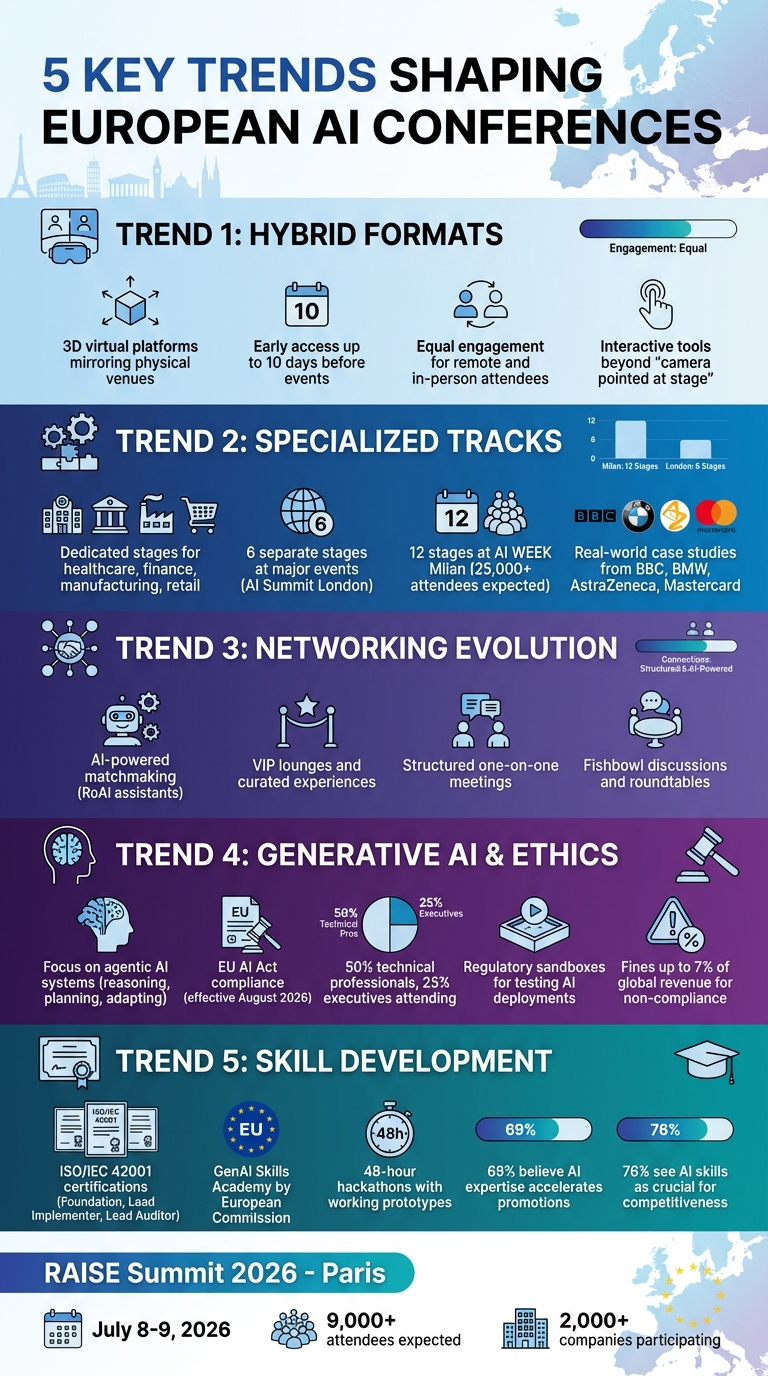
AI conferences in Europe are evolving rapidly, transforming from academic gatherings to large-scale events catering to industry leaders. These events now emphasize practical solutions, compliance with the EU AI Act, and actionable strategies for implementing AI technologies. Key trends include:
- Hybrid Formats: Engaging both in-person and virtual audiences with interactive 3D platforms and early access to digital tools.
- Specialized Tracks: Industry-focused sessions for sectors like healthcare, finance, and manufacturing.
- Networking Evolution: VIP experiences, curated matchmaking, and structured events for building partnerships.
- Generative AI & Ethics: Sessions on advanced AI applications and compliance with upcoming EU AI Act regulations.
- Skill Development: Certifications and hands-on workshops tailored for professionals navigating AI implementation.
Upcoming events like the RAISE Summit 2026 in Paris highlight these changes, offering opportunities for over 9,000 attendees to connect, learn, and collaborate. With a growing focus on regulation, ethical AI, and industry-specific applications, these conferences are now essential for professionals aiming to stay ahead in AI development and compliance.
5 Key Trends Transforming European AI Conferences in 2026
The Future of AI in Europe
sbb-itb-e314c3b
Hybrid and Interactive Conference Formats
European AI conferences are moving away from the simple "camera pointed at a stage" setup. Instead, they’re crafting hybrid experiences that keep both remote and on-site audiences equally engaged. Take a recent Berlin event, for instance: it recreated its physical venue as a 3D space on the MEETYOO platform. Remote attendees could navigate virtual foyers and stages designed to mirror the actual event space [6]. This shift reflects a growing preference for conference formats that are more engaging and inclusive.
"Hybrid shouldn't mean half-baked. When people show up online and in person, they expect more than a camera pointed at a stage. They want a shared experience." - Mandi Schmeckebier, Project Manager, MEETYOO [6]
The emphasis now is on active participation rather than passive listening. For example, RAISE Week 2026, happening from 4–9 July in Paris, will include a 48-hour hackathon where engineers and researchers will collaborate to prototype AI systems under practical constraints [7]. This hands-on approach ensures attendees leave with working prototypes instead of just theoretical knowledge. Alongside this innovation-focused environment, advanced networking tools are helping attendees connect more effectively.
Networking has become smarter and more tailored. Tools like RoAI, a custom AI assistant, are being used to recommend sessions, create personalised schedules, and even draft LinkedIn posts in real time [6]. Smart matchmaking systems take it a step further, connecting participants based on specific goals - whether they’re looking for investors, hiring talent, or building partnerships. These advancements align with the broader push to meet evolving compliance and governance expectations.
Another trend is early access to virtual platforms. Many conferences now open their digital venues up to 10 days before the event. This gives attendees time to explore the platform, plan their schedules, and get familiar with networking tools. By doing so, organisers are breaking down barriers and ensuring that everyone - whether attending in person or remotely - can make the most of the live event.
Generative AI and Ethical AI Topics
European AI conferences are evolving, now spotlighting advanced AI applications while underscoring the need for ethical and regulation-compliant practices. This dual focus reflects the growing importance of responsible innovation in the field.
Generative AI: Applications Across Industries
The conversation around generative AI has moved beyond basic chatbots to agentic AI - systems capable of reasoning, planning, and adapting. For example, in December 2025, Sabato Leo, Director of AI at Tipico, introduced a multi-agent framework that processes complex data and strategic inputs. This system delivers actionable insights within hours, freeing teams to focus on higher-level strategic tasks [3]. Similarly, Holiday Extras developed a custom large language model (LLM) platform, speeding up development cycles and enabling more personalised, cost-effective travel experiences [3].
Conferences are now dedicating entire tracks to industry-specific applications of generative AI. At the Gen AI Summit 2025, 50% of attendees were technical professionals, such as engineers and data scientists, while 25% held executive positions like CTOs and CIOs. This shift underscores the focus on production-ready AI systems [2]. In April 2026, Christian Sebregondi, Head of AI at Zürcher Kantonalbank, will present case studies on using generative AI in banking to optimise operations and manage risks [9]. These sessions highlight the importance of secure, compliant systems that deliver measurable returns, steering away from fragmented pilot projects.
While these applications showcase the transformative potential of generative AI, they also highlight the need for robust ethical oversight.
Ethical AI and EU Regulatory Requirements
With the EU AI Act’s transparency obligations set to take effect in 2026, conferences are increasingly featuring legal experts alongside technical speakers. For instance, in February 2026, the European Data Protection Supervisor hosted a workshop in Brussels. Participants evaluated a fictional high-risk AI recruitment system, focusing on bias and transparency [10]. This hands-on approach demonstrates how compliance can be leveraged as a competitive advantage.
"The implementation of the AI Act should not be seen as a constraint, but as an opportunity... to combine innovation and responsibility." - Elisabeth Margue, Luxembourg Minister Delegate for Media and Connectivity [11]
Practical topics like risk classification, AI literacy programmes (required by the AI Act), and governance frameworks for multi-agent systems are now central to these discussions. In January 2026, Luxembourg’s "AI Act in Action" conference attracted over 300 participants and introduced the "Regulation Meets Innovation (ReMI)" initiative. This regulatory sandbox allows companies to test AI deployments in a controlled environment [11]. Given that non-compliance could result in fines of up to 7% of global revenue, these conversations have become essential [12].
Ethical and regulatory considerations are no longer just theoretical - they are integral to the responsible development and deployment of AI systems.
Industry-Specific AI Tracks and Use Cases
European AI conferences are increasingly focusing on industry-specific tracks, offering professionals a chance to dive into the unique challenges and opportunities within sectors like healthcare, finance, manufacturing, and retail. These tailored sessions bring the practical application of AI to the forefront.
Dedicated Tracks for Healthcare, Finance, and Other Sectors
Many major events now dedicate entire stages or days to specific industries. For instance, The AI Summit London features six separate stages, each focusing on areas like finance, healthcare, retail, and manufacturing [13][4]. Similarly, the Data Innovation Summit in Stockholm sets aside its third day exclusively for industry-focused tracks, covering everything from finance and manufacturing to healthcare, retail, and the public sector [4].
In May 2026, AI WEEK in Milan will organise its programme around specialised summits such as the AI Marketing Summit, AI Healthcare Summit, and AI Sport Summit. Spread across 12 stages, the event is expected to attract over 25,000 attendees [5][8]. Meanwhile, Germany's data:unplugged Festival includes a "Mittelstand Stage" tailored to decision-makers from small and medium-sized enterprises [4].
These tracks are also addressing regulations like the EU AI Act, offering sessions designed for high-risk sectors. This focus makes room for real-world case studies that illustrate how AI is transforming industries.
Case Studies from Organizations
To provide actionable insights, conferences now highlight real-world examples of AI in action, showcasing measurable improvements in areas like efficiency, cost savings, and revenue growth [13].
At the ESMO AI Congress in November 2025, the Horizon Europe-funded I3LUNG programme presented its work on multimodal AI for non-small cell lung cancer immunotherapy. The programme, involving over 70 experts, underscored that while AI shows great promise, data readiness remains a significant hurdle in healthcare [15].
"AI-designed drug candidates have already entered the clinic, with early-phase success rates that nearly double historical averages." – Owkin [15]
In March 2026, the European Congress of Radiology featured Dr. Oliver Lester Saldanha's presentation on the ODELIA project, which introduced "swarm learning." This innovative technique allows AI models to be trained across multiple institutions for breast cancer screening without sharing patient data [14].
Over in the energy sector, the ML Conference 2026 showcased Flexa's Virtual Power Plant, which uses AI to optimise energy management across decentralised resources, ensuring grid stability [16].
Prominent organisations like the BBC, Met Office, Citi, BMW, Mercedes-Benz, AstraZeneca, Mastercard, and Unilever are also sharing their experiences with AI implementation at these events [13]. These case studies not only highlight AI's potential but also provide a roadmap for others looking to adopt similar technologies.
Regulation and Compliance Focus
With the EU AI Act set to take full effect in August 2026, European AI conferences are shifting gears. The focus has moved from abstract legal discussions to hands-on strategies that help organisations implement compliance measures. These events aim to guide businesses through the complexities of Europe's landmark AI legislation, turning regulatory insights into practical solutions.
EU AI Act Requirements and Standards
A major theme at these conferences is the AI Act's categorisation of systems into four risk levels: unacceptable, high-risk, limited-risk, and minimal-risk. Each category comes with specific obligations, and the events are helping organisations pinpoint where their AI systems fit and what steps they need to take to comply [17][18].
For example, the Luxembourg "AI Act in Action" conference introduced tools like the "AI Act Single Information Platform" and the "AI Act Service Desk." These resources are designed to help organisations meet compliance requirements more effectively [11]. Such tools highlight how regulatory discussions at these events are directly tied to actionable business outcomes.
High-risk systems, including facial recognition, biometric surveillance, credit scoring, and recruitment tools, receive special attention. Sessions focus on transparency requirements and mandatory developer disclosures [17]. The Act also requires organisations to promote "AI literacy", ensuring their teams are educated on how to use AI systems safely and in compliance with the law [11].
Compliance Frameworks and Risk Management Sessions
To help organisations navigate these standards, conference organisers are offering practical frameworks for managing compliance risks. For instance, in February 2026, the European Data Protection Supervisor (EDPS) hosted the third meeting of the AI Act Correspondents Network in Brussels. Wojciech Wiewiórowski and Gemma Galdón Clavell (CEO of Eticas.ai) led a hands-on workshop exploring high-risk AI in recruitment. They used a fictional screening tool to tackle issues like bias, transparency, and human oversight [10].
At the European AI & Cloud Summit in May 2025 in Düsseldorf, Azar Koulibaly from Microsoft showcased how the company's "Responsible AI Standard" translates into actionable compliance tools for Azure users. Using solutions like Purview Compliance Manager with EU AI Act templates, Microsoft reported a 75% risk reduction and a 98% boost in stakeholder trust [19].
"Compliance is an opportunity to innovate responsibly, build trust, and gain a competitive edge in the global market." – Mac Mani, Attendee of the European AI & Cloud Summit 2025 [19]
Another standout initiative was the "Regulation Meets Innovation (ReMI)" program launched at the Luxembourg conference. Alongside this, the CNPD introduced an AI regulatory sandbox, offering a controlled environment for testing AI solutions under regulatory supervision [11]. These initiatives provide companies with a space to experiment while staying compliant. Carlo Thelen, Director General of the Luxembourg Chamber of Commerce, underscored the value of integrating compliant AI solutions into business processes [11].
Networking and Professional Development
Conferences today are redefining their value by focusing on networking and professional growth. The emphasis is on creating structured spaces where professionals can form meaningful connections and gain practical skills. Through matchmaking tools, curated events, and hands-on learning sessions, these gatherings aim to provide attendees with measurable career benefits.
Structured Networking Events and VIP Experiences
Top European AI conferences are shifting towards networking-focused formats to help participants build impactful connections. Tools like structured matchmaking allow attendees to plan one-on-one meetings well in advance [20]. Formats such as fishbowl discussions and industry-specific roundtables encourage collaborative problem-solving rather than passive listening [5][13].
Exclusive VIP experiences take networking to another level. Many conferences now feature VIP lounges and dedicated hubs for targeted interactions, attracting thousands of professionals and hundreds of speakers [5][8]. Premium sessions for senior executives like CIOs, CTOs, and CDOs offer intimate opportunities to share and benchmark strategies [21]. Single-day immersive events also provide unique chances to engage directly with researchers from leading organisations like OpenAI, NVIDIA, and DeepMind [5][22].
"Where serious connections happen." – AI Summit Barcelona [22]
These VIP offerings come at a premium, granting attendees access to personalised concierge services, private lounges, and tailored networking opportunities [8][22].
Certifications and Skill-Building Programs
Another growing trend is the inclusion of formal certification programs aimed at skill-building. For instance, the ISO/IEC 42001 series offers certifications like Foundation, Lead Implementer, and Lead Auditor, focusing on AI management systems and regulatory compliance [24]. Similarly, the Artificial Intelligence Engineer (AiE™) credential from the Artificial Intelligence Board of America (ARTiBA) certifies expertise in machine learning and AI integration [23].
In 2025, the European Commission launched the GenAI Skills Academy under the Digital Europe Programme. This initiative provides advanced training in Generative AI, specifically targeting SMEs and public sector professionals [25]. These programs often require participants to tackle real-world case studies or develop practical modules, moving beyond traditional lecture-based learning [26].
"An AI certification serves as proof of your skills, capabilities, and understanding of advanced AI concepts. It differentiates certified professionals from their peers." – Sieh Qian Ying, Social Media Officer, PECB [24]
The value of these certifications is clear: 69% of professionals believe AI expertise accelerates promotions, while 76% see AI skills as crucial for staying competitive in the job market [23]. Certified experts also tend to earn higher salaries, as their credentials immediately signal their expertise to employers. In Europe, where regulations like the EU AI Act are shaping industries, certifications focusing on AI ethics and compliance are becoming increasingly sought after by professionals in regulated sectors [24][26].
These networking opportunities and certifications equip professionals with the tools to turn conference takeaways into tangible career advancements.
Conclusie
AI conferences across Europe have become dynamic hubs where professionals actively shape the future of the industry. With the introduction of hybrid formats, hands-on workshops, and structured networking, these events have evolved into action-oriented environments. For instance, flagship gatherings like the RAISE Summit in Paris, scheduled for 8–9 July 2026, are expected to host over 9,000 attendees and more than 2,000 companies, offering unmatched opportunities to connect and collaborate [1].
This growth reflects a broader industry focus on regulatory alignment and ethical considerations. The spotlight on generative AI, ethical frameworks, and compliance with the EU AI Act highlights a maturing sector. These events also provide direct access to policymakers and regulatory specialists, enabling organisations to stay ahead of legislative shifts - critical for advancing Europe’s digital sovereignty and building independent AI infrastructures [27].
The addition of focused tracks and certification programmes underscores how AI has transitioned from experimental ideas to fully operational systems [13]. For businesses aiming to remain competitive, participation in these conferences has become essential. They offer a comprehensive view of the AI landscape, helping organisations turn ambitions into tangible results. Whether through exclusive C-level forums or 24-hour hackathons developing bold prototypes, these events drive real-world innovation [1].
This holistic approach reinforces the trends explored throughout this article. The future of AI in Europe will be defined by those who actively participate, transforming discussions into measurable achievements.
Veelgestelde vragen
How do I choose the right track for my industry?
To navigate the RAISE Summit effectively, consider the 4F Compass framework: Foundation, Frontier, Friction, and Future. Each track caters to distinct AI interests:
- Foundation focuses on practical AI applications and core technologies.
- Frontier explores cutting-edge advancements in AI.
- Friction addresses regulatory and ethical challenges.
- Future delves into emerging trends shaping AI’s trajectory.
Choose the track that aligns with your industry’s priorities. For example, if you're interested in operational AI solutions, Foundation might be the best fit. On the other hand, if you're tackling regulatory hurdles, Friction could provide the insights you need. This approach ensures you gain insights and connections tailored to your objectives.
What should I do now to prepare for the EU AI Act in 2026?
Getting ready for the EU AI Act? It’s all about understanding compliance and transparency requirements early. One key player to know is the European Data Protection Supervisor (EDPS), which will oversee compliance as the Market Surveillance Authority and act as the Notified Body for AI systems used by EU institutions.
To stay ahead, keep an eye on official updates and announcements. Participating in workshops or testing out regulatory sandboxes and pilot projects can provide hands-on insights into what compliance might look like in practice. Connecting with industry networks is another smart move - it’s a great way to stay informed and adapt as standards evolve.
How can I measure the ROI of attending an AI conference?
To figure out the return on investment (ROI) for attending an AI conference, think about these key aspects:
- Networking: Count the meaningful connections you make - whether they’re potential clients, collaborators, or industry experts.
- Knowledge Gained: Reflect on the insights, skills, or trends you’ve learned and how they can enhance your current or future projects.
- Business Results: Look at concrete outcomes, such as securing new deals, partnerships, or even funding opportunities.
- Engagement Metrics: Use the event's tools or platforms to track your participation and gauge its impact.
- Follow-Up: Keep an eye on the long-term value, such as partnerships or strategies that sprout from the conference.
These factors can help you determine whether the time and money spent on the event were worthwhile.