

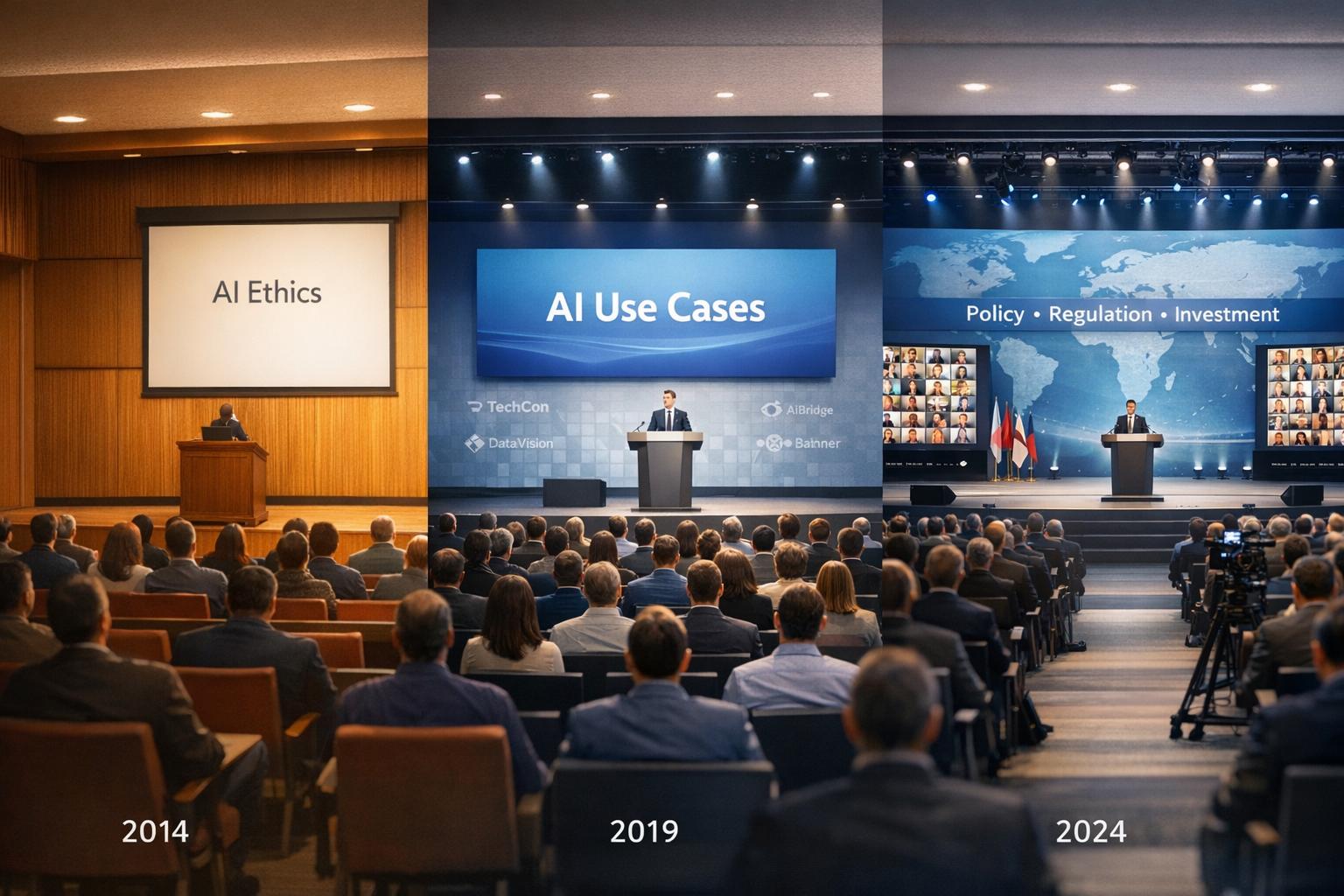
AI summits have transformed significantly in the past 10 years. Initially academic gatherings, they are now global hubs for decision-making, funding, and partnerships. Modern summits attract top CEOs, investors managing billions, and policymakers driving AI adoption. Key trends include:
- 2016-2019: Focused on academic research and ethics, with events like the Asilomar Conference shaping AI principles.
- 2020-2022: Shift to virtual/hybrid formats during COVID-19, improving accessibility but facing engagement challenges.
- 2023-2025: Highlighted industry-specific applications, advanced computing, and open-source AI models.
- 2026: Prioritizing global collaboration and regulatory alignment, with events like the India AI Impact Summit emphasizing equity and resource sharing.
RAISE Summit, held annually in Paris, exemplifies this evolution, blending innovation showcases, networking, and policy discussions. It has become a key platform for aligning AI strategies and driving investment.
Key takeaway: AI summits have moved from theoretical discussions to shaping global AI strategies, fostering partnerships, and addressing regulatory challenges.
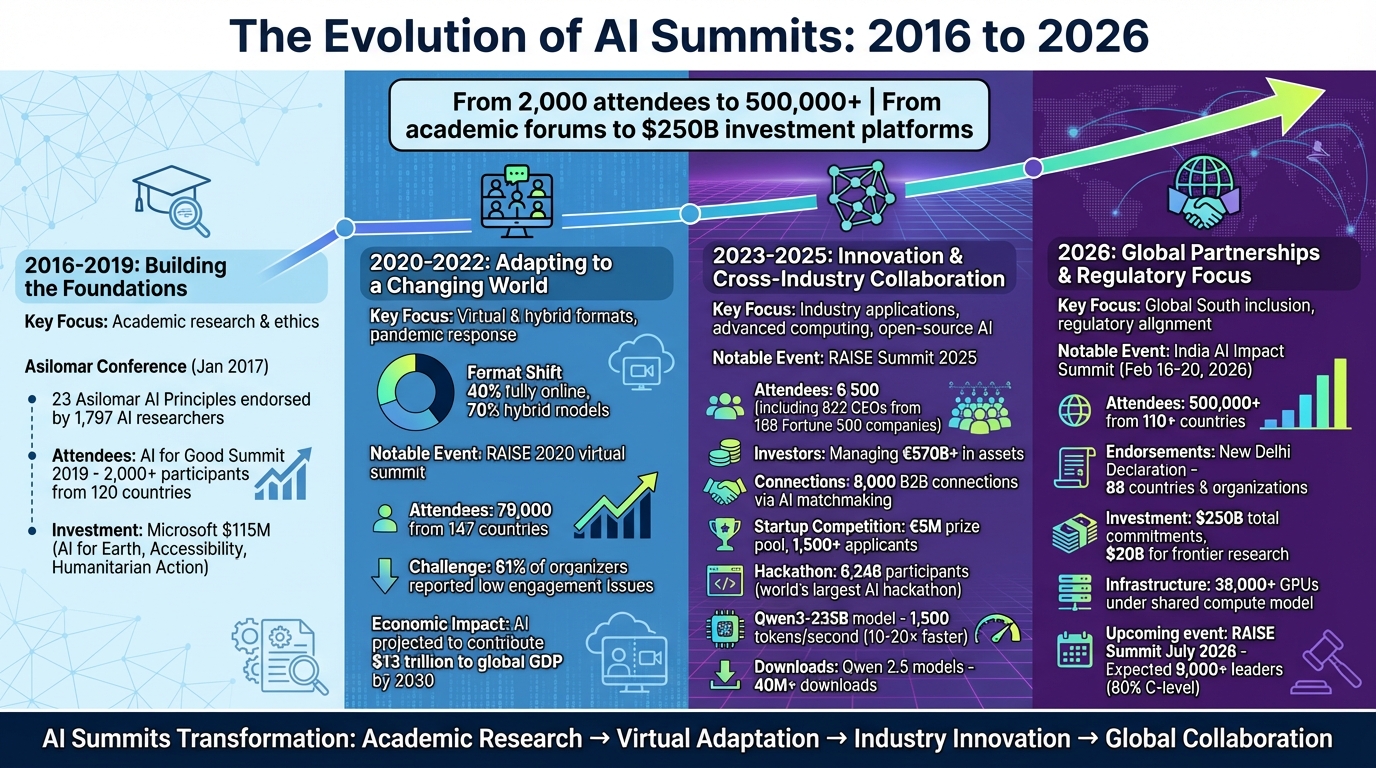
Evolution of AI Summits 2016-2026: From Academic Forums to Global Policy Platforms
The evolution of AI models
2016-2019: Building the Foundations
Between 2016 and 2019, AI summits primarily served as platforms for academics and researchers to exchange ideas, share findings, and explore how deep learning could transition from theoretical models to practical uses in areas like health, education, and environmental sustainability. These events aimed to align AI advancements with the UN Sustainable Development Goals (SDGs). During this time, research communities began to solidify, paving the way for more specialized academic gatherings.
Academic and Research‑Focused Events Take Shape
The early summits brought together various specialized research areas under one umbrella. A notable example was HLAI 2016, held in July 2016 at The New School in New York City. This event combined four distinct conference series - Artificial General Intelligence (AGI), Biologically Inspired Cognitive Architectures (BICA), Neural‑Symbolic Learning (NeSy), and the Artificial Intelligence and Cognition workshop. It also featured demonstrations where researchers showcased practical applications of human-level AI theories [5].
By May 2019, the AI for Good Global Summit in Geneva had grown into a major event. ITU Executive Director Houlin Zhao introduced five 'Breakthrough Sessions' focusing on health, education, human dignity, scalable AI, and space. The summit drew over 2,000 participants from 120 countries, with more than 300 speakers [3]. During this event, Microsoft announced a US$115 million investment in initiatives like AI for Earth, AI for Accessibility, and AI for Humanitarian Action [3]. By the year's end, the AI for Good repository had cataloged over 150 projects aimed at applying AI for social benefit [3].
Early Conversations on AI Ethics and Governance
Alongside research efforts, early summits sparked crucial discussions on AI ethics and governance. A significant milestone was the Asilomar Conference on Beneficial AI in January 2017, held at the Asilomar Conference Grounds in California. Organized by the Future of Life Institute, the event gathered over 100 thought leaders, including Demis Hassabis (CEO of Google DeepMind), Yann LeCun, and Yoshua Bengio. The conference produced the 23 Asilomar AI Principles, which addressed research challenges, ethical considerations, and long-term governance. These principles were endorsed by 1,797 AI and robotics researchers and 3,923 non-researcher signatories, including figures like Elon Musk and Stephen Hawking [4]. Each principle received support from at least 90% of participants [6].
"The road to safe, reliable, and comprehensive AI requires unprecedented collaboration among governments, industries, academia, and civil society." – Houlin Zhao, ITU Executive Director [3]
These events marked the beginning of a multi-stakeholder approach to AI development. Economists, legal experts, ethicists, and philosophers joined discussions that had previously been dominated by computer scientists. In 2018, the Focus Group on AI for Health (FG‑AI4H) was launched as a collaboration between the ITU and the World Health Organization. This group created 11 topic areas to standardize how AI methods are evaluated for diagnosing conditions like breast cancer and Alzheimer’s disease, achieving 95% accuracy in pilot diagnostics [3]. Sectors like healthcare, transportation, and criminal justice emerged as key areas where ethical and regulatory oversight was urgently needed.
These early efforts laid the foundation for the collaborative and multi-disciplinary AI summits we see today.
2020-2022: Adapting to a Changing World
When the COVID-19 pandemic hit in March 2020, AI summits had to tackle an urgent challenge: how to keep global collaboration alive while travel came to a standstill. Organisers quickly pivoted from traditional in-person events to virtual and hybrid formats, reshaping the way the AI community connected and shared insights. By 2022, 40% of events were held entirely online, while 70% adopted hybrid models, blending physical and digital participation [7]. This transformation didn’t just overcome logistical hurdles - it opened up new opportunities for broader participation and fresh ideas.
The Shift to Virtual and Hybrid Formats
Switching to digital platforms knocked down barriers that had long kept some participants out of the conversation. Researchers and professionals from regions like the Global South, often limited by visa issues or high travel expenses, could now join discussions without leaving their homes. In fact, around 80% of event organisers reported that virtual formats were more cost-efficient than in-person events [7]. A striking example of this expanded reach was the RAISE 2020 virtual summit, hosted by India’s Ministry of Electronics and Information Technology and NITI Aayog, which drew in approximately 79,000 attendees from 147 countries [11].
AI played a key role in making these events more dynamic. Real-time sentiment analysis helped organisers gauge audience reactions, while automation simplified event logistics. Personalised algorithms recommended sessions tailored to attendees’ interests, and accessibility tools like live captions, subtitles, and screen readers ensured that neurodivergent participants and non-native speakers could fully engage [8]. However, challenges remained: 61% of event marketers pointed to low engagement as a persistent issue [7]. Gender disparities also surfaced, with studies showing women asked only half as many questions as men during virtual sessions [8]. The academic focus on virtual conferencing surged, with nearly 70% of related research papers published between 2020 and 2023 [8].
"The integration of AI in event management is more than just an enhancement - it represents a fundamental shift, ushering in a new era of how events are planned and executed." – Saluja, Eventible [7]
AI's Role in Healthcare and Remote Work
During the pandemic, healthcare applications of AI took center stage. RAISE 2020 shifted its focus to pandemic preparedness, showcasing tools like AI-driven COVID-19 testing systems and algorithms capable of accurately predicting mortality rates [11]. In October 2020, SigTuple Technologies gained recognition for its AI-powered screening solutions, while other breakthroughs included rapid diagnostic kits and early detection methods for Autism [11].
Healthcare leaders called for a complete digital overhaul of medical systems. Dr Devi Prasad Shetty, Chairman of Narayana Hospitals, made a compelling case:
"For healthcare to be affordable and safer, pen and paper need to be replaced by mobile devices in the hands of doctors, nurses and medical technicians" [11].
Beyond healthcare, summits also explored how AI-supported tools could sustain remote work. Discussions covered everything from maintaining communication in distributed teams to addressing burnout and ensuring employee well-being [9]. These events highlighted AI’s dual purpose: responding to immediate crises while also acting as a stabilising force for the economy. By 2030, AI is projected to contribute around $13 trillion to global GDP [10].
sbb-itb-e314c3b
2023-2025: Innovation and Cross-Industry Collaboration
From 2023 to 2025, AI summits transitioned from theoretical discussions to showcasing practical, real-world applications. Industries like manufacturing, logistics, and healthcare took center stage, with events focusing on how AI could address specific challenges [15]. This period also highlighted the growing importance of advanced computing infrastructure. Summits began emphasizing the need for scaling GPUs and accelerators to support cutting-edge AI models [12]. Open-source models reached new levels of intelligence during this time, rivaling closed-source alternatives but at a fraction of the cost [21,25]. These developments laid the groundwork for more tailored and integrated AI solutions across industries.
Showcasing New AI Technologies
The pace of innovation was staggering. At the RAISE Summit in July 2025, Cerebras Systems introduced the Qwen3-235B model, capable of processing 1,500 tokens per second - a speed 10 to 20 times faster than traditional GPU-based solutions for code generation [13]. This model delivered advanced capabilities at just €0.57 per million input tokens and €1.14 per million output tokens [13]. Meanwhile, Alibaba Cloud made waves in September 2024 by releasing over 100 open-source Qwen 2.5 models at the Apsara Conference, which collectively surpassed 40 million downloads [16]. Their Qwen2-VL vision-language model demonstrated the ability to process videos exceeding 20 minutes, making it ideal for use in mobile devices, vehicles, and robots for automated tasks [16].
Multimodal AI and agentic systems became defining trends. For example, Cerebras collaborated with the coding agent Cline, which had 1.8 million installations, to integrate Qwen models directly into Microsoft VS Code in July 2025. This setup allowed developers to handle multiple files with a 131,000-token context window, achieving code generation speeds 10–20× faster [13]. Saoud Rizwan, CEO of Cline, remarked:
"This kind of fast inference isn't just nice to have – it shows us what's possible when AI truly keeps pace with developers" [13].
These advancements not only demonstrated technical achievements but also underscored the role of summits in driving cross-industry innovation.
Industry-Specific Tracks and Networking Opportunities
Building on these technological breakthroughs, AI summits expanded their focus to include strategic networking and capital investment. The events evolved into high-stakes platforms where business leaders, investors, and innovators could align on strategies and commit resources [17]. The RAISE Summit led this transformation with "RAISE Week", a city-wide ecosystem in Paris that hosted specialized summits like MACHINA (focused on physical AI and robotics) and the CxO Summit (centered on enterprise strategy). This approach encouraged targeted, cross-industry discussions [26,27]. The 2025 edition brought together 6,500 attendees, including 822 CEOs from 168 Fortune 500 companies, investors managing over €570 billion in assets, and facilitated 8,000 B2B connections through AI-powered matchmaking platforms [2,27].
Startup competitions also gained prominence as platforms for identifying emerging talent. The "RAISE the Stakes" competition in 2025 featured a €5 million prize pool and attracted over 1,500 applicants, with an acceptance rate below 0.2% [2,31]. Hirundo.io, a machine unlearning platform that reduces AI hallucinations by 55% and biases by 70%, emerged as the winner from a pool of more than 1,100 startups [2]. Additionally, the "RAISE Your Hack" event became the largest AI hackathon globally, drawing 6,246 participants to tackle industry-specific challenges, supported by Groq and Meta [2,27]. As Hadrien de Cournon, Co-Founder of RAISE Summit, explained:
"This is not a forum for observing trends; it is where strategy is set, and capital is committed" [17].
| Industry | Key AI Application | Impact/Outcome |
|---|---|---|
| Retail | AI Stylists & Personal Advisors | Enhanced personalized recommendations and improved online shopping experiences [14] |
| Healthcare | AI-assisted Image Analysis | Improved radiology screening and early detection; personalized health support [14] |
| Finance | Fraud Detection & Risk Management | Faster incident response, automated compliance, and tailored financial advice [14] |
| Media | Content Localisation & Dubbing | Automated captions, subtitles, and streamlined media production [14] |
| Software | Agentic Coding Agents | Real-time reasoning across codebases with 10–20× faster code generation [13] |
2026: Global Partnerships and Regulatory Focus
By 2026, the focus of AI summits shifted from discussing theoretical risks to implementing practical solutions for AI deployment. The emphasis was on creating a globally inclusive environment and aligning regulations to ensure equitable access to AI resources. Leaders recognized that fragmented policies and unequal distribution of resources hinder progress on a global scale.
Increased Focus on Global South Inclusion
One of the most notable events of the year was the India AI Impact Summit, held from 16 to 20 February 2026. This summit was a milestone as it marked the first major global AI event hosted in the Global South. Drawing over 500,000 attendees, it featured delegates from more than 110 countries and 30 international organizations [18]. Unlike earlier summits, which often concentrated on high-level risks, this event adopted an "AI for Humanity" agenda, focusing on bridging digital divides and making foundational AI resources more accessible.
The summit concluded with the New Delhi Declaration, endorsed by 88 countries and international organizations [19]. This framework was structured around seven thematic "Chakras", which addressed areas like human capital development, democratizing AI resources, and social empowerment [21]. Michael Kratsios, Director of the White House Office of Science and Technology Policy, highlighted the U.S. commitment to prioritizing "trade over aid" in AI development [20]. Serbian President Aleksandar Vučić stressed the importance of data sovereignty, stating:
"Sovereignty in the 21st Century includes the ability to control data, regulate algorithms, and develop domestic expertise. Without that capacity, sovereignty risks becoming merely formal" [20].
The summit also saw significant partnerships and investments. OpenAI partnered with the Tata Group to lease 100 megawatts of data center capacity from Tata's HyperVault. Yotta Data Services announced a $2 billion investment in infrastructure powered by Nvidia GPUs [22]. Additionally, India revealed plans to deploy over 38,000 GPUs under a shared compute model, reducing reliance on external markets [23]. Altogether, the summit generated $250 billion in total investment commitments, with $20 billion earmarked for frontier deep-tech research [22]. This collaborative and inclusive approach laid the groundwork for unified global regulatory efforts.
Regulatory Consensus and Policy Discussions
As the push for inclusivity gained momentum, regulatory bodies turned their attention to harmonizing governance frameworks. The challenge of regulatory fragmentation loomed large in 2026, prompting summits to advocate for standards that could work across borders. The AI Standards Hub Global Summit, held in Glasgow in March 2026, focused on translating the Seoul Statement on Artificial Intelligence (adopted in December 2025) into actionable strategies [24]. Representatives from the OECD, UN OHCHR, and the Partnership on AI explored ways to align Testing, Evaluation, Verification, and Validation (TEVV) processes across national policies [24].
India emerged as a key player, acting as a bridge between advanced economies that prioritize safety and emerging markets focused on digital growth. Engaging with over 30 countries, India worked to develop cooperative mechanisms addressing challenges like deepfakes and algorithmic bias [25]. Balaraman Ravindran from the Centre for Responsible AI at IIT Madras commented:
"While operational details are thin... the agreement has consensus from so many countries, including the two AI superpowers. That is an acknowledgement of the growing need to focus on immediate challenges to beneficial AI adoption across the world" [20].
The New Delhi Declaration also introduced voluntary initiatives, such as the Charter for Democratic Diffusion of AI and the Global AI Impact Commons. These frameworks aim to promote equitable access to resources and share successful AI applications among nations [21]. Such efforts reflect a broader move toward collaborative platforms that balance innovation with responsible implementation, paving the way for the continued development of global AI policies.
Looking Ahead: RAISE Summit as a Catalyst for Collaboration
With global partnerships and regulatory frameworks advancing rapidly, AI summits are shifting their focus towards driving tangible outcomes and operational progress.
Emerging Focus Areas for AI Summits
AI summits have evolved from merely tracking trends to becoming hubs for launching real-world initiatives like enterprise AI deployments and pilot programs. Today, the spotlight is on a few key areas: implementing ethical governance frameworks, developing scalable infrastructure to address the energy-compute challenge, and fostering collaboration across industries. These priorities unfold against a backdrop of increasing regulatory complexity, heavily influenced by the 'Brussels Effect.' The EU AI Act is setting a precedent, shaping governance models not only in Europe but also in regions like Latin America, Asia, and Africa. Summits now face the dual challenge of helping organizations navigate these regulations while staying competitive and innovative.
RAISE Summit's Position as a Global Leader
In this landscape, the RAISE Summit has emerged as a central player in shaping the future of AI innovation.
Scheduled for July 2026 at the iconic Carrousel du Louvre in Paris, the RAISE Summit will debut the exclusive CxO Summit. This invitation-only event is tailored for Fortune 1000 leaders and spearheaded by co-founder Hadrien de Cournon. It will offer carefully curated strategic sessions and an AI-driven matching platform to connect senior executives with policymakers, paving the way for meaningful partnerships, pilot projects, and finalized agreements.
Building on its strong track record, the 2026 edition is set to draw over 9,000 global leaders, with 80% of attendees being C-level executives and founders. Investors managing more than €570 billion in assets will also be present. Eric Schmidt has praised the summit's rapid rise as a key player in Europe’s AI landscape. Beyond executive networking, the event will host the world’s largest AI-focused hackathon, the RAISE Hackathon, bringing together 7,000 developers to tackle cutting-edge challenges. As Hadrien de Cournon aptly put it:
"We are curating RAISE as the essential platform for the Fortune 1000 C-suite to connect directly with the frontier builders and policymakers who are shaping the next decade of intelligence." [1]
Veelgestelde vragen
How have AI summits shifted from research to decision-making?
Over the past ten years, AI summits have shifted from being primarily research-focused gatherings to becoming central hubs for strategic discussions. While these events once catered mainly to researchers and developers, they now draw a broader audience, including executives, policymakers, and investors. The emphasis has expanded to cover topics like AI implementation, governance, and return on investment (ROI). Many summits also include private sessions and networking opportunities, prioritizing actionable results and influencing both industry trends and global policy directions.
What changed with virtual and hybrid AI summits after 2020?
Since 2020, virtual and hybrid AI summits have transformed into dynamic, highly interactive gatherings tailored to industry needs. These events now prioritise hybrid engagement, offering a mix of in-person and online participation, while focusing on practical solutions and ensuring compliance with regulations. Topics like generative AI, ethical considerations, and networking opportunities take centre stage, making these summits more than just online meetings - they're platforms designed to encourage collaboration and tackle crucial industry challenges.
Why are regulation and Global South inclusion central in 2026?
In 2026, the spotlight is on regulation and the inclusion of the Global South to ensure fair AI development and governance. These priorities aim to tackle the dominance of Western technology by encouraging solutions that are more aligned with the cultural and societal needs of diverse regions. The ultimate goal? To make sure the advantages of AI are shared worldwide.
Recent global summits have underscored the need to amplify voices from the Global South. By focusing on decolonising AI, these efforts seek to break away from one-size-fits-all approaches, instead fostering collaboration and inclusivity across regions with unique perspectives and challenges. This shift is seen as vital for creating a truly balanced and representative AI landscape.