

Specialized AI conferences are reshaping how industries adopt and implement AI. These events focus on domain-specific challenges and solutions, connecting experts, policymakers, and investors to drive progress in areas like infrastructure, robotics, and applied intelligence. Unlike general AI summits, these gatherings offer tailored insights, practical applications, and focused networking opportunities for high-level professionals.
Key Highlights:
- Infrastructure AI: Events like infra/CAPITAL (April 2026) and AI Infra Summit (September 2026) explore AI's role in networks and systems, from autonomous network operations to energy efficiency in data centers.
- Robotics: Conferences such as Machina 2026 focus on "Embodied Intelligence", advancing humanoid robotics, industrial automation, and simulation-to-reality applications.
- Applied Intelligence: Business-focused events emphasize measurable outcomes, ROI, and AI integration in regulated industries like finance and healthcare.
These conferences prioritize actionable strategies, aligning resources, technology, and policy to help industries transition from pilot projects to full-scale AI implementation.
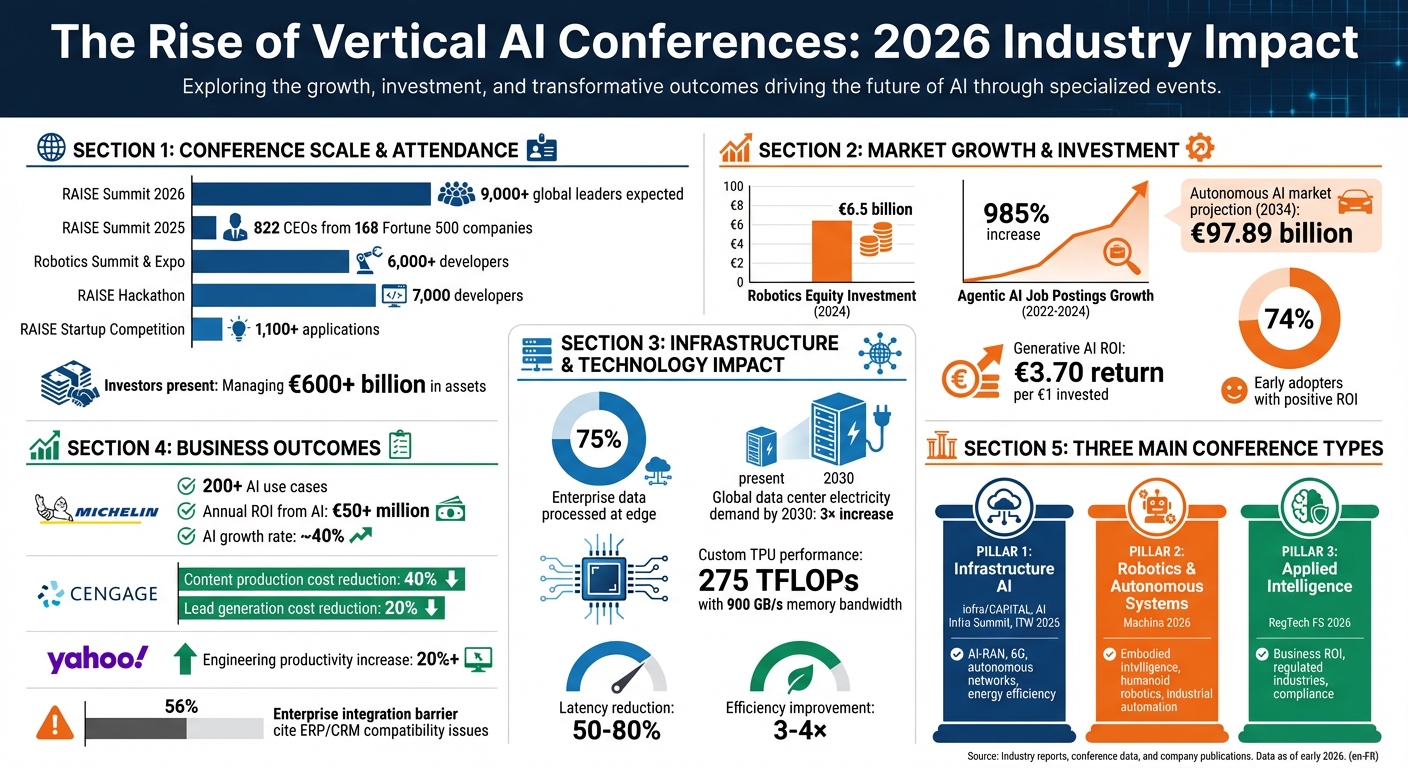
Vertical AI Conferences 2026: Key Statistics and Industry Impact
2026 AI Outlook: The Great Startup Churn & Enterprise Adoption
sbb-itb-e314c3b
Infrastructure AI Conferences: Networks and Systems
Infrastructure AI conferences provide a focused platform for exploring how artificial intelligence is reshaping the networks and systems that underpin modern economies. These events bring together telecom engineers, urban planners, and network architects to tackle the complexities of integrating AI into physical systems. Notable examples include infra/CAPITAL (Paris, April 2026), AI Infra Summit (Santa Clara, September 2026), and ITW 2026 (National Harbor, May 2026) [6][8][4].
The shift in how data is processed has been profound. Today, about 75% of enterprise data is created and handled at the edge rather than in centralised data centres [10]. This change demands that telecom providers evolve beyond their traditional role as connectivity vendors to become providers of distributed AI infrastructure. NVIDIA's Ronnie Vasishta describes this transformation as creating an "AI Grid", which moves computing power from centralised data centres to the network edge [7]. This evolution has given rise to three major themes dominating discussions at these conferences.
Main Topics in Infrastructure AI Events
Infrastructure AI events focus on three key areas of technological development:
- AI-RAN and 6G systems: These integrate AI directly into Radio Access Networks (RAN), with next-generation 6G systems being developed as "AI-native." These systems are initially tested in digital twin simulations before real-world deployment [7].
- Autonomous network operations: Moving beyond rule-based automation, these systems use AI to self-configure, self-optimise, and self-heal without human intervention [7].
- Energy efficiency in infrastructure: With global data centre electricity demand expected to triple by 2030, energy-aware solutions are critical [9].
At NVIDIA GTC 2026, companies like SingTel, led by CEO Bill Chang, and Deutsche Telekom, represented by SVP Peter Lorenz, showcased their sovereign AI clouds. These platforms leverage NVIDIA's infrastructure to deliver secure and locally compliant AI capabilities tailored for government and industrial applications [7]. Similarly, Nscale partnered with telecom providers in the U.K. to deploy full-stack AI infrastructure directly at telecom sites, enabling high-performance edge computing [7].
In practice, Network Operation Centres now use AI models to autonomously handle alarm storms, conduct root-cause analysis, and resolve incidents. As Lilach Ilan, Global Head of Business Development for Telco Operations at NVIDIA, explains:
"Automated networks follow predefined rules; autonomous networks understand context, analyse data, reason, act, and learn continuously" [7].
Policy and Standards in Infrastructure AI
As AI continues to transform infrastructure, the need for updated policy frameworks and industry standards becomes increasingly urgent. Infrastructure AI events are addressing these issues, particularly as the autonomous AI market is projected to reach €97.89 billion by 2034 [9]. For European operators and policymakers, ensuring compliance and standardisation is a top priority.
One critical area of discussion is data sovereignty. Sovereign AI clouds, such as those deployed by SingTel and Deutsche Telekom, illustrate how telecom providers can meet strict local regulatory requirements while maintaining high-performance computing capabilities [7]. These conferences also delve into the challenges of democratic oversight, as private companies negotiate the rights to essential resources.
Another focus is technical interoperability. Open-source architectures, aligned with initiatives from the Linux Foundation, are promoted to ensure seamless communication between various urban AI systems [11]. Ryan Pan, Programme Assistant at the Atlantic Council GeoTech Centre, highlights the urgency of operationalising AI strategies:
"The central question for AI in 2026 is not whether governments have an AI strategy - it's whether they can operationalise it and quickly deliver the benefits to their citizens" [9].
Robotics and Autonomous Systems: Automation Advances
The rapid evolution of AI infrastructure is pushing robotics into a new era of industrial deployment. Events like Machina 2026 (Paris, April 2026) are becoming essential for connecting robotics innovators with investors and partners, helping to move projects from lab prototypes to real-world applications. The event’s agenda highlights four key areas: Humanoid (focusing on movement and dexterity), Industrial (applications in factories and warehouses), Training (simulation and synthetic data), and Integration (perception and autonomy) [1]. This sector-specific approach reflects a growing trend toward targeted AI events aimed at achieving industry-specific progress.
A major focus in robotics now is "Embodied Intelligence" - the ability of AI systems to perform physical tasks and adapt to changing environments in real-time [1]. This shift is mirrored in the market, where equity investment in robotics hit €6.5 billion in 2024, and job postings for agentic AI roles skyrocketed by 985% between 2022 and 2024 [17]. To meet these demands, hardware and software are increasingly designed together in "codesign" strategies. For example, custom Tensor Processing Units (TPUs) now deliver 275 TFLOPS with 900 GB/s memory bandwidth, slashing latency by 50–80% and boosting efficiency by 3–4× [15].
Practical Robotics Applications Across Industries
Robotics is already transforming industries like manufacturing and logistics. At the Robotics Summit & Expo, which draws over 6,000 developers from sectors like aerospace, healthcare, and manufacturing, Jonathan Hurst of Agility Robotics shared how his team identified two key vendors for components needed in the production of their "Digit" humanoid robot [18]. These robots are enhancing operations by automating tasks such as production scheduling, last-mile delivery, and warehouse management, often working alongside human employees [14][17].
Healthcare is also seeing new applications for robotics beyond surgical tools. Autonomous drones are now delivering essential medications to remote locations, while AI-driven systems assist with patient triage and electronic medical record management [14][17]. In construction, robotics aids in risk and cost forecasting during the planning stages. However, fragmented data systems in the industry pose challenges to efficient data collection and retention [12].
Solving Robotics Deployment Problems
As robotics applications grow, deployment challenges become more pressing, especially the "Sim-to-Real" gap - the difficulty of transferring simulated training to real-world environments. To tackle this, Intrinsic (an Alphabet company) and Open Robotics launched the "AI for Industry Challenge" in March 2026. The competition focuses on solving complex tasks like electronic cable assembly, which involves handling deformable objects. Participants use tools like the Intrinsic Flowstate developer environment and the Intrinsic Vision Model to train robots for precise cable insertion. Finalists then test their models on physical workcells at Intrinsic’s headquarters, competing for a $180,000 prize pool. The judging panel includes prominent figures like Amit Goel from NVIDIA and Francesco Nori from Google DeepMind [19].
"Sessions, demos, and discussions focus on what works in the real world" [18].
Despite these advancements, most organizations are still in the "Experimentation" phase (rated 2 out of 5), where prototypes are being tested but short-term ROI is not yet a priority [17]. Technical hurdles remain, such as the lack of advanced sensory feedback for material texture recognition and the variability of physical systems compared to simulations [13]. Integration is another major challenge, with 56% of enterprises citing compatibility with existing ERP and CRM systems as a significant barrier [14][16].
Applied Intelligence: AI in Business Operations
Applied intelligence events highlight how AI reshapes enterprise decision-making and streamlines workflows. By 2026, these events help businesses move from small-scale pilots to achieving measurable outcomes, focusing on strategic value and efficient use of resources [2].
Driving Business Growth with AI
The key to successful AI implementation lies in setting SMART goals - Specific, Measurable, Achievable, Relevant, and Time-bound - that align with business priorities [21]. A great example is the Michelin Group, which has deployed AI across over 200 use cases, generating more than €50 million in annual ROI and achieving a growth rate nearing 40% [20]. As Ambica Rajagopal, Group Chief Data and AI Officer at Michelin, explains:
"The primary lever for AI adoption... is identifying potential value at the proof-of-concept stage" [20].
The financial returns are impressive too. For every €1 invested in generative AI, businesses see an average return of €3.70, with 74% of early adopters reporting positive ROI [25][26]. For instance, Cengage, an educational publisher, cut content production costs by 40% and reduced lead generation expenses by 20% using AI-driven automation. Similarly, Yahoo's engineering teams boosted productivity by over 20% with AI-assisted coding tools [20].
However, technology alone isn’t enough. Organisational readiness plays a pivotal role. As Harvard Business School Professor Karim Lakhani puts it:
"Culture eats strategy for breakfast... If you don't understand the cultural aspects - the organisational aspects of change - then your best strategies will just simply not work" [23].
To succeed, businesses must evaluate their readiness in four key areas: data security, data availability, computing power and storage, and talent. Starting with small pilot projects and gradually scaling up, while fostering collaboration between IT specialists, data scientists, and domain experts, often leads to smoother integration.
For industries with high compliance requirements, scaling AI brings unique hurdles.
AI in Regulated Industries
Sectors like finance, healthcare, and energy face distinct challenges when implementing AI. These industries must adhere to strict compliance standards, making "privacy-by-design" principles and transparent, auditable algorithms essential [22]. Events like the RegTech FS 2026 conference address these challenges by focusing on transforming regulatory requirements into operational frameworks [27]. The conference highlights the importance of proving AI systems' reliability and compliance with regulations like MiFID III, the EU AI Act, and DORA standards [27].
"The programme is shaped around real supervisory pressure. It focuses on how firms are expected to prove that controls work in practice, how accountability is evidenced across business and technology, and how AI and data-driven systems are governed at scale." – RegTech FS 2026 [27]
In regulated industries, ROI is often calculated through "Cost Avoidance" - minimising compliance errors, avoiding fines, and reducing reputational risks with automated auditing systems [24][26]. For AI projects launched in 2026, the ideal payback period is under 12 months for small and medium-sized enterprises (SMEs) and under 18 months for larger organisations [25].
Benefits of Attending Specialized AI Conferences
Attending vertical AI conferences offers distinct advantages that can translate into tangible outcomes. For instance, at the 2025 RAISE Summit, 822 CEOs from 168 Fortune 500 companies came together, along with investors managing over €600 billion in assets, showcasing the event's influence and reach[5].
Networking and Collaboration
These conferences excel in facilitating targeted connections. AI-powered matchmaking platforms now make it easier to arrange one-on-one meetings aligned with specific partnership goals. Exclusive forums like the CxO Summit provide a private space for Fortune 1000 leaders to compare strategies and establish meaningful partnerships. As Hadrien de Cournon, Co-Founder of RAISE Summit, puts it:
"The CxO Summit exists so companies don't just talk about AI, they leave RAISE with real partnerships, pilots, and signed deals."[5]
Startup competitions and initiatives like the "Founder & Funder" summits directly connect emerging AI companies with venture capitalists. Hackathons featuring up to 7,000 developers foster rapid prototyping and valuable networking. Additionally, niche events like MACHINA for robotics create focused opportunities for neurotech innovators, robotics entrepreneurs, and industrial operators to collaborate[1].
These connections provide immediate access to the latest advancements and open doors to impactful collaborations.
Access to Latest Technologies and Research
Specialized AI conferences offer an insider's view of cutting-edge innovations. At Machina 2026, attendees will experience live robot demonstrations and witness how "physical AI" is evolving from prototypes to real-world applications. Technical sessions will highlight advancements in humanoid robotics, neurotechnology, and autonomous systems - areas still emerging in mainstream markets.
Industry-specific tracks also help organizations stay competitive by benchmarking their AI strategies and navigating complex regulatory landscapes. At RAISE Summit 2026, over 9,000 global leaders are expected to attend, with dedicated tracks such as Foundation (infrastructure), Frontier (agentic systems), Friction (ROI and compliance), and Future (AGI pathways)[3][5]. The event will also include a Hackathon featuring 7,000 developers and a Startup Competition that attracted over 1,100 applications from forward-thinking AI companies[5].
By combining exposure to the latest tech with actionable insights, these events empower organizations to craft more effective strategies.
Industry-Specific Solutions and Strategies
These conferences go beyond discussing AI's potential - they focus on real-world implementation. Vertical summits align resources like funding, infrastructure, and policy to accelerate global AI adoption[3]. For robotics professionals, MACHINA provides practical strategies for integrating advanced AI into existing operations across factories, warehouses, and infrastructure[1].
Participants also gain access to frameworks that guide AI adoption from pilot projects to large-scale deployment, ensuring governance and reliability along the way[2]. Dedicated sessions, such as the "Friction" track, tackle challenges like achieving ROI, allocating capital effectively, and managing workforce transformation. By engaging directly with policymakers, attendees can prepare for regulatory and infrastructure changes before they impact their operations[3].
Eric Schmidt, Former CEO & Chairman of Google, aptly describes the RAISE Summit as:
"the fastest-growing AI Tech conference in Europe, and maybe in history."[5]
Conclusion: The Future of Specialized AI Conferences
Key Takeaways
Specialized AI conferences have transformed into hubs of action where strategies are crafted and investments are made. These events bring together talent through hackathons, funding opportunities via startup competitions, and leadership through exclusive CxO summits. Instead of passively observing trends, attendees dive into thoughtfully designed environments where Fortune 1000 leaders refine AI strategies and establish crucial partnerships. These gatherings provide direct access to policymakers, cutting-edge technologies ready for deployment, and funding sources that speed up implementation.
"This is not a forum for observing trends; it is where strategy is set, and capital is committed." [5]
These advancements are setting the stage for the next evolution of industry-specific AI events.
What's Next for Specialized AI Events
Looking forward, the future of these events will focus even more on solving specific industry challenges. Building on the current wave of vertical AI innovations, upcoming conferences will address pressing issues like the energy-compute balance, sovereign cloud infrastructures, and scaling robotics from prototypes to real-world applications. Emerging specialized tracks are designed to tackle practical challenges such as achieving ROI, optimizing capital use, and transforming workforces. Events like vertical robotics forums and enterprise strategy summits highlight how targeted approaches lead to actionable outcomes rather than abstract discussions.
RAISE 2026, which is set to welcome over 9,000 global leaders, exemplifies this trend. The event will focus on breaking down silos by aligning funding, computing resources, and policy [5]. AI-driven networking tools will enable impactful meetings, while hackathons involving up to 7,000 developers will work on solving practical problems [5]. For organizations navigating the complexities of AI adoption, these conferences are becoming essential in moving from pilot phases to full-scale implementation.
Veelgestelde vragen
How do I choose the right vertical AI conference for my role?
To find the right vertical AI conference, consider how the event's themes align with your professional focus. For instance, RAISE Summit features tracks such as 'Foundation' and 'AI Infrastructure', making it ideal for those in hardware or infrastructure roles. If robotics and autonomy are your area of interest, Machina 2026 is a great choice. For a broader discussion on applied intelligence, including regulations, applications, and strategic investments, the AI Summit 2026 Paris offers relevant sessions. Matching your career goals with the event's focus ensures a more rewarding experience.
What should I bring to turn conference meetings into real pilots?
To transform conference meetings into actionable pilots, come prepared with a clear use case that fits seamlessly into industry workflows. Bring along a working prototype or a proof of concept to demonstrate how your technology integrates effectively. Ensure you have relevant data, technical documentation, and a well-thought-out scaling plan ready to present. This preparation not only encourages productive discussions but also boosts the likelihood of turning ideas into tangible outcomes.
How can regulated industries prove AI compliance at scale?
Regulated industries can manage AI compliance effectively by using governance frameworks that emphasize traceability, transparency, and accountability. This involves practices like ongoing monitoring, ensuring human oversight, and maintaining clear, understandable decision-making processes. By adopting advanced infrastructure designed to align with evolving regulations - such as the EU AI Act - and incorporating industry-specific safeguards like response controls and audit mechanisms, organisations can streamline compliance efforts while fostering trust and adhering to regulatory demands.
Gerelateerde blogberichten
- Waarom de RAISE Summit dit jaar bijzonder actueel is
- Hoe AI-evenementen de ontwikkeling van AI zelf weerspiegelen
- Conferenties over infrastructuur versus applicaties: waar de echte gesprekken plaatsvinden AI-evenementen versus tech-evenementen: waarom het verschil ertoe doet Van onderzoeksfora tot commerciële topbijeenkomsten: het spectrum van AI-evenementen Hoe u de juiste AI-conferentie kiest voor uw functie
- Het Europese ecosysteem van AI-evenementen: een praktisch overzicht voor 2026