
Through the eyes of Henri Delahaye (Co-founder of RAISE Summit and MACHINA Summit) and Jim Butler (Head of Sales, RAISE Summit and MACHINA Summit)
NVIDIA GTC continues to set the pace for the global AI ecosystem.
This year marked a clear inflection. Not a gradual shift - a structural one. The conversation has moved beyond model capability and into the industrialisation of intelligence, where AI is no longer a digital layer sitting on top of existing systems, but an operational one embedded into real-world infrastructure.
Our team attended GTC to be part of that conversation. To understand how quickly this transformation is materialising, and to represent what we are building at RAISE and MACHINA as the European arena for these discussions.
Across the week, we spoke with founders, operators, and infrastructure partners building and deploying AI systems at scale - from robotics and autonomous vehicles to enterprise platforms and agentic systems.
Alongside this, RAISE convened a private sovereign AI dinner, bringing together senior leaders across infrastructure, capital, and policy for an intimate discussion on the future of national compute, power, and AI independence.
From the ground, the signals are no longer speculative. They are being built, deployed, and scaled.
The newcomers are now the establishment
There was a time when GTC belonged to the research labs and the hyperscalers. The AI-native companies were exciting but peripheral - clustered at the edges of the floor and the conversation.
That has changed decisively.
Walking the floor this year, the companies commanding the most attention - the biggest booths, the most sought-after sessions, the loudest hallway conversations - were names that barely existed five years ago. The AI-native generation has matured fast, and they have moved from challenger positions to centre stage. The incumbents are now learning from the disruptors, not the other way around.
This is what a maturing industry looks like: the early bets have become the infrastructure everyone else is building on.
Inference is now the main game
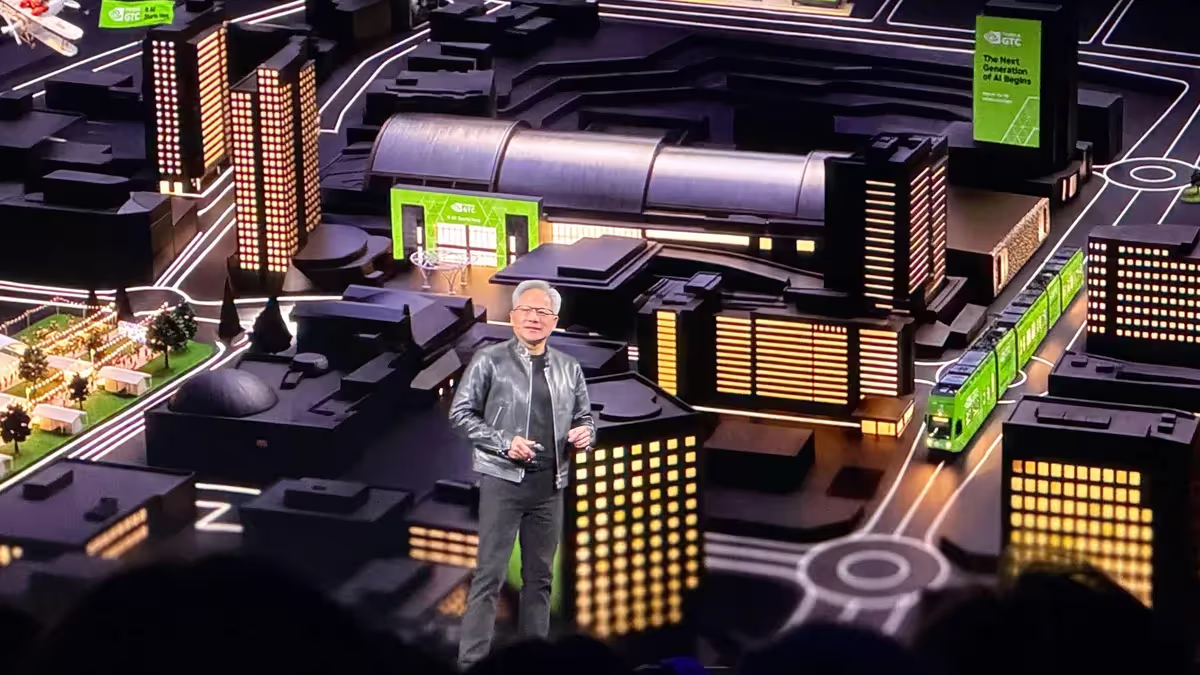
Jensen Huang was explicit: AI development has shifted from the training phase into the inference and agentic era. The $1 trillion inference market he projected is not a rounding error - it is a structural realignment of where the economic value of AI gets created and captured.
Training is no longer the constraint. Running models continuously, at scale, and at cost, is.
The companies built around inference - optimised serving, low-latency deployment, efficient production infrastructure - are no longer niche players. They are the new critical layer. Companies like Fireworks AI and Decart represent a broader truth: the model is table stakes now. What matters is how fast, how reliably, and how cheaply you can run it in production.
Tokens are emerging as a unit of value, reflecting a broader shift toward AI as an economic layer rather than a purely technical capability.
"What stood out at GTC is how quickly conversations have shifted from experimentation to deployment. Buyers are no longer asking what AI can do, they are asking how quickly it can be implemented."
Jim Butler, Head of Sales, RAISE & MACHINA
The developer moment - and the agent stack
One of the most strategically significant announcements of the week was NVIDIA's move around OpenClaw - the open-source AI agent platform that has become the developer community's default building block since its launch last year.
Jensen announced NemoClaw: NVIDIA's enterprise-ready stack built specifically to support OpenClaw deployments at scale, with the privacy, security, and integration capabilities that large organisations require.
"Every company in the world today needs an OpenClaw strategy, an agentic-system strategy," Huang said from the keynote stage. He called AI agents "the new computer."
NVIDIA is not just selling hardware anymore. It is building the operating system for the agentic era - and positioning the developer as the most important person in the room. Developer sessions were packed. The energy around building agents - not just deploying models - was unmistakable.
The AI stack is consolidating around production-ready tooling:
- NeMo and OpenClaw introduce a more secure foundation for autonomous agents
- NVIDIA Dynamo 1.0 positions inference as a scalable operating layer
- The Vera CPU signals optimisation for agentic and reinforcement learning workloads
This is infrastructure designed for deployment, not experimentation. The stack is becoming tighter, more interconnected, and harder to separate into individual layers.
Physical AI is moving into the real world
If there was a single theme running through GTC 2026 like a current, it was physical AI. Robotics, autonomous vehicles, humanoids, industrial automation - NVIDIA has been building toward this for years, and this year it became undeniably central.
From Disney's collaboration with NVIDIA to bring a walking Olaf robot to life on stage - trained in NVIDIA's Newton physics simulator - to robotaxis launching with Uber across 28 markets by 2028, to Nissan, BYD, Hyundai, and Toyota building Level 4 autonomous vehicles on NVIDIA's Drive Hyperion platform: the gap between digital intelligence and physical execution is closing fast.
Over 110 robots on the show floor. Jensen's projection: 10 million digital workers operating alongside humans in physical form. Not speculative positioning - a deployment roadmap.
The conversation is no longer about what robots could do. It is about where they will be deployed first, and how quickly.
Closing the simulation gap
One of the clearest technical developments of the week was the role of synthetic data in enabling physical AI at scale.
The Physical AI Data Factory blueprint points to a future where robots and vision systems are trained in simulated environments before they ever operate in the real world. For systems working in unpredictable, high-variance conditions, this is not a shortcut. It is what makes scale possible.
The simulation gap - between what a system can do in a controlled environment and what it can handle in the real world - is closing. That changes the deployment timeline for the entire physical AI sector.
Enterprise is no longer the laggard - it is the driver
One of the clearest signals from GTC 2026 was the composition of the room. More enterprise leaders, more CTOs and CIOs, more operational teams than any previous year.
Across conversations, a consistent commercial pattern emerged:
- Buyers are more informed and more decisive
- Demand is shifting toward end-to-end solutions, not standalone capabilities
- Sales cycles are increasingly shaped by infrastructure readiness
- The distinction between software, hardware, and deployment is disappearing
This is no longer a speculative market. It is operational.
"What's happening now is a convergence of infrastructure, intelligence, and the physical world. The next phase of AI will be defined by how these systems operate outside of data centres."
Henri Delahaye, Co-Founder, RAISE & MACHINA
What this means for Europe
Europe is not on the sidelines of this shift.
There is growing momentum across robotics, applied AI, and infrastructure. The opportunity lies in bringing these conversations together - across industries, use cases, and deployment environments - and ensuring European organisations are shaping deployment strategy, not just adopting it.
Why MACHINA exists
The conversations happening at GTC do not stay in Silicon Valley.
They move into factories, cities, and real-world environments. They land in boardrooms, on production floors, and at the policy tables where deployment decisions get made.
"The conversations we're seeing at GTC are exactly why MACHINA exists. This is about moving from theory to real-world systems, and bringing the right people together to make that happen."
Henri Delahaye, Co-Founder, RAISE & MACHINA
The direction of travel is clear. AI is moving out of the data centre and into the physical world.
At MACHINA, this shift is explored through the people building it - from founders developing autonomous systems to infrastructure leaders enabling deployment at scale. The programme reflects where AI is being applied, not just imagined.
This is where the conversation moves from signal to execution.
MACHINA Summit - 7 July, Station F, Paris
Explore MACHINA and secure your early access ticket.