


AI summits today are no longer just about listening to speeches - they are action-packed events with hackathons, competitions, and forums at their core. These activities bring developers, startups, and industry leaders together to solve problems, pitch ideas, and discuss AI's future. Here's what you need to know:
- Hackathons: Short, intense events where teams create AI solutions in 24–48 hours. For example, the July 2025 RAISE Summit hackathon had 6,246 participants and a $250,000 prize pool. These events help participants learn, network, and develop portfolio-worthy projects.
- Competitions: Platforms for startups and individuals to showcase ideas, secure funding, and gain visibility. The "RAISE the Stakes" competition awarded €5 million in July 2025, with finalists pitching to investors like Sequoia Capital and Nvidia.
- Forums and Panels: Spaces for discussions on AI trends, regulations, and strategies. At RAISE Summit, 350 speakers guided 9,000 attendees through topics like generative AI and compliance with the EU AI Act.
These events compress months of work into days, providing hands-on experience, funding opportunities, and direct access to industry leaders. Whether you're a developer or a business executive, participating in AI summits can accelerate your journey in AI.
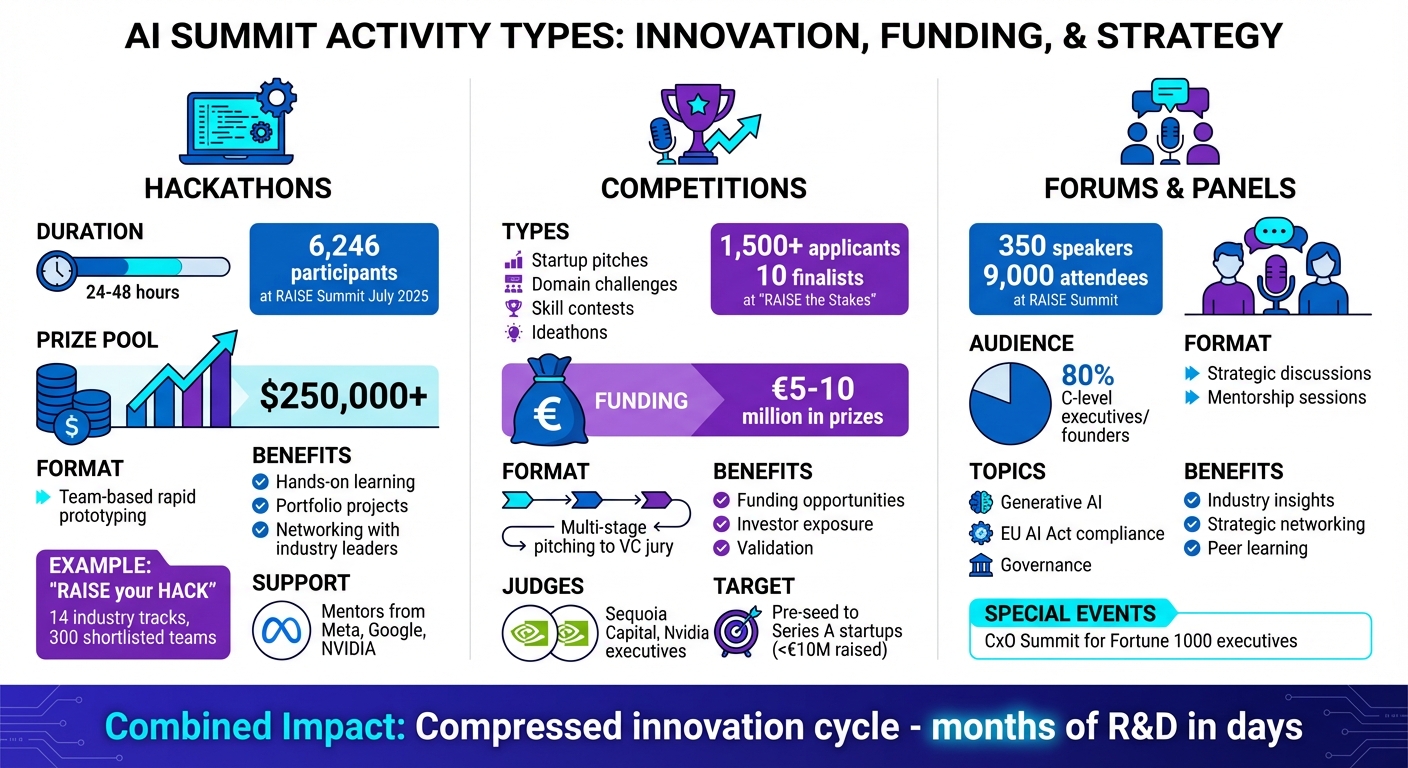
Types of Activities at AI Summits: Hackathons vs Competitions vs Forums
24-Hour Hackathon at Global AI Summit 2026 | GLA Greater Noida #aisummit #hackathon
sbb-itb-e314c3b
Hackathons: Building AI Solutions Through Team Collaboration
Hackathons transform AI summits into fast-paced hubs of creativity and problem-solving. These high-energy, time-constrained events push participants to create practical solutions by fostering quick decision-making and teamwork. The result? A space where ambitious ideas meet real-world challenges, driving both personal growth and breakthrough solutions.
How Hackathons Work at AI Summits
At the RAISE Summit, the "RAISE your HACK" hackathon runs for 24 hours, focusing on 14 industry-specific tracks [1]. Teams, often composed of individuals from varied disciplines, tackle real-world problems like healthcare data analysis, autonomous systems, or environmental challenges. To prepare, participants can attend pre-event masterclasses designed to sharpen their skills before the clock starts ticking.
Throughout the hackathon, technical support is readily available. Mentors from top-tier companies such as Meta, Google, and NVIDIA work closely with teams, helping them refine their ideas. For example, during the July 2025 event, participants utilized cutting-edge tools like Llama models and Groq APIs, with support from partners like Qualcomm and Vultr. Success often hinges on how well teams integrate these sponsor-provided technologies, with prizes frequently rewarding their effective use.
"A focused challenge bringing together elite engineers and ambitious teams to build fast and prove faster. In 24 hours, ideas become demos - and demos become momentum." - RAISE Summit [1]
Benefits for Participants and Organizations
Hackathons offer a wealth of opportunities for both individuals and companies. For participants, these events are a crash course in working with advanced AI tools and frameworks. They also provide a chance to receive direct feedback from industry leaders. Beyond gaining hands-on experience, participants can create portfolio-worthy projects in just a day. And the stakes are high - the RAISE Summit boasts a prize pool exceeding $250,000 [1]. Even those who don't win walk away with invaluable connections and insights, as emphasized by Tia Shah, a 2022 Hackathon Winner:
"Take the risk and try your best, because even if you don't win there are so many opportunities and benefits to be gained... You will gain access to network with top industry leaders." - Tia Shah [11]
For organizations, hackathons are more than just competitions - they're recruitment goldmines. Companies can discover talented individuals who might not be reachable through traditional hiring methods. Ben Dias, Data Science and Analytics Director at easyJet, highlights this point:
"Hackathons engage a diverse group of very capable candidates who won't generally apply directly to job advertisements." - Ben Dias [11]
Additionally, hackathons deliver fresh, tailored solutions to pressing problems. What might take months to develop in a standard setting can be prototyped in just days. For instance, at the July 2025 RAISE Summit hackathon, 6,246 participants formed 300 shortlisted teams, producing a wealth of innovative ideas for partner organizations [6].
Teams retain ownership of their creations, while pitched concepts enter the public domain. Judges evaluate projects based on technical soundness, business feasibility, scalability, and originality - ensuring that the work continues to influence the field long after the hackathon ends.
Competitions: Identifying Talent and Advancing AI Solutions
AI summits go beyond hackathons, offering a variety of competitions that spotlight cutting-edge innovation and provide structured opportunities for ideas to grow. These events help visionary entrepreneurs showcase their potential, validate business models, and connect with resources to scale their ideas. From pitching startups to solving industry-specific challenges, these competitions create a bridge between raw talent and practical opportunities.
Types of Competitions at AI Summits
AI summits host several types of competitions, each designed to achieve specific goals:
- Startup Pitch Competitions: These are aimed at early-stage companies, typically from Pre-seed to Series A, with less than €10 million raised. They focus on business potential and market impact. For instance, the "RAISE the Stakes" competition at the RAISE Summit offers over €10 million in prizes and funding. Out of more than 1,500 applicants, only 10 finalists pitch live to investors like Sequoia Capital and executives from Nvidia [13].
- Domain-Specific Challenges: These competitions tackle targeted industry issues. Participants must develop prototypes that align with specific technical standards, such as autonomous networking or cybersecurity. These challenges often push teams to meet exacting benchmarks [15].
- Skill-Based Contests: These events test specific AI skills in real time. For example, the "Prompt Battles" at Milan AI Week highlight expertise in prompt engineering, with participants competing live to solve challenges [14].
- Ideathons and Innovation Challenges: These focus on the idea phase, encouraging teams from diverse backgrounds to propose solutions to global issues like digital trust or sustainability. The iSAFE Hackathon 2026, for example, offers €20,000 in prizes and internships with the International Telecommunication Union [12].
| Competition Type | Primary Objective | Typical Format | Key Example |
|---|---|---|---|
| Startup Pitch | Secure funding and partnerships | Multi-stage pitching to VC jury | RAISE the Stakes |
| Domain Challenge | Advance industry-specific tech | Prototype development + pitch | Google Cloud AI Challenge |
| Skill Contest | Showcase specific AI expertise | Live, interactive "battles" | Prompt Battle |
| Innovation Challenge | Tackle social and policy issues | Proposal + mentorship + finale | iSAFE Hackathon |
This variety ensures participants are challenged in different ways while also creating opportunities for recognition and growth.
Opportunities for Talent Recognition
Competitions at AI summits provide a platform for participants to showcase their skills in front of influential decision-makers. At events like RAISE, where around 80% of attendees are C-level executives or founders [2], finalists gain unparalleled exposure. For example, in July 2025, the "RAISE the Stakes" competition selected three winners from over 1,500 applicants: Alexandre Pasquiou (Neuralk AI), Ben Luria (Hirundo), and Vincent Molina (pyannoteAI). The panel of judges included industry heavyweights like Julien Bek from Sequoia Capital and Serge Lemonde from Nvidia [13]. Ben Luria’s Hirundo.io impressed with a machine unlearning platform that reduced AI hallucinations by 55% and biases by 70% [6][13].
"Hackathons have quietly evolved from high-energy coding contests into serious talent and innovation arenas. Enterprises are now paying close attention to who shows up, how they build, and what they ship." - Aarzoo Sarin, The Feed [7]
For organisations, these competitions are a goldmine for discovering emerging talent and groundbreaking ideas. They provide a hands-on view of how participants perform under pressure, solve problems, and collaborate in high-stakes environments [7]. Sponsors not only gain early access to innovative startups but also receive detailed insights into their approaches, paving the way for strategic partnerships and investments [13]. By combining mentorship, learning opportunities, and real-time feedback, these competitions help summits become launchpads for the next wave of AI advancements. It's a win-win: participants gain exposure and validation, while organisations identify future leaders in AI before they hit major funding milestones.
Forums and Panels: Sharing Knowledge and Connecting with Mentors
Hackathons and competitions are all about building and pitching, but forums and panel discussions take a different approach. They offer the strategic insights needed to understand where AI is heading and how to scale ideas effectively. These sessions act as a bridge between hands-on experimentation and practical implementation, helping turn prototypes into solutions ready for the enterprise level.
The Role of Forums in AI Summits
Forums at AI summits are where conversations about current technologies, emerging trends, and future challenges come alive. Take the RAISE Summit 2026, for example. Over 350 speakers guide 9,000 attendees through tracks like "Foundation", "Frontier", "Friction", and "Future." These tracks are designed to help participants transform their AI ambitions into actionable strategies [2]. Sessions are often tailored to specific roles - whether you're a builder, an executive, or a customer manager - ensuring that the knowledge shared is directly relevant [9].
Some forums, like the exclusive CxO Summit, cater specifically to Fortune 1000 executives. These sessions provide a unique space to benchmark strategies and address complex governance challenges [3][14]. Meanwhile, roundtables and problem-solving forums focus on peer-to-peer learning, encouraging active collaboration rather than passive listening [8]. With about 38% of businesses fully integrating AI into their marketing processes by early 2026, topics like ROI modeling, compliance with the EU AI Act, and operationalising generative AI have become central to these discussions [8]. These forums naturally lead into panel discussions, which deepen mentorship opportunities and foster strategic connections.
Mentorship Through Panel Discussions
Panel discussions build on the interactive nature of forums by offering direct mentorship opportunities. At RAISE Summit, these panels connect attendees with industry pioneers who not only share their expertise on stage but also provide structured follow-up support. This guidance helps participants refine their AI prototypes and tackle technical execution challenges.
With 80% of RAISE Summit attendees being C-level executives or founders, these panels create a high-density environment for mentorship and networking [2][14]. Keynote panels often feature leaders discussing cutting-edge research and governance issues. Attendees can make the most of these opportunities by engaging in Q&A sessions, setting up one-on-one meetings, and participating in side events like VIP dinners and exclusive receptions. These interactions go beyond surface-level networking, paving the way for meaningful mentorship and strategic partnerships.
Getting the Most from AI Summits Through Combined Activities
Combining Learning and Networking Opportunities
AI summits shine when you actively participate in a variety of formats. Keynotes and forums spotlight emerging trends - like agentic workflows, sovereign AI, and inference optimisation - while hackathons let you put these ideas to the test in real-time. This mix creates what’s often called a "compressed innovation cycle", where months of R&D are packed into just a few days [7]. Whether it’s rapid prototypes from hackathons or creative pitches during competitions, this blend of activities helps turn concepts into real-world AI solutions.
Take the RAISE Summit 2026, for example. With over 9,000 attendees and 350 speakers [2], it’s designed to encourage networking across a diverse group of participants - from hackathon developers and startup founders to C-suite leaders in strategic forums. The summit's thematic tracks help participants align their hackathon projects with the scalability needs that enterprise judges prioritize. Plus, activities like AI Playgrounds and Solution Centres offer a hands-on experience without the pressure of a full 48-hour hackathon, giving you the chance to explore cutting-edge tools and ideas. This balance between theory and practice sets the stage for actionable strategies that attendees can take home.
Practical Tips for Attendees
The summit's dynamic structure makes it a goldmine of opportunities, but getting the most out of it requires a bit of planning. Here are some tips to help you maximize learning, networking, and practical application during the event.
Start preparing online before the summit begins. Many AI hackathons kick off virtually several days in advance, giving you time to set up your coding environment and infrastructure remotely [4][10]. Join online masterclasses to get a head start. For example, in July 2025, developer Nezhar participated in the RAISE Summit hackathon in Paris while also attending conference sessions. Working solo, he developed a functional speech-to-text app called VoiceVault, all while making time for workshops and after-events [16].
"Take the risk and try your best, because even if you don't win there are so many opportunities and benefits to be gained by participating in this. You will gain access to network with top industry leaders, as well as attend various parts of the summit to find out the latest advancements."
– Tia Shah, 2022 Hackathon Winner [11]
Connect with judges and mentors early. Don’t wait until the final pitch to engage with them. As 2022 winner Athithya Balasubramani shared:
"It was a fantastic opportunity as I was able to connect with the hackathon leaders there on the day. This gave me a lot of visibility and exposure" [11]
With around 80% of RAISE attendees being C-level executives or founders [2], these early interactions can lead to career-changing connections. Use the summit’s networking app to register for limited-capacity side events like VIP dinners, and pick up your badge a day early to avoid the first-morning rush [16].
Conclusion
The dynamic mix of hackathons, competitions, and forums is changing the game for AI summits, transforming them from passive gatherings into hubs of active innovation. These events accelerate progress by condensing research timelines, validating groundbreaking ideas, and connecting participants with some of the brightest minds in AI. For instance, hackathons pack months of R&D into just 24 to 36 hours, turning concepts into working prototypes in record time [17]. Competitions not only spotlight innovative ideas but also provide funding and recognition. Meanwhile, forums and panels offer direct access to AI leaders like Geoffrey Hinton and Andrew Ng, tackling topics ranging from technical advancements to ethics and governance [14].
As Hadrien de Cournon, co-founder of the RAISE Summit, aptly states:
"The hackathon and the Startup competition are today the two biggest events on their theme in the world" [5].
Whether you're a developer, a startup founder, or a business executive, these events shift you from being a spectator to becoming a key player in shaping the future of AI [3]. You'll work hands-on with cutting-edge tools, receive feedback from industry leaders, and build partnerships that can lead to real-world implementation. By combining practical learning with strategic networking, these summits lay the groundwork for impactful AI solutions. And with hybrid formats now available, you can even start remotely, ensuring you make the most of your time before attending in person.
So don’t just show up - get involved. Register early, refine your pitch, and connect with mentors to turn your AI ideas into reality. The RAISE Summit 2026 is set to take place from 7–9 July at Le Carrousel du Louvre in Paris [1][3]. Developer passes start at €599, while PRO passes are available for €999 (VAT excluded), making this an accessible opportunity to invest in your AI journey.
The real question isn’t whether to join - it’s how much you’re ready to achieve.
FAQ
Which summit activity should I choose: hackathon, competition, or forum?
Your decision should align with what you're aiming to achieve. Hackathons are great for hands-on collaboration, allowing you to work on practical solutions while sharpening your skills. Competitions emphasize showcasing your expertise, often rewarding participants with challenges, prizes, and recognition. Meanwhile, forums are perfect for networking, gaining industry insights, and engaging in discussions - without the pressure of deadlines. Whether you're looking to create, stand out, or broaden your horizons, there's an option to suit your goals.
Do I need to be an expert to join the hackathon or compete?
No, you don’t need to be an expert to join! Hackathons and competitions are open to people of all skill levels. They’re all about learning, teamwork, and bringing fresh ideas to life. These events offer a fantastic chance to build experience, meet like-minded individuals, and share your ideas in a welcoming and encouraging space.
How can I turn summit connections into real funding or partnerships?
The RAISE Summit offers a dynamic platform to help you secure funding or partnerships through structured networking and tailored meetings. With pre-scheduled one-on-one sessions, exclusive spaces designed for C-level executives, and exciting opportunities like a €5 million startup competition, this event connects you directly with investors and industry leaders.
Take advantage of hackathons, pitch sessions, and various side events to present your ideas and demonstrate their potential. Use these moments to build meaningful relationships, and ensure you follow up with clear, actionable value propositions to transform these connections into real opportunities.