


Integrating AI into legacy systems can be challenging but offers immense potential for improving efficiency and reducing costs. Many companies rely on outdated systems, some over 20 years old, which often lack the flexibility to accommodate AI. However, with the right approach, businesses can overcome these obstacles and unlock measurable gains. Here's a quick overview:
- System Audit: Assess hardware, software, and data compatibility.
- Business Goals: Define clear objectives and track progress with measurable KPIs.
- Data Governance: Standardize, clean, and secure data for reliable AI outputs.
- Integration Strategies: Use APIs, middleware, and incremental methods like the Strangler Fig Pattern to modernize safely.
- Security & Reliability: Employ encryption, access controls, and fail-safe mechanisms to protect and stabilize systems.
- Phased Deployment: Roll out AI gradually with testing, monitoring, and rollback plans.
Real-world examples, like HSBC’s fraud detection system, show how AI integration can double efficiency while cutting errors. To succeed, focus on preparation, technical compatibility, and strong governance. Events like the RAISE Summit 2026 in Paris offer insights and networking opportunities for professionals tackling AI integration challenges.
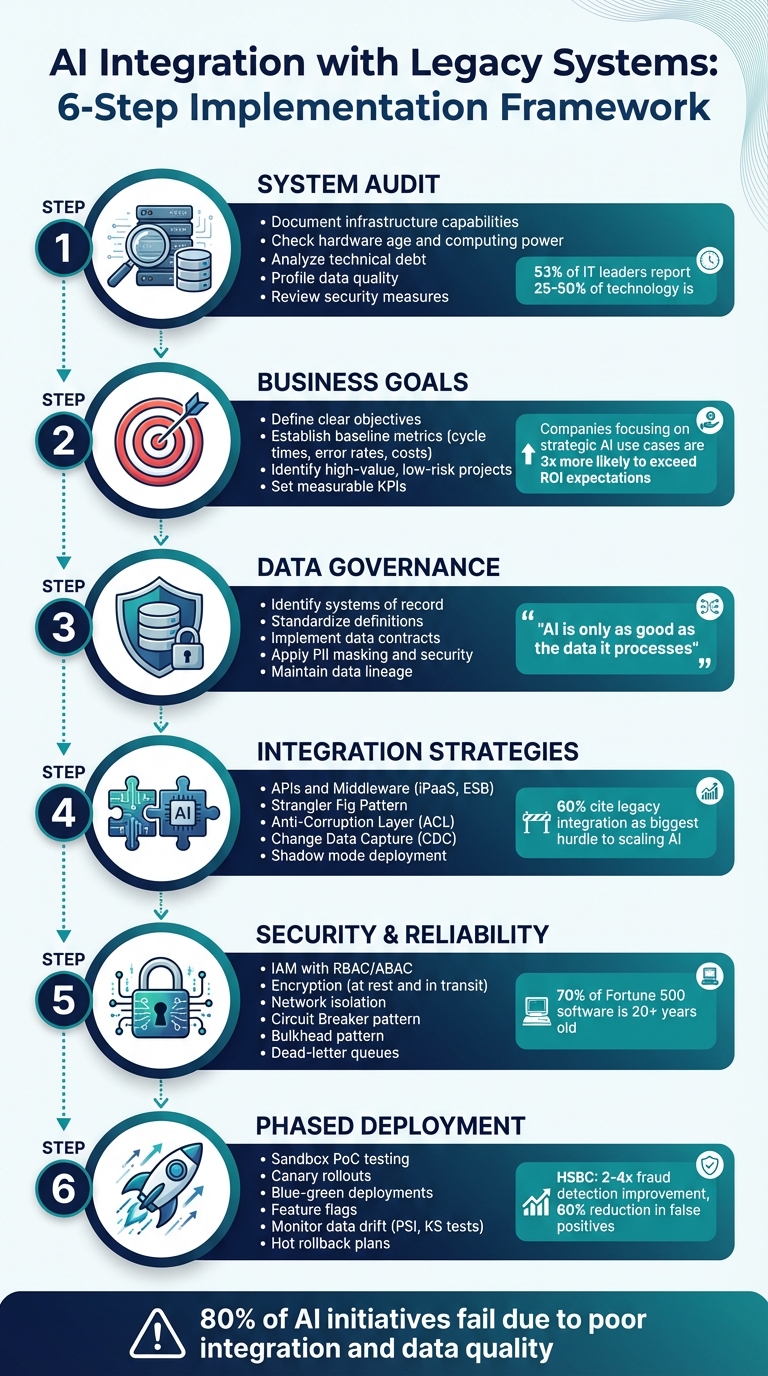
AI Integration with Legacy Systems: 6-Step Implementation Framework
Challenges in AI Integration with Legacy Systems | Exclusive Lesson
sbb-itb-e314c3b
Preparation Checklist: Getting Ready for Integration
Tackling integration challenges starts with a thorough review of your existing systems. Careful preparation helps avoid costly missteps and ensures your integration aligns with business goals. Here's a checklist to guide you through the essential steps for a smooth AI deployment.
Conduct a Complete System Audit
Start by auditing your legacy systems. Document your infrastructure's capabilities to pinpoint AI-ready features and areas needing improvement [6]. Check hardware age, computing power, and compatibility with cloud-based solutions. Determine whether your system is monolithic or supports modern features like low-latency APIs and real-time inference [4].
Don’t overlook technical debt analysis. Outdated code, custom fixes, and fragile architecture can complicate upgrades [6]. Identify dependencies and bottlenecks that could hinder compatibility with AI tools [2]. Also, assess your team's ability to handle legacy programming languages like COBOL alongside newer, cloud-native AI platforms [4].
Pay close attention to data profiling. Examine your data for missing values, inconsistencies, and redundancies [2][4]. Review your security measures to ensure they meet modern standards like encryption, multi-factor authentication, and GDPR compliance [6][2]. Keep in mind that 53% of IT leaders report that a significant portion (25% to 50%) of their technology is considered outdated [3].
Define Clear Business Goals
Integration efforts often fail when technology takes precedence over business needs [9]. Before choosing tools or platforms, focus on defining the "why" behind your integration. Identify specific workflows where AI can make measurable improvements. Establish baselines early - track current cycle times, error rates, and costs within the first two weeks to create a clear benchmark for progress [10].
Evaluate AI opportunities by weighing their potential value against the effort required to implement them. Starting with low-risk, high-reward projects can build momentum and demonstrate quick wins [11]. Research shows that companies focusing on strategic AI use cases are almost three times more likely to surpass ROI expectations [11]. Additionally, organisations where AI teams help define success metrics are 50% more likely to use AI effectively [11].
Clearly outline workflows that must remain stable, regulatory requirements that need to be upheld, and operational windows (like batch processing times) that cannot be disrupted during integration [9]. Choose a small set of metrics to monitor both risks and benefits, such as transaction latency during integration and recovery time after errors [9].
Once business goals are clear, establish strong data governance practices to ensure reliable insights.
Set Up Data Governance
Strong data governance is the backbone of successful AI integration. Start by identifying systems of record - determine which legacy system owns specific data fields to avoid conflicts during synchronisation [9]. Create standardised definitions for key terms like "customer" or "order" to align data practices across both old and new systems [9][10].
Introduce data contracts that define which data attributes are authoritative and which are supplementary, ensuring AI models rely on trustworthy information [10]. Use granular security measures, such as PII masking and row-level security, to protect sensitive data and meet compliance standards like GDPR [10]. Maintain data lineage to track how data moves from its source to AI outputs, making every decision traceable and auditable [10].
"AI is only as good as the data it processes."
– Mila Rowe, Technology Writer, Kovair [2]
Run a data quality check early in the process. Look for duplicate records, missing keys, and inconsistent code sets before starting integration [9]. To prevent outdated data from affecting AI models, consider building an anti-corruption layer - a tool that translates legacy data into formats compatible with modern AI systems [9]. Lastly, establish clear rules for resolving "write" conflicts when both the legacy system and AI platform attempt to update the same record [9].
Integration Strategies Checklist: Connecting Legacy Systems and AI
Once your systems are audited and business goals are clear, the next step is tackling the challenge of connecting legacy systems to AI. For many enterprises, this is no small feat - over 60% cite "integration with legacy systems" as the biggest hurdle to scaling AI [5]. Using proven integration methods can help AI enhance older systems while keeping disruptions to a minimum.
Use APIs and Middleware
APIs and middleware act as bridges between legacy systems and modern AI solutions. Tools like API gateways and facades help standardise access, enforce security protocols, and manage traffic to prevent AI queries from overloading outdated hardware [5]. For organisations juggling multiple systems, platforms like Integration Platform as a Service (iPaaS) and Enterprise Service Buses (ESB) centralise orchestration, making it easier to route requests and handle data transformation across various platforms [5].
For systems without programmatic interfaces, Robotic Process Automation (RPA) can step in temporarily. RPA mimics user actions to extract or input data through existing interfaces, offering a quick but short-term solution. However, keep in mind that RPA requires ongoing maintenance. For real-time operations, consider event-driven architecture with tools like Apache Kafka. This approach enables AI to respond to system triggers without creating rigid dependencies on fragile legacy systems [5].
A great example comes from the banking sector, where middleware allows real-time data capture for AI-driven fraud detection, showing how such strategies can work in high-stakes environments [3].
Apply Incremental Modernisation Patterns
Gradual modernisation is often safer than overhauling everything at once. The Strangler Fig Pattern is one such method. It works by intercepting system requests and routing them to new AI-powered services while keeping the old system running in parallel [13][14]. This approach ensures continuous functionality during the transition.
"The Strangler Fig pattern provides a controlled and phased approach to modernisation. It allows the existing application to continue functioning during the modernisation effort."
– Microsoft Azure [14]
Another useful strategy is the Anti-Corruption Layer (ACL). This method wraps legacy systems in a modern API layer, translating outdated protocols like SOAP or COBOL into formats such as REST/JSON that AI tools can use [15][8]. This is particularly beneficial for systems that are too critical to replace, like core banking platforms, as it avoids altering the original code [4].
You can also start with shadow mode deployment, where AI runs alongside legacy systems to validate its accuracy before taking over. For instance, Valley Medical Centre used the Xsolis Dragonfly AI tool in this way, leading to increased clinical observations (from 4% to 13%) and improved staff efficiency by automating manual reviews [3].
These methods allow for a smoother upgrade of legacy functionalities, creating a solid foundation for future AI integration.
Improve Data-Level Integration
Data integration is another key piece of the puzzle. Change Data Capture (CDC) tools replicate data from legacy systems in real time without modifying the original database [5][4]. This is particularly useful when legacy systems can’t handle the extra load of AI queries. Alternatively, data virtualisation lets AI models access legacy data without moving it, using federation layers to create a unified view [5].
For systems that can’t handle real-time streaming, micro-batching offers a middle ground by simulating near-real-time updates [5]. Adding caching can also speed up access to critical legacy data [5]. To ensure data quality - a common stumbling block for AI projects - automate data cleansing processes to standardise formats and address missing values. Poor data quality is responsible for 80% of AI project delays [12]. Additionally, establish clear rules for syncing data when both the legacy system and AI platform need to update the same fields [9].
Security and Reliability Checklist: Protecting Your Integration
Keeping your AI-legacy system connection secure and reliable is essential. The Australian Signals Directorate emphasizes this by stating, “AI systems are software systems. As such, deploying organizations should prefer systems that are secure by design, where the designer and developer of the AI system takes an active interest in the positive security outcomes for the system once in operation” [19]. A well-rounded approach ensures that your integration remains stable and protected, building on earlier strategies to maintain smooth operations.
Apply Security Controls
To safeguard your integration, start by implementing Identity and Access Management (IAM) with Role-Based Access Control (RBAC) or Attribute-Based Access Control (ABAC) to limit access to sensitive data [16][17][18]. Avoid hardcoded credentials - use managed identities for secure authentication between AI components and legacy systems [16].
Encrypt data both at rest and in transit using modern standards like HTTPS and TLS. Additionally, isolate networks with Virtual Networks (VNets), private links, and dedicated enclaves [16][17][19]. For workflows that handle sensitive information, deploy Data Loss Prevention (DLP) tools to detect and redact sensitive data [16]. Protect model weights, checkpoints, and configurations in secure environments to prevent unauthorized access or tampering [18][19].
Adopt the "default-deny" principle by blocking all external calls and network access unless explicitly allowed through allow-lists [18][19]. For operations like model deployment or accessing model weights, use Two-Person Integrity (TPI), requiring multiple parties to authorize sensitive actions [18][19].
Run AI and middleware in isolated, hardened containers to minimize risks from potential exploits [18][19]. Strengthen exposed APIs with robust authentication, rate limiting, and schema validation to prevent issues like model inversion or unauthorized data extraction [18][19]. Keep detailed logs of prompts, outputs, and tool calls to aid forensic investigations and incident response [18].
Improve System Reliability
Security measures protect your data, but reliability ensures your system runs smoothly. With 70% of Fortune 500 company software being over 20 years old [3], resilience is critical. Use the Circuit Breaker pattern to prevent cascading failures - if the AI system acts up or the legacy system is overloaded, the circuit breaks to maintain stability [15][20]. Similarly, apply the Bulkhead pattern to isolate failures within specific components, preventing issues from spreading across the system [17].
To avoid duplicates or overloads, ensure idempotent writes and use exponential backoff retries [15][9]. Route failed messages to a dead-letter queue for manual review or automated replay, ensuring no data is lost during failures [9][10].
Monitor system health by tracking correlation IDs, latency, and error rates across the entire integration path - from the AI agent to the legacy system [15][9]. Distribute AI services across multiple regions to maintain availability during regional outages or quota limits [20]. Tools like API Management or Application Gateways can automatically distribute requests to healthy instances and manage failovers [20][22]. Set up alerts for unusual activities like adversarial inputs, data drift, or high-frequency repetitive actions that may signal a breach [19].
Plan for Resilient Deployments
Deployment strategies are key to minimizing disruptions. Use blue-green deployments, where two identical environments exist - one live and one updated - allowing for quick rollbacks and minimal downtime [21]. Gradual canary rollouts shift a small portion of traffic to the new integration, reducing the risk of widespread issues [21].
Test AI in shadow mode to validate its accuracy without affecting your legacy system [15][10]. Feature flags allow you to toggle AI capabilities on or off without redeploying the system [10]. Prepare for emergencies with "hot rollback" plans that instantly disable AI channels and use compensating transactions to reverse problematic changes [15].
Conduct Failure Mode Analysis (FMA) to map out potential failure points, like network timeouts or service outages, and define automated responses such as retries or failovers [20]. Finally, automate load testing with tools like Azure Load Testing to identify bottlenecks and validate failover mechanisms before going live [10].
Deployment and Monitoring Checklist: Scaling AI in Production
With security and reliability measures in place, the next step is to deploy AI effectively and monitor its performance. Considering that over 80% of AI initiatives falter due to poor integration and data quality issues [23], having a structured deployment strategy is non-negotiable.
Follow a Phased Deployment Plan
Start by documenting your architecture and identifying low-risk integration points. Before committing to a full-scale rollout, test integration patterns and evaluate business impact through a sandbox proof-of-concept (PoC).
Take HSBC, for example. In collaboration with Google Cloud, they implemented an AI-powered fraud detection system capable of analyzing 900 million transactions monthly. By deploying the system in phases, they enhanced fraud detection rates by 2–4 times while reducing false positives by 60% [3].
Phased rollouts often benefit from techniques like canary releases, where new features are introduced to specific regions or user groups first. This way, any issues are contained without impacting the majority of users.
For instance, an oil and gas company added a generative AI query layer to an existing equipment dashboard. This layer summarized alerts from over 1,000 IoT sensors. Before scaling up, they conducted a six-month PoC focusing on 20 machines, successfully preventing expensive unplanned outages [24].
Set clear quality gates - performance benchmarks that models must meet before advancing from development to testing and finally to production. Also, design systems with circuit breakers to revert to traditional logic if the AI service fails or produces faulty results.
Once the phased rollout confirms the system’s reliability, ensure backward compatibility to maintain smooth operations.
Maintain Backward Compatibility
Backward compatibility is crucial for seamless AI integration. Feature flags allow you to control AI rollouts and quickly disable features if performance drops. Use API gateways to manage protocol translation - for instance, converting JSON requests into fixed-width character strings for legacy systems - while enforcing modern security standards on older endpoints.
Versioning is another key practice. Maintain versions for your code, models, and datasets to enable smooth upgrades and rollbacks. For legacy systems, wrap functionality in a controlled API layer. This standardizes interactions and enforces contracts, allowing the core system to remain unchanged as AI components evolve.
For AI systems with write access, implement deterministic and auditable compensating transactions to reverse any problematic actions in live environments. These precautions ensure operational continuity while you move toward robust monitoring.
Set Governance and Monitoring Standards
Governance should begin early, at the use case intake stage. Assign risk levels based on the potential business impact and require essential artefacts - such as input/output schemas, training data, baseline data, and metric test configurations - before advancing. Automated test suites can then check for stability, data drift, and concept drift before any model snapshot is deployed to production.
Use metrics like PSI, KS tests, and Jensen–Shannon divergence to monitor for data, performance, and safety drifts. Standardize tooling across teams by defining consistent SDKs and APIs, reducing compatibility issues and speeding up development cycles. Configure systems to automatically attach performance and drift monitors based on the model type before deployment. Additionally, ensure on-call staff have access to single-button pathways to disable specific routes, tools, or models in case of safety or performance issues.
These practices lay a solid foundation for scaling AI systems effectively and ensuring their reliability as part of broader strategic discussions at events like the RAISE Summit.
RAISE Summit: Learning AI Integration from Industry Experts

Bringing AI into older systems isn't just about technology - it's about having the right guidance. The RAISE Summit 2026 (8–9 July, Paris) is set to host over 9,000 attendees and more than 350 speakers, all aligned with its "4F Compass" framework: Foundation, Frontier, Friction, and Future [25][27].
AI Strategy Sessions at RAISE Summit
The Frontier Track dives into the nitty-gritty of transitioning AI from concept to reality. Sessions like "AI Adoption Frameworks: From Pilots to Production" and "'DATA': The Backbone of Enterprise AI Architecture" focus on bridging cutting-edge AI with older infrastructures [27]. Meanwhile, the Friction Track takes on the tough stuff - sessions such as "The ROI Dilemma" and "The Cyber Resilience Challenge" tackle the financial and security hurdles of modernising legacy systems [27].
For executives managing large-scale AI rollouts, the CxO Summit provides a space to explore high-level strategies for organisational integration [26]. Industry heavyweights like Vishal Talwar (FedEx), Philippe Rambach (Schneider Electric), and Amit Zavery (ServiceNow) will share their experiences [25][28]. On 8 July 2026, David Flynn, CEO of Hammerspace, will take the Main Stage to discuss "AI-Ready Data For AI Anywhere", focusing on breaking down data silos to streamline AI infrastructure [30]. These sessions are designed to spark ideas and lead into meaningful networking opportunities.
Networking Opportunities for AI Integration Professionals
RAISE Summit is a hotspot for decision-makers - about 80% of attendees are C-level executives or founders. This means direct access to those who control budgets, oversee infrastructure, and navigate regulatory landscapes [25][26]. The Side Events Week offers exclusive dinners, workshops, and meetups aimed at solving challenges like data silos and system interoperability [25].
"As things become more virtual, I think it's increasingly important for people to come together. The serendipity that can happen when you're together in a physical space is life-changing." - Chamath Palihapitiya, Co-founder, Social Capital [29]
On 7 July 2026, the MACHINA Summit will focus on how AI interacts with robotics, autonomous hardware, and other physical systems. This is especially valuable for professionals in manufacturing and industrial sectors [26]. Attendees can also visit booths like Hammerspace (Booth 3B) to discuss solutions for eliminating data silos - essential for seamless AI integration [30].
Attendee Benefits and Ticket Options
RAISE Summit equips attendees with practical tools and strategies for integrating AI into older systems.
| Plan | Price (excl. VAT) | Key Features |
|---|---|---|
| PRO | €999,00 | Access to summit, expo, sessions, workshops, networking app, startup pitches |
| VIP | €1 899,00 | Includes VIP lounge access, curated experiences, and all PRO features |
| VIP MAX | €3 499,00 | Adds an exclusive Paris dinner to all VIP and PRO benefits |
The event also features a startup competition with a €5 million prize pool and a global AI hackathon offering €200 000,00 in prizes, spotlighting fresh solutions for AI integration [25]. Early-bird tickets are now available for this must-attend July 2026 event [25].
Conclusion: Key Points for AI Integration Success
The Importance of Preparation
Laying the groundwork for AI integration is not just helpful - it's absolutely necessary. As we've discussed in the preparation and integration checklists, starting with a thorough system audit and implementing strong data governance practices are crucial first steps. Clearly defining business goals and setting measurable KPIs - like accuracy, latency, and ROI - helps focus efforts on impactful, low-risk use cases. According to Gartner, by the end of 2026, 60% of AI initiatives will fail if the foundational data isn't properly prepared [1]. These statistics underline the importance of preparation as the cornerstone of AI success.
Technical and Security Best Practices Summary
Staying technically agile and secure is paramount when integrating AI into legacy systems. Strategies like incremental modernisation, including the use of the Strangler pattern, allow organisations to gradually replace outdated components without disrupting operations. Wrapping stable functions with APIs ensures older systems can work alongside AI seamlessly, while middleware and message queues help manage the slower processes of legacy systems without causing bottlenecks.
Security, of course, cannot be an afterthought. From the outset, encryption for data at rest and in transit, role-based access controls, and multi-factor authentication should be in place. Testing AI in shadow mode is another smart move - it allows organisations to validate AI outputs without risking live operations.
"Integrating AI into legacy systems is among the critical challenges and opportunities facing CIOs today." – Michael Fauscette, Founder, CEO & Chief Analyst, Arion Research [7]
When combined with earlier preparation steps, these technical and security measures create a framework for dependable AI deployment.
Continue Learning and Networking
AI integration isn't a one-and-done task; it's a continuous process that evolves with the technology. Staying informed about emerging trends like Generative AI and Agentic AI is vital for staying competitive. Upskilling teams who already have experience with legacy systems is another key factor - this not only ensures smooth AI operations but also preserves institutional knowledge that might otherwise be lost.
Networking also plays a big role in avoiding costly mistakes. Between 60% and 80% of AI project budgets are often spent on integration rather than development [8], making it clear that learning from others' experiences can save both time and money. Events like the RAISE Summit (8–9 July 2026, Paris) provide a great opportunity to connect with industry leaders and gain practical insights into AI integration. These gatherings are particularly valuable for professionals navigating the complexities of merging AI with existing infrastructures.
FAQs
What’s the safest first AI use case for a legacy system?
When introducing AI into a legacy system, the best starting point is automating routine tasks with AI. This approach is low-risk and highly practical. Begin with small-scale implementations, like pilot projects or Minimum Viable Products (MVPs). These phased steps help ensure smooth integration, reduce disruptions, and allow you to test compatibility with existing systems. It’s a cautious yet effective way to evaluate performance and make adjustments as needed.
How can we integrate AI without rewriting the core platform?
To bring AI into your system without overhauling your core platform, consider non-intrusive solutions like Change Data Capture (CDC), file watchers, or middleware. These tools can mirror data and interfaces from your legacy system, making integration smoother.
Using decoupled layers - such as APIs or message queues - helps keep AI components separate from the main system, reducing the risk of interference. During testing, running AI processes in parallel ensures the system remains stable while the AI operates on real-time data. This approach allows you to integrate AI effectively without disrupting your existing architecture.
How do we keep AI outputs secure, compliant, and auditable?
To keep AI outputs secure, compliant, and traceable, it's essential to implement security measures tailored to each stage of the AI lifecycle. This means safeguarding training environments, protecting model artifacts, maintaining ongoing monitoring, and applying strict access controls. For a solid foundation, refer to trusted frameworks like NIST’s SSDF and CISA’s 'Secure by Design' principles for expert guidance.

.avif)