

Enterprise AI events and startup AI events serve completely different audiences and goals. Enterprise events focus on scalability, compliance, and long-term ROI, attracting C-level executives and decision-makers from large organizations. Meanwhile, startup events emphasize speed, experimentation, and funding, drawing founders, developers, and investors looking to create and launch new ideas.
Here’s a quick breakdown:
- Enterprise Events: Target senior executives, focus on governance and system integration, and prioritize structured networking like VIP sessions or closed-door discussions. Example: IDC AI & Data Summit (8 April 2026), which tackles scaling AI and compliance.
- Startup Events: Cater to founders and developers, highlight fast-paced innovation, and feature hackathons and pitch competitions. Example: RAISE Summit (8–9 July 2026), with over €5 million in prize pools and 9,000+ attendees.
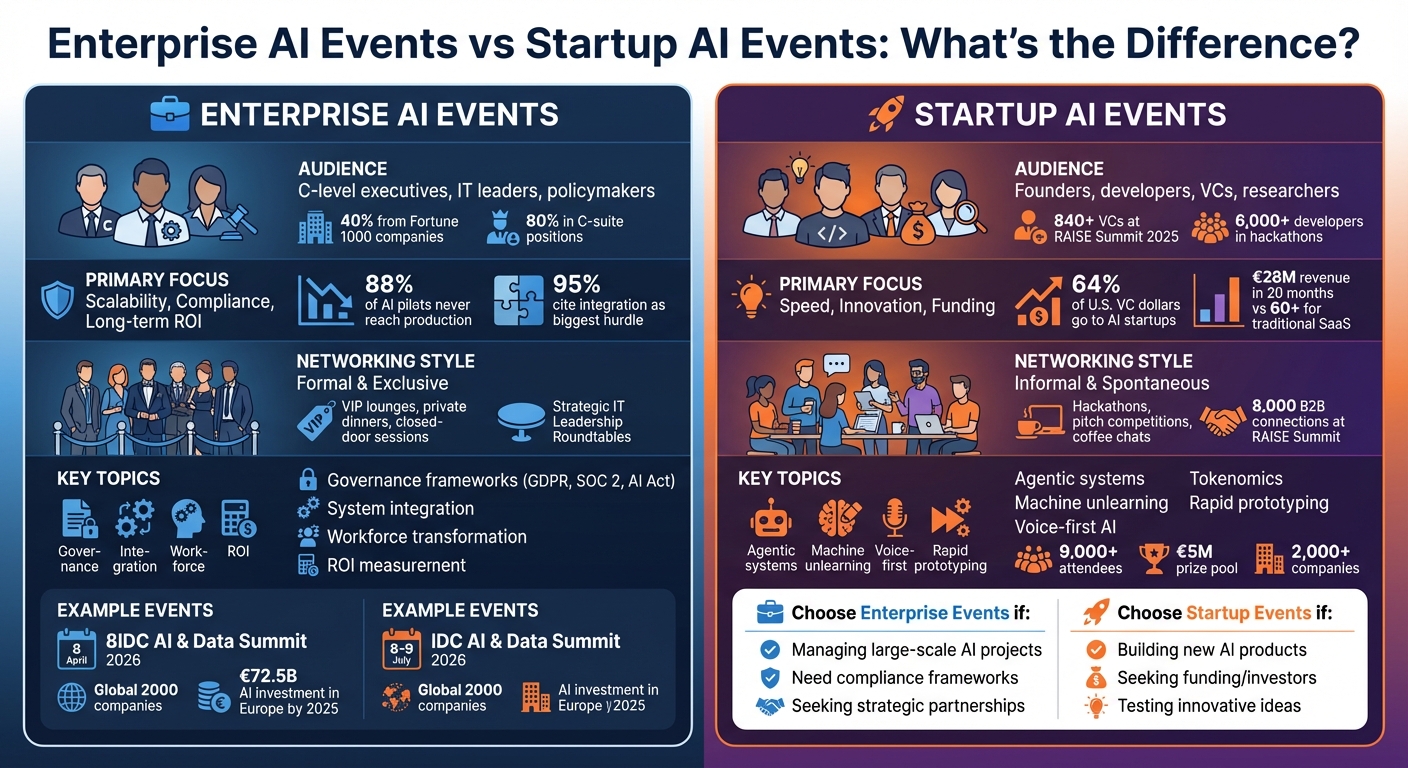
Enterprise vs Startup AI Events: Key Differences in Audience, Focus, and Networking
6 Rules for Winning with AI: Startups vs Enterprises
sbb-itb-e314c3b
Quick Comparison
| Criteria | Enterprise AI Events | Startup AI Events |
|---|---|---|
| Audience | C-level executives, IT leaders, policymakers | Founders, developers, VCs, researchers |
| Focus | Scalability, compliance, ROI | Speed, new ideas, funding |
| Networking Style | Formal, exclusive (VIP lounges, private dinners) | Informal, spontaneous (hackathons, coffee chats) |
| Event Highlights | Governance frameworks, ROI strategies | Pitch competitions, agentic systems |
| Example Event | IDC AI & Data Summit (8 April 2026) | RAISE Summit (8–9 July 2026) |
Choosing the right event depends on your goals. Executives managing large-scale AI projects should attend enterprise events for structured strategies. If you're a founder or developer chasing new opportunities, startup events offer the perfect platform.
Who Attends Enterprise vs. Startup AI Events?
Enterprise and startup AI events draw distinct crowds, and understanding these differences sheds light on why their agendas, conversations, and networking opportunities vary so much. The makeup of attendees directly shapes the event's focus, from the topics explored to the connections formed.
Enterprise AI Events: Senior Executives and Company Leaders
Enterprise-focused AI events attract high-level decision-makers, particularly from Fortune 1000 companies. In fact, 40% of attendees at these events represent Fortune 1000 firms, and 80% occupy C-suite positions [1][4]. These leaders are responsible for managing large budgets and driving strategic initiatives, making their priorities clear: they need scalable solutions that integrate seamlessly with existing ERP and CRM systems while adhering to strict governance frameworks.
Discussions at these events center on scalability, compliance, and long-term ROI. Attendees often participate in exclusive, closed-door sessions where they tackle topics like GDPR compliance, SOC 2 standards, and frameworks for measuring ROI. These forums also serve as a space to explore strategic partnerships and regulatory alignment. Beyond executives, MLOps engineers, data officers, and policymakers attend to ensure that the technological infrastructure aligns with broader AI strategies at both the corporate and national levels.
Startup AI Events: Founders, Developers, and Investors
Startup AI events, on the other hand, bring together a different mix of participants. Founders, co-founders, and entrepreneurs dominate, along with developers, researchers, and technical innovators focused on creating groundbreaking prototypes. These events also draw a significant number of venture capitalists. For instance, at the RAISE Summit in July 2025, more than 840 VCs and investors attended, hunting for the next big idea.
This crowd thrives on fast-paced innovation and immediate results. Their goals are clear: secure funding, validate ideas, and connect with like-minded innovators. Hackathons are a hallmark of these events, often featuring thousands of participants. Take "RAISE Your Hack" in July 2025, where over 6,000 developers competed for a share of a €5 million prize pool. At the same event, Hirundo.io gained attention by winning the "RAISE the Stakes" competition with a platform that reduced AI hallucinations by 55% and biases by 70% [1].
The contrast between these two attendee profiles highlights how enterprise and startup events differ in their goals, networking styles, and content priorities - differences that become even more evident in the themes they emphasize.
Goals and Themes: What Each Event Type Prioritizes
The distinct profiles of enterprise and startup audiences shape the priorities of their respective AI events. From the topics covered to the networking opportunities offered, each event type is tailored to address the unique challenges and goals of its audience.
Enterprise Events: Governance, Scalability, and ROI
Enterprise AI events are all about delivering measurable outcomes while keeping risks in check. These events focus on overcoming hurdles like achieving ROI and turning experimental AI projects into fully operational systems.
A major theme at these gatherings is governance. Sessions often dive into regulatory frameworks such as the AI Act, GDPR compliance, and SOC 2 standards. For instance, the RAISE Summit 2026, set for 8–9 July at Le Carrousel du Louvre in Paris, dedicates an entire "Friction" track to addressing compliance challenges and the "ROI Dilemma." Hadrien de Cournon, Co-Founder of RAISE Summit, highlights the event's importance:
"This next edition will be the European flagship AI event for businesses, offering C-suite executives a unique platform to shape their AI strategies and connect with the partners needed to drive meaningful implementation." [5]
Scalability is another hot topic, with discussions focusing on cloud infrastructure, compute optimisation, and workforce transformation to support global AI deployments. Notably, enterprise AI spending has shifted significantly, moving from experimental budgets to core IT infrastructure - a trend that has seen a 75% year-over-year growth [2].
While enterprises aim for controlled and scalable solutions, startup events thrive on speed and innovation.
Startup Events: Speed, New Ideas, and Disruption
Startup AI events are fast-paced and innovation-driven. Without the baggage of legacy systems, founders focus on creating new solutions from scratch. The energy at these events is palpable, with "vibe coding" - a prompt-based approach enabling even non-technical founders to quickly launch apps - setting the tone [6].
Pitch competitions and hackathons are central to the agenda, with the primary goals being to secure funding and validate product-market fit. Unlike enterprises, startups are less concerned with quarterly reports and more focused on breaking new ground.
Collaboration across industries is another key focus. With 53% of small businesses already using AI [9], startup events explore how AI can be applied in novel ways across different sectors. Topics often include agentic AI, cost management strategies for large language models, and the "talent war", which has seen a 38% growth in AI-related job postings between 2020 and 2024 [6]. Kristie Poon from Salesforce captures the essence of these events:
"For startups, AI visibility allows for faster iterations, experimentation, and innovation." [10][11]
These differences in focus make it easier to determine which type of event aligns better with your professional goals and interests.
Networking Opportunities: Formal vs. Informal Connections
The way professionals connect at AI events can differ significantly, shaped by the event's goals and audience. Whether you're at a polished enterprise summit or an energetic startup gathering, networking opportunities define much of the event's value. Enterprise events focus on structured, high-stakes interactions, while startup events thrive on spontaneous exchanges where ideas and opportunities flow freely.
Enterprise Events: VIP Experiences and Executive Deal-Making
Enterprise AI events are designed with exclusivity in mind, offering curated networking opportunities that cater to senior decision-makers. These events often include private forums, VIP lounges, and invitation-only dinners where C-level executives discuss high-level strategies and business deals. For instance, at the RAISE Summit, over 80% of attendees are either C-level executives or founders, creating an environment where partnerships with global impact are forged [4][7].
This structured approach is deliberate. Events like Strategic IT Leadership Roundtables operate under strict no-vendor policies, allowing executives to openly address challenges in AI implementation. Similarly, speed networking formats such as Enterprise Connect's "Meet, Greet & Repeat" provide a fast-paced yet focused setting, with participants rotating through multiple three-minute discussions. These formats prioritize tangible outcomes, from aligning budgets with infrastructure needs to navigating complex regulations [4][12].
Scheduled for 8–9 July 2026 at Le Carrousel du Louvre in Paris, the RAISE Summit exemplifies this structured networking model, offering tiered access to help senior executives form meaningful alliances.
Startup Events: Hackathons, Pitch Competitions, and Community Building
Startup events, on the other hand, are all about energy and spontaneity, emphasizing community-driven formats that encourage collaboration. Hackathons are a major highlight, with events like "RAISE Your Hack" drawing thousands of participants [1]. These 24-hour coding marathons are not just about innovation - they're a chance for startups to engage directly with potential users and gather unfiltered feedback that surveys can't provide [6].
Pitch competitions add even more excitement. The "RAISE the Stakes" competition, for example, awarded a €5 million prize pool in 2025 [1][7]. Beyond the stage, informal "hallway track" conversations often lead to pivotal insights, whether through quick coffee chats or impromptu brainstorming sessions over dinner [6].
The atmosphere at these events is intentionally casual. Founders use this setting to test prototypes, find early collaborators, and refine their ideas in real time [6][11]. With AI job postings increasing by 38% between 2020 and 2024 [6], startup events have also become essential for talent recruitment. The RAISE Summit in 2025 facilitated 8,000 B2B connections over two days, blending executive networking with broader community-building efforts [1].
These contrasting approaches to networking highlight the distinct priorities of enterprise and startup AI events, each catering to its audience's unique needs and ambitions.
Technologies and Content: What's on Display?
The technologies featured at enterprise and startup AI events highlight distinct priorities. Enterprise gatherings focus on reliable, scalable systems that meet strict compliance standards. Meanwhile, startup events showcase bold, experimental innovations aiming to redefine possibilities. This divide in focus offers a fascinating lens to explore the unique dynamics of each event type.
Enterprise Events: Scalable Systems and Compliance-Centric Solutions
Enterprise AI events are all about infrastructure that can handle large-scale demands while adhering to complex regulations. Think sovereign cloud systems, robust data architectures, and governance frameworks. For instance, at the recent RAISE Summit in Paris, WEKA introduced NeuralMesh™, a storage solution designed to accelerate AI deployment at scale [1]. Cerebras Systems also made waves by presenting Qwen3-235B, a model with 131K context support, deployed on their inference cloud. This approach, developed in collaboration with Hugging Face and Docker, promises enterprise-level AI deployment at a fraction of the cost of proprietary models [1].
A recurring theme at these events is integration. With enterprises juggling an average of 897 applications, seamless compatibility with new AI systems is a massive challenge. In fact, 95% of IT leaders identify integration as the main hurdle to adopting AI [2]. Topics like MLOps and centralized model management take center stage, addressing how to overcome these obstacles. Tracks such as "Compute as Capital" and the "Energy-Compute Nexus" further explore the infrastructure demands of large-scale AI systems [8]. The focus remains firmly on ROI, compliance with standards like GDPR and ISO 27001, and sustainable growth.
While enterprises emphasize stability and scalability, startup events take a radically different approach.
Startup Events: Innovation and Prototypes in Action
Startup AI events thrive on showcasing bold, experimental technologies. These gatherings highlight agentic systems, machine unlearning platforms, and specialized foundation models tailored for fields like robotics and commerce [1]. One standout example is Hirundo.io, which won the €5 million "RAISE the Stakes" competition in July 2025. Their machine unlearning platform, designed to help AI models "forget" specific data, reportedly reduces hallucinations by 55% and biases by 70% [1]. Another breakthrough came from Drill Surgeries, which unveiled ZAORY, an AI-powered surgical guidance system cutting operating times by 75% and radiation exposure by 60% during trauma surgeries [1].
The emphasis here is on rapid innovation and performance leaps. H Company introduced SurferH, a browser-based automation agent that achieved a 92.2% success rate on the WebVoyager benchmark [1]. Events like the "RAISE Your Hack" competition at the 2025 RAISE Summit exemplify this spirit. Over 6,000 participants developed entirely new solutions in just 24 hours [1]. These presentations push boundaries, focusing on faster inference speeds, longer context windows, and novel automation tools. While enterprise events ask, "How do we scale responsibly?", startup events ignite the question, "What can we build that changes everything?"
Discussion Topics: Implementation vs. Experimentation
Enterprise events zero in on scaling AI solutions, while startup gatherings push the boundaries of what's possible. This difference highlights their contrasting priorities: enterprises focus on proven strategies, while startups thrive on daring innovation. Let’s dive deeper into how these different approaches shape the transformation of ideas into real-world outcomes.
Enterprise Events: Scaling Responsibly and Implementation
For enterprises, the big question is: how do we move from prototype to production? Gloria Macias, a Partner at McKinsey, summed it up well:
"2024 is the year we see a transition from experimentation to scalable production use cases" [13].
That shift is critical, especially when you consider that 88% of AI pilots never make it to production [2]. Enterprise leaders are determined to change this.
A major focus is governance. With the EU AI Act now in effect, compliance is a hot topic. Enterprises are working on auditability, algorithmic transparency, and ensuring data provenance [14]. A great example of this practical approach comes from Pierre Matuchet, SVP of IT & Digital Transformation at Adecco Group. At World Tour Paris in June 2024, he shared how Adecco developed a generative AI-powered CV Maker tool in just 3–4 weeks. But the real challenge? Scaling it globally across multiple languages and regions - all while staying compliant [13].
Other key topics include "Workforce Transformation", strategies to avoid vendor lock-in, and multi-LLM (large language model) approaches. These discussions reflect the enterprise focus on risk management and long-term strategies [13][8]. Enterprise AI events are all about careful planning and execution, ensuring innovation is implemented responsibly.
Startup Events: Testing New Ideas and Breaking Barriers
Startups, on the other hand, focus on taking bold ideas and turning them into game-changing products. Their mantra is simple: build what doesn’t exist yet [4]. A standout example comes from the ai-PULSE conference in December 2025. Jérôme Monceaux, CEO of Enchanted Tools, showcased the Mirokaï social humanoid robot. Deployed at Paris's Institut du Cerveau, this robot transformed a stressful, hour-long radiotherapy session for children into a calm, manageable process. The result? A 10x boost in medical machinery productivity [15]. This is the startup mindset in action: focus on creating breakthroughs first, and worry about scaling later.
Key discussion points at these events include emerging agentic systems, simulated world models, and voice-first AI [8][15]. Startups also explore areas like the "Energy-Compute Nexus" and tokenomics, as they navigate the rapidly decreasing costs of intelligence. Aaron Levie, CEO of Box, captured this perfectly:
"The cost of intelligence is going to go to zero. Like it's just absolutely guaranteed" [3].
While enterprises ask, "How do we implement this safely?", startups are busy asking, "What impossible thing can we make real?"
Examples from France: Comparing Real Events
These contrasting approaches come to life through notable events hosted in France, each catering to different audiences and needs.
Enterprise Example: IDC AI & Data Summit
On 8 April 2026, the IDC AI & Data Summit will bring together CIOs, Chief Data Officers, and AI leaders from Global 2000 companies. This one-day event focuses on key enterprise priorities like governance, compliance, and scaling AI from pilot projects to full-scale production. The Advisory Board includes prominent figures such as Philippe Rambach (SVP, Chief AI Officer at Schneider Electric), Sébastien Pacchini (Head of Data & AI Operation at Renault), and Christophe Vaudable (VP Data at Accor). These experts address pressing challenges, including managing "Shadow AI" risks.
The event highlights an important statistic: 68% of European companies cite a lack of AI and data skills as a major barrier to scaling AI, while AI investments in Europe are projected to hit $72.5 billion by 2025. Attendees can also take advantage of structured networking opportunities, such as a Networking Breakfast, Lunch, Cocktail, and IDC Connect Workshops, fostering confidential, peer-to-peer discussions among executives [16].
Startup Example: RAISE Summit
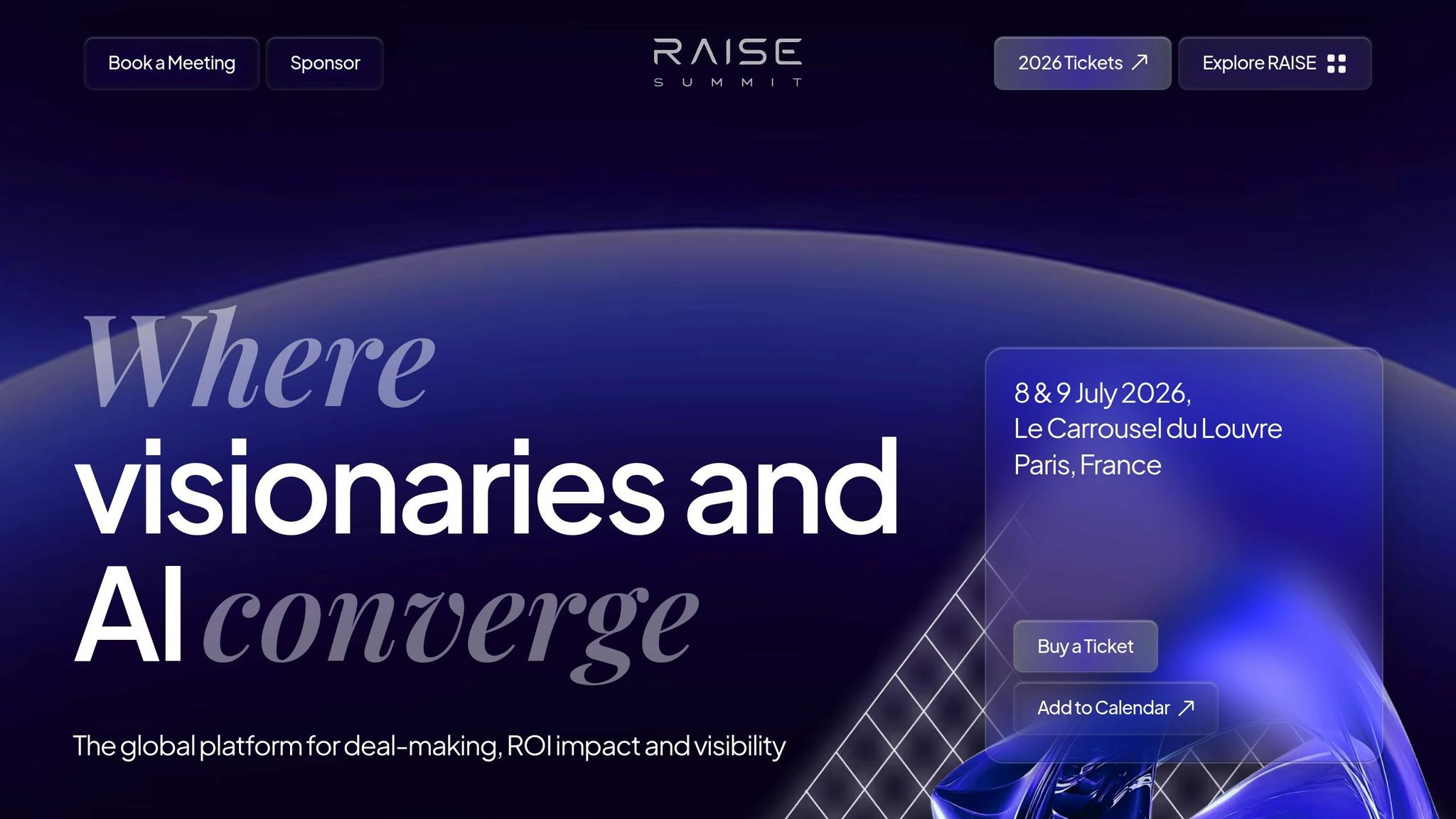
Taking place on 8–9 July 2026 at the Carrousel du Louvre, the RAISE Summit is a two-day event that attracts over 9,000 attendees and more than 2,000 companies. Eric Schmidt, former CEO and Chairman of Google, described it as:
"The fastest-growing AI Tech conference in Europe, and maybe in history" [7].
The program is built around the "4Fs": Foundation, Frontier, Friction, and Future. For instance, the Frontier track examines agentic systems and tokenomics, while the Future track dives into superintelligence and multimodal AI. Beyond its agenda, the summit offers interactive opportunities, including a startup competition with a €5 million prize pool for 10 finalists and a global AI hackathon boasting a €200,000 prize pool, which draws over 8,000 participants.
Networking here is equally dynamic, featuring a "Side Events Week" packed with exclusive dinners, meetups, and workshops across Paris. A meeting booking system also connects founders with investors and corporate leaders. As Delphine Moulu, Co-founder of Femtech France, noted:
"All the ecosystem is there. It's where you get to meet your next investors or clients. It's a key event!" [17].
Conclusion: Choosing the Right Event for Your Goals
Selecting the right event hinges on your career stage and what you aim to achieve. For senior executives, enterprise events can be a game-changer. These gatherings focus on governance, scalability, and ROI - critical factors, especially given that 42% of enterprise AI projects fail to deliver measurable returns [2]. With an emphasis on regulatory compliance, large-scale system integration, and strategic transformation, these events cater to the challenges of managing complex AI implementations.
On the other hand, startup events are a hub for founders, developers, and investors eager to push boundaries. Consider this: 64% of U.S. venture capital dollars in the first half of 2025 went to AI startups [18]. These events are packed with opportunities, from pitch competitions to hackathons, where innovation takes center stage. The pace here is unmatched - AI companies often hit €28 million in annual revenue within just 20 months, compared to over 60 months for traditional SaaS businesses [18].
Networking is another critical factor. If your goal is to connect with C-suite executives and engage in high-level deal-making, enterprise summits are the place to be. But if you're looking for venture capital, technical partnerships, or mentorship, startup-focused events provide direct access to investors and like-minded innovators.
Practical challenges also play a role. For instance, 95% of IT leaders cite integration as AI's biggest hurdle [2], making enterprise events valuable for those tackling complex systems. Meanwhile, startup events offer entrepreneurs the chance to showcase their technical expertise and turn initial meetings into funding opportunities. As Jonathan Ross, CEO of Groq, puts it:
"RAISE is where everyone in AI is going." [5]
The key is aligning your choice of event with your specific goals. Doing so can open doors to the transformative opportunities AI has to offer.
FAQs
Which event type is best for my role?
The ideal type of event really hinges on what you're aiming to achieve. Enterprise AI events are perfect for individuals working in large organisations, where the focus is on scalability and tackling intricate business challenges. On the other hand, startup AI events cater to those who thrive on innovation, flexibility, and cutting-edge technologies. If you're looking for a blend of both worlds, major gatherings like the RAISE Summit provide a unique mix - offering enterprise-level discussions alongside startup-centric activities, such as hackathons, to meet a variety of professional interests.
What should I prepare before attending?
Attending an AI event like the RAISE Summit in Paris is a fantastic opportunity to expand your knowledge and connections. To make the most of it, here’s how you can prepare:
- Research the agenda and speakers: Take time to review the event schedule and identify sessions that align with your interests. Whether you’re keen on enterprise AI or specific emerging trends, planning ahead ensures you won’t miss key discussions.
- Set clear goals: Decide what you want to achieve. Are you there to learn about cutting-edge AI applications, connect with industry leaders, or explore potential collaborations? Having a focus will guide your time effectively.
- Update your professional materials: Bring essentials like updated business cards or a digital portfolio. These are vital for networking and leaving a lasting impression.
- Stay informed on industry trends: Brush up on the latest developments in AI to engage in meaningful conversations and better understand the topics being discussed.
- Prepare your devices: Make sure your phone, laptop, or tablet is fully charged and bring portable chargers. You’ll likely need them for note-taking, live-tweeting, or connecting with others.
- Plan your logistics: The event takes place in Paris on 8–9 July 2026, so sort out travel arrangements, accommodation, and any other details to ensure a smooth experience.
By being well-prepared, you’ll maximise your time at the RAISE Summit and walk away with valuable insights and connections. Paris awaits!
Can one event work for both scaling and funding?
Absolutely, a single event can tackle both scaling and funding needs, depending on how it's organized. Take the RAISE Summit in Paris (July 2026), for example. This event brings together a mix of participants - investors, industry leaders, and startups - all under one roof. Attendees can benefit from opportunities like:
- Competing for funding prizes exceeding €10 million.
- Networking to build partnerships that drive growth.
- Gaining insights and sharing knowledge to refine strategies.
That said, the impact of such events often depends on their primary focus. Some are designed to prioritise funding opportunities, while others lean more towards scaling by fostering collaboration and sharing industry expertise.