

In 2026, Europe's AI conferences are all about scaling AI and solving real business challenges. Key trends include hybrid event formats, regional AI ecosystems, and embodied AI (integrating robotics with machine learning). Major hubs like Paris, Berlin, Amsterdam, and London host top events, with Paris leading through the RAISE Summit on 8–9 July 2026, attracting 9,000+ attendees and 80% C-level executives. Other highlights include ESANN in April (Bruges) for researchers, AI Summit London (July) for enterprise AI, and World Summit AI (October, Amsterdam) for global innovation. Whether you're an executive, researcher, or startup founder, these events offer tailored insights and networking opportunities. Plan early, set clear goals, and choose events that align with your needs.
Watch the Space - AI in Europe in 2026 | DLD26 (Roberto Viola)
sbb-itb-e314c3b
RAISE Summit: Paris' Leading AI Conference
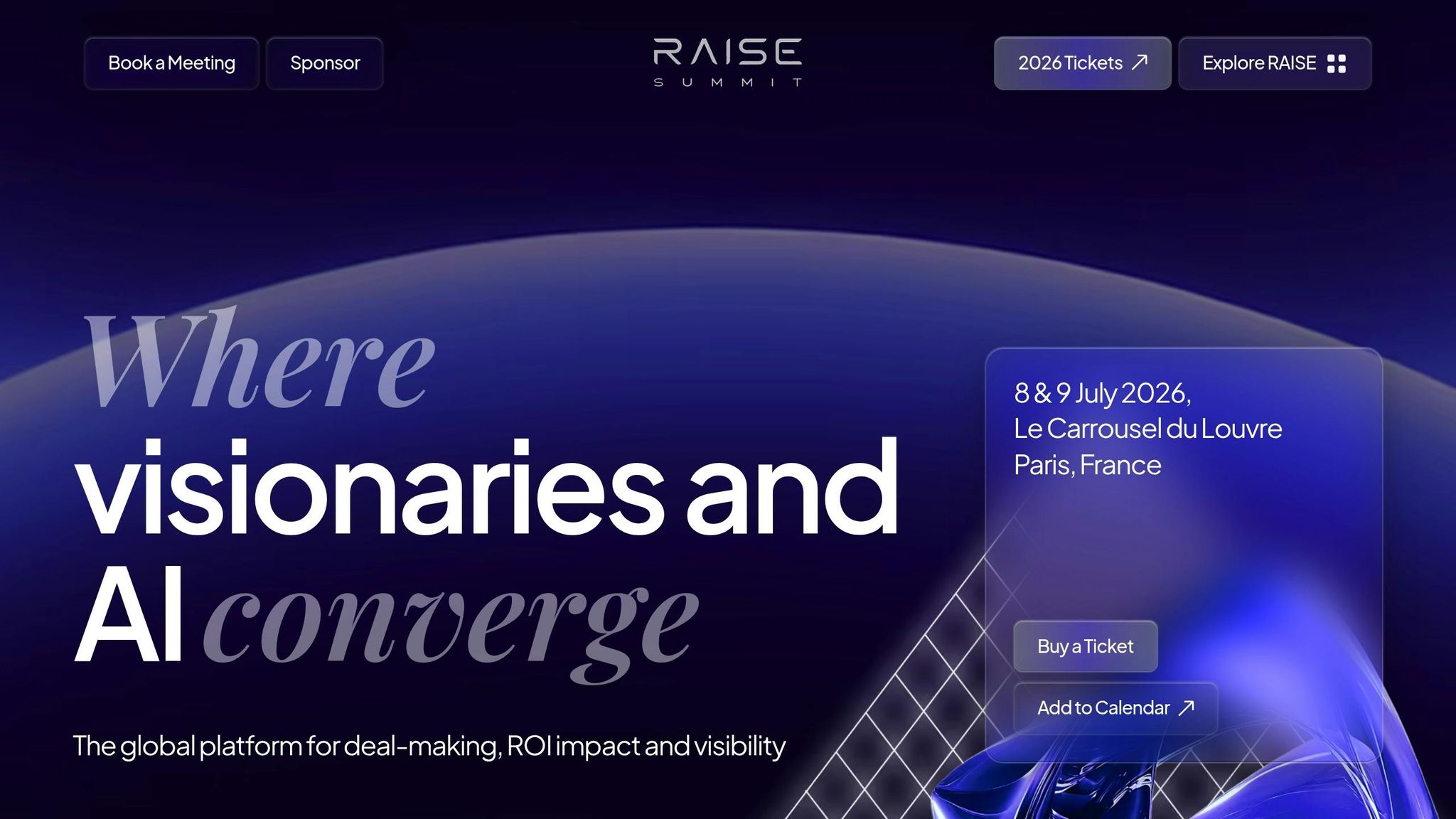
Set to take place on 8–9 July 2026 at the iconic Carrousel du Louvre, the RAISE Summit stands as a highlight of Europe's AI calendar. With over 9,000 attendees and representatives from more than 2,000 companies, this event attracts a remarkable concentration of decision-makers - 80% of participants are C-level executives or founders [1] [5]. This unique mix creates what organisers call "Intimacy at Scale", blending high-stakes deal-making with meaningful knowledge-sharing opportunities. Here's a closer look at why RAISE is a central hub for AI policy, innovation, and business.
The summit's reputation isn't just about the numbers. In 2025, it brought together 822 CEOs and representatives from 168 Fortune 500 companies, while attending investors collectively managed $600 billion in assets [5]. Jonathan Ross, CEO and Founder of Groq, summed up the event's significance:
What sets RAISE apart is its ability to bridge policy, capital, and innovation. While many conferences focus narrowly on specific aspects of AI, RAISE uses its "4F Compass" framework to connect the dots: Foundation (infrastructure and funding), Frontier (emerging systems and applications), Friction (regulatory and ROI challenges), and Future (AGI and long-term sustainability) [1] [6]. This approach aligns with Europe's growing emphasis on actionable AI strategies. Whether you're working on sovereign cloud solutions, enterprise AI deployment, or navigating compliance, RAISE offers practical insights tailored to your needs.
Adding to its appeal, the summit features an exclusive programme for senior executives. The CxO Summit, held in a private area of the Louvre, is an invitation-only gathering for Fortune 1000 C-suite leaders. With AI-powered business matching and curated discussions, it’s designed to turn conversations into tangible outcomes. As co-founder Hadrien de Cournon puts it:
"The CxO Summit exists so companies don't just talk about AI, they leave RAISE with real partnerships, pilots, and signed deals." [5]
Complementing the main event is the MACHINA Summit, scheduled for 7 July. This co-located event focuses on Physical AI, showcasing live demonstrations of robotics, humanoids, and autonomous systems [2] [7]. It reflects the industry’s growing interest in embodied intelligence, where AI extends beyond digital interfaces into the physical world.
RAISE Summit continues to solidify its place as a must-attend event for anyone shaping the future of AI. From groundbreaking partnerships to cutting-edge demonstrations, it’s where the industry’s biggest decisions and innovations take root.
Spring AI Events (April – June 2026)
Spring brings a packed schedule of events tailored to meet the diverse needs of Europe's AI community. From academic discussions to executive networking, these gatherings continue the momentum set by the RAISE Summit, offering insights and opportunities across different sectors.
ESANN 2026 (22–24 April, Bruges, Hybrid)

For those in academia, ESANN 2026 is a must-attend event. Taking place from 22–24 April in Bruges, Belgium, the 34th European Symposium on Artificial Neural Networks, Computational Intelligence and Machine Learning promises a focused, single-track program. Over three days, more than 100 speakers will present cutting-edge technical papers, making it a key platform for researchers, data scientists, and machine learning engineers [8].
As Michel Verleysen highlights:
The 34th European Symposium on Artificial Neural Networks, Computational Intelligence and Machine Learning will be organized in hybrid mode... Both in-person and online participation will be possible [8].
This hybrid format ensures accessibility for a global audience. Submissions closed on 26 November 2025, with final decisions announced by 23 January 2026 [8].
AI Summit Kitzbühel (17–18 June, Austria)
Scheduled for 17–18 June in the picturesque town of Kitzbühel, Austria, this summit is tailored for C-level executives and innovation leaders. It focuses on integrating AI into business strategies, offering a platform for meaningful discussions and strategic exchanges. The alpine setting creates a unique atmosphere for fostering collaboration and exploring practical applications of AI in corporate environments.
GITEX AI EUROPE 2026 (30 June–1 July, Berlin)

Berlin will host GITEX AI EUROPE on 30 June and 1 July, marking the brand's expansion into Europe [9]. This event caters to enterprise professionals and institutional investors, focusing on large-scale AI implementation and partnership opportunities. It’s an ideal venue for those seeking funding or exploring enterprise-level solutions, underscoring its importance for businesses aiming to scale their AI initiatives.
Summer and Autumn AI Events (July – November 2026)
As the year progresses, the focus on responsible AI implementation and practical deployment continues through summer and autumn. These events cater to varied audiences, from executives shaping governance policies to technologists refining AI deployment strategies.
AI Summit London (10–11 July 2026)
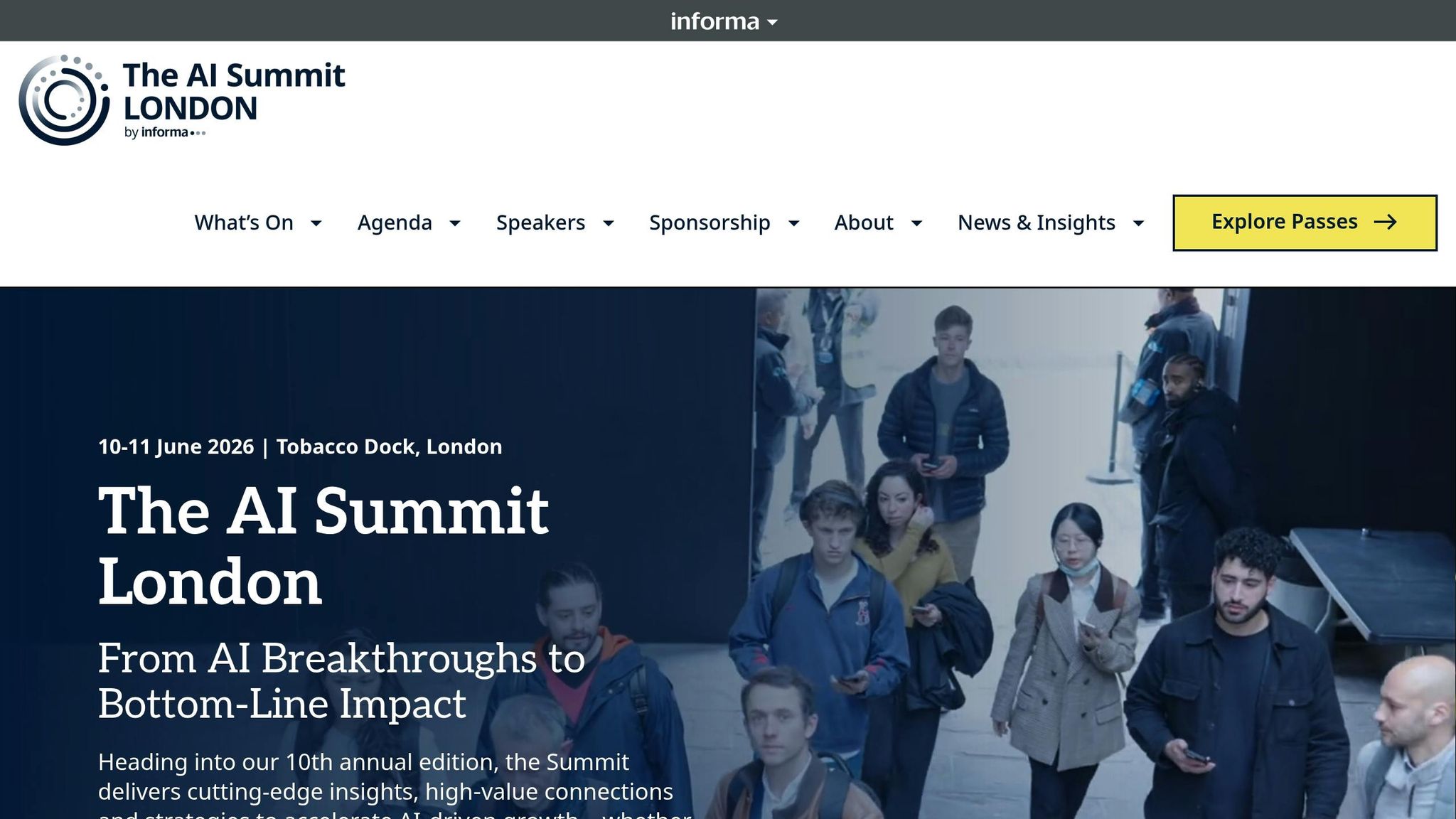
Marking its 10th anniversary, the AI Summit London returns on 10–11 July at Tobacco Dock as part of London Tech Week. This milestone event expects over 5,000 attendees, more than 300 speakers, and 100+ sponsors and exhibitors [11].
Caroline Hicks, VP at The AI Summit Series, shares:
In 2026, the summit reflects a new reality, one where organisations are scaling AI responsibly, embedding trust and governance, and delivering tangible outcomes. [11]
The summit offers tailored tracks for three key groups. Policymakers and executives can explore AI governance, ethics, and public policy frameworks. Technologists and data scientists will benefit from the "AI Trail" and interactive zones showcasing emerging tools. Meanwhile, commercial leaders can dive into sector-specific applications - spanning finance, healthcare, manufacturing, and retail - with a focus on ROI and growth strategies [10][11].
Registration opened in February 2026, and early sign-ups are encouraged. The AI Expo floor will feature over 100 technology providers, offering attendees a chance to compare solutions firsthand.
World Summit AI (October 2026, Amsterdam)
Set for October in Amsterdam, World Summit AI serves as a global stage for unveiling the latest AI innovations [12]. Unlike vendor-heavy expos, this event emphasizes visionary ideas and advanced technical discussions, making it ideal for both industry leaders and academic researchers [10].
The summit features six distinct tracks:
- Mainstage: Discussions on economic, societal, and ethical AI for policymakers and executives.
- Adopt AI: Strategies for global deployment and ROI tailored to enterprise leaders.
- AI Labs: Theoretical insights into areas like NLP and robotics, designed for academics.
- Frontier Founders: A focus on AI innovation and venture capital for startups and investors.
- Sovereign AI: Exploring data sovereignty and infrastructure control for government and tech leaders.
- AI Media: Human-AI collaboration in content creation for creative professionals [10].
This event stands out for its mix of visionary talks and technical depth, making it a highlight of the autumn calendar.
Big Data Conference Europe (25–27 November, Vilnius, Hybrid)

Running from 25–27 November in Vilnius, the Big Data Conference Europe offers both onsite and virtual formats [14][15]. Known for its strong technical focus, the conference covers topics like Big Data, High Load, Data Science, Machine Learning, and AI implementation.
The event kicks off with workshops on 24 November, followed by three days of in-depth technical sessions. Key topics include Generative AI, Data Governance, Quantum Computing, Ethical AI, Deep Learning, and Predictive Analytics [13][14][16].
Tickets, priced between €550 and €700, provide access to both onsite and virtual sessions, as well as exhibition areas via the event platform [14]. Attendees are encouraged to attend the workshops on the first day for hands-on training with specialized tools before diving into the main sessions [13][16].
How to Choose the Right Events
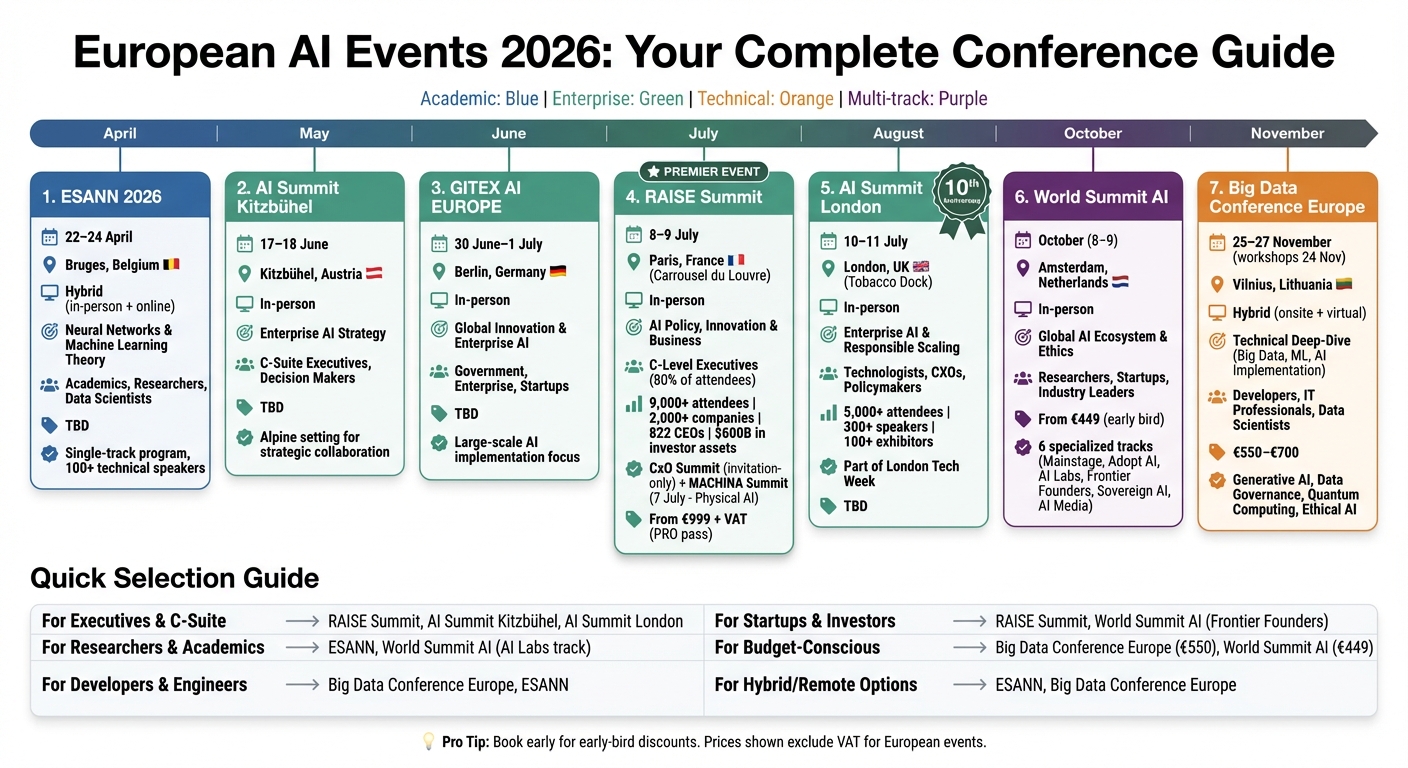
European AI Events 2026: Complete Conference Comparison Guide
Event Comparison Table
With so many AI conferences happening across Europe, picking the right one can feel overwhelming. To make it easier, here’s a side-by-side look at some major 2026 events. The table outlines key details like dates, locations, focus areas, target audiences, and starting prices (where available).
| Event | Dates | Location | Primary Focus | Target Audience | Starting Price |
|---|---|---|---|---|---|
| ESANN 2026 | 22–24 April | Bruges, Belgium (Hybrid) | Neural Networks & Theory | Academics, Researchers | TBD |
| AI Summit Kitzbühel | 17–18 June | Kitzbühel, Austria | Enterprise Strategy | C-Suite, Decision Makers | TBD |
| GITEX AI EUROPE | 30 June–1 July | Berlin, Germany | Global Innovation | Government, Enterprise, Startups | TBD |
| AI Summit London | 10–11 July | London, UK | Enterprise AI | Technologists, CXOs | TBD |
| World Summit AI | October (8–9) | Amsterdam, Netherlands | Global Ecosystem & Ethics | Researchers, Startups | €449 |
| Big Data Conference Europe | 25–27 November | Vilnius, Lithuania (Hybrid) | Technical Deep-Dive | Developers, IT Professionals | €550–€700 |
For instance, World Summit AI and AI Summit London are ideal for attendees looking for multi-track events that cater to diverse audiences. On the other hand, ESANN is tailored for academics focusing on neural network research. This table helps you quickly compare options based on your goals, audience type, and budget.
How to Prioritize Events
Once you’ve reviewed the options, the next step is narrowing them down based on your role and goals. For executives, events like RAISE Summit (starting at €999 for Pro passes) or AI Summit Kitzbühel are great choices. These gatherings focus on high-level strategies, such as ROI modeling and aligning AI initiatives across teams.
Meanwhile, developers and data scientists might find more value in technical-focused events like Big Data Conference Europe or ESANN, which delve into areas like MLOps and neural network advances.
Cost can also play a big role in your decision. For example, World Summit AI offers early-bird pricing at €449, but ticket prices go up as the event approaches. If you’re on a tight budget, consider conferences with virtual attendance options, such as ESANN or Big Data Conference Europe.
Location matters too. Cities like London and Paris are hubs for enterprise AI and robotics, while Berlin and Amsterdam are known for fostering innovation. If staying updated on regulations like the EU AI Act is crucial for you, look for events featuring discussions led by policymakers.
Planning and Preparation Tips for 2026
Once you've pinpointed your key events, the next step is strategic preparation. This ensures you get the most out of your investment and time.
AI Trends to Watch in 2026
By 2026, AI is no longer just a tool for experimentation - it’s becoming deeply embedded in daily operations. Interestingly, 66% of professionals say AI now enables them to dedicate more time to high-value tasks [18]. The focus is shifting from simply adopting AI to scaling it strategically across organisations and mastering its large-scale integration [4].
One of the standout themes in Europe is sovereign technology. This includes discussions on sovereign clouds, trusted infrastructure, and what’s being called the "Silicon Horizon" - a vision of a future where computing power is treated as a key resource, much like capital [1].
Many events are now structured around recurring themes such as core infrastructure, emerging technologies, compliance hurdles, and long-term sustainability. Familiarising yourself with these topics can help you identify which sessions align best with your goals.
Another notable trend? The rise of smaller, more intimate gatherings. Instead of massive expos, there’s a growing preference for micro-events like executive dinners or localised meetups. These formats are designed to foster meaningful connections, and they’re working - 85% of attendees are more likely to return if they experience a moment of personal significance during the event [21].
With these trends in mind, here’s a checklist to help you prepare effectively.
Event Preparation Checklist
- Plan your calendar early: Use the DD/MM/YYYY format to map out your schedule. For instance, the RAISE Summit takes place from 08/07/2026 to 09/07/2026 in Paris [1]. Planning ahead helps you secure early-bird discounts and organise travel across cities.
- Budget smartly: Keep in mind that most European events list prices without VAT. For example, the RAISE Summit’s PRO pass starts at €999 + VAT [7]. Use rolling forecasts to adjust your budget as registration and market conditions evolve [19].
- Leverage event apps: Download apps in advance to arrange meetings and access materials like pitch decks. AI-powered matchmaking tools can handle up to 95% of initial queries, leaving you free to focus on building meaningful connections [7][20].
- Set clear objectives: Define your goals before attending. Whether it’s boosting your sales pipeline, increasing brand visibility, or scouting new technologies, having clear priorities will help you measure success. Notably, over 90% of attendees report making a purchase after engaging with a brand post-event [18]. Proper planning directly impacts your results.
Conclusion: Planning Your 2026 AI Event Calendar
The European AI scene in 2026 isn’t about attending every conference - it’s about making smart choices. As the industry transitions from hype to practical implementation, the events you prioritize can shape your ability to stay competitive in a rapidly evolving space [23]. The trick is to strike a balance: attend a major summit for broad visibility and complement it with one or two niche events that align closely with your goals [23]. This approach ensures focused planning and a better return on investment.
While 2025 championed AI hype, 2026 is defined by real-world adoption and robust infrastructure. – Best AI Events [23]
Start early: secure tickets, organize your team, and pick events that align with your objectives for 2026. Whether your focus is on mastering compliance with the EU AI Act, diving into agentic AI workflows, or building connections with key decision-makers, a carefully curated event lineup can make all the difference [10].
These gatherings provide direct access to the people driving AI’s next phase - founders, researchers, policymakers, and corporate leaders [22]. Whether you’re locking in early-bird rates for flagship conferences [17] or exploring smaller, regional meetups, each event offers opportunities to forge partnerships, develop skills, and stay on top of trends like green AI and physical robotics [3].
Your AI event calendar isn’t just a schedule - it’s your guide to navigating Europe’s ever-changing innovation landscape.
FAQs
Which 2026 AI event fits my role best?
To find the best AI event in 2026 for your role, start by matching the conference's theme and audience to your objectives. The RAISE Summit in Paris (8–9 July 2026) stands out as Europe’s largest AI gathering, perfect for leaders, executives, and ecosystem builders aiming to expand their networks, gain strategic insights, and establish influence. If your focus is research, consider attending IJCAI-ECAI in Bremen or Rise of AI in Berlin, which cater to more academic and technical audiences. On the other hand, industry pioneers may find AI Summit London or Machina by RAISE in Paris more aligned with their innovative pursuits.
How do I maximise ROI from an AI conference?
To get the most out of an AI conference, it’s all about preparation and active participation. Start by selecting events that align with your objectives - whether that’s networking, learning about new trends, or showcasing your own solutions. Choose the ticket tier that offers the features you’ll actually use, like access to exclusive workshops or networking sessions.
Before attending, map out the sessions and speakers that matter most to you and pinpoint key contacts you'd like to meet. During the conference, don’t just sit back - join discussions, ask questions, and engage with professionals in your field.
Once the event wraps up, reach out to the people you connected with. A quick follow-up can open doors to collaborations and turn those initial conversations into real opportunities.
What 2026 AI trends should I track at events?
In 2026, keep an eye on AI infrastructure, compliance, AGI (Artificial General Intelligence), policy changes, and applied AI developments. These areas are expected to play a major role in shaping the industry. Sectors like healthcare and retail will likely feel the strongest impacts, offering plenty of opportunities and challenges.
Also, frameworks like the 4Fs - Foundation, Frontier, Friction, and Future - will continue to guide AI's progression. Staying updated on these trends and frameworks will help you navigate the evolving landscape and get the most out of upcoming AI events.