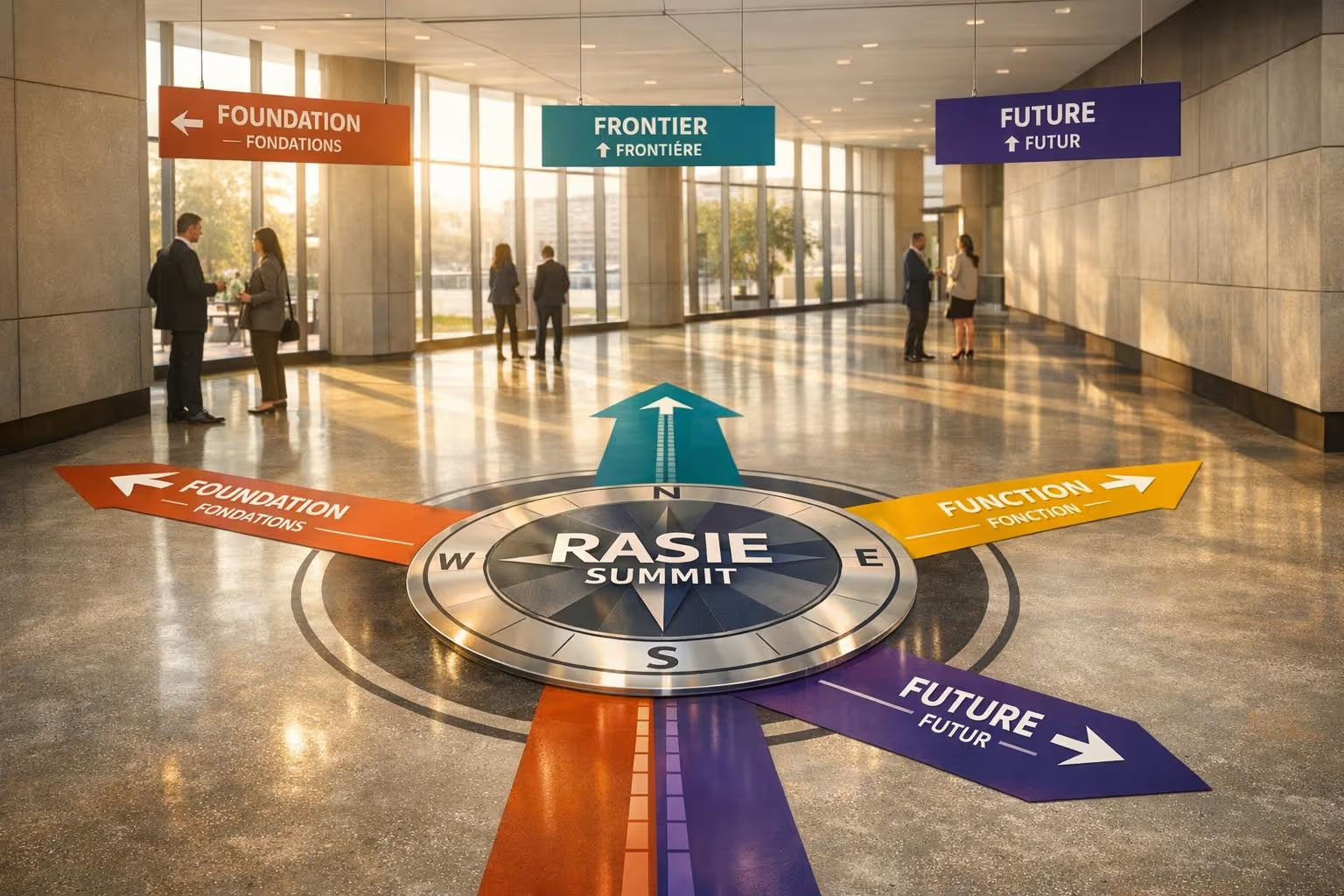


AI events in Europe are shaping the future of technology by addressing key themes that matter to businesses, governments, and researchers. Here's what you need to know:
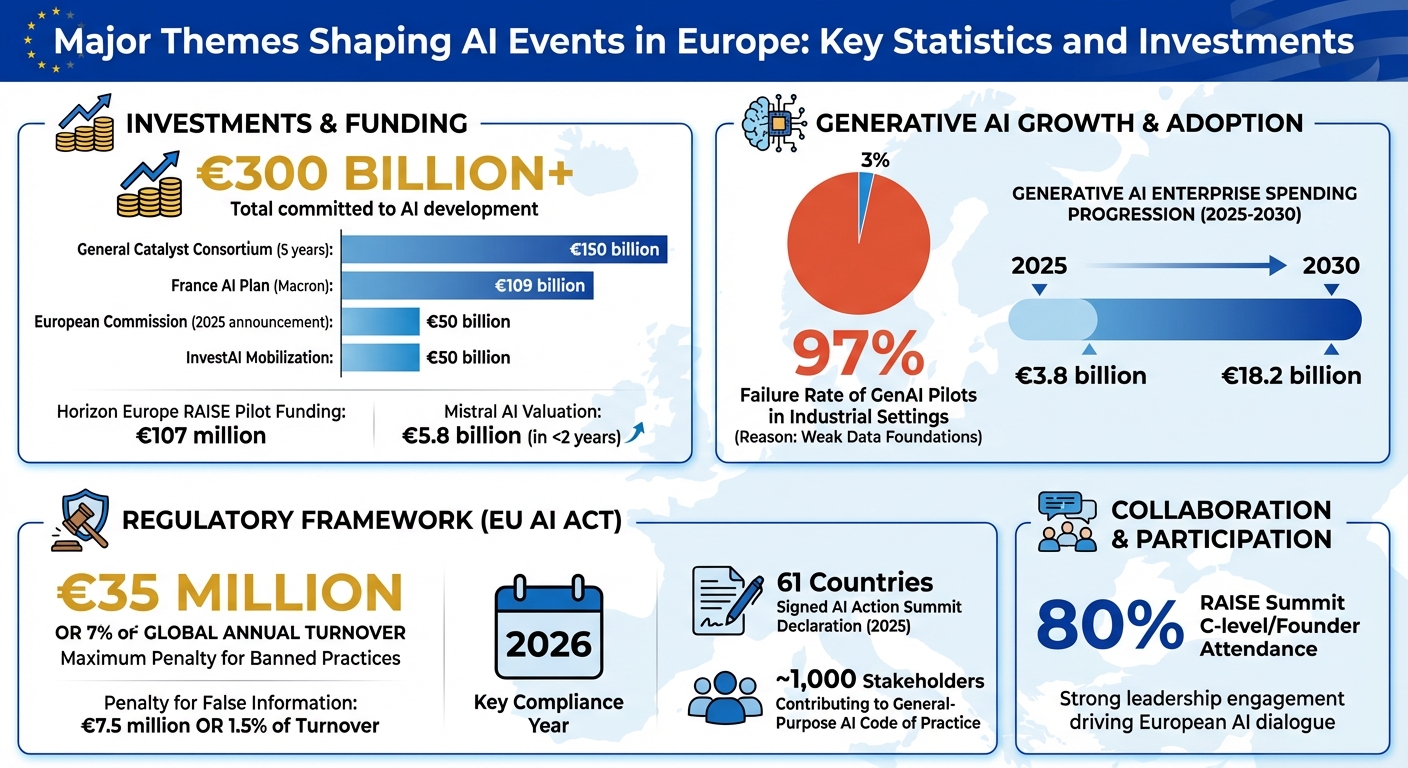
- Massive Investments: Over €300 billion has been committed to AI development, including €50 billion announced in 2025 by the European Commission.
- Ethical AI Focus: Events emphasize compliance with the EU AI Act, which enforces strict rules on transparency and risk management for AI systems.
- Generative AI Growth: Businesses are leveraging AI for complex tasks, though weak data foundations lead to a 97% failure rate for pilots in industrial settings.
- Sector-Specific Applications: From healthcare to finance and manufacturing, AI is solving targeted problems like fraud detection, drug discovery, and production quality.
- Collaboration and Networking: Events like the RAISE Summit connect leaders, startups, and policymakers to drive partnerships and innovation.
These gatherings highlight Europe's determination to lead in AI, focusing on ethical governance, practical solutions, and building sovereign infrastructure. If you're attending, prepare by identifying challenges, seeking funding opportunities, and networking strategically.
Major Themes Shaping AI Events in Europe: Key Statistics and Investments
Ethical AI and Governance: A Central Theme at European AI Events
Creating Transparent and Fair AI Systems
European AI conferences are increasingly focused on actionable strategies to align with ethical and regulatory standards. Gemma Galdón Clavell, CEO of Eticas.ai, highlights a shift from superficial compliance to building real capabilities for addressing AI's social and technical challenges[6].
For example, in February 2026, the European Data Protection Supervisor (EDPS) held a workshop in Brussels. EU institution representatives, including Emanuele Parisini and Manuel García Sánchez, assessed a high-risk AI recruitment tool. Their evaluation focused on bias, human oversight, and transparency, all in preparation for the 2026 compliance deadlines[6]. This hands-on approach reflects a growing trend in European events to provide sector-specific guidance, particularly for high-risk areas like recruitment and human resources.
There's also a push for "neuro-explicit" AI models that integrate generative methods with symbolic logic. These models aim to deliver decisions that are both verifiable and self-explanatory. This approach stands in contrast to the scaling-focused strategies often seen elsewhere, aligning instead with the EU AI Act's emphasis on transparency and reliability[4]. At the 2025 AI Action Summit in Paris, where 61 countries signed a landmark declaration, industry leaders advocated for open-source AI. They argued that open-source systems improve transparency by allowing vulnerabilities to be identified and audited.
These discussions and initiatives underline the importance of fully understanding and implementing the EU AI Act's risk-based framework.
Understanding AI Regulations in Europe
European AI events have become vital for navigating the EU AI Act's risk-based framework, which tailors regulatory requirements to the potential harm of AI systems. The Act classifies AI into four categories: unacceptable risk (banned), high risk (subject to strict compliance), limited risk (requiring transparency), and general-purpose AI (covered by a code of practice)[7].
"2026 is a decisive year for the AI Act, with transparency obligations becoming applicable and the EDPS assuming its responsibilities as Market Surveillance Authority and Notified Body."
- Wojciech Wiewiórowski, European Data Protection Supervisor[6]
Non-compliance carries heavy penalties: up to €35 million or 7% of global annual turnover for banned practices, and up to €7.5 million or 1.5% of turnover for providing false information to regulators[7]. In February 2026, Spyros Sarigiannidis from the European Commission showcased "GPT@EC", a general-purpose AI tool designed for institutional use. This tool uses a hybrid infrastructure and governance model to meet the EU AI Act's stringent compliance requirements[6]. Additionally, nearly 1,000 stakeholders contributed to drafting the first General-Purpose AI Code of Practice, which took effect on 2 August 2025[5].
sbb-itb-e314c3b
Generative AI and New Technologies: Innovation at the Forefront
How Businesses Use Generative AI
Across Europe, AI conferences are moving beyond basic chatbots, spotlighting autonomous systems capable of managing entire business workflows. This shift aligns with a broader trend of embracing AI as a transformative force. It's no surprise that global enterprise spending on generative AI is expected to rise from €3.8 billion in 2025 to €18.2 billion by 2030, highlighting its growing importance across industries[10].
At the Agentic AI Europe conference in Barcelona in December 2025, Sabato Leo, Director of AI at Tipico, shared a fascinating example of this evolution. He unveiled a multi-agent framework designed to mimic a marketing department, capable of turning complex inputs into actionable insights within hours[9]. Meanwhile, Rafael Socorro Hernández, Head of Data & Analytics at ACCIONA, explained how autonomous agents for data quality have revolutionized enterprise data preparation, improving project bids and financial reporting[9][11].
At Bosch, Dr. Jochen Kokemüller conducted a survey with over 500 developers using tools like GitHub Copilot and large language models. The findings? Developers reported significant productivity boosts in coding, testing, and documentation. This aligns with Bosch's R&D mantra: "Think Big – Start Small – Scale Fast"[9][11]. In finance, Dieter Konrad, CFA at Union Investment, introduced the "FundAImental" approach, combining human expertise with AI tools such as MALINA and SustAIn. This blend improved forecasting accuracy and capital market outcomes while maintaining transparency[9][11].
These examples underscore how generative AI is reshaping industries, paving the way for the next wave of AI innovation.
Next-Generation AI Technologies
The focus is now shifting from operational improvements to rethinking AI's very architecture. A key concept gaining traction is "World Models", which go beyond text-based AI systems. At the ai-PULSE 2025 conference in Paris, Yann LeCun, Chief AI Scientist at Meta, highlighted this shift:
"Most of human knowledge is not well represented by text. World models are the missing piece: systems that can perceive, predict, and simulate the dynamics of the world"[12].
These Joint Embedding Predictive Architectures (JEPA) aim to replicate human-level intelligence by focusing on physical reasoning instead of just text generation.
Multimodal systems are also advancing rapidly, with real-time voice AI taking center stage. At the same conference, Neil Zeghidour, CEO of Gradium, demonstrated a groundbreaking system linking a voice AI API to a Hugging Face Reachy Mini robot. This setup allowed the robot to transcribe and translate in real time, seamlessly switching between voices, languages, and even personalities[12]. Such innovations mark a shift from screen-based interactions to speech-driven experiences.
Physical AI is another area making waves by merging digital agents with humanoid robotics. At ai-PULSE, Jérôme Monceaux, CEO of Enchanted Tools, showcased the Mirokaï social humanoid robot. Deployed at ICM to assist children undergoing radiotherapy, the robot turned a stressful, hour-long process into a much calmer experience. This intervention not only improved patient comfort but also increased medical equipment productivity tenfold. As Monceaux put it:
"The value of emotional robotics isn't just in utility, but in how their ability to provide emotional support can create tangible, productive outcomes"[12].
Meanwhile, Sovereign AI infrastructure is gaining traction across Europe. Mistral AI is rolling out an AI cloud in France, powered by 18,000 Grace Blackwell chips, to support its models and enterprise workloads[8]. Partnerships with companies like Scaleway further underline Europe's push to build its own AI infrastructure and reduce reliance on non-European technology stacks[8][12].
Industry-Specific AI Applications: Solutions for Different Sectors
AI in Healthcare, Finance, and Manufacturing
European AI events are increasingly highlighting industry-specific applications. At the Adopt AI 2025 summit in November 2025, Novartis showcased how they integrate AI and data strategies to prioritize patient needs. By leveraging generative models and multimodal data, they’ve accelerated drug discovery and clinical insights while adhering to EMA regulations. This approach not only streamlines diagnosis and treatment but also enables more personalized care [16][13][14].
In the finance sector, Société Générale and BNP Paribas demonstrated how AI is being utilized for fraud detection, credit decision-making, and risk monitoring. Their AI systems focus on detecting fraud, managing risks, and offering tailored financial product recommendations to customers [16][14].
Meanwhile, manufacturing events have spotlighted equally impactful applications. At the Industrial AI Summit in September 2025, Sébastien Bey (CIO, Siemens Smart Infrastructure) and Julian Senoner (CEO, EthonAI) shared a compelling case study on scaling AI in production. Siemens tackled the challenge of inconsistent quality data from over 20,000 daily visual inspections by implementing a four-step strategy. This method, which addresses operational challenges and ensures global scalability, reflects a growing focus in Europe on deploying AI solutions across international operations [15].
How AI Transforms Traditional Industries
AI is not just advancing specific sectors - it’s also reshaping traditional industries by introducing transformative practices. A notable trend at recent events is the inclusion of "Fail Stages", where companies openly share lessons from unsuccessful AI implementations. This collective learning approach is crucial, as nearly 97% of Generative AI pilots in industrial settings fail to deliver ROI. The main culprit? Weak, fragmented, and context-lacking data foundations [15]. As Prof. Dr. Torbjørn Netland, Head of Production & Operations Management at ETH Zürich, explained:
"GenAI struggles in industrial environments not because the algorithms are insufficient, but because data foundations are weak, fragmented, and lack context" [15].
The automotive industry provides a striking example of AI-driven transformation. At the Industrial AI Summit, Frank Ortmann (Delivery Manager ID.Family, Volkswagen) and Philipp Noll (Co-Founder, SPREAD AI) highlighted how data-driven engineering is revolutionizing software-defined vehicles. Their approach accelerates root-cause diagnostics and shortens validation cycles, helping to avoid expensive late-stage failures [15].
This evolution from theoretical AI research to practical, real-world applications demonstrates how European industries are bridging the gap between innovation and deployment. From healthcare to finance and manufacturing, these case studies underline Europe’s dedication to turning AI concepts into operational achievements [16].
Networking and Collaboration: Connecting Europe's AI Community
Creating Connections Across Industries
Discussions around ethics, innovation, and industry transformation reveal one thing: Europe's AI future depends heavily on strong networking and collaboration.
European AI events are proving to be key meeting points for forming high-level partnerships. Take the RAISE Summit, for example. With 80% of its attendees being C-level executives or founders, the event creates an environment ripe for deal-making. It uses curated formats like exclusive CxO forums and networking dinners in iconic locations such as Versailles to foster meaningful connections [20].
Another standout event, the AI Policy Day: Scaling AI in Europe, took place in December 2025 at the AI House in Amsterdam. This gathering aimed to bridge the gap between regulation and innovation. Chiara Frencia, Secretary General of SERN, co-moderated the event, which brought together key players like the European Commission, the StepUp StartUps consortium, and Innovation Radar Bridge. The event concluded with a shared commitment to modernising the public sector through AI and addressing the scale-up investment gap [18].
Meanwhile, French startup Mistral AI has been making waves. Founded by Arthur Mensch, Guillaume Lample, and Timothée Lacroix, the company used the February 2025 Paris AI Action Summit to secure collaborations with major names like BNP Paribas and Dassault Systèmes. With a valuation of €5.8 billion in less than two years, Mistral AI also showcased its distribution partnerships with giants like Microsoft, IBM, and Google Cloud [17]. These types of collaborations are not just business deals; they are building blocks for expansive, regional innovation ecosystems.
Regional Innovation Centres in Europe
Beyond individual partnerships, regional innovation centres are stepping up to unite local expertise and resources. Conferences across Europe are becoming the stage for showcasing these efforts. For instance, the AI in Science Summit in Copenhagen (November 2025) launched the RAISE Pilot initiative. During the event, Henna Virkkunen, Executive VP for Tech Sovereignty, and Ekaterina Zaharieva, Commissioner for Startups, Research and Innovation, announced €107 million in Horizon Europe funding. This funding will support a virtual institute designed to pool computational resources, data, and talent from EU Member States and private companies to accelerate AI-driven scientific progress [19]. Initiatives like these highlight Europe's dedication to collaborative and sovereign advancements in AI.
France, in particular, has emerged as a major player in the AI space. President Emmanuel Macron unveiled plans for €109 billion in AI investments, focusing on infrastructure like computing clusters and data centres. On top of that, a consortium led by General Catalyst has committed €150 billion over five years to support European AI startups and infrastructure [17]. These investments reflect a strong push toward developing independent AI capabilities while encouraging cross-border partnerships across the continent.
Conclusion: Main Takeaways from AI Events in Europe
Summary of Main Themes
Europe's AI landscape is advancing at an impressive pace, backed by over €300 billion in funding and strategic initiatives. This investment is being channelled into infrastructure, start-ups, and tailored applications across various industries.
Four major themes have emerged from European AI events. First, ethical AI and governance remain a priority, with growing attention on how to implement the EU AI Act in ways that encourage innovation. Second, generative AI continues to make waves, even though 97% of pilot projects fail due to weak data foundations [15]. Third, industry-specific applications are gaining traction, with sectors like healthcare, manufacturing, and finance receiving tailored solutions as part of Europe’s selective specialisation approach. Lastly, networking and collaboration are enabling partnerships that transform ambitious ideas into actionable projects, as highlighted in key events. These themes encapsulate the trends discussed throughout this guide.
How to Get the Most from AI Events
To translate these insights into meaningful outcomes, it’s important to approach AI events strategically.
Focus on events that align with your objectives. If forming partnerships is your goal, opt for high-level networking events like the RAISE Summit, which brings together industry leaders and entrepreneurs. For in-depth technical insights, events such as ECAI 2025 offer workshops and tutorials that bridge the gap between research and practical applications [1].
Preparation is key. Start by pinpointing the specific challenges you aim to address. Effective AI implementation often begins with solving clear business problems. For instance, Siemens Smart Infrastructure successfully scaled their AI initiatives by targeting specific operational challenges instead of launching overly broad pilots [15]. Arrive with well-defined questions and a clear articulation of your needs - European AI events thrive on collaborative problem-solving.
Lastly, explore funding opportunities. Initiatives like InvestAI, which mobilises €50 billion to attract private investment, provide significant support [3]. Regional innovation centres and public–private partnerships also offer valuable resources. As Ursula von der Leyen remarked:
"This is not a promise – it is happening right now, and it is the largest public investment for AI in the world" [2].
The tools and funding are available - it’s up to you to connect your projects to these opportunities.
Opening Keynotes | ai-PULSE 2025 | 3rd Edition
FAQs
How do I know if my AI system is “high-risk” under the EU AI Act?
To figure out if your AI system falls under the “high-risk” category as defined by the EU AI Act, start by examining if it aligns with the use cases listed in Annex III. Additionally, check if it serves as a safety component in regulated products or meets the specific classification criteria detailed in the Act. Conducting a thorough self-assessment using these benchmarks is a critical step to ensure compliance.
Why do so many GenAI pilots fail in industry, and how can I avoid it?
Many generative AI projects stumble not because the technology falls short, but due to hurdles in execution, integration, and adapting within organisations. Typical challenges include trouble embedding AI into day-to-day workflows, misalignment with broader strategic goals, and solutions that don't meet the actual needs of users. To steer clear of these issues, it's crucial to prioritise seamless integration into existing processes, involve users from the outset, maintain transparency, and gain strong executive backing to scale successfully.
What should I prepare before attending an AI event in Europe to get real ROI?
To get the most out of an AI event in Europe and boost your ROI, start by defining your objectives - whether it’s building connections, staying informed on regulatory changes, or exploring investment prospects. Dive into the event agenda ahead of time to pinpoint sessions and speakers that align with your goals.
Make sure to craft pitches and questions that are tailored to the European AI scene. For instance, understanding the implications of the EU AI Act can help you have informed discussions and identify potential opportunities. Don’t forget practical essentials like business cards or presentation decks to leave a lasting impression. Staying informed on regional developments will ensure your conversations are relevant and impactful.