


Student entrepreneurs are reshaping tech, leveraging AI to launch startups, solve problems, and secure funding - all while balancing their studies. Here's what you need to know:
- AI tools are empowering students: Generative AI platforms like ChatGPT and Claude enable even non-coders to create advanced products.
- Impressive milestones: A 15-year-old in France launched BeyondSPX, gaining 50,000 monthly users, while Sweden's Roster AI forecasted €70,000 in revenue within a year.
- Key sectors: Students are innovating in education (e.g., Revyze with 1M+ users), healthcare (e.g., NeuroSync tackling eating disorder recovery), and sustainability (e.g., AI systems optimizing plant growth in mines).
- Support systems: Programs like HEC Paris Startup Launchpad and hackathons provide mentorship, funding, and networking opportunities.
- Challenges: Juggling studies, securing funding, and overcoming skepticism remain hurdles, but many succeed through time management, creative funding strategies, and building strong networks.
Takeaway: These student-led ventures are not just projects - they're shaping the future of AI-driven solutions in various industries.
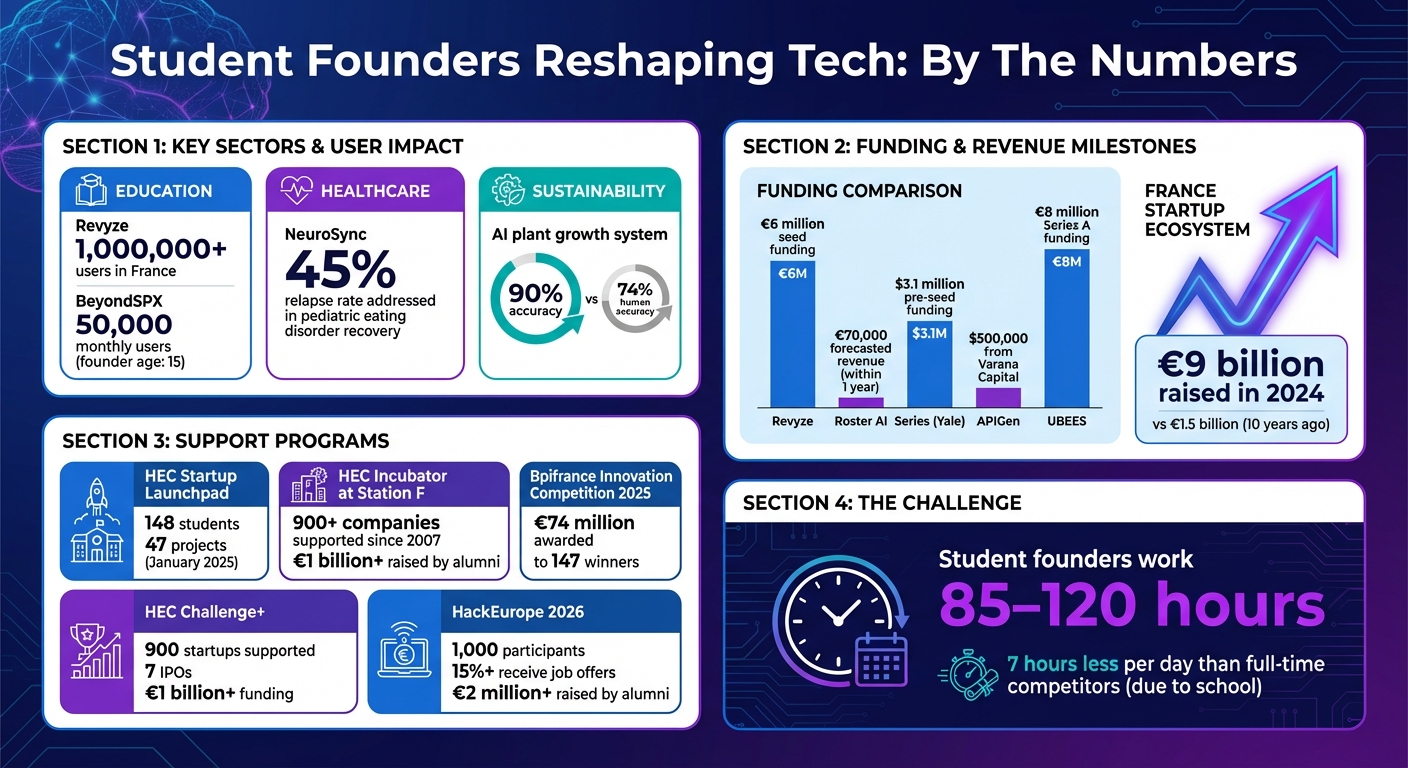
Student Founder Statistics: Key Sectors, Success Metrics, and Growth Data
A Yale Student Raised $3.1M in 2 Weeks for an AI Social App | Series, Nathaneo Johnson
sbb-itb-e314c3b
Where Student Founders Are Building: Main Technology Areas
Student founders are using AI to tackle real-world problems, focusing on challenges they’ve encountered in their daily lives. Their efforts span classrooms, hospitals, and environmental initiatives, demonstrating a hands-on approach to solving pressing issues.
AI Applications in Education, Healthcare, and Sustainability
Education has become a popular arena for student-driven AI innovation. For example, Revyze, launched by HEC Paris graduates Florent Sciberras, Guillaume Perrot, and Anatole Blanc, hit over 1 million users in France by December 2024. The app, which helps 9th-grade students prepare for their national exams, secured €6 million in seed funding from investors like Speedinvest and Moonfire [3]. Similarly, students at FHNW School of Business created flashcardsGPT in July 2024. This tool converts lecture PDFs into study aids, relying on secure, open-source models to prioritize data safety [6].
Healthcare is another area where student founders are making strides. In March 2024, Daniel Tcheurekdjian launched Aleph Innovations, which uses AI to streamline the process of matching patients with doctors and navigating insurance authorizations. The startup gained recognition through programs like the President's Buckeye Accelerator and Intel Liftoff [9]. Tcheurekdjian sees AI as a game-changer:
"AI provides an opportunity to erase these resource problems to get people to the places they need to be to receive care" [9].
In August 2025, NeuroSync, a team led by Kacira Foster and Mikaela Beakley, developed an AI-powered tool for summarizing recovery data for doctors treating pediatric eating disorders. This innovation addresses a concerning 45% relapse rate post-hospitalization and earned them the top prize in the Deep Learning track at the MIT FutureMakers Create-a-Thon [4].
Sustainability projects are also thriving. In August 2025, students from the Floyd County School of Innovation in Kentucky designed an AI system that automates plant and mushroom growth decisions in mine environments. Their system achieved 90% accuracy in optimizing water and light usage, outperforming human operators who managed only 74% [4]. Other student teams are working on tools like computer vision systems for waste classification in Nigeria and real-time plant identification technologies [7]. These projects reflect a commitment to addressing environmental issues these young entrepreneurs have encountered firsthand.
These examples highlight how students are applying AI to areas that directly impact their lives, paving the way for further advancements in biotech and climate tech.
Biotech and Climate Tech Projects
Student founders are also venturing into biotech and climate tech, addressing complex challenges with innovative solutions. In December 2025, Alex Yang, an 18-year-old entrepreneur, launched Reteena, a startup focused on Alzheimer’s care. The team developed a deep learning method to improve low-field MRI scan resolution and created “Remembrance,” an AI-based therapeutic service that uses reminiscence therapy to help patients recall and archive memories [10]. Yang shared his motivation:
"It was about learning to build solutions that address authentic problems rather than chasing viral success" [10].
Climate tech has also attracted attention, with many projects responding to local environmental crises. In February 2026, UBEES, a French startup focused on regenerative agriculture through beekeeping technology, raised €8 million in Series A funding. The company uses bee data to promote environmental sustainability [8]. Other student-led initiatives include AI tools for wildfire monitoring and automated systems for reforestation [11][12].
What stands out across these sectors is the personal connection these founders have to the problems they’re solving. Whether it’s struggling to prepare for exams, facing barriers in healthcare, or witnessing environmental challenges, these young innovators are creating solutions rooted in real needs rather than fleeting trends.
Resources and Programs Supporting Student Entrepreneurs
Student entrepreneurs in France have access to a variety of programs and initiatives designed to support their ventures. These include accelerators, incubators, and funding opportunities that provide mentorship, funding, technical expertise, and networking opportunities.
Accelerators and Incubators for Students
HEC Paris offers tailored programs for student startups at different stages of development. One of its standout initiatives is the HEC Startup Launchpad, an 11-week accelerator that helps transform ideas into minimum viable products (MVPs) using lean startup methods. For example, in January 2025, 148 students worked on 47 projects in sectors like AI and sustainability. The program culminates in a Demo Day where participants pitch their ideas to investors. A notable success story is Siva, an AI-powered assistant for healthcare professionals, which won the Jury Prize in April 2025. The team behind Siva - Ugo Benazra, Samuel Mesguiche, and Ruben Weinstein - secured a 4-month incubation at Incubateur HEC Paris and a speaking slot at Viva Technology [17][22].
For startups ready to scale, Incubateur HEC Paris at Station F offers a 4-month program designed to accelerate growth. In September 2025, 14 startups joined the incubator, including Claimy, an AI platform for music rights, and Zilo Énergie, which focuses on solar energy subscriptions. The program costs €300 per desk per month and has supported over 900 companies since 2007, with alumni collectively raising more than €1 billion [15][19].
For deeptech ventures, the HEC Challenge+ program is a 9-month initiative aimed at high-tech projects with significant growth potential. By 2024, it had supported 900 startups, resulting in seven IPOs and over €1 billion in funding. The program offers scholarships that reduce the €30,000 fee to €6,500 (including VAT) or €4,500 per person for teams of three [18].
Sector-specific accelerators also play a key role. The AI Startup Accelerator, a collaboration between Meta, SNCF Connect & Tech, Hugging Face, and HEC Paris, launched its third edition on 8 January 2026 at Station F. The initiative supports startups working on open-source AI applications for mobility and sustainability. Five startups were selected in November 2025, benefiting from monthly technical guidance from Hugging Face experts [13][14]. Meanwhile, science-driven startups can turn to Creative Destruction Lab (CDL) – Paris, which focuses on seed-stage ventures. For instance, Isentroniq, a quantum computing startup, won the i-Lab Grand Prize at the Bpifrance Innovation Competition in October 2025 after participating in CDL-Paris [16].
In addition to these structured programs, hackathons and competitions provide platforms for idea testing and investor engagement.
Hackathons and Competitions for Testing Ideas
Hackathons offer student entrepreneurs a chance to prototype ideas and connect with potential investors. HackEurope 2026, set for 21–22 February 2026, will take place simultaneously in Paris (CentraleSupélec), Dublin (Trinity Business School), and Stockholm (Norrsken House). This 30-hour overnight event will bring together 1,000 young developers and designers. The free event has a strong track record, with over 15% of participants receiving job offers and alumni raising more than €2 million [20].
Another notable event is the Hi!ckathon, organized by Hi! PARIS (a collaboration between HEC Paris and Institut Polytechnique de Paris). This competition focuses on data science challenges and includes a preparation phase with technical courses on machine learning and pitch workshops. The final sprint weekend is followed by an international challenge in Heilbronn, Germany, hosted by the IPAI Foundation in Spring 2026 [21].
Funding competitions also provide critical support for startups. In 2025, the Bpifrance Innovation Competition awarded €74 million to 147 winners across three tracks. The i-Nov track alone provided over €51 million to 45 winners, while the i-PhD track targeted young researchers transitioning their work into deeptech startups. For example, Zebramed, a biomedical innovation startup supported by the HEC LuminEdge program, won an i-Lab Grand Prize for its contributions to faster diagnostics [16].
Demo Days are another way for startups to gain visibility. The HEC Paris Startup Launchpad Demo Day supports around 38 projects per cohort. In late 2025, Solfair, a team working on energy procurement solutions for SMEs, won the Audience Prize and subsequently joined the Fall 2025 batch of the HEC Paris Incubator at Station F [15][22].
Common Challenges Student Founders Face
The journey of student founders is marked by juggling academics, limited resources, and skepticism from the professional world. Unlike traditional entrepreneurs, they must balance the demands of their studies while competing against full-time teams with more resources and time at their disposal.
Managing Studies and Startup Work
Elliot Evertsson Norrevik, founder and CEO of Roster AI, captures the challenge perfectly:
"I have seven hours less than my competitors because I'm at school. That's a problem" [2].
Some student founders report working as much as 120 hours per week to keep up with their dual responsibilities [23][24]. Effective time management becomes critical in this scenario. For instance, Ethan Shaotran, a Harvard student, maintained an 85-hour work week in September 2024 while developing Spark, an AI scheduling tool that secured a $100,000 grant from OpenAI. His secret? Strict time-blocking. By separating academic tasks, meetings, and deep work sessions, and even using AI note-takers during lectures, he managed to stay on top of both worlds. As Shaotran put it:
"Blocking my time off has been helpful because there is such a big cultural difference between academia and the startup world" [23].
Other founders, like Nathaneo Johnson, a Yale senior behind Series, an AI-driven social network, made sacrifices in their social and extracurricular lives. Johnson managed 120-hour work weeks while raising $3.1 million in pre-seed funding, observing:
"The time that students put into extracurricular activities, their friendship groups, and so many other minuscule time commitments, I spend on my startup" [24].
Some students opt for gap years or semesters to focus entirely on their ventures during critical growth phases [25][27]. Others find ways to align their academic requirements with their entrepreneurial goals. For example, Alexandre Lagarde and Nathanaël Guilbault from Albert School replaced their mandatory first-year internship with 150 hours of development on Flowcus, their AI productivity app. Using no-code tools like Lovable and the Google Calendar API, they built a functional prototype without having to code every line manually [26].
While mastering time management is a major hurdle, securing funding and resources poses an equally tough challenge.
Finding Funding and Early Resources
For student founders, gaining access to funding is often an uphill battle. Without established industry connections, the path to early-stage capital can seem daunting. However, several strategies have proven effective for those willing to put in the effort.
Hackathons and competitions are a great starting point, offering non-dilutive funding through cash prizes. University resources, including venture capital societies, incubators, and alumni networks, also provide valuable support [2][25][3].
Cold outreach, when done thoughtfully, can open doors. Take Christopher Fitzgerald and Nicholas Van Landschoot, for example. These high school graduates secured $500,000 from Varana Capital in June 2024 for their startup, APIGen, after showcasing their alpha version at an AI Meetup and conducting targeted LinkedIn outreach. Fitzgerald explained their approach:
"We asked people to destroy this pitch deck" [28].
By inviting critical feedback, they built trust and demonstrated adaptability, eventually winning over investors during a two-hour presentation.
Building in public has also become a powerful tool for networking and team-building. In December 2024, Alex Yang, then 18, assembled a 12-person team for Reteena, an AI diagnostics startup, through Discord and online forums. By sharing updates on LinkedIn, Yang connected with mentors from Y Combinator and Pear VC, and even co-authored research published at the IEEE BigData 2024 Conference [10].
Some founders create their own opportunities for networking. Nathaneo Johnson, for instance, launched a podcast to interview industry leaders, turning it into a platform for building relationships with potential investors [24]. Others, like 18-year-old Zach Yadegari, have self-funded their ventures using proceeds from previous successes. Yadegari used €94,000 from selling a gaming app to launch an AI nutrition startup, which now generates approximately €28 million in annual revenue [25].
However, professional skepticism remains a persistent obstacle. Young founders often face age-related biases. As Komy A, founder of Genta AI Solutions, shared:
"Many clients actually try to take advantage of me. They say, 'He's young, he doesn't have much,' and then they try to get more work for free, or they try to cut the price" [29].
Overcoming such challenges often requires delivering tangible results, demonstrating technical expertise, and sometimes bringing in senior talent to boost the team’s credibility [29].
How Student Founders Can Grow Their Tech Ventures
After overcoming the initial challenges of starting out, student founders need to focus on turning their ideas into ventures that can thrive. This involves testing their concepts, using resources wisely, and building valuable connections.
Creating MVPs to Test Market Fit
The journey to a successful tech startup begins with answering one fundamental question: Does anyone need what you’re building? Instead of waiting for the "perfect" idea, successful founders often start by identifying everyday problems and exploring trends to uncover potential opportunities [30].
Start by talking directly to potential customers. A simple landing page with a clear call-to-action can help gauge interest [30]. When it’s time to build, keep it simple. Think of your first version as a "skateboard" - a basic, functional product that solves the core problem - rather than a fully loaded solution [30].
Take the example of Factuality, an AI-powered fact-checking Chrome extension. Created in just one day during the Generator-Microsoft Buildathon in November 2024, this project by Babson and Olin students, including Robert Sevcik and Taihei Eastwood, won first place and a €2,350 prize [5]. Taihei Eastwood shared:
"The neat thing about AI and entrepreneurship is that it allows people to realise their ideas so much easier... with AI, you can do and learn a lot of it yourself." [5]
Modern tools like Codium and Cursor AI, along with no-code platforms like Lovable and Bubble, have made building prototypes far more accessible. For example, students used no-code tools to create Flowcus, an AI productivity app prototype [26]. Even if some processes need to be handled manually behind the scenes, keeping the front-end simple is key [30].
Once you’ve validated your MVP, the next step is assembling a team that can bring your vision to life.
Building Teams and Professional Networks
A validated product is just the beginning - building a strong team is what drives long-term success. Combining skills in growth, product development, and technical expertise is crucial for evolving from a student project into a full-fledged startup [3]. Florent Sciberras, co-founder of Revyze, emphasizes:
"Recruit passionate, quick-learning team members who share your values." [3]
Universities are goldmines for networking. Campus incubators, innovation labs, and alumni networks provide access to mentors, collaborators, and even early adopters. For instance, at École Polytechnique, 75% of students secure jobs before graduating, and 15% enter the tech sector [1].
Events like the RAISE Summit offer unparalleled networking opportunities. Held annually at the Carrousel du Louvre in Paris, it gathers over 9,000 attendees, 2,000+ companies, and 350+ speakers, all focused on AI and collaboration. For €599, the STARTUP pass gives students access to networking sessions, live competitions, and workshops - perfect for building connections that can drive growth.
Hackathons and buildathons are also great platforms. They not only provide non-dilutive funding through prize money but also offer exposure to venture capitalists who often serve as judges [2][5].
Growing Through Partnerships with Established Organisations
Strategic partnerships can help student founders scale their ventures faster. Collaborations with companies like Microsoft or Google.org offer access to resources, visibility, and industry connections [4][5]. These partnerships work best when student founders have already shown early success and have a solid team in place.
Universities often act as bridges to these opportunities. For example, in March 2025, Sakhi Patel, a UC Irvine pharmacy student, and Shrey Modi, a CSULB graduate, created CuraVoice, an AI voicebot for healthcare students to practice patient interactions. They won €940 at the Sunstone Innovation Challenge and refined their business strategy through the UC Irvine AI Innovation Course [32].
To attract partnerships, it’s essential to show tangible progress, like a working prototype and positive user feedback. Models like B2B2C or B2G2C can also help navigate complex markets by aligning the interests of businesses, governments, and end-users [31].
France’s startup ecosystem has seen explosive growth, with startups raising €9 billion in 2024 compared to less than €1.5 billion a decade ago [1]. This expanding landscape presents countless opportunities for student founders who can demonstrate both technical expertise and a clear understanding of their market.
Conclusion: Student Founders Shaping the Future of Tech
Student founders are shaping tomorrow with their work today, harnessing AI tools to turn ideas into real-world impact at an impressive pace. Take Highcast, for example - their AI software has helped industrial clients cut electricity costs by 5% to 20% [11]. Or consider NeuroSync, whose platform is tackling the 45% relapse rate in paediatric eating disorder recovery [4]. These examples highlight how student-led initiatives are making a measurable difference.
What makes this generation stand out is their direct connection to the problems they aim to solve. They've identified inefficiencies in areas like education, healthcare, and sustainability, and are crafting solutions that resonate with their peers. As Taniya Mishra, PhD, Leader of SureStart, aptly puts it:
"You decided to invest in yourself... turning that investment into tangible, impactful work." [4]
This marks a shift from simply excelling in academics to delivering real, actionable outcomes - a redefinition of learning and leadership.
France’s startup ecosystem mirrors this energy. In 2024, student-led startups raised an impressive €9 billion, a dramatic rise from less than €1.5 billion just ten years ago [1]. This growth reflects the ecosystem's commitment to nurturing young innovators.
But success in this space goes beyond technical expertise. It requires collaboration, mentorship, and a supportive community. Events like the RAISE Summit play a pivotal role. Held annually at the Carrousel du Louvre in Paris, this gathering attracts over 9,000 attendees, 2,000 companies, and 350 speakers - all focused on AI. With a STARTUP pass priced at €599, eligible founders gain access to invaluable networking opportunities, live competitions, and workshops designed to fast-track their growth.
As these student founders continue to innovate in dorm rooms, hackathons, and labs, they’re not just reshaping traditional sectors with AI - they’re redefining the tech landscape itself. The breakthroughs they achieve today will lay the foundation for the technologies we depend on tomorrow. Tech’s future isn’t being built in boardrooms - it’s being forged by students, one experiment at a time.
FAQs
How do student entrepreneurs in France manage both their studies and startups?
Student entrepreneurs in France juggle their academic commitments and business ventures by mastering time management and tapping into the support systems offered by their universities. Careful planning and prioritisation allow them to stay on top of both their studies and entrepreneurial pursuits without compromising either.
Institutions like École Polytechnique encourage innovation by offering students access to mentorship programs, professional networks, and adaptable academic schedules. These resources empower budding entrepreneurs to secure funding, form partnerships, and even launch their startups while continuing their education.
What sets these student founders apart is their discipline, focus, and ability to merge their academic learning with entrepreneurial aspirations. By making the most of the opportunities around them, they manage to excel in both arenas.
What are the best ways for student entrepreneurs to secure funding for their startups?
Student entrepreneurs have plenty of options to secure funding for their ventures. One key approach is building a strong network. By connecting with mentors, investors, and seasoned entrepreneurs, students can tap into valuable funding opportunities and gain insights that help shape their business journeys.
Another popular method is participating in startup competitions. These events not only boost visibility but often come with prize money or direct access to investors. For instance, some competitions draw thousands of attendees, including industry leaders and potential collaborators, creating a vibrant platform for budding entrepreneurs.
Universities also play a significant role in supporting student ventures. Many entrepreneurship centres in France and beyond offer grants and funding programmes, with some awarding as much as €25,000 - or even more - for promising projects. On top of that, joining accelerators is another smart move. These programmes often provide early-stage funding, mentorship, and resources designed to help students scale their ideas effectively.
By leveraging these strategies, student entrepreneurs can secure the financial backing they need to turn their innovative ideas into reality.
How is AI helping solve real-world challenges in education and healthcare?
AI is reshaping education and healthcare by introducing tools that make these fields more accessible, efficient, and tailored to individual needs.
In education, AI-powered platforms are bringing in adaptive learning systems that adjust to how each student learns best. These tools can automate repetitive tasks like grading, offer personalized feedback, and handle administrative duties. This frees up teachers to focus on teaching while helping students achieve better results. Imagine a classroom where every student gets guidance suited to their pace and style of learning - AI makes this possible.
In healthcare, AI is proving to be a game-changer in areas like medical diagnostics and patient care. For example, AI tools can assist radiologists by interpreting imaging data faster and with greater precision. Beyond diagnostics, AI platforms are making it easier for patients to navigate the healthcare system - whether it’s finding the right doctor, booking appointments, or managing insurance paperwork. By simplifying these processes, AI is breaking down barriers to care and ensuring more people get the support they need.
These developments highlight how AI is tackling key challenges in education and healthcare, ultimately enhancing lives in meaningful ways.