


Enterprise AI summits are specialized events where decision-makers and tech leaders focus on scaling AI projects from pilots to full deployment. Unlike general AI conferences, these summits prioritize ROI, implementation, and governance, tailored for C-suite executives, investors, and policymakers. Attendees gain actionable tools like frameworks for security, compliance, and AI integration across industries like healthcare, finance, and manufacturing.
Key takeaways:
- Focus: Business outcomes over theoretical advancements.
- Audience: CEOs, CTOs, investors, and regulators.
- Content: Workshops, networking, and industry-specific tracks.
- Example: The RAISE Summit in Paris attracts 9,000+ leaders annually, emphasizing partnerships and measurable results.
If you're looking to connect AI strategies directly to business goals, these summits provide the tools, insights, and connections to make it happen.
The enterprise AI playbook: Five must-have strategies
sbb-itb-e314c3b
Core Structural Elements of an Enterprise AI Summit
Enterprise AI summits revolve around three key elements that transform strategic discussions into tangible outcomes, propelling AI projects from pilot stages to full-scale implementation. Let’s explore how keynote speeches, hands-on workshops, and networking opportunities create the backbone of these events.
Keynote Speeches and Industry Panels
Keynote speeches and industry panels set the stage by offering strategic insights that align AI initiatives with broader business goals. For instance, the RAISE Summit features topics like "AI is the Pivot – Data is the Power," while panels tackle pressing questions such as "Is Enterprise Defensibility Possible in an AI World?" These sessions delve into AI-driven transformation, policy considerations, and return on investment (ROI). They also introduce tools like the "4F Compass" to help organisations measure their progress effectively [6, 3, 15].
Workshops and Technical Sessions
Workshops and technical sessions act as a bridge between AI’s potential and its practical application. These 90-minute deep dives address real-world implementation challenges, such as creating autonomous agents or deploying open-source LLMs with encryption [6, 22]. For example, the "Build Your Own Sales Agent" workshop provides step-by-step guidance on achieving ROI while ensuring secure deployments [6, 17]. These sessions focus on platform-level infrastructure, enabling organisations to connect AI projects to measurable outcomes like revenue growth and cost savings [4].
Networking and Vendor Showcases
Networking opportunities are a cornerstone of these summits, fostering meaningful connections through carefully curated sessions. Dedicated networking zones bring together builders, investors, and policymakers to spark strategic collaborations. Senior-level engagement is a hallmark, with exclusive events like VIP dinners, private CxO forums, and city-wide meetups enabling impactful partnerships. The RAISE Global AI Hackathon is a standout example, blending networking with innovation, offering a 200 000 € prize pool, and attracting over 8 000 participants [2].
Main Themes and Sessions at Enterprise AI Summits
Enterprise AI summits focus on bridging the gap between AI's potential and its practical implementation. They tackle everything from infrastructure challenges to compliance issues, aligning discussions with strategic priorities.
Core Themes: AI Strategy, Governance, and Integration
The agendas at these summits often revolve around five interconnected themes:
- Compute as Capital: Exploring sovereign cloud systems and the energy-compute relationship that fuels enterprise AI.
- Agentic Intelligence: Shifting from basic AI assistants to fully autonomous agents capable of transforming workflows.
- Governance and Security: Tackling adoption barriers through compliance advancements, cyber resilience, and frameworks for scaling responsibly.
- ROI and Value Realisation: Focusing on moving AI projects from pilot stages to full-scale production while ensuring optimal capital allocation.
- Data Architecture: Highlighting the importance of data provenance, synthetic data pipelines, and privacy measures as the backbone of effective AI strategies.
For instance, in July 2025, Bruno Gagliardo (Sanofi) and Larry Orimoloye (Snowflake) presented on AI's role in transforming the pharmaceutical value chain - from molecule discovery to market delivery. Similarly, Danielle Belgrave (GSK) and Natalia Vassilieva (Cerebras) discussed how high-performance computing is revolutionising life sciences during a fireside chat.
These themes guide both strategic insights and technical showcases, shaping the diverse session formats offered at the summits.
Session Types: Business Insights vs. Technical Demonstrations
Enterprise AI summits cater to both strategic decision-makers and technical practitioners, offering a mix of leadership-focused sessions and hands-on workshops.
| Feature | Business Insights (Leadership Sessions) | Technical Demonstrations (Practitioner Workshops) |
|---|---|---|
| Primary Audience | C-suite executives, founders, and investors | Engineers, data scientists, and architects |
| Core Focus | ROI models, strategy, governance, workforce transformation | Optimising inference speed, API integration, model training, infrastructure |
| Key Benefit | Strategic networking and high-level alignment | Practical implementation and troubleshooting |
| Example Topics | "Marketing in the AI Era", "The ROI Dilemma" | "Building with Llama", "Agentic Pipelines with n8n" |
In July 2025, Jennifer Tejada (PagerDuty) and Tyson Singer (Spotify) led a fireside chat on using AI to build reliable customer experiences, focusing on observability and performance scaling. On the technical side, workshops like "Agentic Pipelines" offered engineers actionable frameworks for deploying AI models in production.
By tailoring sessions to different audiences, these summits ensure both strategic and technical needs are addressed.
Industry-Specific Tracks
Beyond general themes, sector-focused tracks dive into the unique challenges faced by industries like healthcare, finance, manufacturing, and public policy.
- Healthcare and Life Sciences: Topics include genomics, personalised medicine, and AI's role in pharmaceutical innovation.
- Finance and Banking: Discussions cover capital strategies, regulatory compliance, and cybersecurity.
- Manufacturing: Practical sessions explore AI applications in diagnostics and production optimisation.
- Public Policy and Sovereign AI: Leaders discuss regulatory challenges and the future of AI governance.
For example, in July 2025, Helena Chao (Bank of America) and Peter McKay (Snyk) hosted a session on addressing cybersecurity challenges in global finance. In August 2025, Kentaro Yoshimura (Hitachi) and Daikin demonstrated how generative AI can optimise manufacturing diagnostics, presenting detailed technical frameworks.
These industry-specific tracks foster collaboration between sector leaders and investors, driving results through targeted discussions and partnerships.
RAISE Summit as the Benchmark for Enterprise AI Events

RAISE Summit 2025 Ticket Plans Comparison: Features and Pricing
Overview of the RAISE Summit
The RAISE Summit has firmly established itself as a cornerstone event for enterprise AI, aligning with its mission to generate actionable outcomes in the field. Held annually in Paris each July, the summit attracts over 9,000 global leaders, with 80% of attendees being C-level executives or founders, representing more than 2,000 companies [2][7]. Former Google CEO Eric Schmidt praised the event, calling it "The fastest‑growing AI Tech conference in Europe, and maybe in history" [2][7].
In 2025, the summit welcomed an impressive roster of participants, including 822 CEOs and representatives from 168 Fortune 500 companies. Investors managing a staggering 600 billion euros in assets also attended, underscoring the summit's influence [7]. Using an "Intimacy at Scale" model, the event facilitates personalised business interactions through an AI-driven matchmaking platform and curated networking opportunities [5][7]. As Hadrien de Cournon, Co-Founder of RAISE Summit, aptly put it:
The CxO Summit exists so companies don't just talk about AI, they leave RAISE with real partnerships, pilots, and signed deals
Main Features and Offerings
The RAISE Summit's programme is tailored to its elite attendee base, delivering focused and strategic content through the 4F Compass Framework: Foundation (infrastructure and funding), Frontier (cutting-edge applications), Friction (challenges like ROI and governance), and Future (topics like AGI and sustainability) [2].
The event offers a range of specialised programmes:
- CxO Summit: Exclusive roundtables for Fortune 1000 executives to refine AI strategies and address policy issues [7].
- MACHINA Summit: A dedicated track for robotics and autonomous systems, spotlighting the intersection of software and hardware in enterprise AI [5][6].
- Global AI Startup Competition: A prize pool of 5 million euros aimed at fostering innovation among start-ups [2][7].
- Global AI Hackathon: Engages 7,000 developers competing for 200,000 euros in prizes [2][7].
Networking opportunities abound, with high-profile events like VIP dinners and the Versailles AI Gala at the Louvre, designed to facilitate high-level deal-making and relationship building [5][7].
Comparison of Ticket Plans
The RAISE Summit offers a variety of ticket plans to suit different needs and budgets, with early bird pricing providing significant savings. Here's a breakdown of the options:
| Ticket Plan | Early Bird Price | Full Price | Key Features | Best For |
|---|---|---|---|---|
| VOLUNTEER | Free | Free | Behind-the-scenes access and hands-on event experience | Those seeking in-depth event involvement |
| DEVELOPER | 599 € + VAT | 599 € + VAT | Includes PRO features, application required | Emerging developers (eligibility required) |
| STARTUP | 599 € + VAT | 599 € + VAT | Includes PRO features, application required | Early-stage companies (< 5M € funding, < 4 years) |
| MACHINA | 699 € + VAT | 999 € + VAT | Access to robotics and physical AI track | Robotics and autonomous systems specialists |
| PRO | 999 € + VAT | 1 799 € + VAT | Access to exhibition floors, stages, workshops, Startup Competition, and networking app | Industry professionals and managers |
| VIP | 1 899 € + VAT | 2 999 € + VAT | PRO features plus VIP lounge, MACHINA Summit access, start-up pitch decks, and reports | Strategy leads and senior decision-makers |
| VIP MAX | 3 499 € + VAT | 4 599 € + VAT | VIP features with Versailles AI Gala at the Louvre | C-suite executives and high-level visionaries |
The VIP plan includes perks like access to the MACHINA Summit (normally valued at 699 €) and exclusive resources such as start-up pitch decks and industry reports [5][6]. For those seeking a premier experience, the VIP MAX tier offers all these benefits plus entry to the Versailles AI Gala, an event crafted for executive-level networking [5]. Additionally, a bundled pass combining RAISE Summit and Paris Blockchain Week provides a cost-effective way to gain access to both events [5].
How to Evaluate Enterprise AI Summits
Continuing our look at the unique value of enterprise AI summits, let’s dive into how to assess their ROI and align them with your organisation’s strategic objectives.
Checklist for ROI-Focused Participation
When evaluating summits, focus on measurable ROI rather than flashy marketing promises. Start by reviewing the agenda - does it prioritise tangible P&L outcomes over vague productivity claims? As Keith Kirkpatrick, VP and Research Director at The Futurum Group, puts it:
The 2026 buyer is significantly more sophisticated... Enterprises are now demanding that every AI capability connect directly to revenue growth or margin improvement.
This is crucial because only 29% of executives can confidently measure AI ROI, and roughly 95% of generative AI pilots fail to deliver measurable results [14].
Next, check the speaker lineup. Does it feature a diverse range of industry experts? Ensure the sessions are relevant to your organisation’s stage of AI adoption and tackle the "ROI dilemma" head-on [1][3]. Pay special attention to governance frameworks - companies with streamlined governance structures report 3.6 times higher ROI. Look for summits that provide actionable tools, such as templates for Zero-Trust architecture, data lineage tracking, and AI model observability, rather than just theoretical discussions [8][10][12].
Industry-specific sessions are another must. Networking opportunities should be carefully structured - closed-door forums and curated matchmaking often yield more value than open networking. Does the summit address upskilling and talent adaptation? This is critical, as 78% of tech roles now require AI expertise [8]. Lastly, confirm that the event covers your infrastructure needs, whether that’s GPU architectures, AI factories, or edge-to-core integration [8].
Once you’ve reviewed these criteria, align them with your organisation’s unique AI goals.
Aligning Summit Outcomes with Organisational AI Goals
To get the most out of a summit, align its content with your organisation’s AI maturity. Frameworks like the 4F Compass can help you pinpoint the sessions relevant to your challenges: Foundation (infrastructure and capital), Frontier (advanced applications), Friction (ROI and compliance hurdles), or Future (AGI and sustainability) [1]. If your focus is on autonomous systems, look for summits offering assurance frameworks for monitoring AI agents at scale [10].
It’s also important to evaluate the time horizons addressed by the summit. Are they tackling short-term efficiency gains (6–18 months), financial impacts (18–36 months), or long-term competitive advantages (3–5 years)? As Chuck Robbins, Chair and CEO of Cisco, notes:
AI is no longer an innovation initiative. It is foundational infrastructure.
This perspective is key - summits centred on quick wins may not align with organisations aiming for deep, transformative change.
Consider whether the event addresses core business workflows where most AI value - 62%, to be exact - is generated. This includes areas like R&D, manufacturing, and supply chain operations [13]. Look for sessions that tackle data readiness and breaking down silos [9]. For larger organisations, prioritise summits that discuss unified platforms rather than isolated solutions, as 65.9% of enterprises are moving toward integrated data fabrics [11]. Ultimately, the summit should offer practical strategies to connect AI capabilities directly to your goals, whether that’s boosting revenue, improving margins, managing risks, or sharpening your competitive edge.
Conclusion
Enterprise AI summits have become a cornerstone for organisations aiming to navigate and succeed in the rapidly evolving AI landscape. The RAISE Summit, in particular, stands out by bringing together top decision-makers and fostering discussions that prioritise return on investment (ROI) and strategic impact. With over 80% of attendees being C-level executives and founders, this event is not your typical industry gathering - it’s a hub for high-stakes decision-making and transformative deals [2].
As Eric Schmidt aptly described it:
The fastest‑growing AI Tech conference in Europe, and maybe in history
The summit’s commitment to execution, rather than just ambition, is what sets it apart. By addressing the 4F Compass - Foundation, Frontier, Friction, and Future - it provides actionable frameworks for tackling governance challenges, aligning capital investments, and transforming workforces [2].
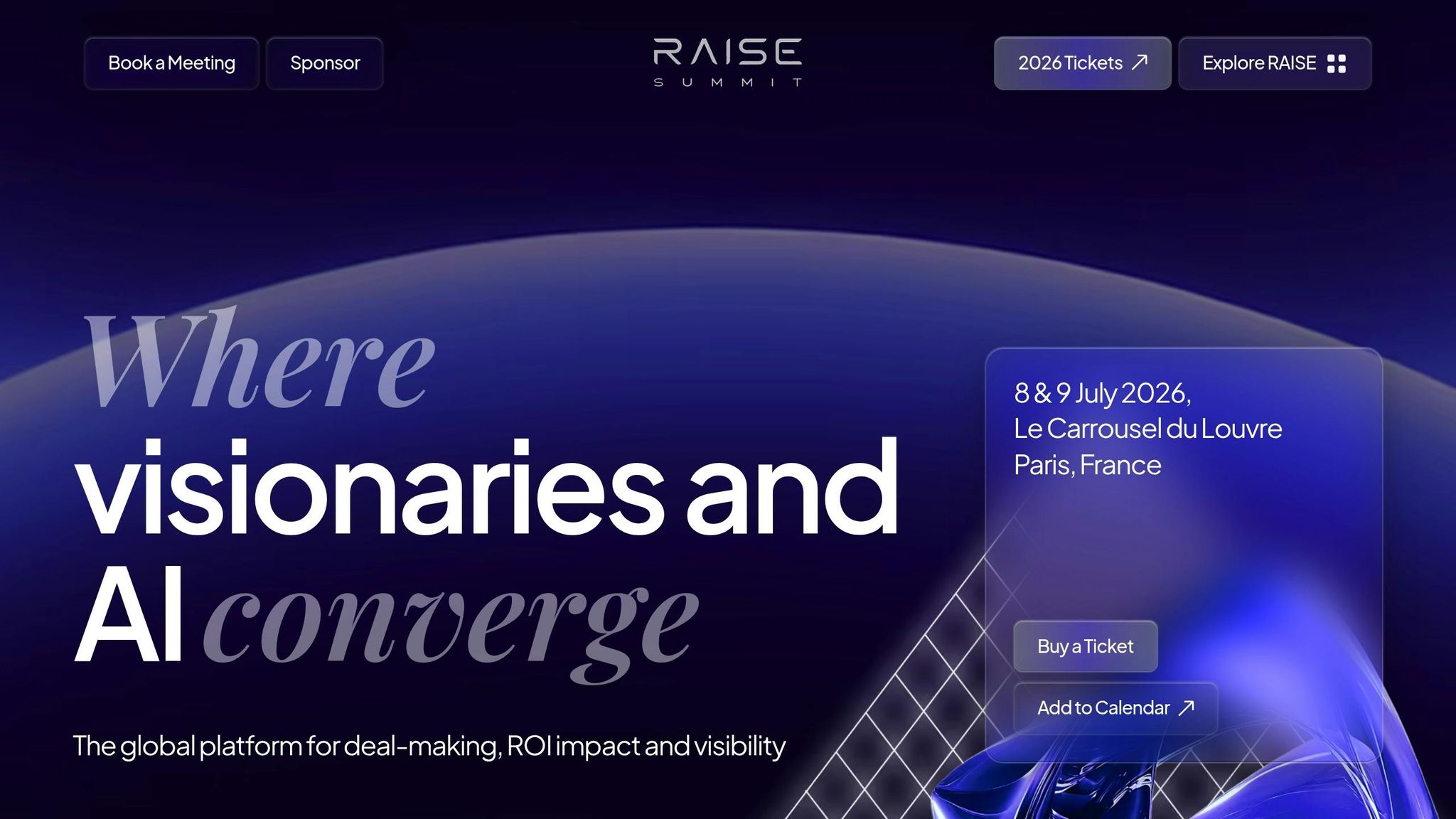
Scheduled for 8–9 July 2026 in Paris, the RAISE Summit is expected to attract thousands of participants and hundreds of speakers, all focused on turning insights into action [2]. The inclusion of substantial prize pools further underscores its dedication to driving measurable outcomes [2]. Through its emphasis on governance, financial alignment, and workforce innovation, the summit serves as a catalyst for turning AI aspirations into tangible competitive advantages.
Whether your focus is on solving ROI challenges, building sovereign AI systems, or deploying advanced agentic technologies, the right summit can provide more than just ideas - it offers the partnerships, tools, and resources needed to achieve long-term success. Jonathan Ross, CEO and Founder of Groq, summarised it perfectly:
RAISE is where everyone in AI is going
For those ready to lead the AI revolution, attending the RAISE Summit is a step toward securing the alliances, frameworks, and funding that define true competitive edge.
FAQs
How do I know if an AI summit will deliver real ROI for my organisation?
To figure out if an AI summit is worth your investment, focus on a few key aspects. Look for content that aligns with your objectives, offering insights that directly support your goals. Check if the summit delivers practical takeaways - real examples of AI in action that you can apply. Also, assess the potential for networking and deal-making, as these can lead to valuable partnerships.
Make sure the event prioritizes measurable outcomes. For example, will it boost engagement or provide actionable strategies? Look for clear metrics to evaluate its impact. These elements can help you gauge whether the summit offers real value beyond just showing up.
Which sessions should I prioritise based on my company’s AI maturity?
To get the most out of your experience, choose sessions that align with your company’s current stage in AI development. If your team is just starting out, introductory tracks can provide a solid base. For those working on scaling AI or diving into advanced uses, sessions on cutting-edge technologies and challenges should take priority. Companies with well-established AI programs might benefit most from high-level keynotes and discussions about future trends. Additionally, enterprise-focused events covering topics like scaling, governance, and security can offer practical insights tailored to more developed AI operations.
What should I prepare before attending to leave with pilots or signed deals?
To make the most of an Enterprise AI Summit and potentially walk away with pilots or signed deals, preparation is key. Here’s how you can get ready:
- Define your value proposition clearly: Tailor it to match the specific needs and challenges of enterprises attending the event.
- Develop a compelling pitch and demo: Focus on demonstrating return on investment (ROI) and showcasing practical, real-world benefits.
- Identify key attendees: Do your homework on who will be there, especially decision-makers, and plan your approach accordingly.
- Bring evidence of success: Share case studies, pilot results, or any tangible proof to build credibility and trust.
- Plan your follow-ups: Have a strategy in place to maintain connections and nurture leads after the event.
By focusing on these steps, you’ll be well-positioned to create meaningful opportunities during the summit.