

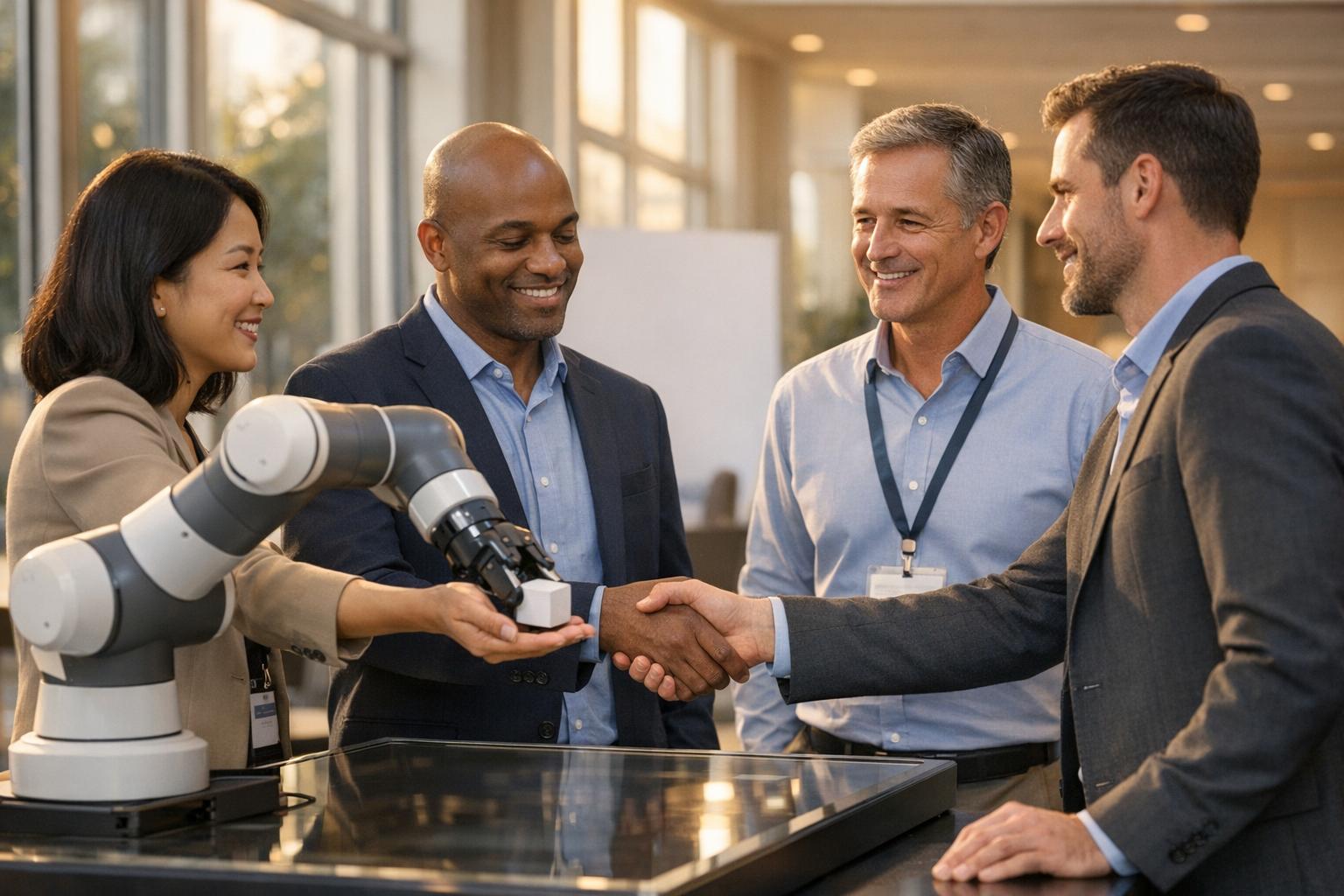
AI's growth depends on more than just virtual tools - it thrives on in-person collaboration. While online platforms streamline routine updates, they lack the depth needed for trust-building, high-stakes decisions, and showcasing complex technologies like robotics or autonomous systems. Events like the RAISE Summit in Paris prove why physical gatherings remain vital. In July 2025, it united 822 CEOs from 168 Fortune 500 companies, alongside investors managing over €570 billion, to solidify strategies and partnerships.
Key Takeaways:
- Networking and Trust: Face-to-face meetings foster trust and spontaneous connections, which virtual settings struggle to replicate.
- AI Demonstrations: Physical events allow hands-on interaction with cutting-edge AI tech, crucial for understanding real-world applications.
- Outcomes: The 2025 RAISE Summit facilitated 8,000 B2B connections and launched projects like "VoiceVault" and "MailMind" within 48 hours.
- Upcoming Event: The RAISE Summit 2026 (4–9 July, Paris) will host 9,000 attendees and focus on funding, policy, and AI advancements.
For businesses in AI, attending physical events isn’t optional - it’s where decisions are made, partnerships are formed, and the future is shaped.
The Art & Science of Networking: Stand Out & Get Results in the AI Era
Why Virtual Collaboration Has Limits
Digital tools are great for routine communication, but they fall short when it comes to deep, high-stakes collaboration. The issue lies not with the technology but with human interaction. Virtual platforms simply can't replicate the warmth of a handshake, the subtle cues of body language, or the energy that comes from sharing a physical space with others [3]. In industries where trust and quick decision-making are essential, these shortcomings can become major hurdles.
Building Trust and Relationships Online Is Difficult
Trust often develops in what professionals call "hallway moments" - those unplanned chats or brainstorming sessions that happen over coffee or in passing [3]. These spontaneous, in-person interactions are nearly impossible to recreate in a virtual environment. As Tullio Siragusa, Executive Leader & Advisor, succinctly put it:
Humans still change most deeply in rooms, not in feeds [6].
Similarly, Isoline Communications highlighted the irreplaceable nature of physical interactions:
no one can fake that handshake (yet) [4].
Virtual meetings also struggle to capture participants' full attention. Unlike in-person events, where attendees are more likely to be fully engaged, virtual settings often lead to multitasking - checking emails or browsing the web - further eroding trust and connection [3]. These gaps in engagement and trust contribute to another challenge: screen fatigue.
Screen Fatigue Reduces Participation Quality
Long video calls are mentally draining. Participants focus on staying in frame and interpreting nonverbal cues instead of fully engaging with the discussion [11]. Research shows that the feeling of being "trapped" is one of the strongest predictors of videoconference fatigue, with psychological factors playing a big role [10]. This mental strain can lead to less active participation and a tendency to conform during virtual meetings, which stifles debate and creativity [12]. Beyond fatigue, virtual environments also struggle to effectively showcase the capabilities of AI technologies.
AI Demonstrations Don't Translate Well to Virtual Formats
As AI advances into robotics, autonomous systems, and other physical applications, virtual demonstrations often fall flat. A study conducted by McGill University between January and March 2022 compared AI-led virtual instruction with in-person expert guidance for 97 medical trainees. While the AI system performed well in terms of scores, participants reported a higher cognitive load when learning virtually (1.19 versus 1.13 on a 5-point scale, p = 0.005) [8].
Virtual tools can also present visuals that feel "unrealistic or uninspiring", and they often struggle with technical nuances, especially in complex, high-stakes scenarios [7][9]. For safety-critical applications, physical demonstrations are essential. As one expert pointed out, "you cannot hallucinate a brake line or a surgical incision" [5]. When precision and safety are on the line, there's no substitute for in-person demonstrations.
What Physical Events Offer That Virtual Ones Cannot

Virtual vs Physical AI Events: Key Differences in Networking and Outcomes
Physical events bring something to the table that virtual platforms simply can't replicate. They create an environment where collaboration happens faster and more naturally, often leading to breakthroughs in AI development. The RAISE Summit is a prime example of how these in-person gatherings inspire partnerships and drive progress.
Spontaneous Conversations Lead to New Partnerships
Some of the best outcomes from physical events come from unexpected encounters. Take the RAISE Hackathon in Paris, July 2024, for example. Azzedine Idir Aitsaid struck up a conversation with Gustavo Neiva de Medeiros and Gonzalo F. about their shared frustration with email overload. That chat led to the creation of "MailMind", a browser extension for deep email searches that secured 3rd place in the Groq track [13].
Similarly, while browsing exhibition stands, researcher Zhihui LI shared a theory about using AI to "transmute" proteins between species, sparking interest in real-world applications [13]. These kinds of spontaneous moments flourish in what organisers call a "high-signal" environment - where over 80% of attendees are top-level executives and founders [2]. Azzedine Idir Aitsaid summed it up perfectly:
Engage, listen, and explore. The opportunities will follow. Be purely and simply curious. [13]
These unplanned interactions are just one part of the equation. Physical events also let attendees get hands-on with cutting-edge technology.
Direct Interaction with AI Technology
Seeing is believing, and live demonstrations at physical events build trust in ways that pre-recorded videos can't match. When attendees interact directly with AI tools, they can see how the software handles complex, unpredictable scenarios in real time [14]. This is especially important for robotics and autonomous systems, where real-world performance is key [16]. Plus, in-person demos engage multiple senses, leaving a stronger impression than virtual presentations ever could [3].
Being in the Same Room Speeds Up Innovation
Proximity matters. When startups, manufacturers, logistics experts, and researchers share the same space, silos break down, and collaboration happens naturally [15]. Events like the RAISE Summit also bring together critical resources - capital, compute power, and policy discussions - all in one place [2]. This creates an ecosystem where solutions are co-created in real time, with decision-makers working side by side [15].
With over 9,000 attendees and 350 speakers, the RAISE Summit is a hub for high-stakes networking and deal-making. As the organisers put it:
The room is curated, the dialogue is discreet, and the relationships formed here tend to last beyond the week. [1]
sbb-itb-e314c3b
RAISE Summit: How Physical AI Events Drive Progress
The RAISE Summit addresses the limitations of virtual meetings by turning conversations into tangible actions. Scheduled for 8–9 July 2026 at the Carrousel du Louvre in Paris, this event is expected to host over 9,000 attendees and 2,000 companies. The organisers describe it as a hub for "high-density deal-making", with a focus on securing contracts and launching pilot programmes rather than just casual networking [2][17]. Hadrien de Cournon, Co-Founder of RAISE Summit, puts it this way:
We are curating RAISE as the essential platform for the Fortune 1000 C-suite to connect directly with the frontier builders and policymakers who are shaping the next decade of intelligence. This is not a forum for observing trends; it is where strategy is set, and capital is committed. [18]
With over 80% of attendees being C-level executives or founders, discussions take place among decision-makers [17].
What Happens at RAISE Summit
The summit's agenda is built around "The 4Fs": Foundation (infrastructure and funding), Frontier (cutting-edge applications), Friction (regulatory and ROI challenges), and Future (AGI and sustainability) [17]. These themes guide the insights of over 350 speakers through keynotes and panels that tackle practical challenges.
Some of the event's standout formats include:
- RAISE Hackathon: A 48-hour marathon where engineers compete to prototype advanced AI systems, with 7,000 to 8,000 participants vying for a €200,000 prize pool [17][18].
- RAISE the STAKES: A dynamic startup competition with a €5 million prize pool, giving founders the chance to pitch directly to investors and enterprise buyers [17][1].
- CxO Summit: A private forum that uses AI-powered tools to arrange one-on-one meetings between senior leaders [18].
Beyond the summit itself, RAISE Week (4–9 July) includes events like the MACHINA Summit, which showcases physical AI and robotics, the Versailles AI Gala, and workshops across Paris covering sectors like health, finance, climate, and creative industries [1].
How RAISE Summit Connects Different Industries
RAISE Summit is designed to break down barriers by bringing together discussions on funding, technology, and policy in one space [2]. The MACHINA Summit, for example, serves as a meeting ground for robotics founders, industrial operators, and investors, helping to define the physical AI sector and foster partnerships [1]. Meanwhile, partner-hosted events during the week encourage collaboration in specific fields, such as healthcare and finance, to co-develop practical solutions [1].
Jonathan Ross, CEO and Founder of Groq, sums it up:
RAISE is where everyone in AI is going [17]
This convergence of industries and expertise highlights the advantages of physical gatherings over virtual alternatives.
Virtual vs. Physical Events: A Direct Comparison
| Aspect | Virtual Events | Physical Events (RAISE Summit) |
|---|---|---|
| Networking Quality | Limited to chat boxes or scheduled video calls | High-density deal-making with AI-powered 1:1 matching for executives [18] |
| Demonstration Effectiveness | Reliant on screen-sharing and pre-recorded videos | Live robot demos and hands-on hardware interaction at MACHINA [19] |
| Collaboration Speed | Slower, asynchronous communication across time zones | 48-hour hackathons for immediate prototyping [1] |
| Outcome Focus | General knowledge-sharing and trend observation | Direct deal-making, pilot launches, and capital commitments [18][2] |
Measurable Results from Attending Physical AI Events
In-person AI events deliver results that go beyond just networking. They act as catalysts for business growth, technological innovation, and policy development, offering outcomes that digital meetings often struggle to replicate.
Forming Stronger Professional Connections
Attending physical AI events helps build lasting professional relationships. Take the 2025 RAISE Summit as an example: over just two days, the event facilitated 8,000 B2B connections, with 840 venture capitalists and investors actively networking. Impressively, 80% of attendees were C-level executives or founders, individuals with the authority to make budgetary decisions and sign contracts on the spot [20].
The impact goes beyond networking. Teams meeting for the first time at similar events have collaborated to build prototypes and secure competition placements - all within 48 hours. These gatherings are more than just meet-and-greets; they create an environment where ideas transform into action quickly, accelerating both partnerships and project timelines.
Moving Projects Forward Faster
Access to the right tools and experts at these events often speeds up development cycles. A clear example is from July 2025, when a developer at the RAISE Summit created VoiceVault, a speech condenser with a user interface, over a single weekend. By participating in the Vultr hackathon track, they integrated advanced tools like container registries, compute instances, and S3 storage - showcasing how hands-on exposure to platforms can fast-track technical adoption [21].
Companies also use these events to finalise major deals. Cerebras Systems, under CEO Andrew Feldman, announced four strategic partnerships at the 2025 RAISE Summit with Hugging Face, DataRobot, Docker, and Notion. These collaborations aimed to enhance their inference cloud platform, enabling it to scale intelligence capabilities at a fraction of the cost of closed-source models [20]. Startups also benefit: Hirundo.io, for instance, competed against over 1,100 startups in the "RAISE the Stakes" competition. By engaging directly with judges and industry leaders, they demonstrated their machine unlearning platform, reducing AI hallucinations by 55% and biases by 70%, earning a share of the €5 million prize pool [20].
Influencing AI Policy and Business Strategy
Physical events often serve as platforms where business and policy intersect. At the 2025 RAISE Summit, 822 CEOs - including representatives from 168 Fortune 500 companies - and investors managing over €570 billion in assets came together [18]. This concentration of decision-makers transforms discussions into actionable strategies. As Michael Amar, Co-founder of RAISE Summit, puts it, these events allow participants to "validate their AI strategies through real-world use cases" [20].
The Paris AI Action Summit in February 2025 highlights how face-to-face collaboration can drive large-scale initiatives. For instance, Current AI, a project spearheaded by Martin Tisné and supported by leaders from Google and Salesforce, secured €380 million in funding to develop ethically governed AI models for health and education. Additionally, a coalition of 91 partners, including 37 tech companies from 10 countries, was formed to tackle AI's environmental challenges [22]. These tangible outcomes underscore how in-person gatherings can turn strategic conversations into impactful commitments.
Conclusion
The advantages of in-person engagements are undeniable, especially when it comes to forging the kind of high-impact connections that virtual tools simply can't replicate. As Hadrien de Cournon, Co-Founder of RAISE Summit, aptly states:
This is not a forum for observing trends; it is where strategy is set, and capital is committed [18].
With more than 80% of attendees being C-level executives, founders, and policymakers, these events bring together the decision-makers who can transform discussions into real-world outcomes - partnerships, pilot programmes, and signed agreements [2] [18].
The numbers speak for themselves. At the 2025 RAISE Summit, 822 CEOs from 168 Fortune 500 companies convened alongside investors managing over €600 billion in assets [18]. This level of influence and opportunity cannot be matched by webinars or virtual forums. These tangible results illustrate how such gatherings fuel the rapid evolution of the AI industry.
AI is progressing at a pace that leaves no room for passive observation. Physical events provide direct access to the individuals shaping regulations, driving infrastructure changes, and advancing technology. They give organisations the edge to predict and prepare for industry shifts rather than scrambling to adapt [2].
For companies aiming to stay ahead in AI, attending in-person events is no longer optional - it’s a necessity. The RAISE Summit 2026, scheduled from 4th to 9th July in Paris, is set to welcome over 9,000 global leaders and representatives from more than 2,000 companies [2] [18]. These are the spaces where the future of AI is being crafted.
Don’t just watch from the sidelines. Be part of the conversation. Secure your place at events that shape the industry and ensure your organisation takes an active role in defining what’s next [2].
FAQs
When is the best time to attend RAISE Summit 2026?
The ideal time to attend RAISE Summit 2026 is on 8-9 July 2026 in Paris. This top-tier event provides a rare chance to meet AI pioneers, explore interactive demonstrations, and participate in discussions that influence the future of AI. Save the date and be part of two days packed with forward-thinking ideas and valuable networking opportunities.
How do I choose the right people to meet at RAISE Summit?
To make the most of your time at RAISE Summit, prioritize connecting with attendees whose objectives align with yours - whether they’re industry leaders, investors, or potential collaborators. Leverage the event app and AI-driven meeting tools to pinpoint and arrange meetings with key players like C-level executives, founders, or other decision-makers. With more than 80% of attendees being senior professionals, these tools can help you focus on building impactful and strategic relationships throughout the summit.
What should I prepare for a live AI or robotics demo?
To get ready for a live AI or robotics demo at the RAISE Summit, it’s essential to focus on showing how your technology works in everyday scenarios while keeping the demo both engaging and flawless.
Here’s how you can make it happen:
- Highlight practical applications and the advantages your solution offers.
- Run extensive tests to ensure everything operates seamlessly.
- Pack all required equipment - and don’t forget backups for peace of mind.
- Craft short, clear explanations that can connect with a diverse audience.
By following these steps, you can create a presentation that grabs attention and leaves a lasting impression.