
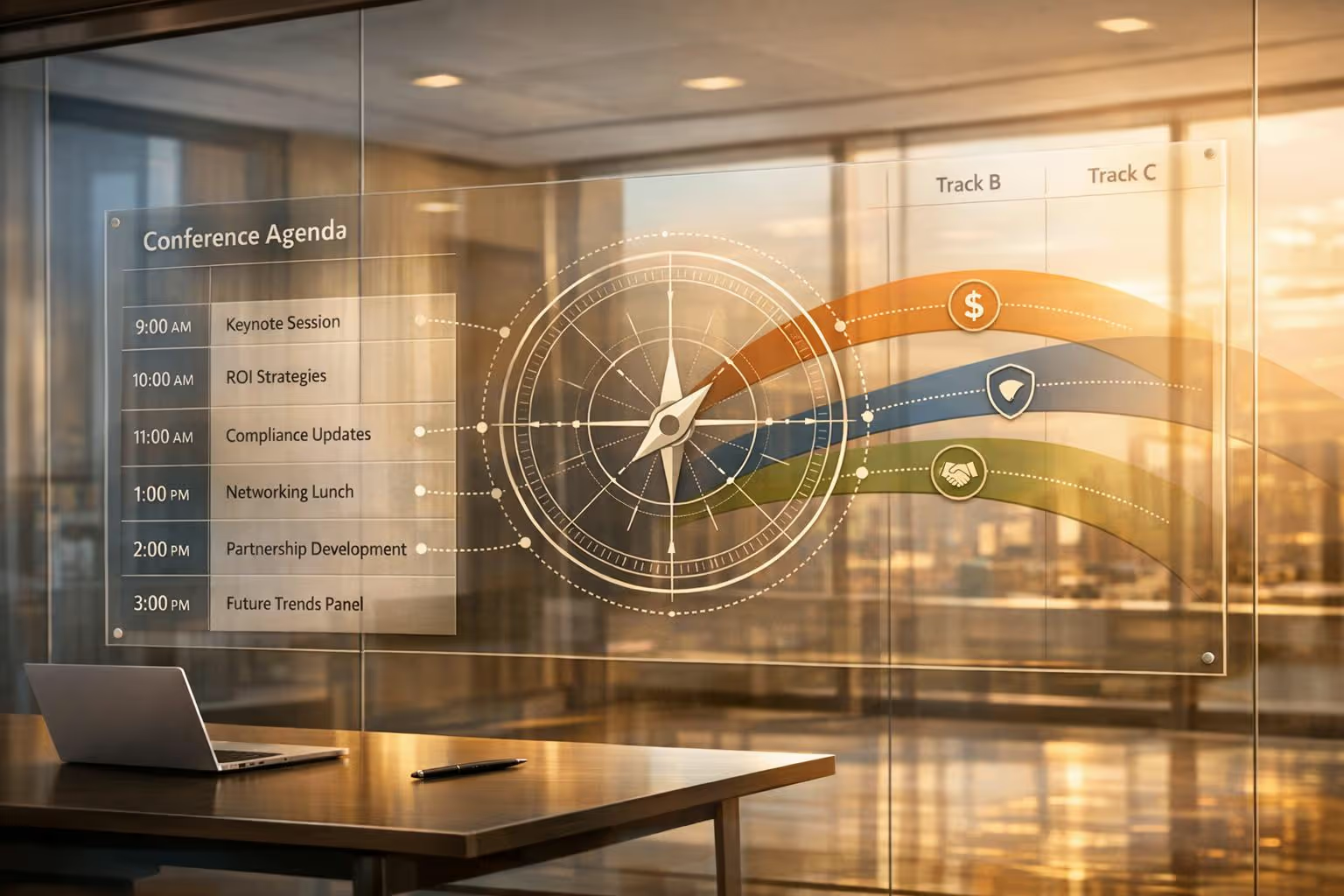
AI conferences are no longer just about theoretical discussions - they’re now centered on actionable outcomes for businesses and decision-makers. For example, the RAISE Summit uses a "4F Compass" framework to organize topics into Foundation (infrastructure), Frontier (advanced applications), Friction (challenges like ROI), and Future (long-term goals like AGI). This ensures sessions address critical issues like enterprise adoption, sovereign AI, and scalable agentic systems.
Key takeaways:
- Data-driven planning: AI tools analyze attendee preferences to prioritize relevant topics.
- Targeted content: Tracks are tailored to five personas, from engineers to executives.
- High-level participation: 80% of attendees at events like RAISE are C-level leaders.
- Practical focus: Themes include ROI, compliance, and workforce transformation.
RAISE Summit 2026 highlights:
- 9,000 attendees from 2,000+ companies.
- 350+ speakers, with 80% being executives or founders.
- €5M startup competition and €200k hackathon prize pool.
- New MACHINA Summit focusing on robotics and autonomous systems.
Conferences now act as platforms for partnerships, deal-making, and shaping AI’s future direction.
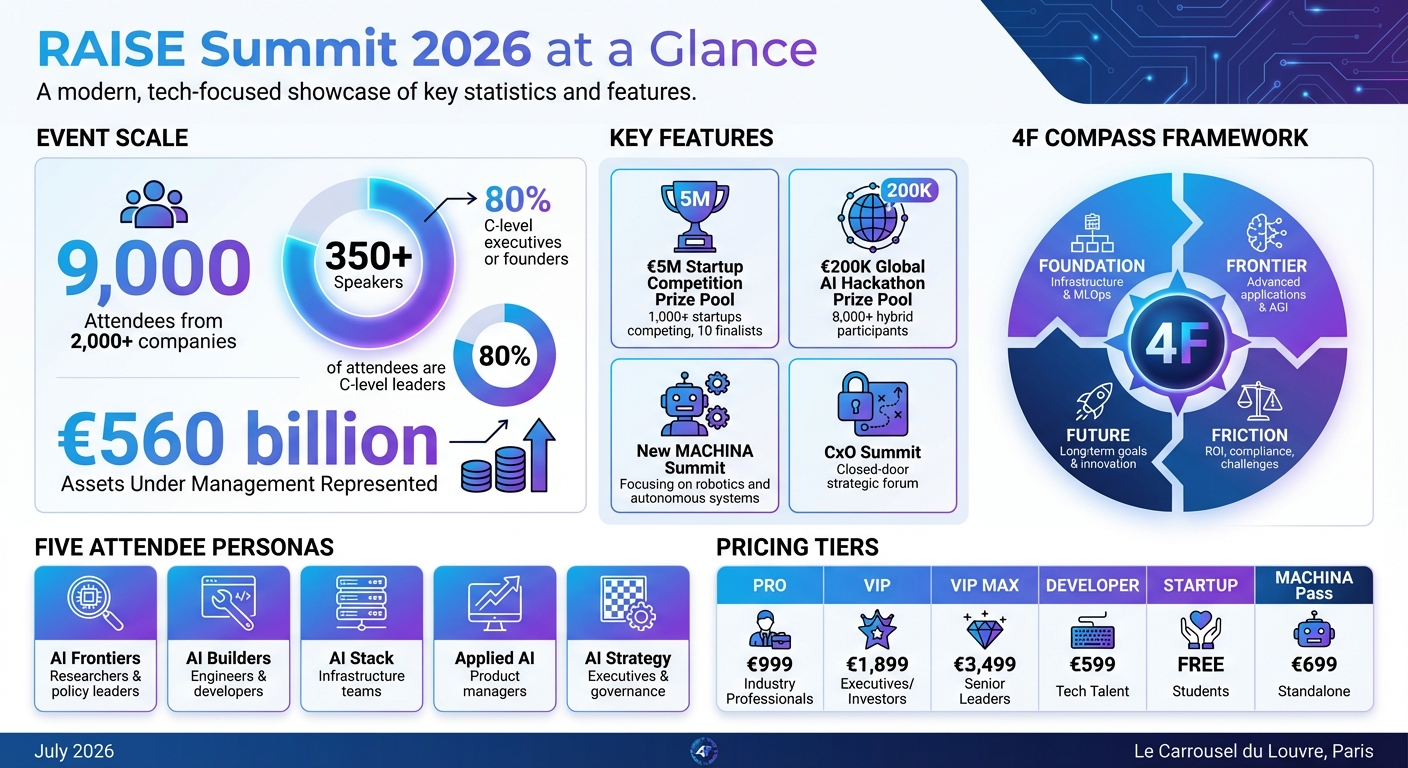
RAISE Summit 2026 Key Statistics and Event Overview
How Event Planners Can Use AI to Transform Their Events
sbb-itb-e314c3b
How Conference Agendas Are Built to Match Industry Needs
AI conference agendas are crafted to keep pace with industry changes and cater to diverse audience segments. This approach reflects the evolving priorities within AI, focusing on practical solutions and aligning with strategic goals. Organisers rely on structured frameworks to categorise content while ensuring that every attendee - whether they’re technical experts or top-level executives - finds sessions tailored to their interests.
Tracking New Trends and Technologies
To stay ahead of the curve, conference planners use the "4F Compass" framework, which divides emerging topics into four categories: Foundation, Frontier, Friction, and Future[2][3]. Additionally, organisers leverage AI tools to analyse data from registration pages, social media, and website interactions. These insights help identify popular topics and refine session priorities. For example, a growing number of event planners - 72%, to be exact - now view AI as essential for improving outcomes[7]. This data-driven approach ensures that conferences focus on translating cutting-edge research into actionable insights.
Combining Research with Real Applications
Today’s AI conferences aim to bridge the gap between theory and practice. Take the RAISE Summit 2026, for instance, which will be held in July at Le Carrousel du Louvre and is expected to draw 9,000 attendees. With 80% of its audience comprising C-level executives, the event zeroes in on ROI and sovereign cloud infrastructure[2][3]. This shift moves away from academic-only discussions, emphasising measurable business outcomes instead.
"Content quality is the #1 indicator for attendee satisfaction." – EventsAir[7]
Designing Programmes for Different Attendee Types
Understanding the diverse needs of attendees, organisers create content tailored to five key personas:
- AI Frontiers: Researchers and policy leaders exploring ethics and large-scale models.
- AI Builders: Engineers working on agentic systems and integrated toolchains.
- AI Stack: Infrastructure teams focused on MLOps and accelerators.
- Applied AI: Product managers implementing automation solutions.
- AI Strategy: Executives managing governance and ROI frameworks.
This targeted approach reflects an industry-wide move towards prioritising depth over breadth. With 61.9% of event professionals citing budget constraints as a major challenge, organisers are shifting focus to high-impact, specialised sessions rather than broad, generic tracks. This strategy ensures that every session offers substantial value, covering topics from distributed inference to executive-level risk management, making the programme relevant for all attendees.
How Speakers and Themes Are Selected
Choosing speakers and themes for a conference is no small task. It requires balancing practical insights with expert knowledge to meet the ever-changing demands of the industry. Organisers aim to feature individuals who bring real-world experience to the table, not just theoretical expertise. Take the RAISE Summit 2026 as an example: 80% of its speakers are C-level executives and founders, ensuring attendees hear directly from those who’ve faced and resolved real implementation challenges[3]. With over 350 speakers, the lineup is carefully curated to represent a mix of engineers, CTOs, venture capitalists, policymakers, and startup founders[2][3]. This thoughtful selection process ensures a variety of perspectives and expertise.
What Determines Speaker Selection
It’s not just about having an impressive job title. Speakers are chosen based on their proven market impact and alignment with the industry's evolving priorities. Using the 4F Compass - Foundation, Frontier, Friction, Future - organisers categorise expertise to create discussions that span current achievements, emerging technologies, practical hurdles, and future possibilities[2]. Diversity of thought is another major factor. Speakers are sought who can tackle pressing issues like ROI challenges, regulatory compliance, and workforce shifts. These considerations also shape the thematic tracks, ensuring they address the most relevant industry applications.
Creating Specialised Tracks for Different Industries
Thematic tracks are designed to drill down into the unique challenges of specific sectors. A Call for Speakers invites submissions highlighting impactful research and scalable solutions[6].
Dedicated tracks focus on areas like AI in healthcare (covering topics such as genomics and personalised medicine), sovereign AI for national infrastructure, and strategies for bolstering cybersecurity resilience[1]. This structure ensures that the 9,000+ attendees from more than 2,000 companies can engage with content tailored to their industries[3]. Adding to this focus on practicality, the €5 million startup competition showcases emerging companies solving real-world problems, further highlighting the conference's emphasis on actionable innovation[3].
How the RAISE Summit Agenda Has Changed Over Time
Since its inception in 2023, the RAISE Summit has undergone rapid changes, adapting to the shifting priorities of the AI industry. By 2025, the event had grown significantly, hosting over 250 speakers and emphasizing topics like AGI and infrastructure development [10][1]. The 2026 edition marked an even bigger leap, with more than 350 speakers and an audience of 9,000 attendees representing over 2,000 companies [3]. This expansion highlights the summit's efforts to tackle AI's evolving challenges while maintaining its focus on practical solutions.
One of the major changes in 2026 was the introduction of a refined 4F Compass framework. This updated structure now guides discussions on critical topics like sovereign AI and agentic systems [2].
The summit has also extended its format. In July 2026, the MACHINA Summit debuted as a dedicated track spotlighting Physical AI, robotics, and autonomous systems [11][4]. This addition reflects the summit's alignment with industry advancements. Furthermore, the Side Events Week has expanded its footprint across Paris, offering exclusive dinners, workshops, and meetups to deepen networking and collaboration opportunities [3].
These changes are woven into the summit’s diverse program, ensuring a comprehensive experience for attendees.
Main Features of the RAISE Summit Program
The RAISE Summit program is designed to highlight the latest in AI developments. Key components include:
- Keynote speeches: Industry leaders share strategic insights, with 80% of attendees being C-level executives and founders. These sessions cover topics like AGI development and workforce transformation, offering perspectives from those actively shaping the field [3].
- Panel discussions: Organized around the 4F Compass tracks, these panels tackle subjects such as "Compute as Capital", "Cyber Resilience", and "Multimodal AI" [2].
- Competitions: The Global AI Hackathon attracts over 8,000 hybrid participants competing for a €200,000 prize pool, while the AI Startup Competition offers a €5 million prize pool. Over 1,000 startups compete, with 10 finalists presenting their solutions to investors and partners [3].
- CxO Summit: A closed-door forum where senior leaders discuss strategic frameworks and organizational intelligence [4].
These features emphasize not just learning but also actionable outcomes, connecting innovators with investors and collaborators.
Pricing Plans and Access Options
The RAISE Summit offers six pricing tiers to accommodate a wide range of participants and budgets. Early bird rates are available until 17 April 2026, ensuring flexibility for attendees.
| Plan | Price (excl. VAT) | Zielgruppe | Key Features | Access Level |
|---|---|---|---|---|
| PRO | €999 | Industry Professionals | Exhibition floor, all stages/workshops, Startup Competition access, networking app, ecosystem party | Standard conference access |
| VIP | €1,899 | Executives/Investors | All PRO features, VIP lounge access, MACHINA Summit access, startup pitch decks, industrial reports | Enhanced networking and exclusive content |
| VIP MAX | €3,499 | Senior Leaders | All VIP features, Versailles AI Gala (exclusive evening dinner) | Premium experience with high-level side events |
| DEVELOPER | €599 | Tech Talent/Researchers | All PRO features with discounted access focused on technical tracks and hackathons | Application-based eligibility |
| STARTUP | €599 | Founders | All PRO features, investor matchmaking, competition participation (companies with <€5M funding, <4 years) | Application-based eligibility |
| VOLUNTEER | FREE | Students/Enthusiasts | Behind-the-scenes event support, access to sessions | Limited to selected applicants |
For those interested in robotics and autonomous systems, the MACHINA standalone pass (€699 excl. VAT) offers full-day access to the MACHINA Summit on 7 July 2026, featuring demonstrations and technical highlights [11]. Additionally, a bundled RAISE × PBW option provides discounted access to both the AI summit and Paris Blockchain Week [11].
Measuring Conference Agenda Performance
To understand how well a conference agenda performs, organisers rely on metrics that show how relevant and impactful the content is for attendees. One key measure is content relevance, which looks at the percentage of participants who found sessions informative and aligned with their professional goals [12]. For example, at the RAISE Summit 2026, where over 9,000 attendees - 80% of whom are C-level executives or founders - are expected, ensuring the agenda provides strategic value to these senior decision-makers is critical [3].
Other important tools include Net Promoter Scores (NPS) and satisfaction ratings, which help gauge the overall experience and the likelihood of attendees recommending the event. Additionally, tracking the ratio of senior leaders to general attendees can confirm whether the agenda is attracting the right audience [3].
Operational metrics also play a role. Monitoring things like registration wait times, the quality of audio-visual setups, and adherence to the schedule allows organisers to make real-time improvements. Post-event, the popularity of session recordings during on-demand periods can highlight which topics continue to resonate with audiences long after the event ends [8]. These metrics provide a foundation for evaluating specific KPIs.
Key Performance Indicators
Conference organisers use a range of KPIs to measure the success of an agenda across various aspects. Attendance is a primary metric - at the RAISE Summit, this includes 9,000 participants representing over 2,000 companies managing more than €560 billion in assets [5]. Sponsor ROI is another critical area, assessed through booth traffic, lead generation, and overall brand perception [12].
Networking success is also evaluated. For instance, previous events brought together 822 CEOs from 168 Fortune 500 companies, leading to partnerships and signed deals [5]. Post-event surveys, ideally sent within 24 to 48 hours, gather immediate feedback on attendee experiences and future intent, including whether participants plan to return or recommend the event. At the RAISE Summit, tracking whether discussions lead to tangible outcomes like new deals or pilot programmes offers clear evidence of the agenda's impact [4].
Using Feedback to Improve Future Events
Collecting and analysing attendee feedback is essential for refining future agendas. Feedback can be gathered through multiple channels, such as post-session Q&A recordings, submission forms on agenda pages, and direct testimonials [9][8]. Additionally, reviewing on-demand session engagement can reveal which topics maintain long-term interest [8].
Sentiment analysis provides deeper insights into shifts in attendee perspectives. For example, Kristin Trusco, a Graphic Designer at the American Dental Association, shared how an event changed her perception of AI:
"Prior to this event, I had a negative feeling regarding AI. I was worried it would steal my job. This actually gave me hope and helped me to realize I can get a leg up on this and allow it to be an asset, not a hindrance" [8].
The RAISE Summit uses a structured framework called the 4F Compass - Foundation, Frontier, Friction, and Future - to categorise feedback. This ensures future agendas address challenges identified by attendees [2]. For instance, tracking which "Friction" topics spark the most discussion helps organisers prioritise sessions on pressing issues like compliance breakthroughs, cyber resilience, and workforce transformation.
Customising content based on attendee roles is another effective strategy. By analysing how different groups - such as marketers, designers, developers, and executives - engage with the event, organisers can create tailored tracks that meet the unique needs of each professional segment [9][6].
Conclusion: Why Well-Designed Conference Agendas Matter
A well-thought-out conference agenda acts as a strategic guide, aligning resources, technology, and policy to advance industry goals. At the RAISE Summit, the programme is built around the 4F framework, enabling builders, investors, and regulators to tackle key challenges like workforce transformation, regulatory compliance, and the intersection of energy and computing power [2]. This structure helps turn ambitious AI ideas into actionable strategies, guiding organisations from small-scale pilot projects to large-scale implementation. The results speak for themselves.
Past summits have facilitated high-level connections that led to real partnerships and signed agreements. These outcomes highlight how a carefully crafted agenda can turn discussions into impactful actions, laying the groundwork for advancing AI innovation and deployment.
Additionally, the summit fosters direct dialogue with policymakers, offering valuable insights into upcoming regulations. Engaging with leaders such as Clara Chappaz, French Minister Delegate for Artificial Intelligence and Digital Affairs, provides participants with a chance to understand and prepare for regulatory changes before they are enforced [1]. This proactive approach allows organisations to shape their AI strategies rather than merely adapting to external changes.
The summit's impact goes beyond the scheduled talks and panels. With over 8,000 participants taking part in the global AI hackathon and a €5 million prize pool for the startup competition, the event opens doors for emerging innovators to connect with key decision-makers who control major resources [3]. Jonathan Ross, CEO and Founder of Groq, summed it up perfectly:
"RAISE is where everyone in AI is going" [3].
Häufig gestellte Fragen
How does the 4F Compass decide what makes the agenda?
The 4F Compass revolves around four central perspectives: Foundation, Frontier, Friction, and Future. These perspectives guide the agenda by addressing the present landscape of AI, highlighting new developments, tackling pressing challenges, and identifying upcoming possibilities. This approach ensures alignment with industry changes and the priorities of key stakeholders.
Which track should I choose for my role?
Choosing the right track at the RAISE Summit depends on what aspect of AI you're most interested in. Here's a quick breakdown:
- The Foundation track dives into the core principles and technologies that form the backbone of AI. Perfect if you're looking to strengthen your understanding of the basics.
- Frontier is all about the latest advancements and innovations pushing AI boundaries. Ideal for those keeping an eye on what's next.
- The Friction track tackles pressing issues like ethics, regulation, and challenges in implementation. A great fit if you're navigating AI's complexities in real-world applications.
- Future takes a big-picture approach, focusing on long-term trends and strategic visions for AI's role in society and industry.
Think about your role and what aligns best with your goals to get the insights that matter most for your work.
How can I measure ROI from attending?
Evaluating the ROI of attending the RAISE Summit means looking at both the measurable and less obvious benefits that align with your business objectives. Think in terms of new partnerships formed, funding opportunities explored, or valuable insights gained during the event.
The summit’s agenda is designed to help you achieve these outcomes. From networking opportunities to learning sessions and even hackathons, the event offers plenty of chances to spark collaborations, secure follow-up deals, or make strategic progress.
To get the most out of it, set clear goals before attending, monitor relevant data during the event, and take the time to evaluate the results afterward. This approach ensures you can connect your participation to real, actionable outcomes.
Verwandte Blog-Beiträge
- Wie KI-Veranstaltungen die Entwicklung der KI selbst widerspiegeln
- Konferenzen zu Infrastruktur- vs. Anwendungs-KI: Wo die wirklich wichtigen Gespräche stattfinden KI-Veranstaltungen vs. Tech-Events: Warum der Unterschied zählt Von Forschungsforen bis hin zu kommerziellen Gipfeltreffen: Das Spektrum der KI-Veranstaltungen So wählen Sie die richtige KI-Konferenz für Ihre Rolle aus
- Das europäische Ökosystem für KI-Veranstaltungen: Ein praktischer Leitfaden für 2026
- Der Aufstieg vertikaler KI-Treffen: Infrastruktur, Robotik und angewandte Intelligenz