

Large AI events fall into two categories: massive conferences and smaller, exclusive forums. Here's the difference:
- Large AI Conferences: Feature thousands of attendees (e.g., 9,000+ at RAISE Summit 2026) and hundreds of speakers. They offer broad insights into industry trends, AI advancements, and networking opportunities with developers, startups, and policymakers. Tools like AI matchmaking and hackathons (€200,000 prize pool) enhance the experience. Ideal for exploring the AI ecosystem and building diverse connections.
- Curated Executive Forums: Invite-only gatherings of about 1,500 C-level executives and founders. Focused on private, in-depth discussions and faster deal-making (average 11 days to close). Examples include the CxO Summit, which hosts leaders from Fortune 500 companies. Best for decision-makers seeking targeted insights and partnerships.
Quick Comparison:
| Aspect | Large AI Conferences | Curated Executive Forums |
|---|---|---|
| Audience | Developers, startups, investors, policymakers | C-level executives, Fortune 500 leaders |
| Size | 9,000+ attendees, 350+ speakers | ~1,500 invite-only participants |
| Focus | Broad AI trends, ecosystem connections | Targeted discussions, deal-making |
| Réseautage | AI-powered tools, large-scale events | Private lounges, exclusive roundtables |
| Outcomes | Industry insights, talent scouting | Partnerships, actionable decisions |
Choose conferences for wide exposure and forums for focused results. Both formats can align with your goals depending on your AI journey.
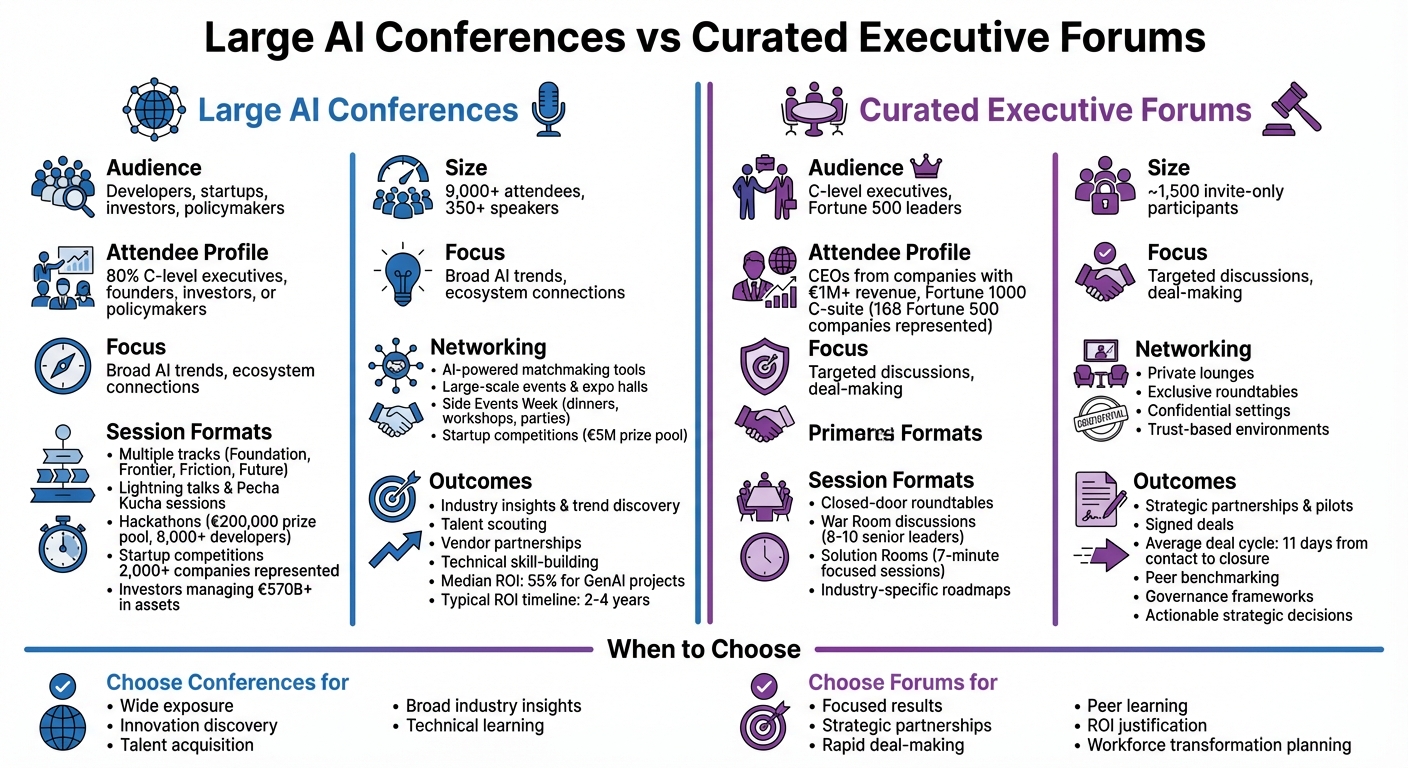
Large AI Conferences vs Curated Executive Forums Comparison
Top 3 AI Conferences You NEED to Attend in 2025!
sbb-itb-e314c3b
Scale and Attendee Profile
The size of an AI event influences everything - from the people you'll meet to how those connections unfold. Whether it's a massive conference or a more selective executive forum, each format creates a unique networking environment.
Large AI Conferences: A Diverse Crowd
Big AI conferences bring together a wide range of participants, creating a melting pot of developers, founders, investors, and policymakers. For instance, the RAISE Summit draws a crowd where over 80% are C-level executives, founders, investors, or policymakers. It also attracts thousands of technical talents through initiatives like the RAISE Hackathon [2].
"RAISE is where everyone in AI is going." – Jonathan Ross, CEO & Founder, Groq [2]
To help attendees make the most of the event's scale, these conferences often incorporate AI-powered matchmaking tools to personalise agendas and streamline networking [6]. Side events - like exclusive dinners, workshops, and networking parties - offer smaller settings for meaningful conversations within the larger gathering [2]. This combination of broad participation and targeted interaction is what makes large conferences stand out.
On the other hand, curated executive forums take a more focused approach.
Curated Executive Forums: Exclusive and Intimate
Executive forums thrive on exclusivity and smaller group dynamics. Take the CxO Summit, for example, which limits attendance to around 1,500 C-level executives and founders, including representatives from 168 Fortune 500 companies [3]. Some sessions, like the "War Room" discussions at the AI For Leaders Forum, go even smaller, with just 8 to 10 senior leaders per group. These settings foster trust, privacy, and open dialogue [5].
"The CxO Summit exists so companies don't just talk about AI, they leave RAISE with real partnerships, pilots, and signed deals." – Hadrien de Cournon, Co-Founder, RAISE Summit [4]
These forums are invitation-only, targeting senior executives such as CEOs from companies with revenues exceeding €1M or members of the Fortune 1000 C-suite [5]. The results speak for themselves: deal cycles at these events are expected to average just 11 days from first contact to closure in 2025, highlighting their efficiency and impact [3].
In short, large conferences offer a chance to explore the broader AI landscape and connect with a wide audience, while curated forums provide a more focused setting for high-level, actionable discussions. The choice depends on whether you're looking to cast a wide net or build targeted, strategic partnerships.
Speaker Lineup and Expertise
Understanding the speaker lineup is key to grasping how different event formats deliver value. Speakers play a crucial role in shaping an event's impact, and their expertise often reflects the event's goals. Large AI conferences and executive forums take distinct approaches to selecting speakers, each catering to their unique audience and purpose.
AI Conferences: Industry Leaders and Policymakers
AI conferences often aim for a broad and inclusive stage, featuring a mix of tech innovators, entrepreneurs, policymakers, and researchers. Take the World AI Cannes Festival (12–13 February 2026) as an example. This event hosted 320 speakers, delivered 250 sessions, and attracted 10,000 attendees. Notable speakers included Francesca Rossi (IBM's AI Ethics Global Leader), Dr. Kristina Kallas (Estonia's Minister of Education and Research), Janine Chamberlin (Head of UK for LinkedIn), and Oliver Patel (Head of Enterprise AI Governance at AstraZeneca) [7]. Under the patronage of President Macron, discussions ranged from business applications to governance and technical advancements.
This diversity serves a dual purpose: inspiring attendees while offering a comprehensive view of regulatory changes, infrastructure advancements, and emerging trends like AGI. With 80% of attendees being C-level executives or founders, these conferences balance visionary ideas with actionable strategies [2].
In contrast, executive forums narrow their focus, emphasizing practical insights from experienced professionals.
Executive Forums: C-Level Experts and Specialists
Executive forums are designed for a more targeted audience, often featuring speakers who are industry veterans and decision-makers. These events prioritize peer-to-peer learning, with speakers such as CIOs, CTOs, Chief AI Officers, and CDIOs from Fortune 500 companies. For instance, the CxO Summit has hosted leaders like Vishal Talwar (CDIO, FedEx), Kaoutar Sghiouer (Sanofi), and Philippe Rambach (Chief AI Officer, Schneider Electric). These experts share practical insights on topics like value creation, governance frameworks, and industry-specific strategies in sectors such as pharmaceuticals, finance, and manufacturing [3].
The combination of highly focused content, selective networking opportunities, and actionable outcomes makes these forums ideal for those looking to tackle specific challenges or refine their strategic plans.
Session Formats and Content Depth
The structure of sessions at events plays a key role in shaping the experience for attendees, helping to deliver meaningful insights and actionable takeaways.
AI Conferences: A Variety of Formats and Topics
Large-scale AI conferences often adopt diverse session formats to cater to a wide-ranging audience. For instance, the RAISE Summit 2026 in Paris, which is projected to welcome over 9,000 attendees, highlights its "4F Compass" framework. This framework covers Foundation (infrastructure), Frontier (emerging technologies), Friction (challenges), and Future (long-term goals). The event also features dynamic activities like hackathons, where more than 8,000 developers will compete for a €200,000 prize pool, and startup competitions offering finalists a chance to win a €5 million prize pool [2].
To facilitate rapid knowledge sharing, the summit includes lightning talks and Pecha Kucha sessions, which are designed for concise and impactful presentations [8][9]. Some conferences even incorporate AI-powered recommendation tools to guide attendees toward sessions that align with their interests. According to data, attendees using these tools are 174% more likely to gain valuable insights [10]. This wide array of formats allows participants to dive into technical advancements, such as generative AI, computer vision, and deep learning, while also exploring business applications and policy discussions [11].
Executive Forums: In-Depth, Targeted Conversations
Executive forums, on the other hand, focus on creating smaller, more targeted settings for deeper discussions. These events tackle strategic challenges like value realization, capital allocation, and risk management [3]. For example, the CxO Summit, which draws over 1,500 C-level executives from 168 Fortune 500 companies, offers exclusive opportunities for collaboration. The summit includes closed-door roundtables and industry-specific roadmaps tailored to sectors like finance, pharmaceuticals, and manufacturing [3][4].
One standout format is the "Solution Room", where groups of 8–10 participants engage in rapid, focused problem-solving sessions lasting just 7 minutes each [9]. As Hadrien de Cournon, Co-Founder of RAISE Summit, explains:
"The CxO Summit exists so companies don't just talk about AI, they leave RAISE with real partnerships, pilots, and signed deals." [4]
These smaller, intimate settings provide executives with a chance to benchmark their strategies, address pressing challenges like ROI justification, and plan for workforce transformation. The focused nature of these forums directly contributes to shaping effective strategic decisions [3].
Opportunités de réseautage
Networking is often the standout feature that defines the value of different event formats.
Large Conferences: Expansive Connections with Tech Assistance
Big AI conferences like the RAISE Summit 2026 thrive on sheer scale, offering thousands of networking opportunities powered by AI-driven matching tools. With over 9,000 attendees and representation from more than 2,000 companies, RAISE uses these platforms to set up meaningful one-on-one business meetings [2][4].
But the networking doesn’t stop at the main event. RAISE hosts a "Side Events Week", transforming Paris into a hub of exclusive dinners, workshops, and parties - perfect for forging connections outside the usual conference settings [2]. The expo halls and industry mixers also serve as key networking arenas, connecting attendees with an ecosystem that includes 7,000 hackathon developers and investors managing over €570 billion in assets [4]. Impressively, the 2025 edition brought together 822 CEOs from 168 Fortune 500 companies, showcasing the high level of decision-makers in attendance [4]. While large conferences provide broad networking opportunities enhanced by technology, smaller, curated forums focus on more targeted, impactful discussions.
Executive Forums: Tailored and Confidential Networking
Executive forums take a more intimate approach, creating spaces for senior leaders to discuss strategic challenges in private settings [12]. At RAISE, the CxO Summit exemplifies this with private lounges, exclusive dinners, and closed-door roundtables designed to build trust and foster strategic relationships [3][4].
"The CxO Summit exists so companies don't just talk about AI, they leave RAISE with real partnerships, pilots, and signed deals" [4]
These forums are designed to establish long-term networking channels, enabling relationships to grow beyond the event itself [12]. Features like Solution Rooms, which limit participation to 8–10 people, create focused environments where meaningful discussions can take place without distractions [3][4]. This setting is ideal for deal-making and helps accelerate strategic decisions, delivering tangible results.
Outcomes and Return on Investment
When it comes to professional events, the real payoff lies in the measurable benefits they bring to your organisation. Beyond networking and diverse sessions, these gatherings offer tangible results.
AI Conferences: Hands-On Tools and Industry Insights
Major AI conferences deliver immediate value by equipping attendees with practical skills and cutting-edge knowledge. Take the RAISE Summit 2026, for example: its hackathon attracts over 8,000 developers tackling real-world industry challenges, with a €200,000 prize pool incentivizing creative solutions [2]. Meanwhile, the startup competition offers an impressive €5 million to support groundbreaking innovations [2].
These events also provide a comprehensive view of the rapidly evolving AI landscape. The return on investment (ROI) becomes evident through new vendor partnerships, access to top talent, and immediate technical skill-building. For product teams adhering to AI best practices, the median ROI for generative AI projects reaches an impressive 55% [15].
Networking opportunities are another significant advantage. With over 2,000 companies and investors collectively managing more than €570 billion in assets, these events foster connections that enhance business growth [4]. Many organisations report seeing a satisfactory ROI on typical AI use cases within 2 to 4 years, making the knowledge gained at these conferences a long-lasting asset [14]. The practical takeaways from these events often translate into both technical advancements and business growth.
Executive Forums: Real-World Insights and Strategic Guidance
For decision-makers, curated executive forums provide a space for strategic clarity and faster deal-making. These intimate gatherings streamline decision cycles, enabling partnerships to form and initiatives to launch more quickly.
The focus here is on peer-to-peer learning, offering insights into what genuinely works. While 79% of executives report productivity gains from AI, only 29% feel confident in measuring financial ROI. These forums tackle this challenge head-on with real-world case studies and actionable governance strategies [15]. As Julie Teigland from EY aptly pointed out:
"There is no ROI if you're not willing to change the job descriptions" [13].
For C-suite leaders facing board pressure - 98% of board members cite ROI measurement as a top priority - these forums provide a platform for benchmarking against peers and exploring practical ways to justify AI investments [1]. Instead of focusing solely on adopting tools, these discussions emphasize transforming business models. For organisations ready to move beyond pilot projects and scale AI across the enterprise, these forums offer the insights needed to make informed, strategic decisions. They highlight how targeted, high-level discussions can drive impactful business outcomes.
Conclusion: Selecting the Right Event Format
Deciding between a large AI conference and a more intimate executive forum hinges on your goals and where you stand in your AI journey. Events like the RAISE Summit provide a sweeping overview of the AI landscape. With multiple tracks covering topics from infrastructure to emerging trends, these large-scale gatherings are ideal for gaining broad insights. They also shine at talent scouting, hosting hackathons with as many as 8,000 developers, making them a hub for innovation and industry-wide perspectives [2].
On the other hand, smaller, curated forums prioritize depth over scale. Take the CxO Summit, for example - it gathers over 1,500 C-level executives, including representatives from 168 Fortune 500 companies, in a more private setting. These forums are designed for efficiency, with participants averaging just 11 days from initial contact to closing their first deal [3].
In essence, large conferences are perfect for discovering startups, fueling innovation, and gaining wide-ranging industry insights. Meanwhile, executive forums cater to senior leaders aiming to refine AI strategies, tackle regulatory complexities, or forge meaningful partnerships in a focused, distraction-free environment [3].
Some events even blend both formats, offering broad industry knowledge alongside exclusive, high-level discussions [3]. This hybrid approach can provide the best of both worlds - insight into the bigger picture while enabling strategic, discreet decision-making. Align your objectives with the event format that best supports your AI aspirations.
FAQ
Which format fits my role and goals?
Choosing between a massive AI conference and a more exclusive executive forum comes down to your goals and professional needs. Large-scale events, such as the RAISE Summit in Paris (8–9 July 2026), offer unmatched opportunities for networking with thousands of attendees, gaining varied perspectives, and keeping up with the latest industry trends. In contrast, curated executive forums are designed for more focused, high-level discussions. These smaller, exclusive gatherings cater to senior leaders, emphasising strategic and ethical considerations in a more intimate setting.
How can I maximise networking in a 9,000+ attendee event?
To make the most of networking opportunities at a major event like the RAISE Summit in Paris, start by setting clear objectives. Decide who you want to meet and what outcomes you hope to achieve. Use tools like event apps or AI-powered platforms to schedule meetings in advance and pinpoint key attendees.
While at the event, dive into discussions, attend workshops, and participate in networking sessions. Don’t overlook informal meetups or the power of social media to spark connections. After the event, follow up with new contacts to solidify those relationships and keep the conversation going.
What should I prepare to turn forum discussions into signed deals?
To transform forum discussions into successful deals, it's all about combining structured networking with practical strategies. Start by setting clear objectives - whether you're aiming for partnerships, investments, or other opportunities. Be ready to communicate your value proposition effectively, ensuring it resonates with potential collaborators.
Engage in purposeful conversations during the event, focusing on sessions or side events where decision-makers are present. Leverage networking tools to make those connections count. After the forum, don't let the momentum fade - send personalized follow-ups, such as tailored messages or proposals, to turn those initial conversations into concrete opportunities.
Articles de blog connexes
- Événements mondiaux sur l'IA : Europe contre Amérique du Nord
- Comment choisir la bonne conférence sur l'IA pour les leaders
- Événements IA pour le développement de partenariats et d'écosystèmes
- Un cadre décisionnel pour choisir les événements liés à l'IA en Europe Faut-il assister à un grand sommet sur l'IA ou à plusieurs événements plus modestes ? Quel est le moment opportun pour assister à une conférence sur l'IA dans le cadre du développement de votre entreprise ? À combien d'événements liés à l'IA les dirigeants doivent-ils assister chaque année ?