


AI is evolving from chatbots that respond to commands into systems that act independently to achieve goals. These agentic systems don’t just answer questions - they plan, execute, and learn to complete tasks with minimal human input. Businesses are already seeing results: reduced workloads, faster processes, and measurable ROI.
Here’s what sets agentic systems apart:
- Goal-driven: They take high-level objectives and figure out the steps to achieve them.
- Autonomous: Operate with minimal supervision, handling complex, multi-step tasks.
- Efficient: Save time and resources by automating end-to-end workflows.
- Learning-enabled: Improve performance over time through feedback.
Examples include IT assistants saving thousands of hours, HR workflows cut from days to minutes, and fraud detection systems preventing losses. With €47 billion projected in global spending by 2025, agentic AI is reshaping industries like healthcare, finance, and supply chain management.
Key takeaway: Agentic systems don’t just talk - they act. This shift is transforming how businesses operate, delivering faster results and cutting costs.
Agentic AI Explained | McKinsey & Company
sbb-itb-e314c3b
What Are Agentic Systems?
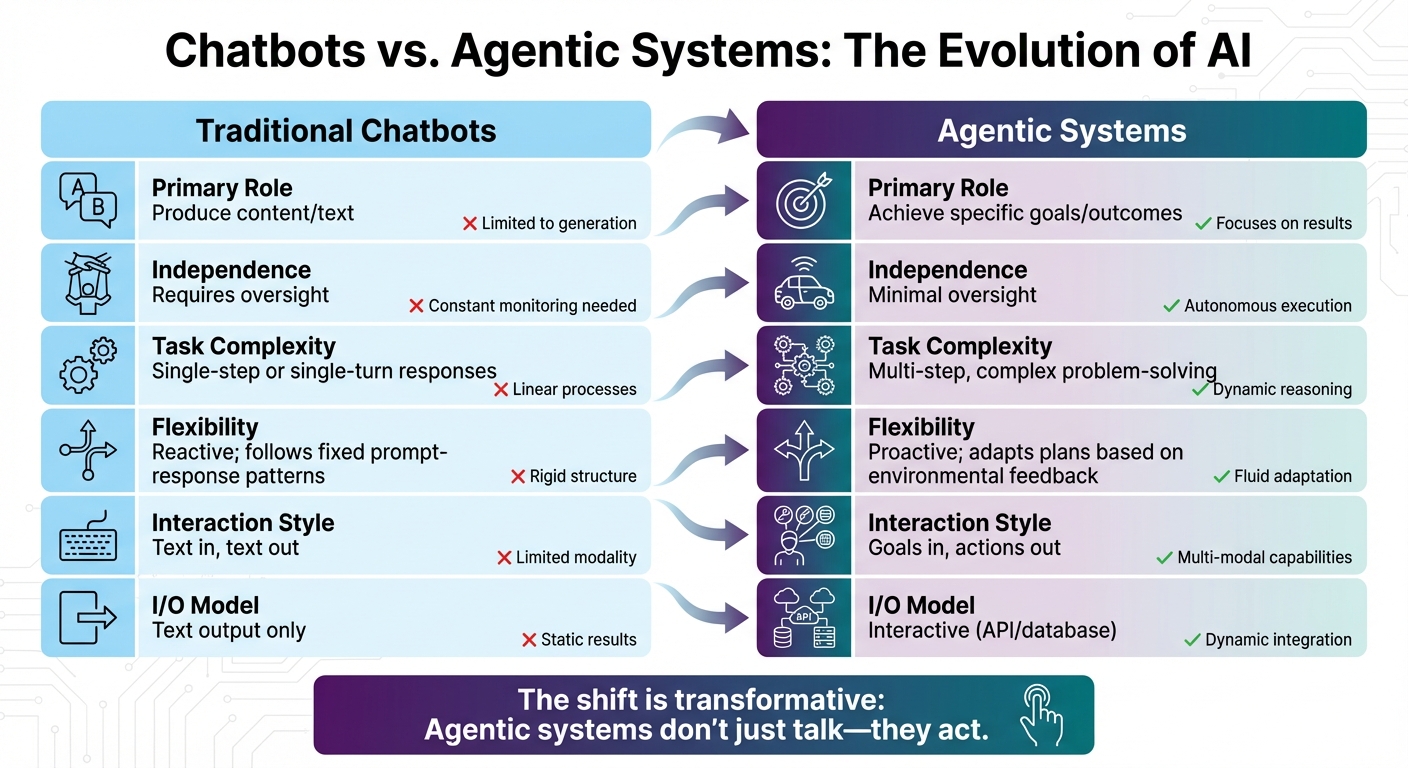
Chatbots vs Agentic AI Systems: Key Differences and Capabilities
Agentic systems represent a step beyond traditional chatbots, offering AI capabilities that can autonomously handle complex, goal-oriented tasks.
These systems are designed to observe their surroundings, reason through objectives, craft multi-step plans, and act independently. While traditional AI focuses on generating content, agentic systems focus on achieving results by interacting with external tools, APIs, and databases.
To put it simply: a chatbot answers your questions with text. An agentic system, on the other hand, takes a goal, figures out the best way to achieve it, and executes the necessary steps - whether it’s accessing a database, calling an API, updating a record, or managing workflows across platforms. IBM sums it up well:
"Agentic AI is an artificial intelligence system that can accomplish a specific goal with limited supervision."
– IBM
These systems rely on a modular design, which includes a reasoning model, tools for external actions, and instructions to define goals. This setup makes it easy for organisations to replace or upgrade individual components as technology advances, without disrupting the entire system. Thanks to this design, agentic systems are independent, adaptable, capable of continuous learning, and skilled at making decisions - qualities that define their core features.
Unlike traditional AI, agentic systems can pursue long-term goals and handle intricate tasks without constant human intervention. They also adapt to new conditions and improve over time through reinforcement feedback. A systematic review of 90 studies from 2018 to 2025 highlights this evolution, tracing the journey from rule-based symbolic AI to today’s neural, large language model–driven agentic systems [7].
These systems are best understood through four defining features.
Core Features of Agentic Systems
Agentic systems are characterized by four main qualities: independence, flexibility, continuous learning, and decision-making ability.
- Independence: These systems operate autonomously, managing multi-step processes without needing human input at every stage. Harrison Chase, CEO of LangChain, explains:
"If the LLM can change your application's control flow, it's an agent. If the flow is fixed by your code, it's not."
– Harrison Chase, CEO, LangChain
- Flexibility: They adapt their actions based on feedback from the environment. If initial attempts fail or conditions change, agentic systems adjust their strategies, unlike chatbots, which can struggle when users deviate from expected patterns.
- Continuous learning: Through reinforcement learning and feedback loops, these systems refine their methods and improve performance over time - without needing manual updates.
- Decision-making ability: This is what sets them apart as truly autonomous. They can sequence decisions, retry actions, and decide when to escalate issues to a human or stop altogether. Most enterprise systems today operate at Level 3 autonomy, where they execute end-to-end processes but still involve humans for low-confidence scenarios.
Chatbots vs. Agentic Systems
The differences between chatbots and agentic systems are striking, as shown in the table below:
| Dimension | Traditional Chatbots | Agentic Systems |
|---|---|---|
| Primary Role | Produce content/text | Achieve specific goals/outcomes |
| Independence | Requires oversight | Minimal oversight |
| Task Complexity | Single-step or single-turn responses | Multi-step, complex problem-solving |
| Flexibility | Reactive; follows fixed prompt-response patterns | Proactive; adapts plans based on environmental feedback |
| Interaction Style | Text in, text out | Goals in, actions out |
| I/O Model | Text output only | Interactive (API/database) |
This shift is transformative. While chatbots wait for commands and respond with text, agentic systems take initiative, make decisions, and autonomously complete increasingly complex tasks. They’re not just talking about what needs to be done - they’re actually doing it.
How Agentic Systems Operate
Agentic systems don’t just respond once and stop - they work through a continuous loop, allowing them to adapt, adjust, and aim for long-term objectives [4]. Unlike chatbots designed for single interactions, these systems keep running until they either achieve a goal or hit a predefined stopping point.
Their design is modular, meaning different components like reasoning models, memory, or decision flow can be upgraded independently. For example, swapping one language model for another doesn’t require rebuilding the entire system [4]. This modularity also enables autonomy, as the system’s control flow determines how decisions are sequenced and how it handles failures without needing human intervention [4]. This structure is key to understanding how these systems operate.
The Perceive-Reason-Act-Learn Process
Agentic systems follow a four-step cycle - perceive, reason, act, and learn - that repeats until a task is fully completed.
- Perceive: The system gathers data from its environment using sensors, APIs, databases, or user inputs to understand the current state and context [4].
- Reason: Often referred to as the "LLM Brain", the system interprets the data, breaks down complex goals into smaller tasks, and plans the next step based on instructions and internal context [9].
- Act: This is where the system executes actions, such as running SQL queries, making API calls, or executing code to produce tangible results in the external world [8].
- Learn: Finally, the system stores the outcomes of its actions in memory, using this information to refine future cycles [4].
Mamdouh Alenezi of Tahakom explains this process succinctly:
"Agency here is an architectural capability, not anthropomorphic intent; it arises from a clean separation of cognition from execution, state management, and policy enforcement." [12]
Most current enterprise systems operate at Level 3 autonomy. They handle end-to-end processes but involve human input in situations where confidence is low [3]. These systems also expand their capabilities by integrating with external tools and platforms.
Connecting with External Systems
Agentic systems don’t operate in isolation - they connect with external tools to extend their functionality. This allows them to retrieve data, update records, send emails, and interact with software that supports API integration [8].
There are three main ways they connect:
- Point-to-point: Directly linking to specific tools through explicit configurations.
- Dynamic discovery: Finding tools or capabilities at runtime using shared registries or catalogues.
- Queued connections: Using asynchronous messaging to ensure reliable communication, even if systems are temporarily unavailable [8].
These tools generally fall into two categories:
- Knowledge tools: Used for retrieving information, such as database queries or vector searches.
- Action tools: Used for modifying external states, like executing API calls, running code, or updating records [8].
Some systems manage over 15 distinct tools effectively, though challenges arise when fewer tools have overlapping or unclear descriptions [1].
A noteworthy advancement is the Model Context Protocol (MCP), which standardises how AI systems access external data and tools. By using MCP servers, agents avoid hard-coded connections, making them easier to maintain and scale [10]. Fahim Ul Haq, CEO of Educative, points out:
"The underlying problem is architectural. Most AI systems today are still designed using mental models borrowed from deterministic software... Agentic systems reject this assumption and instead embrace uncertainty as a design constraint." [10]
For older systems without APIs, agents can mimic human interaction by using "computer-use" models to navigate web interfaces and input data directly [1].
Where Agentic Systems Are Used Today
Agentic systems are reshaping how businesses handle complex workflows. By 2025, global spending on agentic AI is expected to hit €47 billion [13], with early adopters already cutting manual workloads by up to 50%. These systems excel by reasoning, adapting, and coordinating across platforms, tackling end-to-end workflows that traditional automation tools simply cannot manage.
Let’s dive into how these systems are driving efficiency across various industries.
Business Process Automation
In supply chain management, agentic systems are stepping in to handle disruptions with ease - rerouting shipments and optimizing inventory based on real-time demand. For instance, an automotive parts manufacturer invested €950,000 in predictive maintenance and energy optimization agents, which led to €2.4 million in annual savings - a 250% return on investment in just one year [13].
Finance departments are also leveraging these systems. A US bank used agentic AI to generate credit risk memos, boosting productivity by 20–60% [13]. And the trend is growing - 44% of finance teams plan to roll out agentic AI by 2026, marking a staggering 600% year-over-year increase [13].
But it doesn’t stop there. These systems are making waves in healthcare, cybersecurity, and beyond.
Healthcare, Cybersecurity, and Finance Applications
In healthcare, AtlantiCare’s clinical documentation agents have seen an adoption rate of 80%, cutting documentation time by 42% and saving doctors 66 minutes per day [13]. Automated scheduling tools have also improved appointment throughput in hospitals by 32% [14].
Cybersecurity teams are harnessing agentic systems to enhance threat detection and response. For example, Google’s SOC Manager uses sub-agents to analyze data, investigate threats, and enforce containment measures. Similarly, Thailand’s Krungthai Card (KTC) deployed AI agents for fraud management, surpassing an 85% detection target while minimizing losses [14].
In banking, fraud detection agents monitor transaction patterns in real time, flagging suspicious activities before they escalate. Legal teams benefit too - agentic systems can interpret regulatory updates and autonomously adjust compliance policies, slashing document drafting time by up to 91% [14].
Agentic Systems vs. Standard Automation
The difference between agentic systems and traditional automation lies in their capabilities. Here’s a quick comparison:
| Feature | Standard Automation | Agentic Systems |
|---|---|---|
| Data handling | Works with structured, static data [15] | Handles unstructured, dynamic data [15] |
| Decision-making | Rule-based and reactive [15] | Autonomous and reasoning-driven [15] |
| Adaptability | Requires manual updates [15] | Adapts automatically to changes [15] |
| Scope | Focused on specific tasks [15] | Manages entire processes [17] |
| User interaction | Often redirects to self-service [13] | Resolves issues completely [13] |
Manufacturing trials highlight these advantages, delivering 200–400% ROI within 12–18 months [13]. By 2028, Gartner predicts that 33% of enterprise software will incorporate agentic AI, a sharp rise from just 1% in 2024 [16]. This shift is about more than just automating tasks - it's about rethinking workflows to achieve better outcomes, rather than merely replicating manual processes.
Technologies That Power Agentic Systems
Autonomous agents are driven by a sophisticated mix of technologies. At the heart of these systems are Large Language Models (LLMs), which act as the "brain" of the operation. LLMs excel at understanding natural language and breaking down overarching goals into smaller, actionable steps [6][7].
Reinforcement Learning (RL) plays a key role in turning static AI systems into dynamic, adaptable agents. Instead of simply generating isolated responses, RL allows agents to learn from their environment and make decisions autonomously, even in challenging and ever-changing situations [19]. As Guibin Zhang et al. explain:
"Reinforcement learning serves as the critical mechanism for transforming these capabilities from static, heuristic modules into adaptive, robust agentic behaviour." [19]
Tool-augmented execution bridges the gap between abstract reasoning and practical application. By leveraging function-calling APIs, agents can interact with tools like web search engines, code interpreters, and databases [11][7]. A systematic review of 90 studies (2018–2025) highlights this evolution from symbolic methods to neural-based approaches [7]. These technologies collectively enable agentic systems to adapt, reason, and act effectively in real-world scenarios.
Reinforcement Learning and Large Language Models
The combination of RL and LLMs allows agents to go beyond simple reactions to immediate inputs. Instead, they can handle uncertainty and plan over extended timeframes. LLMs bring advanced language understanding, while RL ensures agents can continuously adapt through feedback loops. This synergy enables systems to learn during inference, creating new training states and improving performance without relying on ever-expanding static datasets [18]. Together, RL and LLMs empower agents to adjust their strategies dynamically, responding to outcomes rather than sticking to rigid, predefined scripts.
Multi-Agent Collaboration
Taking adaptability further, modern systems now employ multiple agents working together to tackle complex tasks that a single agent couldn't handle alone. Instead of relying on one monolithic system, teams of specialised agents collaborate. For example, an orchestrator might assign market research to one agent, content creation to another, and quality control to a third [21][7]. This approach leads to what researchers describe as "emergent collective intelligence", enabling agents to solve intricate problems collectively [20][7].
The data backs this up: 73% of practitioners use agentic systems to speed up task completion, while 92.5% design them to assist human users rather than other automated systems [22]. Reliability is also a focus - 68% of production-grade agents complete no more than 10 steps before requiring human oversight [22]. Frameworks like CrewAI and AutoGen have gained traction by assigning specific roles or "personas" to agents, improving their focus and output quality [7]. If one agent fails at a task, the orchestrator can step in, identify the issue, and reassign work to ensure the overall process stays on track [21]. This distributed setup avoids the limitations of relying on a single, overloaded LLM prompt [6][7]. By orchestrating multiple agents effectively, businesses can tackle real-world challenges with coordinated, autonomous actions.
Interestingly, 70% of production cases rely on pre-built models with tailored prompting rather than fine-tuning model weights [22]. This shows that well-organised orchestration can deliver impressive results without needing extensive model retraining.
Conclusion: Getting Ready for Agentic AI
The transition from chatbots to autonomous agents marks a turning point in how businesses function. Unlike traditional AI systems that focus on responding to queries or generating content, agentic AI goes further - it can analyze its surroundings, tackle complex problems, execute actions across tools, and learn from its experiences. The numbers speak for themselves: 80% of global C-suite executives are ramping up investments in agentic AI, with spending expected to almost triple by 2027. Moreover, 72% of executives anticipate transformative outcomes from these systems within the next two years [23].
To adopt agentic AI successfully, businesses need to rethink their workflows. A proven approach is the 10/20/70 rule: dedicate 10% of resources to algorithms, 20% to the tech infrastructure, and 70% to adapting people and processes [5]. Starting with Level 3 autonomy, where agents operate within human-defined boundaries by calling APIs and updating records, is a practical first step [3]. Pair this with a Trust Protocol, which gradually grants agents more independence as they demonstrate reliability [5].
The benefits are clear. Case studies show that agentic AI can cut engineering effort and approval times significantly [5][2]. For instance, some businesses have seen lead times shrink by up to 60%, along with notable gains in workflow automation [5][2]. Adoption is already underway: 35% of organizations are using agentic AI, and another 44% plan to implement it soon [5].
The potential competitive edge is hard to ignore. AI-native companies are achieving 25 to 35 times more revenue per employee compared to traditional businesses. Shared AI tools and data are also helping to lower costs by up to 30% while boosting productivity by 25% [5]. These statistics highlight why embracing agentic systems is not just an option - it’s a necessity for staying ahead.
As BinaryVerse AI aptly puts it:
"The era of AI that talks is ending. The era of AI that actually does things has begun." [3]
FAQs
What makes an agentic system different from a chatbot?
Agentic systems stand apart from chatbots in their level of autonomy and decision-making capabilities. Unlike chatbots, which rely on pre-written scripts to answer user inputs, agentic systems can independently interpret objectives, make decisions, and carry out tasks within intricate workflows. They adjust based on real-time feedback, seamlessly coordinate various tools, and function dynamically without needing constant human supervision. This makes them ideal for handling complex environments that go far beyond basic, scripted interactions.
How do I know which business workflows are best suited for agentic AI?
Agentic AI is best suited for handling complex workflows that involve multiple steps, require autonomous decision-making, or demand seamless collaboration across various systems. Think about areas like customer service, supply chain management, or enterprise automation - these are prime examples.
What sets these systems apart is their ability to manage tasks that call for reasoning, planning, and the flexibility to adjust to changing conditions. By reducing the need for constant manual oversight, they help streamline operations and improve efficiency, especially in scenarios where traditional automation struggles to keep up.
What guardrails are needed to keep agentic systems safe and reliable?
To keep agentic systems safe and dependable, it's essential to implement strong safety measures that cover risk identification, operational checks, and governance throughout their use. Key strategies include activity logging, anomaly detection, and human oversight for actions that could have significant consequences.
On top of that, having control mechanisms like shutdown procedures and transparency practices ensures accountability and helps prevent unintended behavior. These steps are crucial for building trust in autonomous AI systems.