

AI conferences now split into two types: infrastructure-focused and application-focused. Choosing the right one depends on your role and goals.
- Infrastructure Conferences: Cover hardware, GPUs, data centres, and tools like Kubernetes. Ideal for engineers, architects, and DevOps teams focused on AI systems' backbone. Examples: NVIDIA GTC, AI Infra Summit.
- Application Conferences: Focus on deploying AI solutions, model tuning, and user-facing systems. Perfect for product managers, data scientists, and industry professionals. Examples: RAISE Summit, events with business-use cases.
Key Differences:
- Infrastructure Events: Deep technical content, long-term focus, €500–€1,000.
- Application Events: Business strategies, immediate outcomes, €1,200–€4,000+.
Align your choice with your role - technical or business-focused - and budget.
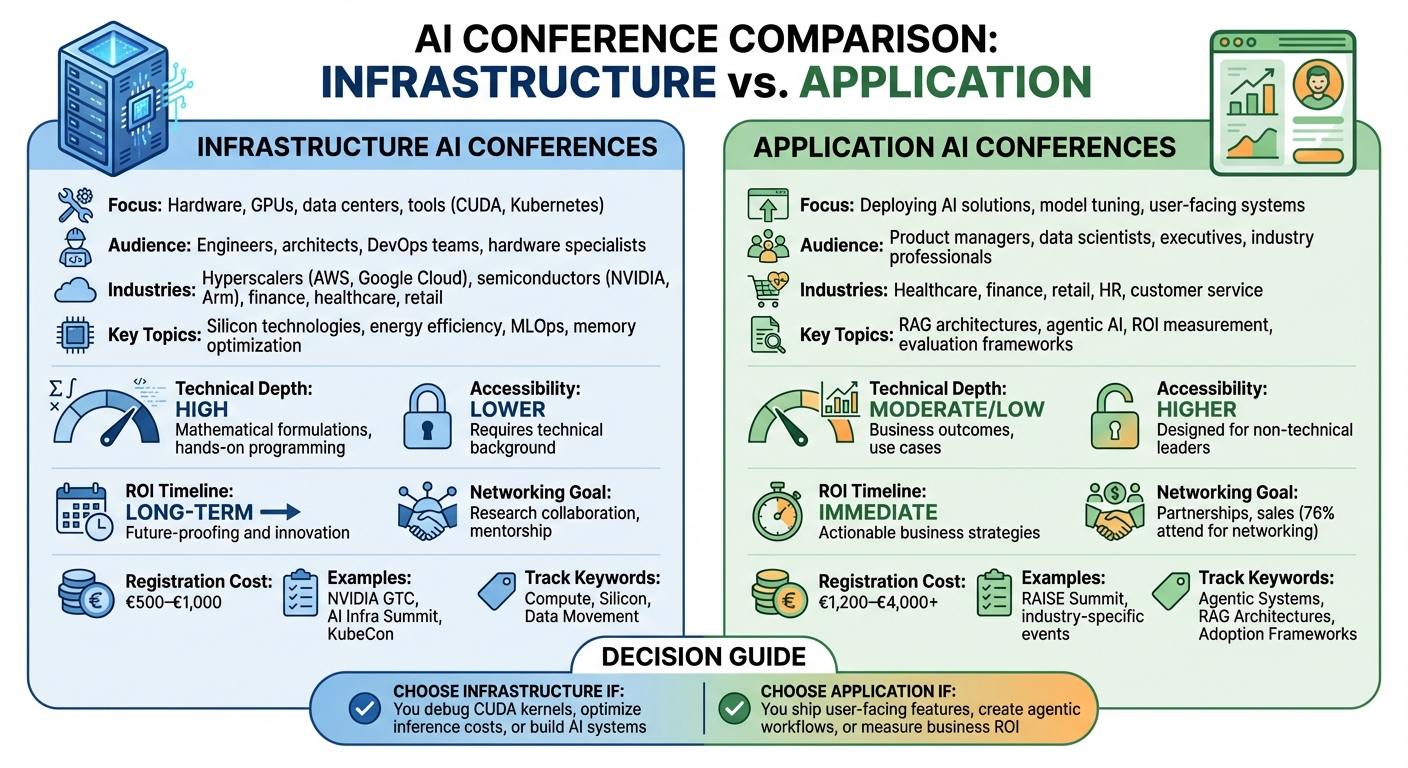
Infrastructure vs Application AI Conferences: Key Differences Comparison
1. Infrastructure AI Conferences
Focus and Discussions
These conferences dive deep into the backbone of artificial intelligence: the hardware and systems that make everything possible. They spotlight advancements in silicon technologies like GPUs, TPUs, and NPUs, as well as innovations in data centres and high-speed networking [8, 17]. Attendees can expect detailed sessions on tools such as CUDA and TensorRT for optimizing performance [17, 19]. A major focus is the challenge of balancing energy demands with computing power, exploring solutions like SMRs (Small Modular Reactors) and carbon-neutral designs [5]. Other cutting-edge topics include photonic fabrics, optical I/O, liquid cooling, and energy-efficient chip designs [5].
One keynote speaker at the AI Infra Summit emphasized the importance of these discussions, stating:
"AI is only as good as the foundation upon which it is built. Unstable infrastructure can turn even the most brilliant algorithms into expensive experiments." [5]
Audience and Roles
These events draw a diverse group of professionals, from hardware architects and systems engineers to data centre operators and MLOps/platform engineers. Around 35% of participants come from enterprise organizations [16, 6]. The audience also includes C-suite executives, policymakers, and infrastructure investors eager to understand the technological underpinnings of AI [7].
Industries represented range from hyperscalers like AWS and Google Cloud to semiconductor giants such as NVIDIA and Arm. Regulated sectors like finance (Visa), healthcare (Pfizer, Optum), and retail (Walmart) also have a strong presence [6, 17]. A Senior Data Scientist from Walmart highlighted the value of these events:
"I found it fascinating to learn about advancements in AI compute and hardware within the LLM space." [3]
Event Goals and Outcomes
The primary aim of these conferences is to close the gap between investment in AI and tangible results. Topics like overcoming the "memory wall", reducing token costs, and improving energy efficiency across the stack are central [5]. They also serve as platforms for unveiling benchmarks like MLPerf Inference results [5].
Participation in these events is growing rapidly. For example, the AI Infra Summit 2026 is expected to host 8,000 attendees and 400 speakers, doubling the numbers seen at previous major infrastructure gatherings [6, 18]. As a Director of Advanced AI Techniques at Robert Bosch put it:
"It's not just another conference - it's the event where the future of AI infrastructure is being defined." [3]
Examples
Notable conferences in this category include NVIDIA GTC (San Jose), AI Infra Summit (Santa Clara), and KubeCon + CloudNativeCon (Amsterdam) [5, 19]. In Paris, the RAISE Summit offers a "Foundation" track tailored to European enterprises focusing on AI infrastructure [5, 19].
Costs vary widely: academic conferences typically charge between €600 and €1,200, while industry events can range from €1,500 to over €5,000 [4]. For platform engineers, events like KubeCon or AI Infra Summit provide insights into scalable ML deployment, while hardware architects gain valuable knowledge at NVIDIA GTC [6].
sbb-itb-e314c3b
How Enterprises Are Rethinking Infrastructure for AI at Scale – Decode Summit
2. Application AI Conferences
While infrastructure events delve into the technical framework, application AI conferences focus on solutions that drive business impact.
Focus and Discussions
These conferences shift attention from hardware and systems to deploying production-ready AI solutions. Key topics include RAG (Retrieval-Augmented Generation) architectures, agent reliability, and evaluation frameworks that prove these systems can thrive in practical settings [9][10]. Conversations often highlight ROI measurement, sector-specific implementations in industries like healthcare, finance, and retail, and enhancing human-in-the-loop experiences [9][10][11]. A prominent theme for 2026 is agentic AI, which revolves around building autonomous systems and orchestrating multi-agent workflows to manage intricate tasks [9][10][2].
Unlike infrastructure-focused events, the challenges here involve managing context and routing models efficiently to maintain optimal performance [1]. As Arize AI aptly notes, the difficult part lies in "separating durable engineering practices (evals, reliability, cost controls, security) from transient tooling churn" [10].
Audience and Roles
These conferences draw a varied crowd, including product managers assessing AI quality frameworks, AI engineers working on production systems, executives focusing on governance and ROI, and professionals from specific industries. For example, radiologists exploring healthcare AI, HR leaders driving workforce changes, and contact centre managers improving customer experience solutions are all part of the mix [8][9][12][13][14]. Interestingly, nearly 73% of attendees at enterprise-focused events are actively involved in evaluating vendors and procurement [13].
Some larger events boast attendance figures reaching up to 12,000 participants, with 1,000 speakers representing over 90 countries and offering multiple industry-specific tracks [9][12]. In Paris, the RAISE Summit caters specifically to European enterprises with application-focused sessions, and PRO passes start at €999 (VAT excluded) [2][6]. These events bring together a diverse audience united by the goal of turning AI concepts into actionable results.
Event Goals and Outcomes
The main objective of these conferences is to transform AI ambitions into workable pilots and measurable business outcomes [11]. They serve as key venues for closing deals, forming partnerships, and addressing pressing issues like regulatory compliance and workforce transformation [2][11].
For AI engineers, technical sessions often feature live coding and production debugging, while product managers benefit from discussions on evaluation frameworks and team workflows [9]. The focus of each event varies: some target specific industries, others prioritise governance and risk management, and certain summits appeal to senior executives with purchasing authority [9][12][14]. Regional events also offer cost-effective opportunities to learn from experts and explore local case studies, making them ideal for teams with tighter travel budgets [14].
Examples
The impact of these conferences is evident in their robust technical programmes and networking opportunities [9]. In Paris, the RAISE Summit stands out, attracting over 9,000 attendees and featuring startup competitions alongside tracks tailored to industries like healthcare, cybersecurity, and finance [2][6]. These events are a testament to the tangible benefits of application-focused AI discussions.
Advantages and Disadvantages
Here’s a breakdown of the key strengths and limitations of infrastructure and application AI conferences, drawing from the detailed profiles above. Each type caters to different professional needs, offering unique benefits and trade-offs.
Infrastructure conferences are celebrated for their deep dive into technical aspects. Events like NVIDIA GTC and NeurIPS provide attendees with early access to cutting-edge advancements - often months before they become widely adopted[14]. They offer hands-on workshops that focus on building neural networks and optimizing hardware, making them ideal for those looking to sharpen their technical expertise. However, this level of focus can be a hurdle for non-technical participants. As highlighted by AI Megazine:
"Academic events stress research rigor."[4]
These conferences are more about long-term gains, emphasizing skill-building and innovation over immediate business results.
On the other hand, application conferences focus on practical implementation and business-oriented insights. These events prioritize real-world case studies and actionable strategies, making them more accessible to non-technical leaders. Networking is a key attraction here, with 76% of attendees citing it as their main reason for attending. Advanced AI-powered matchmaking tools further enhance engagement opportunities[15]. The downside? While they deliver actionable strategies, they lack the deep technical exploration found in infrastructure events, focusing more on outcomes than the mechanics behind them.
| Feature | Infrastructure AI Conferences | Application AI Conferences |
|---|---|---|
| Technical Depth | High – Emphasis on mathematical formulations and hands-on programming | Moderate/Low – Focus on business outcomes and use cases |
| Accessibility | Lower – Requires a specialized technical background | Higher – Designed for non-technical leaders |
| ROI Timeline | Long-term – Future-proofing and innovation | Immediate – Actionable business strategies |
| Networking Goal | Research collaboration and mentorship | Building partnerships and driving sales |
| Registration Cost | Approximately €500–€1,000 | €1,200 to over €4,000 |
Conclusion
Picking the right AI conference starts with aligning the event's focus to your day-to-day work. If your role involves tasks like debugging CUDA kernels or optimizing inference costs, look for infrastructure-heavy events offering deep technical content. On the other hand, if your work revolves around shipping user-facing features or creating agentic workflows, application-focused summits will provide practical case studies and implementation strategies directly relevant to your needs. Pay attention to track titles - terms like "Compute," "Silicon," and "Data Movement" often indicate infrastructure-centric sessions, while "Agentic Systems," "RAG Architectures," and "Adoption Frameworks" point toward application-level discussions [2][9].
Timing and budget also play a role. Early-year conferences, often focused on product and technology, can help refine your roadmap, while late-year events are great for benchmarking progress. Registration fees vary widely, but early-bird discounts at some events can help cut costs [9][6].
For unbiased information, prioritize conferences that highlight proven architectures over sales-driven presentations. If you work in a regulated industry, look for tracks addressing compliance and data privacy [16][6][9]. Senior executives may benefit most from invite-only summits that facilitate peer networking, while hands-on practitioners should seek out events with technical workshops and bootcamps [16][9].
The industry is shifting toward more practical, production-focused discussions. As Maxim AI observed:
"The best part about 2026 is that enough teams have now shipped AI to production that the conversations are getting real. Less speculation, more 'here's what broke and how we fixed it'" [16].
This evolution highlights the importance of learning from real-world successes and failures, rather than sticking to theoretical debates. Whether your focus is on optimizing infrastructure or deploying autonomous systems, the right conference should equip you with actionable insights you can apply immediately. By aligning your conference choice with your role and objectives, you ensure the experience delivers tangible value for your work.
FAQs
Which AI conference type fits my role?
The right AI conference for you hinges on your professional focus. If your work revolves around developing or deploying AI systems, industry-focused events that prioritise hands-on learning and technical strategies are ideal. For those in research or strategic roles, academic gatherings like NeurIPS or ICML are better suited. Meanwhile, professionals involved in infrastructure or enterprise AI might gain the most from specialised summits that delve into hardware and system-level discussions. Align your choice of event with your specific career goals and interests.
What should I look for in the agenda to avoid sales talks?
When selecting agenda items, prioritize sessions that delve into practical insights, technical expertise, or strategic discussions. Look for titles that emphasize research findings, real-world applications, or in-depth technical analysis. Steer clear of sessions that hint at sales, marketing, or product promotions to keep the focus on content that's informative and devoid of sales-driven motives.
Is it worth attending both infrastructure and application events?
Attending AI events that focus on both infrastructure and applications can offer a well-rounded perspective. Infrastructure-focused events dive into the nuts and bolts of AI, covering topics like hardware, foundational technologies, and scalability. On the other hand, application-focused events center around practical use cases, model deployment, and integrating AI into business operations.
By participating in both, professionals can gain a broader understanding of AI's ecosystem, stay updated on advancements, and make informed decisions that align with their specific roles and goals. These events complement each other, bridging the gap between technical frameworks and practical implementations.