


AI, Web3, and climate tech dominate the startup world in 2026. Here's why these trends matter and how young entrepreneurs are leveraging them to build scalable businesses:
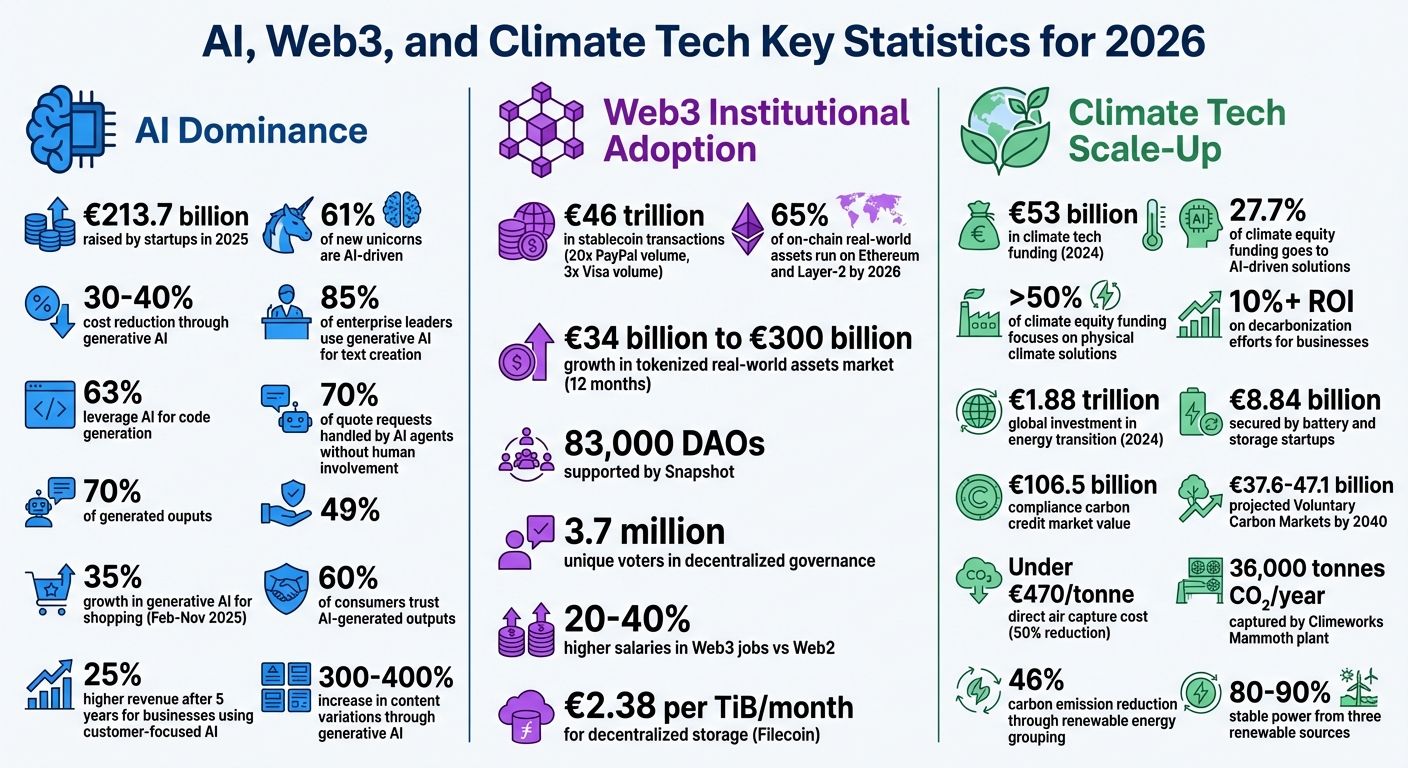
- AI: Startups raised €213.7 billion in 2025, with 61% of new unicorns being AI-driven. Generative AI is transforming business operations, cutting costs by 30–40%, and boosting customer engagement with hyper-personalized experiences.
- Web3: Institutional adoption is replacing hype. Decentralized platforms, tokenized assets, and smart contracts streamline operations and funding, with stablecoin transactions hitting €46 trillion.
- Climate Tech: Funding reached €53 billion in 2024. Focus has shifted to scalable, cost-effective solutions like direct air capture and renewable energy integration, with businesses seeing ROI above 10% on decarbonization efforts.
Young founders are thriving by adopting agile models, AI-powered tools, and decentralized systems. Events like the RAISE Summit in Paris (July 2026) offer resources, networking, and funding opportunities to help entrepreneurs harness these trends.
AI, Web3, and Climate Tech Statistics for Startups in 2026
Top 6 AI Trends That Will Define 2026 (backed by data)
AI Trends Changing How Businesses Operate
Artificial intelligence has shifted from being an experimental tool to becoming the backbone of how startups operate in 2026. Today, 85% of enterprise leaders use generative AI for text creation, while 63% leverage it for code generation [5]. For emerging founders, this evolution means building businesses that are leaner, faster, and more efficient compared to previous generations.
Generative AI for Business Automation
AI is transforming workflows across industries. Startups are increasingly using AI agents to manage diverse roles, from handling customer requests to maintaining internal records. This shift can cut labour costs by 30% to 40% [6], a critical advantage for teams operating on tight budgets.
For example, AI agents now handle roughly 70% of requests for quotes without requiring human involvement [6]. The trend is moving towards "integrated AI platforms", where multiple AI agents collaborate seamlessly across business functions using shared frameworks for memory, orchestration, and governance [6].
In the climate-tech sector, AI-native tools are becoming essential for operations. These tools, used for tasks like weather modelling and grid optimisation, help reduce both capital costs and grid strain [7]. Such advancements enable smaller teams to compete effectively against larger, established players.
While automation optimises operations, AI is also reshaping how businesses interact with their customers.
AI-Powered Personalisation for Customer Experience
The way companies engage with customers has undergone a major transformation. Between February and November 2025, the use of generative AI for shopping-related purposes grew by 35% [8]. Furthermore, over 60% of consumers now express high trust in AI-generated outputs [8]. This trust directly impacts revenue: businesses that integrate generative AI into customer-focused initiatives can see 25% higher revenue after five years compared to those prioritising productivity alone [9].
One approach to leveraging AI is through Answer Engine Optimisation, which involves structuring brand content into modules designed to provide instant answers [8]. Walmart illustrated this in 2025 by partnering with ChatGPT to enable instant checkout, allowing customers to discover and purchase products through a single conversational interaction [8]. This innovation streamlined the traditional marketing funnel into one seamless step.
Volvo Group adopted a different strategy by using AI agents to analyse 6 million data points tagged to over 2,000 emission factors. This enabled 1,500 buyers to propose targeted decarbonisation strategies to suppliers [10]. Similarly, Reckitt achieved a 75x increase in footprint accuracy across 25,000 products, uncovering 60% additional reduction potential through AI-powered sustainability platforms [10].
Generative AI also enhances personalisation at scale, increasing content variations by 300–400% [9]. This capability allows startups to deliver hyper-personalised experiences to their customers. As Accenture Research aptly puts it:
Generative AI is the staff-multiplying, creativity-focusing, strategy-prioritising help we have been waiting for. And it may finally help us close the relevance gap between brands and their customers [9].
These advances in AI not only improve operational efficiency and customer engagement but also align with the broader entrepreneurial trends shaping the business landscape in 2026.
Web3 Technologies for Decentralised Business Models
Web3 is reshaping how businesses operate by cutting out middlemen and automating processes. By 2026, 65% of on-chain real-world assets (RWAs) are expected to run on Ethereum and its Layer-2 ecosystems [16]. This marks a shift from traditional, centralised models to modular "app-chains", giving startups more control over governance and fees.
DeFi and Smart Contracts for Business Operations
Decentralised Finance (DeFi) and smart contracts are transforming business operations. By 2025, stablecoin transactions are projected to reach an astounding €46 trillion [13]. To put that into perspective, that's more than 20 times PayPal's volume and nearly three times Visa's. These technologies make global payments fast and cost-effective.
Smart contracts are also revolutionising industries like supply chain management and insurance. For instance, Pearl Street Technologies cut grid interconnection analysis times from months to mere hours using automation in 2025 [7]. Similarly, AI-driven insurance platforms are using smart contracts to dynamically price policies and automate payouts for climate-related risks [7]. Ethereum’s consistent decade-long uptime [16] ensures reliability for these critical operations.
The tokenisation of real-world assets is another game-changer, with the market expected to grow from €34 billion to €300 billion in just 12 months [16]. This trend allows for fractional ownership of assets like real estate, commodities, and private credit, opening up new funding avenues for entrepreneurs. As Jeremy Allaire, CEO of Circle, puts it:
What blockchains introduce is the missing counterpart to these advances: a system for verifiable transactions and verifiable computation executed on an open public network. [15]
Web3 Platforms for Collaborative Digital Systems
Web3 isn't just about efficiency; it’s also driving collaborative innovation. Decentralised platforms are breaking down traditional barriers. For example, Snapshot supported 83,000 DAOs and 3.7 million unique voters by late 2025 [14]. AI agents are now integral to these Decentralised Autonomous Organisations, handling tasks like treasury management and risk analysis [11].
The Decentralised Science (DeSci) movement highlights how Web3 is tackling issues of access and transparency in research. Unlike traditional science, which often relies on small, closed funding groups, DeSci uses tools like quadratic funding and DAOs to distribute resources transparently [12]. Researchers are also leveraging IP-NFTs to ensure contributors are automatically and fairly rewarded, bypassing institutional bottlenecks. In 2025, the Ethereum Name Service (ENS) integrated with Filecoin Onchain Cloud and Safe, enabling developers to deploy fully on-chain frontends with Filecoin for storage and Safe for multi-signature governance [17].
Web3 jobs are particularly appealing, often offering salaries 20–40% higher than comparable positions in Web2 [11]. For entrepreneurs building collaborative ecosystems, platforms like Filecoin Onchain Cloud provide secure, verifiable storage starting at just €2.38 per TiB per month [17]. Tools like Scaffold-ETH 2 and Foundry make prototyping and deployment faster and easier. Additionally, "chain abstraction" simplifies user interactions, allowing them to engage with Web3 platforms without needing to understand the underlying blockchain [18].
Climate Tech Developments for Environmental Impact
Climate tech has moved beyond the experimental stage. By 2026, more than half of all climate equity funding will focus on physical climate solutions, signaling a shift from small-scale pilot projects to large-scale, execution-driven investments [4]. For emerging entrepreneurs, these established climate tech innovations present a dual opportunity: achieving environmental goals while building commercially viable ventures. These advancements pave the way for transformative progress in emission reduction technologies.
Carbon Capture and Emission Reduction Tools
Direct air capture (DAC) has transitioned into commercial viability. In August 2025, Airhive implemented a system capable of capturing 1,000 tonnes of CO₂ annually at Deep Sky Alpha in Alberta. This system achieved costs under €470 per tonne - half the previous industry benchmark - by employing a fluidisation process that captures CO₂ in less than a second [40,41].
The pace of scaling this technology is impressive. In May 2024, Climeworks opened its "Mammoth" plant in Iceland, capable of capturing 36,000 tonnes of CO₂ annually - nearly ten times the capacity of its earlier facility. The plant operates entirely on renewable geothermal energy, ensuring net-negative emissions [41,42]. GE Vernova is also set to launch a 1,500-tonne-per-year DAC system at Deep Sky Alpha by late 2026, designed as a testing ground for various capture methods [19].
AI advancements are playing a crucial role in this space, enhancing the precision of emission tracking and helping identify previously overlooked reduction opportunities.
"Direct air capture has reached a critical inflection point in 2026, transitioning from experimental demonstrations to commercial‑scale deployment with breakthrough cost reductions." - Sarah Chen, Technology Writer [19]
Alongside carbon capture technology, renewable energy solutions are reshaping how businesses achieve low-emission, cost-efficient operations.
Renewable Energy Solutions for Business Operations
Integrating renewable energy is no longer just environmentally responsible - it’s also economically smart. In 2024, global investment in the energy transition exceeded €1.88 trillion, with battery and storage startups securing roughly €8.84 billion in climate tech supply-chain funding [22]. One promising strategy involves renewable energy-based modular data centres (rMDCs). These centres can be installed directly at energy farms, cutting emissions to near-zero while bypassing the high costs of power transmission, which often account for 50% of total energy expenses [20].
An exciting development in this area came in June 2024 when researchers from the University of Illinois and Microsoft Research introduced "SkyBox." This framework, tested across 555 sites, demonstrated that grouping three renewable energy sources resulted in 80–90% stable power and reduced carbon emissions by 46% [20]. Modern systems now incorporate "energy-aware" technology, where computing systems align with power systems to schedule non-urgent tasks during peak renewable energy production [21].
The financial benefits of decarbonisation are becoming increasingly clear. By 2025, 82% of businesses reported economic gains from these efforts, with nearly half achieving returns on investment above 10% for climate risk adaptation [23]. Entrepreneurs can also take advantage of policy incentives like the U.S. Inflation Reduction Act or the EU "Fit for 55" package, which offer substantial grants and tax credits (up to €2.82 per kilogram for green hydrogen) to reduce integration costs further [22].
sbb-itb-e314c3b
How AI, Web3, and Climate Tech Work Together
By 2026, the intersection of AI, Web3, and climate tech is reshaping both environmental progress and business strategies. AI-driven solutions now represent 27.7% of total climate equity funding, highlighting artificial intelligence as a key driver for scaling climate technologies [1]. At the same time, Web3 introduces transparency and funding mechanisms that traditional systems often fail to provide.
AI plays a crucial role in real-time emissions monitoring and optimization, while blockchain ensures secure and transparent funding pathways. Together, these technologies are creating a seamless ecosystem that supports sustainable advancements.
"AI now serves as the backbone for scaling Climate Tech, both by fuelling capital towards critical energy infrastructure and through AI-enabled solutions." - State of Climate Tech 2025 Report [1]
This synergy is already producing tangible results. In January 2026, researchers unveiled FedCarbonNet, a system combining AI, blockchain, and IoT sensors. The framework achieved nearly a 10% reduction in emissions while maintaining high forecasting accuracy and low energy use [24]. By leveraging federated learning, FedCarbonNet allows organizations to collaborate on climate data without exposing sensitive information.
In April 2025, the Octant platform allocated over €1.27 million to 20 climate-focused projects through community governance. Users locked tokens to decide funding distribution, prioritizing initiatives like Blue Filter, which provides water filters in Palestine, and GEN Ukraine, a network of 60 ecovillages. These results suggest that decentralized donors often prefer projects with immediate, measurable impact over those focused on long-term digital infrastructure. This collaborative model is not only improving operational efficiency but also paving the way for new funding approaches.
AI Tools for Climate and Web3 Applications
Artificial intelligence now acts as the "accountability layer" for climate finance. Geospatial AI (GeoAI), for example, uses machine learning and satellite imagery to verify the effectiveness of nature-based solutions like reforestation. This continuous, real-time monitoring replaces outdated annual assessments, which often lacked reliability in traditional carbon markets [25].
"GeoAI is not merely a technical solution; it ensures continual, verifiable monitoring for climate projects." - Dan Rushton, Picterra [25]
AI also enhances Decentralised Physical Infrastructure Networks (DePIN) by optimizing resource allocation, while blockchain ensures data integrity. For example, machine learning can predict peak renewable energy production and schedule non-urgent computing tasks during those times, reducing grid strain and emissions. Data centers, once static energy consumers, are now becoming dynamic contributors to grid efficiency. Even a minor reduction in energy use - such as a 0.25% load curtailment (one day per year) - could unlock 76 GW of new grid capacity in the United States [7].
AI is also transforming insurance in climate-sensitive regions. By analyzing historical data, AI-powered models outperform traditional actuarial methods, which often struggle to account for risks like wildfires and floods [7].
Web3 Funding Models for Climate Tech Projects
While AI ensures accurate monitoring, blockchain is redefining funding models crucial for scaling climate innovations. The Regenerative Finance (ReFi) movement uses tokenization and decentralized finance to incentivize environmentally positive activities on a large scale [27]. Instead of relying solely on grants or venture capital, founders can access community-governed funding pools that reward measurable environmental impact.
The numbers tell the story. By late 2024, compliance carbon credit markets were valued at approximately €106.5 billion, and Voluntary Carbon Markets are projected to grow to between €37.6 billion and €47.1 billion by 2040 [28]. Tokenization addresses inefficiencies in these markets by introducing modular, automated blockchain architectures, making carbon credits more accessible and transparent.
Research suggests blockchain can simplify carbon credit trading within specific industries [28]. For entrepreneurs, this means focusing on sectors where tokenization can effectively solve existing challenges.
"Blockchain is a powerful tool that can provide breadth and depth to climate mitigation and adaptation efforts by democratising ownership, improving transparency and integrity." - World Economic Forum [27]
This democratization extends to funding mechanisms. Platforms using AI-driven impact evaluation can identify projects with the highest potential to scale. For instance, the Climate Coordination Network has facilitated €4.2 million in funding for hundreds of climate projects [26].
One key insight: decentralized funding platforms tend to prioritize projects with immediate, tangible results. When seeking such funding, emphasize outcomes like clean water access, renewable energy installations, or verified emission reductions over long-term digital infrastructure that lacks visible impact [26].
How Young Founders Can Use RAISE Summit

The RAISE Summit, scheduled for 8 and 9 July 2026 at Le Carrousel du Louvre in Paris, offers young founders an unparalleled opportunity to connect with industry leaders. With more than 9,000 participants - over 80% of whom are C-level executives and founders - the event provides a focused platform to learn, network, and secure critical resources [29][31]. It highlights how emerging entrepreneurs are leveraging AI, Web3, and climate tech to shape future innovations. The summit’s sessions, networking tools, and competitions are ideal for founders looking to dive into these transformative technologies.
Attend RAISE Summit Sessions on AI, Web3, and Climate Tech
The summit’s agenda is structured around the "4F Compass" framework: Foundation, Frontier, Friction, and Future [30]. For climate tech entrepreneurs, the "Sustainable AI: Energy Optimisation and Scalability" session in the Future track offers insights into balancing AI’s energy demands with sustainability goals [30]. Web3 enthusiasts will find value in the "APIs, Tokenomics & Usage Economies" session under the Frontier track, which delves into decentralised business models and AI-driven usage economies [30].
The Foundation track explores the "Energy – Compute Nexus", a session focusing on the intersection of large-scale AI infrastructure and renewable energy. Hardware-focused founders should consider attending the Machina Summit, held on 7 July 2026, which covers advancements in physical AI, robotics, and autonomous systems [31][32]. With over 350 expert speakers, the summit ensures in-depth exploration of AI, Web3, and climate tech trends [29].
Build Connections at RAISE Summit
The event is designed to foster meaningful networking opportunities. All ticket holders have access to a dedicated app, allowing them to schedule meetings with key industry leaders, including a high concentration of C-level executives [32]. Beyond the main event, the Side Events Week offers exclusive gatherings, such as dinners, workshops, and meetups across Paris, providing a more intimate setting to build relationships [33].
"The serendipity that can happen when you're together in a physical space is life-changing." - Chamath Palihapitiya, Co-founder, Social Capital
For those seeking premium experiences, VIP ticket holders (€1,899 early bird) gain entry to the VIP lounge and exclusive startup pitch decks. VIP MAX ticket holders (€3,499 early bird) are invited to "A Royal Dinner" alongside executive leaders. Emerging founders can opt for PRO tickets, starting at €999, which include full exhibition access, workshops, and the networking app [32].
Enter RAISE Summit Startup Competitions
The RAISE Startup Competition is a highlight for young entrepreneurs, offering a €5 million prize pool shared among 10 finalists selected from over 1,000 applicants. This competition provides unmatched visibility, connecting startups with over 2,000 companies and investors focused on AI innovation [29]. A standout example from 2025 is Anton Osika, CEO of Lovable, who scaled his company from $0 to $75 million ARR in just seven months using agentic AI tools - a powerful model for rapid growth [29][31].
Another major draw is the 24-hour AI Hackathon, featuring a €200,000 prize pool and attracting over 8,000 participants in a hybrid format [29]. Founders can also attend funding-focused sessions such as "Financing the AI Boom" and "Value Realisation & Capital Allocation", which offer insights into how investors evaluate AI, Web3, and climate tech startups [30][31].
Conclusion: Getting Ready for 2026 with AI, Web3, and Climate Tech
By 2026, success will hinge on leveraging tailored AI, decentralised technologies, and solutions that build climate resilience. Matthieu Vaxelaire of Hexa puts it succinctly:
Horizontal AI sells hope, while vertical AI sells outcomes. If your AI isn't designed for a specific profession, constrained by its rules, and integrated into its existing tools, it will be replaced. [3]
This shift towards specialised, industry-focused AI means founders must focus on proprietary data access, seamless workflow integration, and sound unit economics. Events like the RAISE Summit provide a platform to transform these priorities into actionable strategies.
Web3 is reshaping enterprise operations, with tools like stablecoins and smart contracts reducing transaction barriers and streamlining processes [34]. Meanwhile, climate tech has matured significantly, moving beyond experimental initiatives to include grid-interactive assets and AI-driven solutions aimed at tackling energy infrastructure challenges. According to 65% of experts across industries, a net-positive AI energy future is achievable by 2035 - provided AI development aligns with energy transitions [2].
The RAISE Summit in Paris is where these insights come to life. With over 350 expert speakers and more than 9,000 participants representing 2,000+ companies, the event offers founders access to the capital, expertise, and networks needed to scale their ventures.
Founders who embrace sustainable energy as a driver of growth rather than a limitation will position themselves ahead of the curve. As Natalie Sunderland, Chief Marketing Officer at Bloom Energy, points out:
The organisations that thrive will be those who treat sustainable energy not as a constraint on innovation but as the engine that powers speed, scale, and competitiveness in the digital age. [2]
The intersection of AI, Web3, and climate tech isn’t just a passing trend - it’s the foundation for building resilient and scalable businesses by 2026.
FAQs
How are young entrepreneurs in 2026 using AI to improve their businesses?
In 2026, young entrepreneurs are turning to AI as a powerful ally to streamline operations, spark innovation, and grow their businesses with greater efficiency. By automating repetitive tasks and improving decision-making, AI frees up time and resources, allowing startups to concentrate on strategic priorities while keeping operational expenses in check.
Many startup founders are using AI to build autonomous systems, refine their product-market fit, and optimise resource allocation. For example, in fields like climate tech, AI plays a crucial role in addressing sustainability challenges. Additionally, AI-powered tools are transforming how businesses approach fundraising, offering smarter ways to connect with investors and secure funding. These advancements enable startups to scale rapidly, often reaching key milestones in just a matter of months, which provides young entrepreneurs with a competitive advantage in today’s dynamic market.
AI equips these founders with the tools to work smarter, push boundaries, and maintain an edge in a rapidly evolving, tech-centric environment.
How does Web3 help startups build more decentralized and transparent business models?
Web3 is reshaping how startups operate by moving away from old-school, centralised systems and embracing decentralised, modular approaches. With blockchain technology at its core, this model breaks tasks into distinct layers - like execution, settlement, and data availability - offering improved scalability and flexibility. By eliminating single points of control, startups gain systems that are more resilient and transparent.
What’s more, Web3 encourages peer-to-peer interactions and trustless transactions, cutting out intermediaries entirely. This opens up exciting possibilities, such as tokenising physical assets, diving into decentralised finance (DeFi), or adopting governance driven by communities. These tools help make markets easier to access and reduce barriers for entrepreneurs, creating a more inclusive and streamlined business landscape by 2026.
How can climate tech help startups balance sustainability and profitability?
Climate tech offers startups a way to tackle environmental challenges while boosting economic performance. Through tools like AI-driven energy optimisation and cleaner energy alternatives, businesses can cut costs, shrink their carbon footprint, and stay aligned with regulatory requirements. These technologies don’t just encourage eco-conscious practices - they also streamline operations, making them more efficient.
On top of that, climate tech provides access to fresh markets and funding opportunities. As the demand for sustainable infrastructure and green energy grows, startups have the chance to create standout products and services that draw investors and establish a competitive edge. By embracing scalable, environmentally friendly technologies, businesses can balance ecological responsibility with financial growth, paving the way for a more sustainable future.