

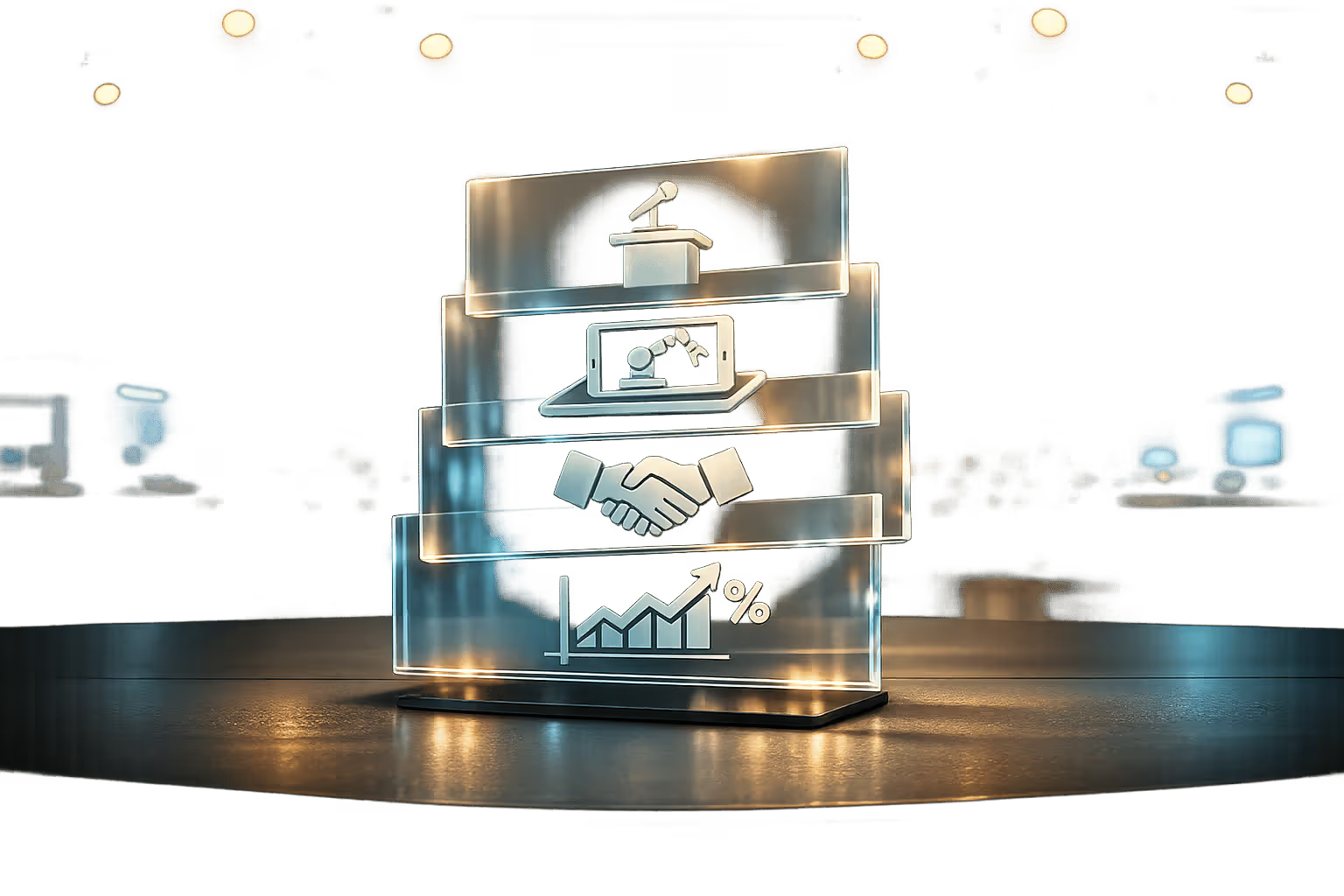
AI events are no longer just networking opportunities - they’re critical platforms for showcasing technology, forming partnerships, and influencing industry trends. Here’s how companies leverage these events for market positioning:
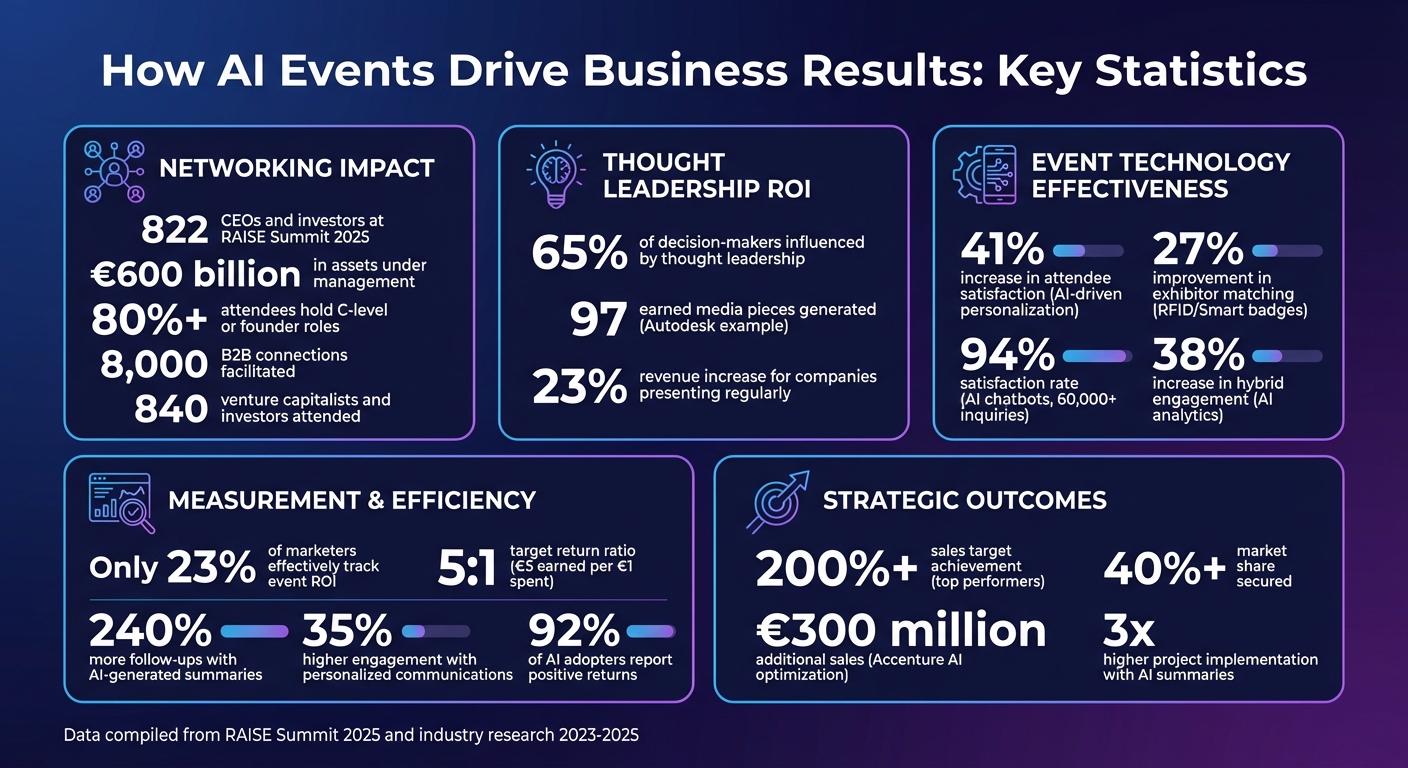
- Executive-Level Networking: Events like the 2025 RAISE Summit in Paris hosted 822 CEOs and investors managing €600 billion, fostering direct business outcomes.
- Thought Leadership: Companies secure speaking slots or sponsor sessions to position themselves as experts. For example, Autodesk generated 97 media pieces by focusing on research-driven leadership.
- Interactive Demos: Live showcases and workshops highlight practical solutions, such as Vultr’s AI workload deployment demo at RAISE 2025.
- Targeted Networking: VIP passes and AI-powered tools connect attendees with decision-makers, leading to partnerships and deals.
- ROI Measurement: Clear goals and AI tools help track leads, partnerships, and long-term impacts, ensuring efficient use of budgets.
AI conferences, like the upcoming RAISE Summit 2026 (8–9 July, Paris), combine expert-led sessions, hackathons, and exclusive networking to help companies solidify their market presence.
AI Event ROI Statistics and Impact Metrics for B2B Companies
Using AI For Event Marketing
sbb-itb-e314c3b
Building Thought Leadership at AI Conferences
Being present at AI conferences is just the starting point. To stand out, companies need to go beyond attendance by securing speaking opportunities and sponsoring educational sessions. This positions them as trusted experts, not just vendors. A great example is Autodesk, which pivoted to research-driven leadership and, in its second year, generated 97 pieces of earned media through its platform [8]. Why does this work? Because it gives executives what they crave most: clear guidance in a fast-changing industry.
"Good thought leadership shouldn't be talking about your products, but it should be leading someone down a path to your product." - Melissa Cavanaugh, Head of Content Strategy, Morgan Stanley [8]
Speaking Slots and Panel Participation
Getting a speaking slot at a major AI conference is like a badge of credibility - something regular advertising just can't match. But it’s not about showing up with generic commentary. Companies that excel in this space focus on hot-button issues, like regulatory challenges or workforce changes, and back their points with solid data [6][9]. In fact, 65% of decision-makers say thought leadership has directly influenced their purchasing decisions for significant engagements [6].
For technical leaders, these speaking opportunities are a golden ticket. When your CTO or AI lead takes the stage, it boosts your brand’s image and showcases your technical depth [7]. And the benefits don’t stop when the event ends. A single conference appearance can be repurposed into blog posts, LinkedIn updates, and video snippets, ensuring it keeps delivering value long after the event [6][8].
Timing is everything. Conference schedules are locked in months in advance, so early proposal submissions are non-negotiable [6]. Using your network - whether it’s investors, partners, or clients - to secure warm introductions to event organisers can also make a big difference in getting your pitch accepted [6].
Beyond speaking engagements, sponsoring sessions or tracks is another way to amplify thought leadership.
Session and Track Sponsorships
Sponsoring specific sessions or tracks at conferences allows companies to tie their brand to key industry conversations while offering educational value. However, broad topics like "AI for business" are less effective. Companies see better results by focusing on niche, industry-specific themes like "AI for regulatory compliance in banking" [12].
Take the RAISE Summit 2026, set for 8–9 July at Le Carrousel du Louvre, Paris. It structures its educational tracks using the "4F Compass" framework: Foundation, Frontier, Friction, and Future [10]. Sponsors can align with tracks like "Agentic Systems" or "The ROI Dilemma" to engage directly with builders, investors, or regulators, depending on the audience.
| RAISE Summit 2026 Track | Focus Areas | Target Audience |
|---|---|---|
| Foundation | Compute as Capital, Silicon Horizon, Energy-Compute Nexus | Builders & Investors |
| Frontier | Agentic Systems, AI Adoption Frameworks, Tokenomics | Innovators & Pioneers |
| Friction | ROI Dilemma, Cyber Resilience, Workforce Transformation | Regulators & Executives |
| Future | AGI Pathways, Sustainable AI, Multimodal Interfaces | Visionaries & Strategists |
The most impactful sponsors don’t just show up - they bring exclusive insights or proprietary data to the table. This transforms them from being just another vendor into a category leader [12]. Experts often refer to this as creating a "lighthouse effect", where authentic expertise helps a company stand out in a crowded field of AI content [14][15].
Building Strong Brand Experiences
Thought leadership grabs attention, but immersive brand experiences turn that attention into action. The best companies create spaces where attendees can interact with technology, making AI concepts feel real and accessible.
Today’s audiences expect more than generic product pitches. They want to see AI in action - how it works in practical scenarios and how they can interact with it. When done well, these experiences build trust, educate, and showcase a company’s capabilities. Below are examples of how live demos and interactive workshops leave lasting impressions.
Live Demonstrations and Practical Workshops
Live demonstrations are powerful because they show what’s possible right now. Take the 2025 RAISE Summit, for example. Vultr’s live demo highlighted seamless AI workload deployment across CPUs and GPUs, emphasizing their focus on practical, real-time solutions. Their booth also hosted sessions with partners like Koyeb and NetApp, showcasing how AI workloads can run without complex orchestration [3].
Daytona also made waves at the same event. Their booth became a hub of activity, demonstrating AI-generated code infrastructure. CEO Ivan Burazin even led a panel on autonomous workflows, underscoring how their AI agents operate securely and at scale [16].
"AI innovation happens faster when partners collaborate on infrastructure, tools, and services that are purpose-built for speed, scalability, and compliance."
– Vultr Blogs [3]
The most effective demos address real customer pain points - like infrastructure complexity or security - rather than just listing technical specs [12]. Workshops take this a step further by letting attendees try tools themselves, focusing on solving real-world challenges.
These hands-on experiences naturally lead to broader networking opportunities and measurable results.
Booth Design and Experiential Marketing
While live demos highlight capabilities, a well-designed booth can solidify a company’s market position. A booth’s design can either draw people in or leave it overlooked. Transparency and interactivity often make the difference. For instance, at the RAISE Summit in July 2025, Genesis Cloud partnered with Lenovo and Intel at booth #55 to display a Lenovo ThinkSystem SR780a V3 water-cooled server. By keeping the hardware open and visible, visitors could see cutting-edge cooling and processing in action - reinforcing Genesis Cloud’s reputation as a high-performance European AI cloud provider [5].
Incorporating smart technology can elevate these experiences even further. Events that use AI-driven personalization report a 41% boost in attendee satisfaction [11]. For example, RFID-enabled smart badges have improved exhibitor-attendee matching by 27% [11], while AI chatbots handling inquiries achieved a 94% satisfaction rate [11].
| Event Technology | Impact/Result | Source |
|---|---|---|
| AI-Driven Personalisation | 41% increase in attendee satisfaction | Bizzabo / 5W PR [11] |
| RFID/Smart Badges | 27% improvement in exhibitor matching | CES 2023 / 5W PR [11] |
| AI Chatbots | 94% satisfaction rate (60,000+ enquiries) | MWC 2023 / 5W PR [11] |
| AI Analytics | 38% increase in hybrid engagement | HubSpot / 5W PR [11] |
The best booths become lively hubs of activity, combining scheduled demos with partner presentations [3]. This strategy keeps foot traffic steady and creates multiple chances for deeper engagement with potential clients.
Building Networks and Partnerships
Creating strong brand experiences is just the beginning. The real game-changer comes when companies foster exclusive spaces for meaningful, high-level discussions. These tailored networking opportunities, often following immersive brand showcases, help solidify a company’s standing in the industry. AI conferences, in particular, attract decision-makers who have the authority to close deals - not just swap business cards. What sets these events apart is the ability to connect with top-tier attendees, including executives, investors, and policymakers who influence the direction of the industry.
Take the RAISE Summit in July 2025 as an example. Over 80% of its attendees held C-level titles, founder roles, or policymaking authority [1][2].
"The CxO Summit exists so companies don't just talk about AI, they leave RAISE with real partnerships, pilots, and signed deals."
– Hadrien de Cournon, Co-Founder, RAISE Summit [1]
This high concentration of executives calls for advanced networking strategies that turn conversations into actionable partnerships. Structured, high-value interactions are key to achieving measurable results.
Using Networking Tools and VIP Access
AI-powered tools make networking more efficient than ever. For instance, the RAISE Networking app allows attendees to pinpoint specific decision-makers - whether they’re industry leaders, policymakers, or investors - and book meetings even before the event kicks off [18].
VIP access takes this a step further. VIP ticket holders (priced at 1 899 € for early bird and 2 999 € for full price) gain entry to exclusive lounges designed for executive-level discussions, away from the hustle and bustle of the main exhibition. For those opting for the VIP MAX experience (3 499 € early bird, 4 599 € full price), opportunities expand further. These attendees are invited to the Versailles AI Gala, hosted in the private salons of the Château and L’Orangerie - a setting crafted for senior leaders. Additionally, the invitation-only CxO Summit, held in a secluded area of the Louvre, gathers Fortune 1000 executives for private benchmarking and partnership-building sessions [1].
| Feature | PRO Pass | VIP Pass | VIP MAX Pass |
|---|---|---|---|
| Networking App Access | Yes | Yes | Yes |
| VIP Lounge Access | No | Yes | Yes |
| Startup Pitch Decks | No | Yes | Yes |
| Versailles AI Gala | No | No | Yes |
| CxO Summit Access | No | Invitation-Only | Invitation-Only |
VIP attendees also gain early access to startup pitch decks and developer profiles, enabling them to identify potential collaborators and schedule productive meetings [18].
Private Events and Scheduled Meetings
The most impactful partnerships are often born outside formal sessions. Private dinners and curated social events provide a relaxed setting where trust can grow naturally. The Versailles VIP Dinner is a perfect example, blending timeless elegance with intimate conversation to position brands at the center of the AI ecosystem [17].
Beyond the official schedule, companies are increasingly hosting their own side events during conference weeks [4]. The RAISE Hackathon, which draws 7,000 to 8,000 developers tackling real-world industry challenges, is one such opportunity. It’s a win-win: organizations can scout emerging talent and innovators, while developers gain visibility with potential employers or collaborators [1][4].
These events aren’t just social gatherings - they’re strategic opportunities. Companies that approach them with clear goals, such as securing pilot programs, exploring joint ventures, or recruiting top talent, often see significant returns. Even after-hours events and soirées, organized through dedicated apps, can be as impactful as the formal sessions when it comes to building lasting business relationships [18].
Measuring Event ROI
AI conferences often consume a hefty chunk of marketing budgets - anywhere from 20% to 40%. Yet, only 23% of marketers effectively track ROI, and more than half of enterprise marketers struggle to calculate it clearly [20]. Given the complexity of B2B AI sales cycles, tracking everything from immediate outcomes like qualified leads to long-term impacts such as partnerships is essential. Without a solid framework, it’s tough to pinpoint which efforts truly drive growth.
Defining Clear Goals
The first step? Set specific, measurable goals. Metrics like Marketing Qualified Leads (MQLs), booth visits, and pilot program launches should be clearly defined. Vague objectives like "increase brand awareness" won’t cut it.
A good benchmark to aim for is a 5:1 return ratio - €5 earned for every €1 spent [19]. For instance, if your team invests €10,000 in VIP passes and booth space, your goal should be at least €50,000 in measurable returns. These returns could come from closed deals, operational efficiencies, or even strategic insights gathered during the event.
It’s also crucial to establish performance baselines before the event. Document things like how much time your team spends on manual reporting, the number of leads in your sales pipeline, and the average time it takes to close a deal. For example, if AI tools can cut post-event reporting time from 15–20 hours to just 2–3 hours [19], those time savings translate into cost reductions and faster follow-ups. Aligning goals across teams - sales, marketing, and leadership - ensures everyone is on the same page about what success looks like.
Once you’ve nailed down your goals, the next step is turning attendee interactions into actionable data.
Tracking Engagement and Conversion Data
With clear objectives in place, tracking detailed engagement data becomes the backbone of measuring event success. AI-powered tools now do more than just count attendees - they can track session attendance, time spent, questions asked, and even resources downloaded [22]. These insights help gauge genuine interest and guide follow-up efforts.
Integration with CRM and marketing automation systems is critical. This allows for multi-touch attribution, where you can follow a lead’s journey - from attending a conference panel to downloading a white paper and eventually requesting a demo weeks later.
| Metric Category | Key Performance Indicators | Business Impact |
|---|---|---|
| Financial | Cost per lead, customer lifetime value, direct revenue | Drives revenue growth and profitability |
| Engagement | Session attendance, content downloads, dwell time | Highlights interest and knowledge retention |
| Brand | Social media reach, media impressions, NPS | Strengthens market presence |
| Strategic | Pilot programs, partnerships, competitive insights | Offers long-term advantages |
| Operational | Time saved, reduced manual tasks | Improves efficiency and speeds execution |
For example, platforms like Snapsight showcase how AI can elevate event measurement. At TechWeek Singapore 2025, Snapsight Premium processed content from over 50 sessions for 10,000 attendees, delivering tailored insights. Engineers received technical guides, while sales teams got qualified leads with detailed context [22].
Events aren’t just about attendance - they’re about actionable insights. Without tools to reinforce learning, attendees typically retain less than 10% of what’s presented [19]. However, organisations using AI-generated summaries see three times higher project implementation rates compared to those relying on manual notes [19]. Metrics like content engagement and follow-up effectiveness can clearly demonstrate an event’s value.
Personalised follow-ups also yield impressive results. Sales teams using AI-generated summaries initiated 240% more follow-ups, and tailored communications based on AI insights achieved 35% higher engagement rates compared to generic outreach [19]. Tracking these follow-up efforts and how quickly they move opportunities through the sales pipeline provides concrete proof of ROI.
Beyond leads, events can offer strategic insights. Monitoring how quickly your team identifies industry trends or competitor moves can shape product roadmaps and marketing strategies. This kind of intelligence often holds long-term value, far beyond individual metrics. Notably, 92% of early AI adopters report positive returns on their projects [19], underscoring the potential of precise ROI measurement.
Take the RAISE Summit 2025 as an example. It facilitated 8,000 B2B connections and drew 840 venture capitalists and investors [21]. Tracking which connections turn into partnerships, pilot programs, or investment opportunities offers a clearer picture of ROI than just counting business cards.
"RAISE exists to... translate ambition into real-world outcomes with a focus on ROI and a palpable evolution of deals and pilot programmes."
– RAISE Summit [2]
Finally, standardising data collection processes is key. Use consistent naming conventions for sessions and speakers, and validate data at every step. Poor-quality data can lead to a 30% failure rate in event analytics [22], undermining your efforts. Clean, structured data ensures accurate tracking and provides actionable insights to refine future event strategies. With these measurement tools in place, events like the RAISE Summit can become powerful drivers of sustained business growth.
Conclusion
AI conferences like the RAISE Summit have become pivotal platforms for companies to establish their presence and influence in the market. The most impactful organisations blend several approaches: thought leadership through speaking engagements, brand exposure via live demonstrations and hackathons, and targeted networking made possible by AI-driven matchmaking and exclusive forums. Together, these elements create a lasting impression that extends well beyond the event itself.
The numbers back this up. Companies that regularly present at events see a 23% increase in revenue [23]. Meanwhile, AI-optimised strategies enable top performers to surpass 200% of their sales targets and secure over 40% of the market share [24]. For example, in 2024, Accenture leveraged AI-powered data optimisation to cut its insight lag from five months to just five weeks, resulting in an additional €300 million in sales - all without increasing its media budget [13]. These results underscore the importance of tracking performance and refining strategies based on measurable outcomes.
Clear metrics make all the difference. By setting defined KPIs and closely monitoring engagement, businesses can distinguish between impactful participation and wasted resources. This disciplined approach ensures that every euro invested delivers value and informs smarter decisions.
The upcoming RAISE Summit 2026, set for 8–9 July at Le Carrousel du Louvre in Paris, exemplifies these strategies in action. With expert-led presentations, cutting-edge demos, and exclusive networking opportunities, the event offers a comprehensive platform for showcasing AI leadership. Highlights include invitation-only sessions, a hackathon involving thousands of developers, and a €5 million startup competition. These features make the Summit a prime opportunity to position your brand at the forefront of AI advancements [1][4].
FAQs
How do I get a speaking slot at RAISE Summit?
To get a speaking slot at the RAISE Summit, you’ll need to submit an application through the official form on their website. Since applications are reviewed continuously, it’s a good idea to apply as early as possible.
Another option is a sponsored speaking slot, which guarantees stage time as part of a sponsorship package. Just make sure your presentation aligns with the event’s theme, and take the time to fill out your application carefully to boost your chances.
What should I demo to attract decision-makers at RAISE?
To capture the attention of decision-makers at the RAISE Summit, focus on presenting AI solutions that solve pressing business challenges and deliver measurable outcomes. For instance, showcase tools like real-time personalization features - such as intelligent matchmaking or tailored agendas - that enhance event experiences. Share compelling case studies or working prototypes to illustrate how your AI can enable quicker project rollouts, improve hiring processes, or boost competitive positioning. Emphasize clear, impactful benefits that align with the priorities of top executives.
How can I prove event ROI beyond counting leads?
To truly show ROI beyond just counting leads, leverage AI tools to monitor attendee engagement, session participation, and the impact of networking activities. Dive deeper by evaluating results such as brand visibility, shifts in industry perception, and the partnerships established during the event. After the event, analyze follow-up actions and engagement campaigns to gauge improvements in customer retention and market positioning. By blending both qualitative insights and hard numbers, you can paint a clearer picture of strategic growth and influence, offering a more comprehensive understanding of the event's success.
Related Blog Posts
- Top 5 Benefits of Attending AI Industry Events
- AI Events for Partnership and Ecosystem Building
- A Decision Framework for Selecting AI Events in Europe Should You Attend One Major AI Summit or Several Smaller Ones? When Is the Right Time to Attend an AI Conference in Your Company’s Growth Journey? How Many AI Events Should Executives Attend Each Year?
- Key Signals to Look For Large AI Conferences vs Curated Executive Forums