
Europe and North America dominate the AI event space, but their approaches are very different. Europe focuses on ethics, regulations, and practical applications, while North America emphasizes technical advancements, private-sector leadership, and scaling innovations. Here's what you need to know:
- Europe: Events like RAISE Summit in Paris highlight ethical AI, cross-industry collaboration, and compliance with frameworks like the EU AI Act. Public funding drives initiatives, with strong ties to healthcare, manufacturing, and public services.
- North America: Conferences such as NVIDIA GTC and Ai4 focus on cutting-edge technologies, hardware-software integration, and rapid market growth. These events are powered by private investments and attract developers, startups, and entrepreneurs.
Quick Comparison:
| Aspect | Europe | North America |
|---|---|---|
| Focus | Ethics, regulations, practical use | Technical innovation, scaling |
| Key Events | RAISE Summit, EurIPS | NVIDIA GTC, Ai4 |
| Funding | Public funding, EU initiatives | Private-sector investments |
| Audience | Policymakers, researchers | Developers, startups |
| Ticket Costs | From €495 | From €1,695 |
Choose European events for regulatory insights and societal impact. Opt for North American conferences if you're seeking advanced technologies and commercialization opportunities.
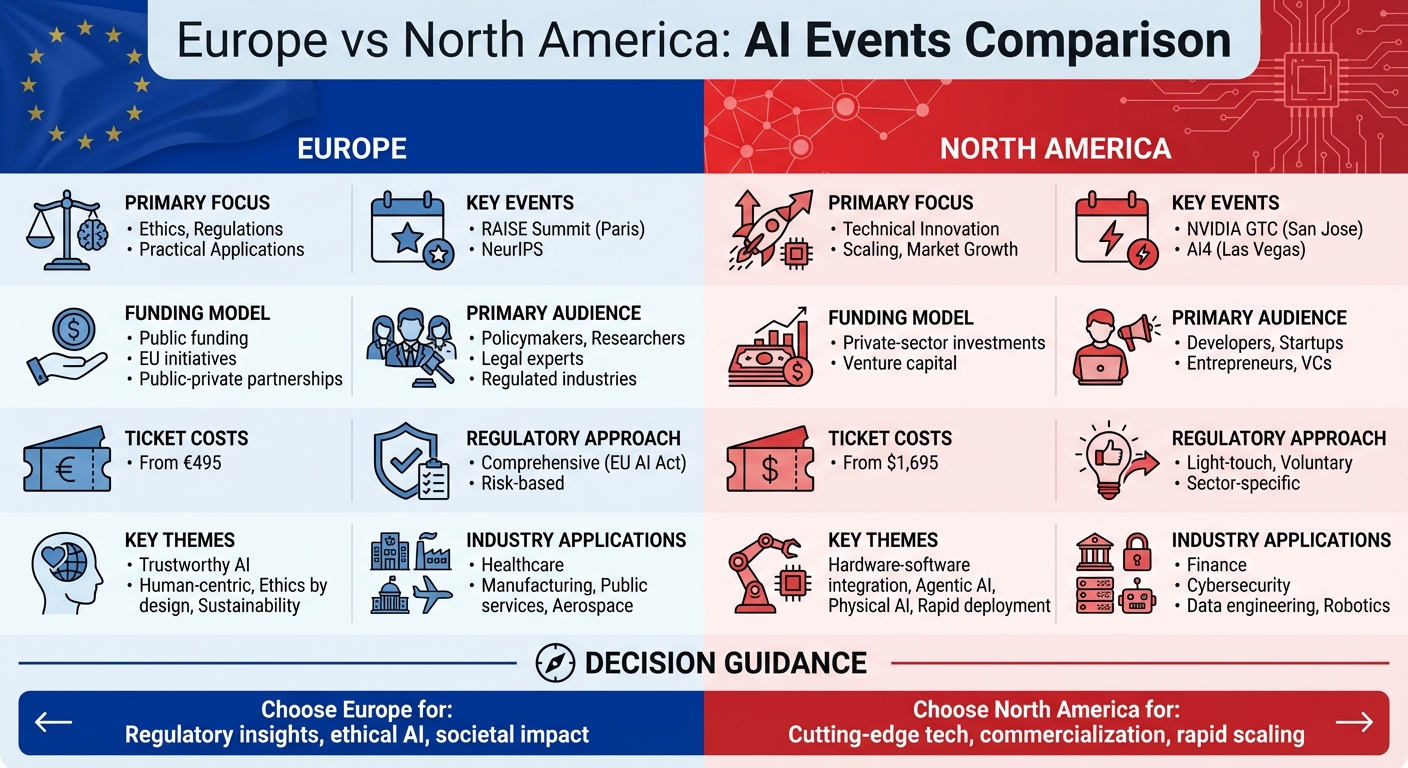
Europe vs North America AI Events: Key Differences in Focus, Funding, and Audience
Europe's AI Event Landscape: Collaboration and Policy Focus
RAISE Summit: Paris-Based AI Conference
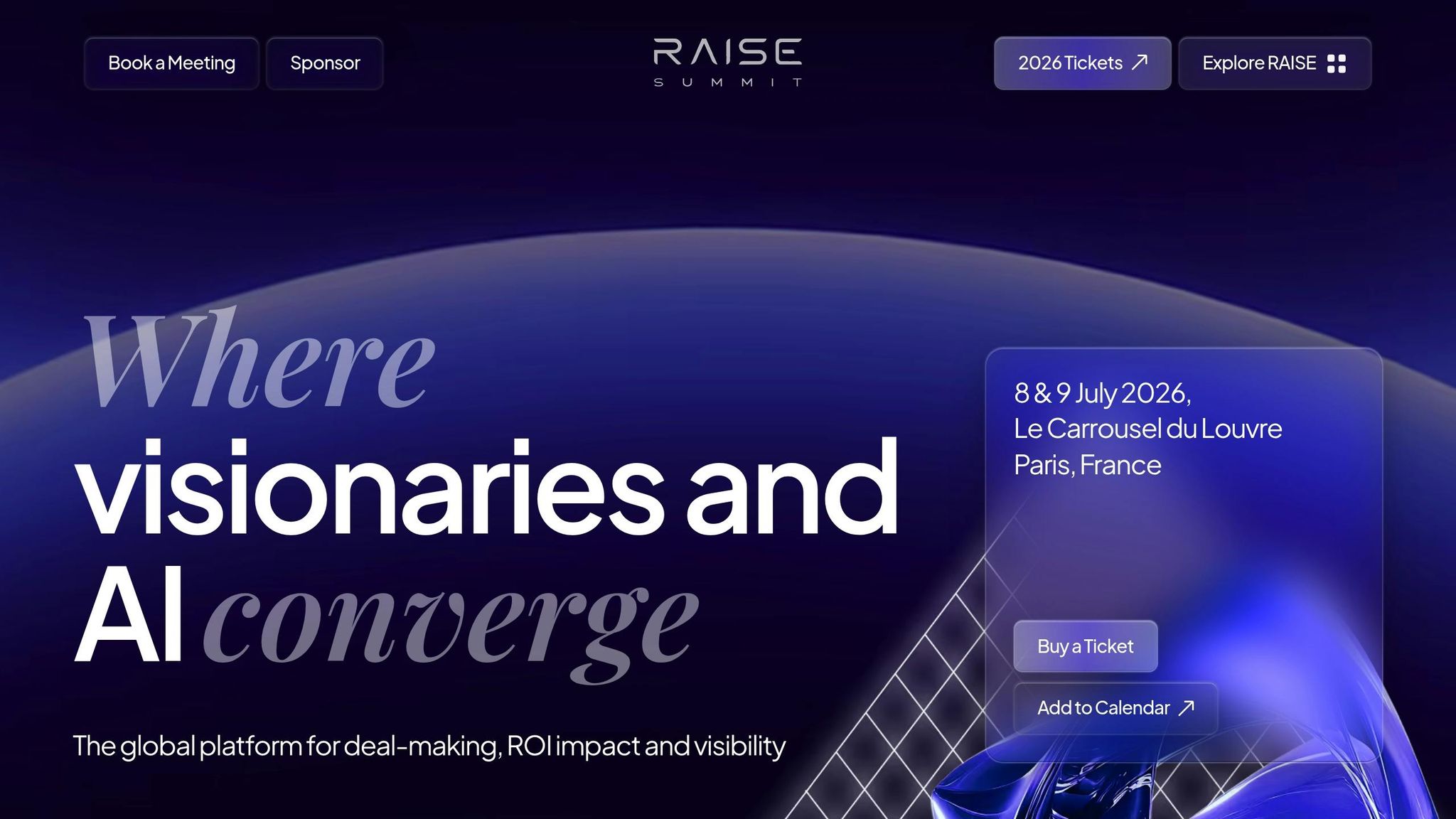
The RAISE Summit, held at the Carrousel du Louvre in Paris, brings together over 9,000 attendees, 2,000 companies, and 350 speakers. This event unites policymakers, researchers, and industry leaders to explore AI's role in shaping society.
In February 2025, during the Paris AI Action Summit - a key event aligned with RAISE's mission - French President Emmanuel Macron, along with industry partners, unveiled Current AI, a public interest foundation. This initiative launched with an initial funding of $400 million, aiming to raise $2.5 billion over five years to support open-source AI tools and high-quality datasets [10][12]. Another notable announcement was the ROOST (Robust Open Online Safety Tools) project, which brings together tech leaders to create free, open-source tools for online safety [10].
The summit also showcased partnerships bridging AI innovation and traditional industries. For example, Mistral AI, a French startup, teamed up with Helsing, a European defence tech company, to develop vision–language–action models for defence applications. This collaboration highlights how the event fosters connections across diverse sectors [10]. The 2025 summit attracted representatives from around 100 countries, over 1,000 startups, and leading tech figures [15].
RAISE's emphasis on ethical AI and cross-industry innovation reflects the broader themes of Europe's AI events.
European Event Themes: Policy, Ethics, and Cross-Industry Applications
European AI conferences heavily focus on "trustworthy AI" and "ethics by design", promoting human-centric development, safety, and accountability [10][11]. At the 2025 Paris summit, 60 countries, including China, France, and India, signed a "Statement on Inclusive and Sustainable AI." Notably, the US and UK chose not to sign [10][13]. This push for global consensus on ethical AI sets European events apart.
The theme of "AI for the common good" is evident in initiatives targeting areas like child protection, environmental concerns, and worker inclusion [9][1]. For example, a coalition of 15–20 stakeholders was formed at the French Consulate in San Francisco to ensure AI products uphold minors' rights [9].
Key industries represented at these events include healthcare (e.g., clinical trials, diagnostics), manufacturing, aerospace, automotive, energy, and finance - sectors where Europe has established expertise [14][16][17]. Practical applications discussed range from reducing teacher workloads to expediting insurance claims and improving public services [15][16]. Additionally, the creation of "Thematic Networks of Excellence" aims to consolidate talent, computational resources, and data across EU member states, addressing research fragmentation [11].
At the RAISE Summit, attendees witness these priorities in action through sessions that emphasize ethical AI solutions and cross-industry collaboration.
sbb-itb-e314c3b
North America's AI Event Landscape: Scale and Technical Focus
Major Events: NVIDIA GTC and Ai4
North America is home to some of the largest AI events in the world, offering unparalleled scale and reach. Take Ai4 in Las Vegas, for example, which is set to host over 12,000 attendees, 1,000 speakers, and 400 exhibitors in 2026 [2]. This conference is known for its diverse content tracks tailored to industries like finance, healthcare, and cybersecurity. Tickets start at $1,695 (about €1,570) [2][6].
Another standout is NVIDIA GTC in San Jose, which shines a spotlight on GPU-accelerated computing, CUDA, and advancements in AI hardware [18][6]. Dubbed the "Woodstock of AI" by Bank of America and called "the single most important event in the history of the technology industry" by SiliconANGLE theCUBE for its 2024 edition, GTC is a magnet for global audiences [18]. Tickets begin at $2,172 (approximately €2,010), drawing attendees eager to experience the latest hardware and software innovations firsthand [2].
These events not only highlight the massive scale of North American conferences but also their commitment to pushing the boundaries of technical innovation.
The AI Conference and Data + AI Summit
The Databricks Data + AI Summit in San Francisco is another key player, expecting over 20,000 attendees and offering more than 700 technical sessions [2]. This event focuses on cutting-edge areas like data engineering, Apache Spark, and LLMOps, showcasing the intersection of data infrastructure and AI platforms.
On the research side, NeurIPS 2025 in San Diego drew over 13,000 participants [5], while CVPR 2025 in Nashville welcomed more than 7,500 attendees, all focused on computer vision and pattern recognition [5]. These gatherings highlight the region's ability to balance research-driven events with industry-oriented summits, emphasizing advanced, production-ready AI solutions.
North American Event Themes: Technical Depth and Industry Applications
North American AI events are defined not just by their size but by their focus on technical depth and real-world applications. For instance, Machine Learning Week prioritizes transitioning AI from experimental pilot programs to fully operational systems [20]. Key themes for 2026 include "Agentic AI" (autonomous agents with reasoning and action capabilities) and "Physical AI" (robotics and industrial digitalization) [18][19].
"2026 marks the shift from AI hype to real-world integration" – Best AI Events [8]
These conferences often feature interactive expo floors and hackathons, providing attendees with hands-on experiences with the latest technologies. The focus on hardware-software integration is clear, as events frequently debut new AI chips alongside open-source optimization tools, creating complete, functional ecosystems [21].
Europe vs North America: Direct Comparison
Event Themes and Focus Areas Compared
AI events in Europe and North America take distinctly different approaches, reflecting their unique regional philosophies. In Europe, conferences often revolve around "trustworthy" and "human-centric" AI, with a heavy emphasis on the EU AI Act, which is set to take full effect by 2 August 2027 [22]. These events frequently position smart regulation as an advantage, promoting the alignment of technology with democratic principles.
Meanwhile, North American events lean heavily on technical innovation and private-sector leadership. The emphasis here is on deregulation to encourage fast-paced experimentation. As US Vice President JD Vance put it:
"We need international regulatory regimes that foster the creation of AI technology rather than strangle it" [1].
Another key difference lies in funding. Europe benefits from public support, while North America relies more on private-sector investments [1]. These contrasting approaches influence not just the themes of these events but also the types of audiences they attract.
| Aspect | Europe | North America |
|---|---|---|
| Primary Theme | Ethics, policy, and trustworthy AI [22][23] | Innovation, scale, and global dominance [22][23] |
| Regulatory Approach | Comprehensive (EU AI Act), risk-based [22] | Light-touch, sector-specific, voluntary [23] |
| Innovation Driver | Public–private partnerships, academic research [22][23] | Venture capital, private-sector giants [23] |
| Infrastructure Focus | Sustainability, energy efficiency, "AI Factories" [22][3] | Energy dominance, rapid data centre build-out [22] |
These differences in focus and philosophy directly shape the attendee demographics at these events.
Regional Priorities and Professional Alignment
The priorities of each region also influence the professional communities that gravitate toward their events. European conferences are a natural fit for individuals in policy, regulation, and compliance. These events attract legal experts, policymakers, and professionals from regulated industries such as healthcare and public services [22][3]. European Commission President Ursula von der Leyen highlighted this focus, stating:
"Bringing AI to industry-specific applications and harnessing its power for productivity and people. This is where Europe can truly lead the race" [1].
On the other hand, North American events primarily draw developers, researchers, and startups eager to scale quickly and commercialise their innovations [23][2]. Venture-backed entrepreneurs and market disruptors find these gatherings particularly appealing.
In short, professionals focused on compliance, ethics, or regulatory frameworks will likely find European events more relevant. Conversely, those prioritising cutting-edge innovation and rapid market entry will feel more at home in North American conferences.
Conclusion: Selecting the Right AI Event
Main Differences Between European and North American AI Events
When it comes to AI events, the differences between Europe and North America are stark, and they reflect the regions' contrasting approaches to innovation and regulation. North American conferences lean heavily toward private-sector initiatives, focusing on rapid implementation and global tech leadership through minimal regulation [22]. These events are a magnet for venture-backed entrepreneurs, developers, and researchers who thrive in fast-paced, innovation-driven environments.
On the other hand, European AI events prioritize "trustworthy" and "human-centric" AI, shaped by comprehensive regulatory frameworks like the EU AI Act [22][3]. These gatherings bring together policymakers, researchers, and industry leaders to tackle ethical concerns, sustainability, and practical applications in fields such as healthcare and manufacturing. These distinct priorities not only define the events themselves but also influence how professionals should approach choosing the right one.
Practical Tips for Event Selection
Navigating these differences is essential for aligning your event choice with your career goals and professional needs.
- Align with your career objectives: If you're seeking deep technical insights into areas like hardware, model training, or data engineering, North American events such as NVIDIA GTC (from €2,172) or Ai4 (from €1,695) might be the right fit. Meanwhile, European events are ideal for professionals needing guidance on regulatory frameworks like the EU AI Act or GDPR compliance, particularly as these regulations are set to be fully enforced by 2 August 2027 [22][2].
- Factor in costs and accessibility: For European professionals, attending North American events can be costly due to higher travel and accommodation expenses [7]. Regional European conferences often offer similar networking opportunities at more affordable prices. For instance, the AI World Congress in London starts at £495 for early bird tickets [2]. Additionally, virtual options like the free access provided by the SANS AI Cybersecurity Summit are worth considering for those on tighter budgets [2].
- Assess the networking vibe: North American events often have a high-energy, "founder mode" atmosphere, driven by venture capital and a focus on rapid market entry [4][23]. In contrast, European conferences foster a more collaborative and research-oriented environment, featuring strong academic involvement and public-private partnerships [22][3].
AI Action Summit: Can Europe catch up with the US and China? • FRANCE 24 English
FAQs
Which region’s AI events best match my role?
The best region for AI events depends on what you’re looking to achieve professionally. If academic research and innovation are your priorities, European events like the European AI Forum or NeurIPS are excellent choices. These gatherings often emphasize cutting-edge studies and discussions around regulation.
On the other hand, if you’re more interested in industry-focused roles, North American events such as NVIDIA GTC or Google Cloud Next are hard to beat. They offer practical workshops, networking opportunities, and insights from leading tech companies, with a strong focus on real-world applications and deployment.
Europe leans toward research and policy, while North America is all about implementation and scaling.
How should I prepare for EU AI Act and GDPR discussions at events?
To get ready for discussions on the EU AI Act and GDPR, it's crucial to grasp Europe’s approach to AI governance. The focus lies in finding a balance between encouraging innovation and ensuring safety and trust in AI technologies. Take time to review the latest policy updates, including the EU AI Act, and consider how these might shape the future of AI development.
Stay ahead by participating in relevant conferences and diving into official documents. Engaging with industry experts can provide valuable insights, and understanding regional nuances in data privacy will position you to contribute effectively to these conversations.
What’s the best way to network effectively at large AI conferences?
To make the most of networking opportunities at large AI conferences, immerse yourself in workshops, panel discussions, and casual meetups where genuine connections can blossom. Focus on events that include networking sessions or specialised industry gatherings, as these create ideal settings for direct, one-on-one conversations.
Leverage LinkedIn to connect with other attendees and speakers - not just after the event, but before and during as well. Come prepared with thoughtful questions, be ready to share your own insights, and don’t forget to exchange contact details. These small steps can pave the way for lasting professional relationships.