

AI events showcase the industry's evolution - from research-focused discussions to business-driven strategies. These gatherings reveal trends, challenges, and future directions, making them essential for professionals navigating this fast-changing field. Here’s what you need to know:
- AI's Journey: Early conferences (1990s–2010s) centered on neural networks and foundational research. By the mid-2010s, focus shifted to scalable applications in industries like healthcare and finance. Today, the spotlight is on autonomous systems, generative AI, and multimodal models.
- RAISE Summit 2026: Scheduled for 8–9 July in Paris, it highlights key themes like agentic systems, AI energy demands, and sector-specific advancements (e.g., genomics, autonomous trading). Over 9,000 attendees - including 80% C-level executives - will explore actionable insights, partnerships, and cutting-edge solutions.
- Key Takeaways for Professionals: AI events provide direct access to emerging trends, exclusive forums for decision-makers, and opportunities like hackathons and startup competitions (€5M prize pool). They’re not just for learning but for forming partnerships and driving results.
Whether you're a developer, policymaker, or executive, attending these events ensures you're not only informed but actively shaping AI's future.
NeurIPS 2024 Conference Overview: Key AI Trends & Breakthroughs (Part 1 of 12)
sbb-itb-e314c3b
How AI Events Have Changed Over Time
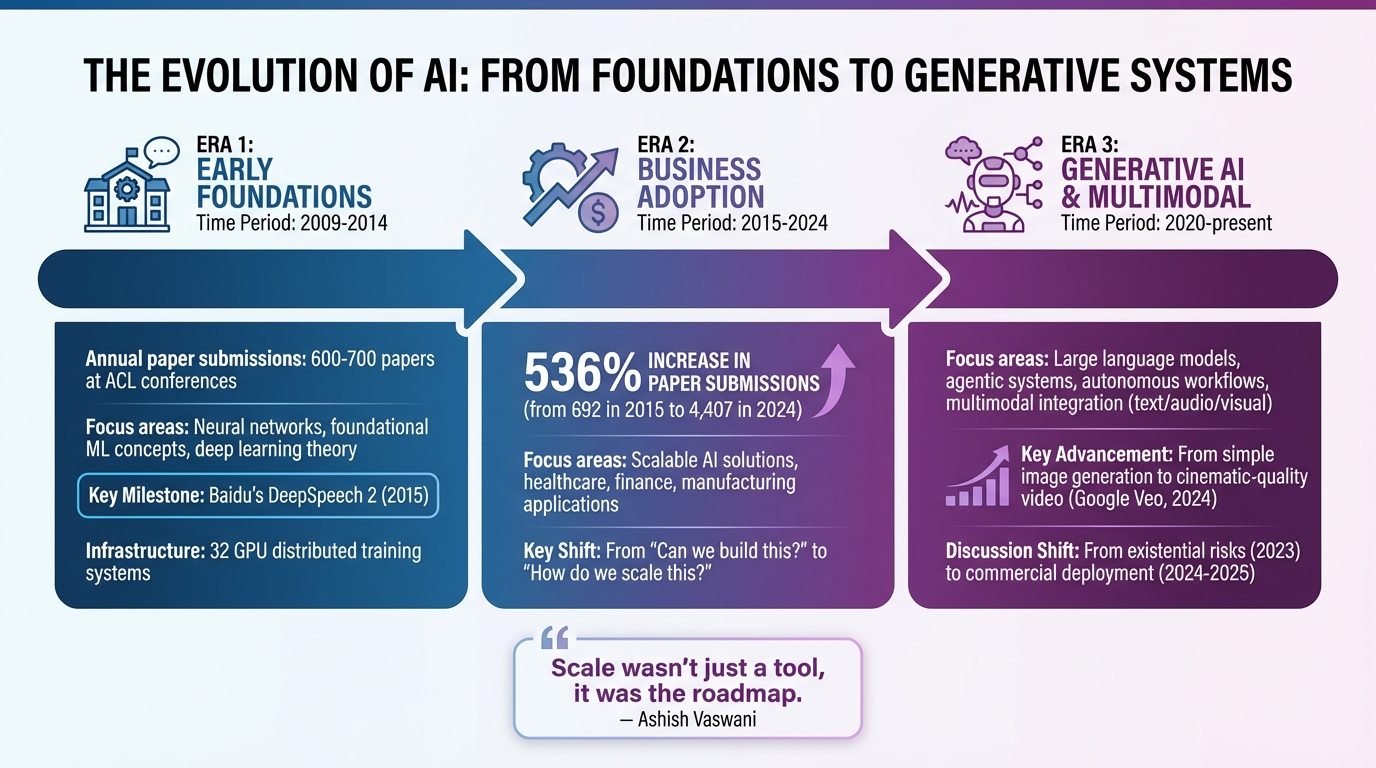
Evolution of AI Events and Focus Areas from 1990s to 2020s
Academic debates about neural networks have transformed into strategic discussions about infrastructure and commercial applications, showcasing AI's journey from research labs to boardrooms and policy discussions.
Early Foundations and First Advances (1990s–2010s)
Between 2009 and 2014, AI conferences like those hosted by the Association for Computational Linguistics (ACL) saw steady submission numbers, hovering around 600 to 700 papers annually [7]. During this time, the focus was on foundational machine learning concepts, neural network theories, and the first steps in deep learning research. Distributed training systems, which were limited to setups of just 32 GPUs, were a hot topic. These discussions laid the groundwork for achievements such as Baidu's DeepSpeech 2 in 2015, which advanced speech recognition [6]. This period set the stage for AI to move from theoretical exploration to more application-focused conversations.
Business Adoption and Practical Uses (Mid‑2010s)
The mid‑2010s marked a shift as conferences began emphasizing scalable AI solutions and their practical applications in industries like healthcare, finance, and manufacturing. Submissions to ACL long-paper tracks skyrocketed by 536%, growing from 692 in 2015 to 4,407 by 2024, reflecting the surge in commercial interest [7]. Conference agendas pivoted from theoretical explorations to real-world implementations, with case studies showcasing neural language models in production environments. The key question evolved from "Can we build this?" to "How do we scale this?" - a clear indicator that AI had moved from experimental phases to becoming a core part of business strategies.
As AI advanced, the focus gradually turned toward generative and multimodal capabilities, reflecting its growing maturity.
Generative AI and Multimodal Systems (2020s)
In the 2020s, generative AI and large language models have taken center stage at AI events. Back in 2014, AI struggled with simple image generation tasks. Fast forward to 2024, and systems like Google Veo can now produce cinematic-quality videos with rich, high-fidelity sound [6]. Ashish Vaswani, co-author of the groundbreaking Transformer paper, summed up this evolution by stating:
"Scale wasn't just a tool, it was the roadmap" [6]
Conferences today explore topics like agentic systems capable of autonomous workflows, unified multimodal models that integrate text, audio, and visuals seamlessly, and the energy demands of cutting-edge AI infrastructure [6]. The focus has shifted dramatically - existential risks dominated discussions in 2023, but by 2024 and 2025, the urgency lies in commercial deployment [6]. Nathan Benaich, founder of RAAIS, captured this transformation perfectly:
"The last ten years has been a story of 'gradually, then suddenly'" [6]
These developments highlight not only the rapid technical strides AI has made but also the shifting priorities reflected in the agendas of AI events.
RAISE Summit: Current AI Trends in Focus
The 2026 RAISE Summit captures the ever-evolving AI landscape, moving from early theories and initial business adoption to today’s cutting-edge advancements in generative AI.
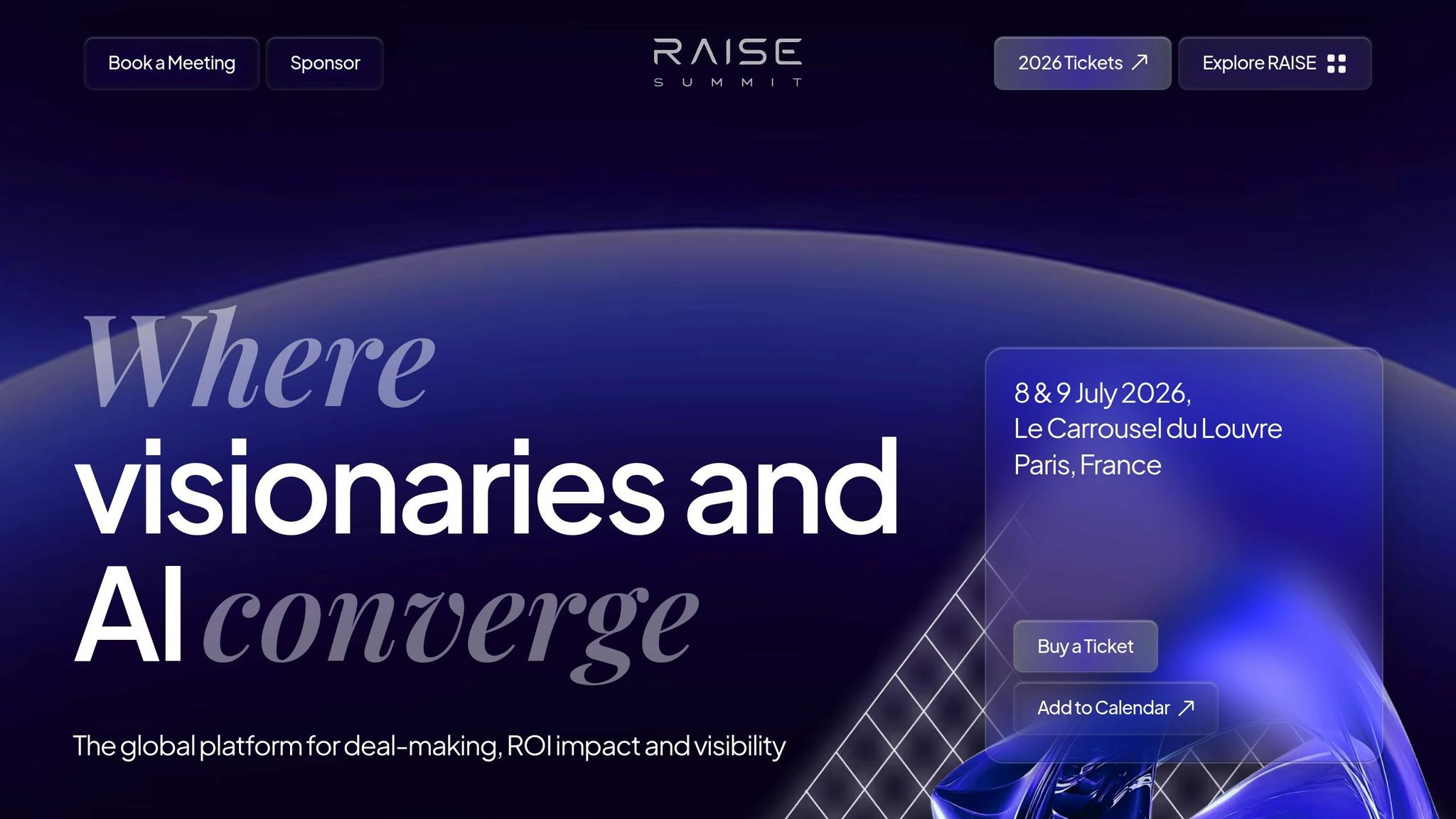
Set to take place on 8–9 July 2026 at Le Carrousel du Louvre in Paris, the summit will host over 9,000 attendees and feature more than 350 speakers addressing the key challenges shaping AI today [2] [5]. Reflecting the industry's shift toward tangible results and measurable ROI, the event is more than just a gathering - it's a snapshot of where AI stands. As Eric Schmidt, former CEO and Chairman of Google, aptly put it:
"The fastest‑growing AI Tech conference in Europe, and maybe in history" [2]
These elements set the stage for an exploration of the summit's thematic focus and its unique opportunities.
Main Topics at RAISE Summit 2026
The summit's agenda is built around the "4Fs" framework - Foundation, Frontier, Friction, and Future - covering AI infrastructure, transformative applications, challenges, and long-term visions [2]. A key focus is on agentic systems and autonomous task execution, signaling the shift from generative AI to solutions capable of performing tasks independently [2]. Another critical area is the Energy-Compute Nexus, addressing the enormous power demands of modern AI systems [2].
Industry-specific innovation takes center stage through dedicated tracks. Healthcare sessions delve into genomics and personalized medicine, while finance tracks explore autonomous trading systems. On 7 July, the Machina Summit spotlights Physical AI, including humanoid robots, industrial autonomy, and robotics, showcasing AI’s integration into physical machines [8]. Cybersecurity is another major focus, with the "Cyber Resilience Challenge" tackling AI-driven threats [2].
For senior executives, the CxO Summit offers an invitation-only platform designed to turn AI ambitions into actionable partnerships. As Hadrien de Cournon, Co-Founder of RAISE Summit, explained:
"The CxO Summit exists so companies don't just talk about AI, they leave RAISE with real partnerships, pilots, and signed deals" [5]
What RAISE Summit Offers Attendees
The summit combines thought leadership with hands-on collaboration opportunities. Over 80% of attendees are C-level executives, founders, investors, or policymakers [2] [5]. The RAISE Hackathon, drawing 7,000 developers, is the largest AI-focused hackathon globally, boasting a €200,000 prize pool [2] [5]. Meanwhile, the Startup Competition offers an impressive €5 million prize pool for emerging AI-native startups.
Networking is a key focus, with an AI-powered matchmaking platform enabling high-value, one-on-one meetings for executives [5]. The partnership with Paris Blockchain Week offers a unique "RAISE x PBW bundle", connecting leaders in AI and digital assets [9]. For those seeking exclusive experiences, VIP MAX ticket holders gain access to the Versailles AI Gala dinner, an event attended by executive leaders [9].
RAISE Summit Ticket Options and Requirements
| Ticket Tier | Price (excl. VAT) | Key Features |
|---|---|---|
| PRO | €999 | Exhibition floor access, stages/workshops, Startup Competition, networking app, official party invite [9] |
| VIP | €1,899 | All PRO features, plus VIP lounge access, Machina Summit entry, startup pitch decks, industrial AI trend report [9] |
| VIP MAX | €3,499 | All VIP features, plus access to the Versailles AI Gala dinner with executive leaders [9] |
| MACHINA | €699 | Full-day access to the Machina Summit, including talks, robot showcases, and live demos [8] [9] |
The ticketing structure ensures there’s something for everyone - developers and startups can participate for €599 with validated applications, while executives can opt for more comprehensive access and exclusive networking opportunities [9].
What AI Events Tell Us About AI's Future
AI events have always been a reflection of the industry's evolution, setting new standards and priorities. Today, these gatherings highlight the shift from advanced models to autonomous systems, strategic infrastructure, and the rising energy demands tied to AI. These focus areas are directly influencing where investments, research efforts, and policy decisions are headed.
New Areas of Focus in AI Development
The concept of agentic AI, which refers to systems capable of autonomous decision-making and workflows, is no longer just theoretical. It's becoming a practical reality. Discussions around "agents" are growing, signaling a transformation in how operational frameworks are designed. Sam Altman, CEO of OpenAI, emphasized the importance of this shift:
"I think the companies that are not set up to be able to adopt AI coworkers very quickly, will be at a huge disadvantage" [10].
Another emerging focus is spatial intelligence. This area deals with AI's ability to understand and interact with the physical world in dimensions ranging from 3D to 4D. As Dr. Fei-Fei Li, Co-Director of Stanford HAI, noted:
"The capacity to understand, reason, interact with, and navigate the physical 3D to 4D world is the foundation - as foundational as language intelligence" [10].
Sovereign AI is also gaining traction, where computing power is increasingly viewed as a form of strategic capital. This shift emphasizes the importance of "Algorithmic Independence" in developing AI infrastructure [1] [4] [3].
These areas are not just influencing technological advancements but are also shaping the standards and frameworks that define the industry.
How AI Events Influence Industry Standards
AI conferences are playing a pivotal role in shaping industry practices and policies. For example, a recent summit introduced the AI Energy Score, a standardized system that rates model efficiency on a scale from 1 to 5 stars. During the event, 166 AI models were tested, with some setting benchmarks for text generation efficiency [11]. This initiative provides a transparent way to measure and compare the environmental impact of AI technologies.
At the same event, 61 countries signed an AI Declaration, though the US and UK notably abstained. Additionally, six national data protection authorities agreed to work on unified legal standards for AI data usage and privacy [11] [13]. These agreements highlight how such events are moving from theoretical discussions to actionable regulatory frameworks.
The European Commission also announced €50 billion in public funding for AI-related digital infrastructure [12]. This investment reflects the growing importance of AI in shaping the future of technology and governance. Through initiatives like these, AI events are laying the groundwork for the ethical, technical, and regulatory standards that will guide the industry's next steps.
Conclusion: Using AI Events to Stay Current
AI's fast-paced evolution makes these events more than just conferences - they're now arenas where the industry's future is actively shaped. Frameworks like the "4F Compass" help professionals navigate shifts in infrastructure, regulations, and technology trends [1]. These summits aren't just about observing changes; they’re about setting strategies, securing investments, and building partnerships that turn ideas into measurable results.
The impact goes beyond strategic insights. These gatherings foster meaningful connections among industry leaders, creating opportunities for high-stakes collaborations that go far beyond typical networking. As Hadrien de Cournon, Co-Founder of RAISE Summit, explains:
"The CxO Summit exists so companies don't just talk about AI, they leave RAISE with real partnerships, pilots, and signed deals" [5].
Main Lessons for AI Professionals
Here are some key takeaways for professionals navigating the AI landscape:
- Engaging directly with leaders and policymakers: These events help attendees get ahead of regulatory and infrastructure changes. Exclusive tracks like the CxO Summit allow professionals to benchmark their strategies against Fortune 1000 companies, covering topics such as enterprise adoption and security reliability [5].
- Hands-on innovation through developer ecosystems: Events like the RAISE Hackathon, which attracts 7,000 developers, and the Startup Competition with its €5 million prize pool, provide a front-row seat to cutting-edge solutions. These platforms not only highlight emerging technologies but also help organisations spot new talent and test innovative ideas [2][5].
- Strategic connections through broader participation: Beyond keynote sessions, workshops, and AI-powered networking tools create opportunities for impactful one-on-one meetings. With over 80% of RAISE attendees being C-level executives, founders, investors, or policymakers, the event design ensures that these interactions lead to real business outcomes [2][5].
These events are no longer just about keeping up - they're about staying ahead, driving innovation, and turning connections into results.
FAQs
What’s the difference between generative AI and agentic AI?
Generative AI focuses on producing new content - whether it's text, images, videos, or even code - by identifying and replicating patterns found in the data it has been trained on. On the other hand, agentic AI takes things a step further. It doesn't just create; it makes independent decisions and carries out tasks on its own. Think of virtual assistants or self-driving cars - these are examples of agentic AI in action. This type of AI emphasizes reasoning, planning, and autonomous actions, moving towards systems that require very little human intervention.
How can I choose which RAISE Summit tracks are most relevant to my role?
To navigate the RAISE Summit effectively, use the 4F Compass: Foundation, Frontier, Friction, and Future. Each track is tailored to specific areas of interest:
- Foundation: Focuses on core AI technologies and their applications.
- Frontier: Explores cutting-edge research and advancements.
- Friction: Addresses ethical dilemmas and regulatory challenges.
- Future: Looks ahead to trends and strategic opportunities.
Think about your role - whether you're a builder, investor, policymaker, or innovator - and choose the tracks that best align with your goals and priorities. This approach ensures you get the most out of the event.
How do AI events influence real-world standards and regulation?
AI events such as the RAISE Summit play a key role in shaping standards and regulations by uniting policymakers, industry experts, and researchers to tackle critical topics like AI governance, safety, and ethics. These gatherings create a platform for discussions on best practices, potential risks, and the importance of international collaboration, ultimately influencing how regulations evolve. Beyond their technical focus, these events also mirror larger economic and geopolitical goals, working to align global standards and encourage policies that balance the need for safety with the push for innovation and growth.