


Investors attend AI conferences to identify startups with growth potential, understand market trends, and build partnerships. With events like the RAISE Summit hosting over 9,000 attendees - 80% of whom are C-level executives or founders - the focus is on finding technologies that can scale efficiently and deliver measurable results. Challenges include filtering through information overload, assessing team expertise, and navigating regulatory complexities.
Key Takeaways:
- What Investors Prioritize: Scalable AI technologies, energy-efficient solutions, and regulatory compliance.
- Startup Evaluation: Proven execution, strong governance, and market alignment are critical.
- Challenges: Differentiating between ambitious ideas and viable solutions.
- Opportunities: Events like the RAISE Summit offer exclusive networking, competitions with €10M+ in prizes, and insights on trends like the "Energy-Compute Nexus."
Preparation is essential - startups should secure meetings in advance, highlight scalability, and focus on delivering tangible business outcomes.
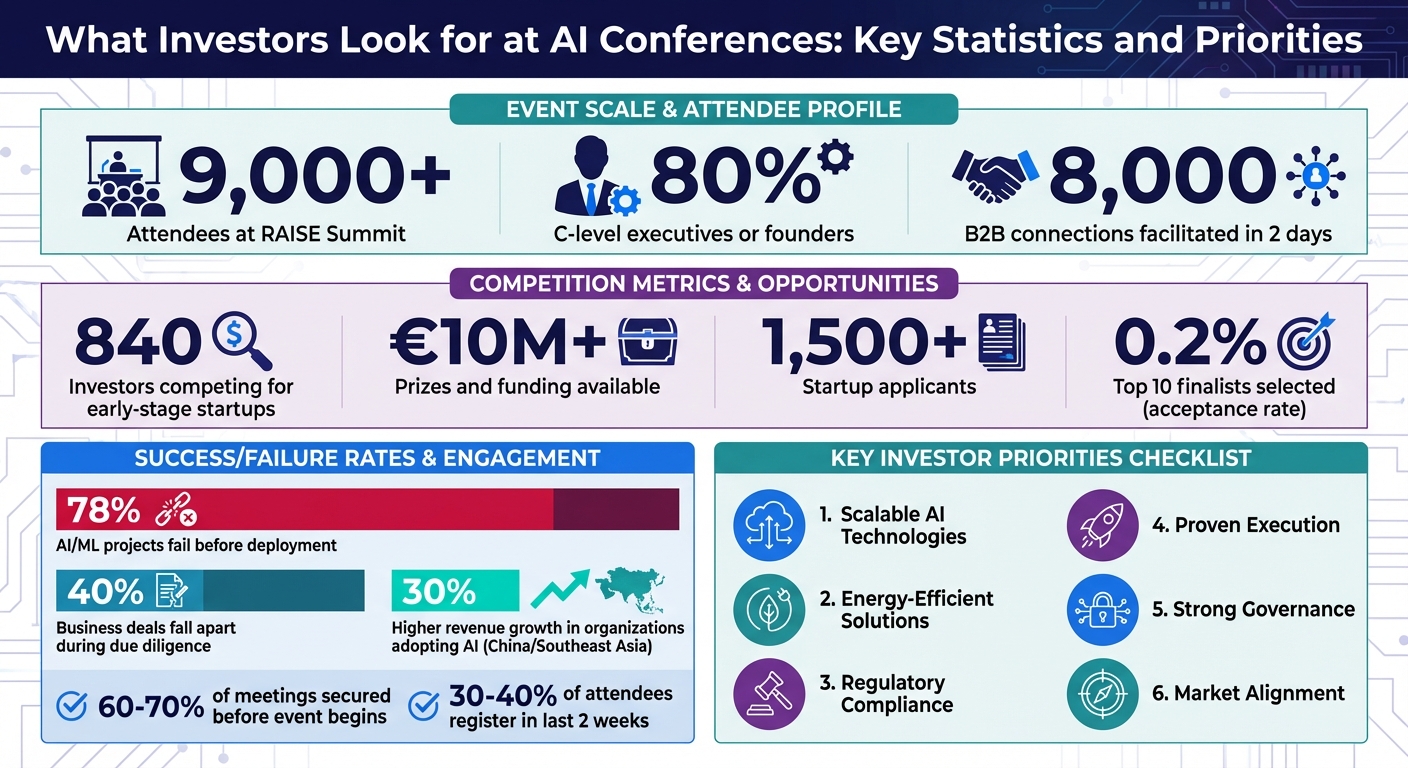
What Investors Look for at AI Conferences: Key Statistics and Priorities
How Investors Identify Scalable AI Technologies
What Investors Look for in AI Technologies
When investors evaluate AI technologies at conferences, they focus on whether the technical infrastructure can handle real-world demands. They look for startups that leverage reliable cloud services such as AWS, Google Cloud, or Azure, often paired with tools like Docker and Kubernetes to efficiently handle growing data volumes and user demands [5].
Another key area of interest is the Energy-Compute Nexus, which assesses how well solutions balance power consumption with performance. Startups using specialised hardware like GPUs or custom ASICs to manage scaling costs often stand out [4][6][7].
Investors also pay close attention to whether a technology is ready for inference. Unlike training, inference requires low latency, distributed deployment, and cost-effective performance. For example, Meta's Research SuperCluster, which uses 16,000 GPUs for large-scale AI research, showcases the infrastructure needed to support production-level AI [6][7].
Beyond technology, investors demand proof that systems can perform under real-world conditions. A comparative study highlighted that organisations adopting AI in regions like China and Southeast Asia achieved 30% higher revenue growth compared to those that did not [8]. Ethical and regulatory compliance is another critical factor. Startups must adhere to frameworks like GDPR, respect intellectual property rights, and meet "Sovereign AI" requirements to ensure they can operate across diverse geopolitical landscapes [5][7]. These stringent criteria help shape the competitive environment at events like the RAISE Summit.
How RAISE Summit Presents Scalable AI Solutions
RAISE Summit uses these benchmarks to showcase scalable AI technologies effectively. For instance, the 48-hour RAISE Hackathon challenges founders to turn concepts into functional systems within a compressed timeframe, highlighting their ability to innovate under pressure [11]. For robotics and autonomous systems, the MACHINA summit provides a specialised platform to demonstrate how AI performs in real-world physical applications [11].
The "RAISE the STAKES" competition is another highlight, offering startups the chance to connect with Tier 1 investors from firms like Sequoia Capital and 20VC. With over €10 million in prizes and funding, this competition attracts top-tier talent. In July 2025, startups like Neuralk AI (CEO Alexandre Pasquiou), Hirundo (CEO Ben Luria), and pyannoteAI (CEO Vincent Molina) showcased their scalability and innovation, rising above 1,500 applicants to secure their spots. With an acceptance rate below 0.2%, the competition ensures only the most promising solutions make it to the main stage [9].
The summit also features industry-specific tracks, such as "AI Adoption Frameworks: From Pilots to Production" and "Value Realisation & Capital Allocation", which allow startups to demonstrate market alignment [10]. The "Scaling AI Responsibly" track addresses governance and compliance concerns, turning potential regulatory challenges into opportunities [10]. For more informal networking, the RAISE House offers a relaxed setting for founders and investors to connect, while the exclusive CxO Summit provides a platform for discussing large-scale AI deployment strategies with senior enterprise leaders [11].
sbb-itb-e314c3b
Assessing Team Expertise and Market Alignment
Why Team Expertise and Market Fit Are Critical
When it comes to backing startups, investors often place more trust in teams with hands-on production experience rather than those with purely academic backgrounds. For instance, a founder who has successfully scaled AI systems in practical settings is seen as a safer bet, especially when considering that 78% of AI/ML projects fail before deployment. A well-rounded team combines technical know-how with expertise in areas like product management, domain knowledge, and go-to-market strategies. This is particularly crucial for startups in heavily regulated sectors like healthcare or fintech. In these industries, team members must not only grasp the real challenges users face but also have the ability to navigate complex regulatory landscapes effectively [12][14].
"Technical excellence without market understanding is a recipe for failure." - Liran Levy, Esinli Capital [12]
Operational cohesion is another key factor. Investors look for signs of strong governance, such as signed co-founder agreements, clear vesting schedules, and a well-defined decision-making structure. These elements are critical, as 40% of business deals fall apart during due diligence. A lack of governance can lead to deadlocks or expose early warning signs that could derail progress. For investors, attending industry events and engaging directly with founders can further validate these governance practices [12][13].
Using RAISE Summit to Evaluate Startup Teams
The RAISE Summit offers investors a unique opportunity to assess startup teams beyond what metrics and pitch decks can reveal. This event brings together high-level decision-makers, making it easier to evaluate a team's strategic vision and adaptability in person [2]. The summit’s networking app allows investors to arrange one-on-one meetings with founders participating in the Startup Competition. From over 1,000 applicants, only the top 10 finalists make it to this stage, giving investors a chance to focus on the most promising teams [2].
Key sessions like "Investment in AI: Who Gets Funded and Why" feature insights from firms such as Balderton Capital, Altimeter Capital, and Teachers' Venture Growth, offering benchmarks for evaluating startups against industry standards [15]. Additionally, tracks addressing challenges like "The ROI Dilemma" and "Compliance Breakthroughs" spotlight teams that excel at transitioning from pilot projects to full-scale production in regulated industries [10]. Exclusive VIP events and dinners further allow investors to observe how teams perform under pressure and interact in high-stakes settings [2].
Explore High-Growth AI Opportunities From Data Centers to Breakthrough Use Cases
Tracking Trends and Managing Investment Risks
Following our earlier discussion on scalable technologies and team assessments, it's time to dive into how trends and risk management shape investor decisions in the AI space.
Key Trends Influencing AI Investment
Investors often rely on the "4F Compass" framework to sift through the noise and identify real opportunities. Introduced at the RAISE Summit, this framework divides AI advancements into four categories: Foundation (infrastructure and funding), Frontier (applications), Friction (risks and regulations), and Future (long-term developments) [10]. It’s a practical tool for understanding where startups or technologies fit within the evolving AI ecosystem.
The spotlight in AI investment is shifting. Physical AI, which includes sectors like robotics and autonomous systems, is becoming a major focus for funding [11]. Another growing trend is Compute as Capital - a concept tied to the "Silicon Horizon", where next-generation infrastructure plays a pivotal role in determining market leaders [10]. Additionally, Sovereign AI is gaining importance as countries prioritize secure data management and trusted cloud solutions to address geopolitical concerns [10][16].
Energy consumption is another critical factor. The "Energy-Compute Nexus" has emerged as a central theme for assessing scalability and long-term viability [10]. Startups that can balance energy efficiency with computational needs are increasingly attractive to investors. Historically, energy limitations have driven the development of scalable AI infrastructure, making this nexus a key determinant of sustainable growth. These trends are shaping the agenda of the RAISE Summit, ensuring investors stay ahead of the curve.
How RAISE Summit Keeps Investors Informed
To help investors navigate these shifting landscapes, the RAISE Summit offers sessions tailored to address regulatory and market challenges. With over 9,000 attendees expected at RAISE Summit 2026 - more than 80% of whom are C-level executives or founders - investors gain direct access to cutting-edge trend analysis [1].
Sessions like "Investment in AI: Who Gets Funded and Why" deliver actionable insights from industry leaders such as Balderton Capital, Altimeter Capital, and Teachers' Venture Growth [15]. The Friction track, alongside exclusive CxO forums, provides deep dives into regulatory barriers and strategic frameworks for swift decision-making [1][10]. Meagan Loyst, Founder and CEO of Gen Z VCs, underscores the importance of agility in this fast-paced domain:
"Speed and execution have become one of the most important metrics for AI companies" [17].
These sessions equip investors with the tools to evaluate whether startups are not only innovative but also capable of navigating the complex regulatory and infrastructure challenges that define today’s AI industry.
Accessing High-Potential Startups and Building Partnerships
Competition for Early-Stage Startups
AI conferences are buzzing with activity, with around 840 investors competing to discover promising early-stage startups [3]. The real challenge, however, isn’t just spotting innovation - it’s about forming connections with founders early on and earning their trust to secure deals.
Take the 2025 RAISE the STAKES competition, for example. Over 1,500 startups applied, but only the top 10 made it through - a razor-thin acceptance rate of less than 0.2%. Partners from Sequoia Capital, 20VC, and Nvidia were part of the selection process, ensuring only the most exceptional startups advanced [9]. This intense scrutiny showcased the summit’s high standards, with the winners standing out as leaders in their fields.
But identifying talent is just one piece of the puzzle. Building strategic partnerships is equally important. During its two-day run, the summit facilitated 8,000 B2B connections, with 80% of attendees being C-level executives or founders [1][3]. This high concentration of decision-makers makes it easier to form meaningful partnerships quickly. The strict criteria and curated environment set the stage for impactful networking opportunities.
Finding Opportunities at RAISE Summit
At the RAISE Summit, it’s not just about evaluating technology or team expertise - it’s about fostering early-stage relationships. By simplifying access and using targeted pre-screening, the summit ensures an investor-focused experience. Attendees have several ways to engage, including VIP access, sponsorships, and specialized niche events.
VIP ticket holders (€1,899–€2,999) gain an edge with access to exclusive startup pitch decks and developer profiles before the event, allowing for targeted outreach [18]. Sponsorships offer even deeper insights, granting full access to all participating startups and their deal-flow data [9].
The RAISE the STAKES competition is another key highlight, offering a concentrated look at early-stage innovation. Startups eligible to compete must be in Pre-seed, Seed, or Series A stages, with prior funding capped at €10 million. The stakes are high, with over €10 million in total prizes up for grabs [9]. Investors can also join the jury, which not only positions them as thought leaders but gives them early access to standout startups before public presentations.
For those interested in Physical AI - like robotics and autonomous systems - the MACHINA Summit (€699–€999) focuses on ventures blending hardware and software [18]. Beyond formal presentations, networking events like the Versailles AI Gala (included with VIP MAX tickets priced at €3,499–€4,599) and the RAISE House provide relaxed settings to build relationships with potential partners [1][18]. These features underline the summit’s goal of creating meaningful connections between investors, innovators, and policymakers in a high-stakes environment.
Conclusion: How to Engage Investors at AI Conferences
To capture the attention of investors at AI conferences, preparation is key. The most effective startups start their outreach efforts 3–4 weeks ahead of the event. They use a mix of communication methods - like email, LinkedIn, and in-app messaging - to lock in meetings with top prospects. In fact, many secure up to 60–70% of their meetings before the event even begins, focusing on prospects who align with their Ideal Customer Profile [19].
At the RAISE Summit, this kind of preparation becomes even more crucial. With over 80% of the 9,000+ attendees holding C-level or founder positions [1], the stakes are high. Highlight how AI is central to your product, and back it up with clear evidence of scalability and measurable ROI [9]. Investors today are less interested in AI buzzwords and more focused on solutions that deliver tangible business results.
Once your groundwork is done, take full advantage of the summit’s unique features. The event offers structured opportunities to set your startup apart. For example, participating in RAISE the STAKES gives you direct exposure to influential figures from firms like Sequoia Capital and 20VC [9]. Similarly, the MACHINA Summit is ideal for startups in robotics or autonomous systems, providing access to investors specifically interested in physical AI [11]. These targeted opportunities align perfectly with the strategic, early engagement approach emphasized throughout this article.
Preparation is everything, as highlighted by Spivot:
"Without preparation, RAISE Summit becomes an expensive networking trip with nothing to show."
- Spivot [19]
For deeper connections, consider attending exclusive networking events like the Versailles VIP Dinner, available with VIP MAX tickets (€3,499) [1]. These intimate settings encourage meaningful conversations that can lead to long-term partnerships. Finally, keep an eye on late registrations, as 30–40% of attendees sign up in the last two weeks - offering fresh opportunities to connect with high-value prospects [19].
FAQs
How do I prove my AI will scale in production?
To show scalability, it's important to present a clear framework paired with established practices for deployment. Use structured methodologies that prioritize business goals and operational excellence. Make sure your infrastructure can scale effectively, incorporating elements like governance, reliability, and monitoring systems. Deployment tools are key here - use them to smoothly move from a proof of concept to full production, all while ensuring performance remains consistent and measurable.
What evidence of ROI do investors expect at a conference?
Investors attending AI conferences are keenly focused on seeing tangible returns on investment (ROI) to back their funding choices. They're often looking for clear, measurable outcomes - like a 30% return, which translates to €300,000 for every €1 million invested. Their priorities typically include metrics such as revenue growth, shortened deal cycles, and expanded sales pipelines.
Beyond financial gains, investors also place importance on responsible AI practices. They want to ensure that the technologies they back not only comply with ethical and regulatory standards but also maintain a balance between profitability and accountability.
How can I show compliance (GDPR, IP, Sovereign AI) quickly?
To show compliance effectively, prioritize governance frameworks, sound data management practices, and strict adherence to regulations. For GDPR compliance, perform thorough Privacy Impact Assessments and stick to the prescribed guidelines. When addressing Sovereign AI, ensure alignment with national AI strategies and principles of digital sovereignty. Using recommended tools and frameworks can help establish a reliable and efficient approach, particularly in professional conferences or industry environments.