

Paris has quickly risen as a global startup hub, now ranking 4th worldwide, behind only Silicon Valley, New York, and Boston. Between 2017 and 2024, startups in Paris grew 5.3x in valuation, reaching €255 billion and creating over 1 million jobs. This growth is fueled by cutting-edge institutions like Station F, world-class AI talent from schools like École Polytechnique, and supportive government policies, including the French Tech Visa and R&D tax credits.
Key drivers include:
- AI dominance: Paris-based AI companies raised €2.04 billion in 2024, the highest in Europe.
- Talent pool: Over 111,000 AI-trained professionals and affordable engineering costs (2.5–3x less than the U.S.).
- Funding challenges: While early-stage funding is accessible, scaling often requires international investors.
- Networking: Platforms like Station F and events such as the AI Action Summit and RAISE Summit connect founders with mentors, investors, and tech leaders.
Paris is redefining its reputation, offering a mix of affordable talent, strong academic support, and government incentives, making it a prime destination for ambitious entrepreneurs.

Paris Startup Ecosystem: Key Statistics and Growth Metrics for Entrepreneurs
Common Barriers for Young Entrepreneurs in AI and Tech
Securing Funding and Financial Support
While early-stage funding has become more accessible, young entrepreneurs often encounter a "scaleup gap" when seeking growth capital beyond €30–50 million. This gap frequently pushes them to seek international investors for larger funding rounds [7]. For instance, in June 2024, Paris-based generative AI startup Mistral AI raised a massive €468 million in a Series B round led by US-based General Catalyst, bringing its valuation to $14 billion [8][5]. Similarly, Poolside, an AI-driven coding startup, secured €445 million in a Series B round in 2024, highlighting how French startups often look abroad for major investments [5].
Adding to the financial strain, French labour laws make hiring and downsizing more expensive compared to the US, which increases risks for lean startups [8]. However, Paris offers a unique safety net for entrepreneurs: unemployment benefits for founders as they develop their ventures. As Marvin Amuzu, CTO and cofounder of Abstrakt News, aptly puts it:
"We often joke that the first investor is the French government, thanks to unemployment rights" [8]
Moreover, Bpifrance has played a significant role in easing financial pressures. In 2023 alone, it provided nearly €4 billion in loans and subsidies, along with €677 million in direct equity investments for startups [7]. Despite these resources, financial challenges often intersect with another key hurdle: finding skilled talent.
Finding Skilled AI and Tech Professionals
The competition for top AI talent is fierce, with startups vying for the industry's most skilled professionals [10]. Although Paris boasts a pool of 111,000 AI-trained professionals [9], the real challenge lies in attracting the standout researchers capable of driving major innovation. Many startups focus on recruiting alumni from prestigious tech research labs. For example, Mistral AI, which launched in April 2023, hired 8 employees from Meta and 6 from Google/DeepMind within just 18 months [6][10]. Startups often win over talent with their bold visions. As Dali Kilani, cofounder of FlexAI, explains:
"The real argument in our favour was the ambition of the project and the promise to be at the heart of decisions" [10]
Paris also offers a cost advantage. Senior machine learning engineers in Paris typically earn between €80,000 and €130,000 annually, far less than the $268,000 average in Silicon Valley [1][10]. Government initiatives like the Cifre programme further help startups by subsidising PhD student hires. Stanislas Polu, cofounder of Dust, notes:
"Basically you get PhD students for free" [1]
While funding and talent are critical, building strong networks is another essential ingredient for entrepreneurial success.
Creating Networks for Collaboration and Support
For many first-time founders, the absence of robust networks for mentorship and investor access can be a significant barrier. Despite these challenges, Paris offers an unparalleled environment for collaboration. Station F, the world’s largest startup campus, hosts over 1,000 startups from 65 nationalities, while the city boasts more than 250 incubators and accelerators, creating abundant opportunities for mentorship and partnerships [11][3][9].
Large events further enhance these connections. In February 2025, the AI Action Summit brought together hundreds of tech founders, 40 heads of state, and industry leaders like Sam Altman and Sundar Pichai to discuss the future of AI [11][12]. During the summit, Station F hosted around 4,000 investors and tech professionals, facilitating discussions on scaling businesses globally [12]. As Roxane Varza, director of Station F, observes:
"The Paris ecosystem has really accelerated over the last 12 to 24 months, largely thanks to AI expertise and a new wave of serial founders" [9]
How Paris Supports Young Entrepreneurs
Access to AI Talent and Research Institutions
Paris boasts an impressive concentration of over 10,000 AI researchers and engineers, making it Europe’s leading hub for tech talent [20]. Prestigious institutions like École Polytechnique, Centrale Supélec, Télécom Paris, and ENS Paris-Saclay produce over 20,000 ICT graduates annually. Remarkably, 75% of these students are hired before they even graduate [19][20]. Paul Midy, an MP and École Polytechnique alumnus, highlights this global influence:
"You can see it in AI labs and in companies across the world: there are polytechnicians everywhere" [19].
Startups in Paris can tap into this talent pool through initiatives like the Cifre programme, where the Ministry of Higher Education subsidizes the hiring of PhD students for applied research. As Stanislas Polu, cofounder of Dust, puts it:
"Basically you get PhD students for free" [1].
Paris also offers collaboration opportunities with leading research bodies like INRIA, CEA List, and CNRS. The AI4IDF initiative simplifies access to academic partnerships by bringing together four major AI institutes - DATAIA, Hi! PARIS, PRAIRIE, and SCAI - under one umbrella [20].
The region’s tech ecosystem is further bolstered by its massive workforce of 710,000 ICT professionals, the largest in Europe, and its extensive intellectual property portfolio, with 133,000 patents compared to London’s 48,000 [20][5]. Together, these resources create an unparalleled foundation for innovation.
Government Programmes and Financial Support
The French government has made AI a national priority, committing €2.5 billion through the France 2030 Plan [15]. In May 2024, nine AI-cluster winners received €360 million to establish research and training centers at top universities [15]. Beyond these large-scale investments, entrepreneurs can access several targeted support programmes:
- The Research Tax Credit (Crédit d'Impôt Recherche) offers generous tax breaks for R&D spending.
- The Pack IA initiative helps around 100 companies annually adopt AI technologies [3][2].
- French Tech Tremplin provides grants of up to €22,900 and a year of incubation for underrepresented founders from marginalized or underserved communities. In October 2024, 218 entrepreneurs were selected for the programme’s fourth cohort [14].
For international entrepreneurs, the French Tech Visa simplifies residency permits for founders, employees, and investors. Additionally, French Tech Central connects startups with public services to resolve administrative challenges quickly [2][13]. In 2024, Paris Region tech companies attracted €3.8 billion in investments, with 35% allocated to AI projects [9][3].
These government-backed programmes are complemented by Paris’s thriving network of incubators and accelerators.
Incubators, Accelerators, and Workspace Options
Paris is home to some of the world’s most dynamic startup ecosystems, including Station F, which hosts over 1,000 startups from 65 countries alongside 600 investment funds [8]. For €400 per month, founders gain access to workspaces and mentorship from tech giants like Google, Apple, AWS, Meta, and Microsoft [17]. With 70% of its startups focused on AI, Station F companies have collectively raised over €1 billion annually since 2021 [8][17].
Success stories are abundant. For example, Biolevate, an AI-driven knowledge platform, was founded at Station F in January 2024. Starting with just two employees, it grew to a team of over 50 and secured a major tender with Sanofi thanks to opportunities within the incubator [8]. Similarly, Sonio, another Station F alumnus, was acquired by Samsung in 2024 [17].
Meanwhile, Paris&Co supports startups in specialized sectors like fintech, healthcare, and creative industries. Through its Metropolitan Innovation Districts (QMI) project, startups can test solutions in real-world settings. In 2024, Paris&Co-backed companies raised over €600 million in just six months, including Electra’s €304 million funding round for electric vehicle charging infrastructure [18]. Across the Paris Region, there are over 250 incubators and accelerators, offering entrepreneurs mentorship, workspace, and partnership opportunities [16][9].
These resources make Paris a fertile ground for startups to grow, connect, and thrive, with platforms like RAISE Summit providing even more opportunities for scaling up.
RAISE Summit: Connecting AI Entrepreneurs in Paris
What RAISE Summit Offers Entrepreneurs
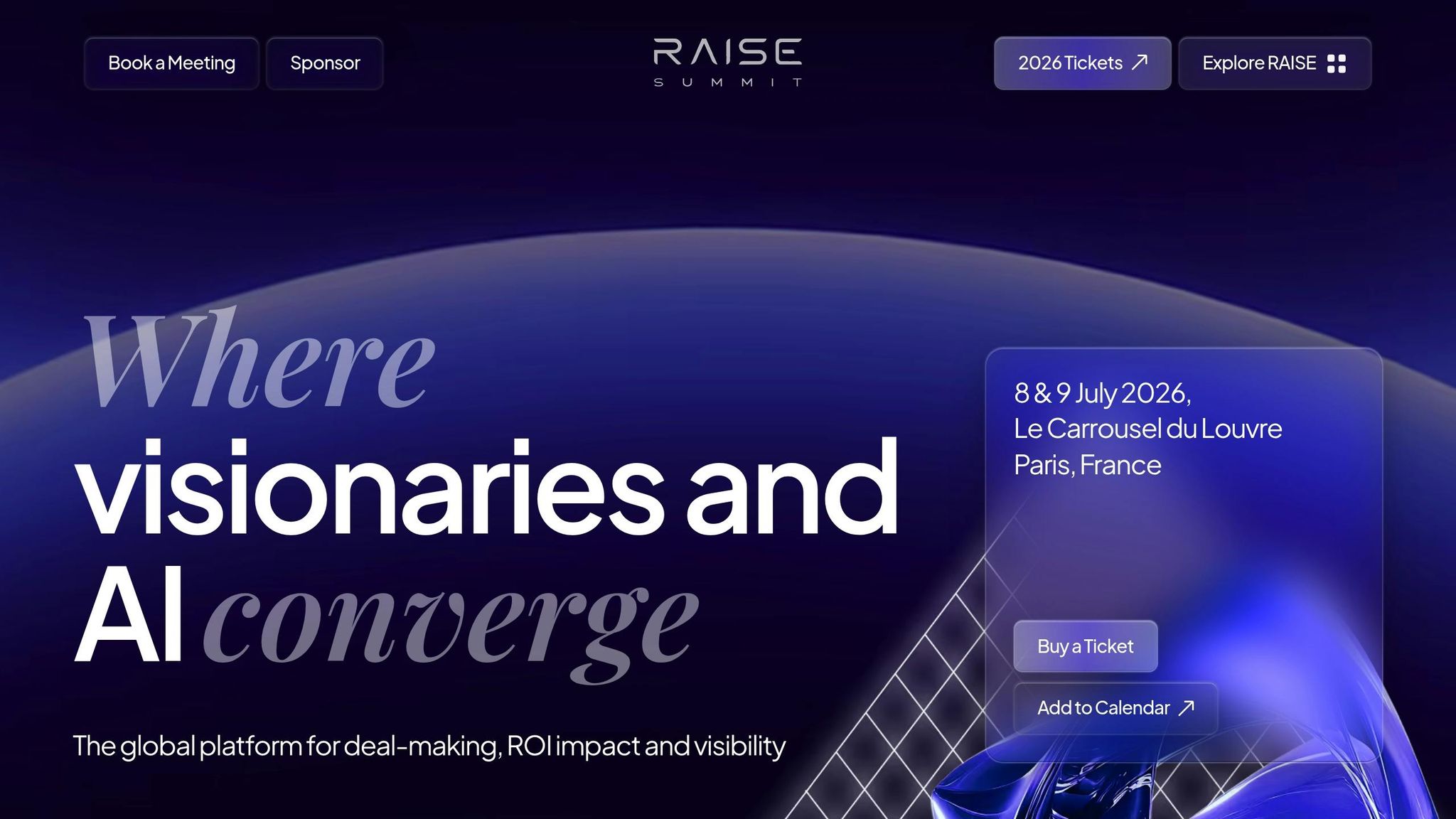
Scheduled for 8–9 July 2026 at the iconic Le Carrousel du Louvre, the RAISE Summit is set to welcome over 9,000 attendees and more than 2,000 companies. Impressively, 80% of these participants are C-level executives and founders. Eric Schmidt describes it as "the fastest-growing AI Tech conference in Europe, and maybe in history" [21].
The summit presents three standout opportunities: the RAISE the STAKES startup competition, the Global AI Hackathon, and an engaging Side Events Week.
- RAISE the STAKES startup competition: With a prize pool topping €10 million, this competition draws over 1,500 applicants vying for just 10 finalist spots. In the 2025 edition, Neuralk AI, Hirundo, and pyannoteAI, led by their respective CEOs Alexandre Pasquiou, Ben Luria, and Vincent Molina, claimed victory. Their innovative solutions were judged by a panel featuring Sequoia Capital partners and Nvidia executives [24].
- Global AI Hackathon: This event attracts more than 8,000 developers competing for a €200,000 prize pool. It offers participants a chance to tackle pressing challenges while showcasing their skills to key industry leaders [21][22].
- Side Events Week: Paris transforms into a buzzing AI networking hub with exclusive dinners, workshops, and meetups spread across the city. Attendees can use a dedicated networking app to make meaningful connections. VIP ticket holders (starting at €1,899 + VAT) enjoy premium perks like access to startup pitch decks, developer profiles, and an exclusive VIP lounge. Chamath Palihapitiya, Co-founder of Social Capital, highlights the value of such in-person interactions, saying, "The serendipity that can happen when you're together in a physical space is life-changing" [23].
These offerings create a robust platform for startups, paving the way for growth and collaboration while setting the stage for how the summit helps emerging businesses thrive.
How RAISE Summit Helps Startups Grow
RAISE Summit addresses key challenges faced by young entrepreneurs looking to scale. With insights from 350+ speakers representing industry giants like Google, AMD, and Microsoft, attendees explore critical topics such as capital, infrastructure, and autonomous intelligence through the '4Fs' framework [21].
The 2025 edition drew 822 CEOs from 168 Fortune 500 companies and investors overseeing more than $600 billion in assets. This convergence of expertise and resources opens doors to new partnerships and funding opportunities [25].
For startups hunting for capital, the summit’s AI-powered matching platform facilitates one-on-one meetings with potential investors and enterprise partners. Jonathan Ross, CEO and Founder of Groq, sums up the event's significance, stating: "RAISE is where everyone in AI is going" [23].
sbb-itb-e314c3b
Young Entrepreneurs Building Successful Companies in Paris
AI Startups That Started in Paris
Paris has become a hub for AI innovation, with startups like Mistral AI leading the charge. Founded by former researchers from Meta and Google AI, Mistral AI made headlines by securing a €105 million seed round just four weeks after launching [1]. The team tapped into Paris's exceptional pool of mathematical and engineering talent to develop proprietary large language models, showcasing how the city's research resources can fast-track ambitious projects.
Another standout is Nabla, an AI-driven healthtech company co-founded by Alex Lebrun, a former Meta executive. Despite the fact that 80% of Nabla's users are based in the United States, the company strategically operates out of Paris, benefiting from the city's cost-effective and highly skilled AI engineers [1].
Alan, a health insurance startup, has also challenged industry norms. By raising a €50 million Series C round in April 2020, Alan brought its total funding to over €125 million [27]. This success demonstrates how Paris-based startups can disrupt traditional sectors, thanks to the city's dynamic and supportive ecosystem.
These examples highlight how Paris provides fertile ground for AI startups to flourish and make an impact on global markets.
Emerging Founders Driving Innovation in Paris
Paris isn't just home to established startups; it's also a launchpad for emerging entrepreneurs. Programmes like the HEC Paris Startup Launchpad help turn ideas into real businesses. For instance, Veeton, founded by Flore Lestrade, began as a student project and evolved into a professional venture through this initiative [26].
Another key resource is the Cifre programme, funded by the Ministry of Higher Education, Research and Innovation. This programme subsidises PhD student salaries for startups, enabling founders to access top-tier research talent without breaking the bank. Such initiatives are part of Paris's broader strategy to empower startups and foster innovation [1].
Stanislas Polu, co-founder of Dust, underscores the unique talent advantage in Paris:
"In the US, OpenAI is absorbing all that talent like a black hole... you end up with a pool of available talent in Paris... that is ready to explore and do stuff" [1].
While top firms in the US often monopolise talent, Paris benefits from a rich pool of innovators eager to create and experiment, further solidifying its position as a breeding ground for entrepreneurial success.
Conclusion
Main Benefits for Entrepreneurs in Paris
Paris stands out as Europe's top tech ecosystem, offering a powerful combination of talent, funding, and infrastructure that’s hard to match. With a pool of over 823,500 scientists and engineers in the region [9], entrepreneurs have access to the expertise needed to build forward-thinking companies. Plus, AI engineers in Paris earn between €60,000 and €90,000, which is significantly lower - roughly 2.5 to 3 times less - than their counterparts in Silicon Valley [1].
The city’s financial ecosystem has also grown impressively. In 2024 alone, tech companies in the Paris Region attracted €3.8 billion in investments, with 35% of that going to AI-related projects [9]. Government initiatives like the Cifre system and Innov'up make it easier for startups to hire PhD researchers at reduced costs, thanks to state subsidies. Paris also boasts a robust support network with over 250 incubators and accelerators, including the renowned Station F, which connects entrepreneurs to more than 30 support programmes and global tech partners [9][4].
As Roxanne Varza, Director of Station F, puts it:
"The Paris ecosystem has really accelerated over the last 12 to 24 months, largely thanks to AI expertise and a new wave of serial founders" [9].
Next Steps: Attend RAISE Summit
To maximise these opportunities, ambitious founders should consider attending the RAISE Summit. Scheduled for 8 & 9 July 2026 at Le Carrousel du Louvre, this event is a hub for innovation and collaboration. With over 9,000 attendees and 2,000 companies, 80% of whom are C-level executives and founders [21], the summit creates a unique environment for deal-making and partnerships.
Highlights of the summit include:
- The largest AI startup competition, featuring a €5 million prize pool.
- A global AI hackathon with €200,000 in prizes.
- Networking with 350+ world-class speakers, including notable names like Mark Cuban, Vlad Tenev (CEO of Robinhood), and Parag Agrawal (CEO of Parallel Web Systems) [21].
Eric Schmidt, Former CEO & Chairman of Google, had this to say about the event:
"The fastest-growing AI Tech conference in Europe, and maybe in history" [21].
For founders looking to secure funding, attract talent, or forge strategic partnerships, the RAISE Summit offers a gateway to the heart of Europe’s thriving AI scene.
Starting Up a Startup Ecosystem in Paris | STYT Paris
FAQs
Why is Paris becoming a leading destination for AI startups?
Paris is quickly gaining recognition as a premier destination for AI startups, thanks to its dynamic innovation scene, robust government backing, and access to exceptional talent. Entrepreneurs are flocking to the city, drawn by a rare blend of resources and opportunities.
One major factor driving this growth is the French government’s active support for startups. Through a mix of incentives and streamlined regulations, the government has created a business-friendly environment that encourages AI innovation. Paris is also home to Station F, the largest startup incubator in Europe, which provides early-stage companies with the tools they need to thrive and expand.
The city’s thriving AI ecosystem has also become a magnet for top talent. Many former researchers from global tech giants are choosing Paris, attracted by its commitment to advancing cutting-edge technology.
With its combination of cultural charm, strategic investments, and a vibrant entrepreneurial atmosphere, Paris is carving out its place as a global hub for AI startups. It’s positioning itself as a compelling alternative to traditional tech centers like Silicon Valley or London.
What are the benefits of the French Tech Visa for international entrepreneurs starting a business in Paris?
The French Tech Visa offers a simplified pathway for international entrepreneurs to live and work in France, granting a renewable four-year residence permit known as the Talent Passport. Tailored for tech professionals - whether you're a founder, employee, or investor - it cuts through the red tape, making it easier to launch or grow your business in Paris.
This program is part of France's push to attract global talent and solidify Paris as a top destination for startups and AI innovation. Entrepreneurs benefit from Paris’s thriving tech ecosystem, which includes government support, robust infrastructure, and a rich mix of international talent. Beyond easing entry, the visa opens doors to opportunities in one of Europe’s most dynamic tech landscapes.
What funding challenges do young entrepreneurs in Paris face as their startups grow?
As startups in Paris progress beyond their initial stages, finding the financing needed for growth and scaling can become a significant hurdle. One of the main obstacles is the scarcity of large-scale capital from local investors. Although Paris boasts a vibrant startup scene, supported by initiatives like La French Tech, the fragmented nature of European markets often limits access to substantial domestic funding.
This forces many entrepreneurs to look beyond France, often turning to U.S. venture capital firms for the larger funding rounds that international expansion demands. While Paris has made progress in attracting venture capital, it still trails behind cities like London when it comes to later-stage funding opportunities. Bridging these gaps will be essential for startups aiming to compete on a global scale.