


Paris has emerged as Europe’s leading hub for artificial intelligence (AI), combining a skilled workforce, academic excellence, and strong government backing. Between 2017 and 2024, the value of startups in Paris grew 5.3x, reaching €270 billion. By 2024, €3.8 billion was raised by tech companies in the Paris Region, with 35% directed toward AI projects. Today, Paris ranks 5th globally and 1st in Europe for AI, supported by 500 AI startups, global tech giants, and robust infrastructure like the Jean Zay supercomputer.
Key highlights:
- AI Talent: Paris has 111,000 professionals trained in AI, with salaries 2.5–3x lower than Silicon Valley.
- Startup Success: Mistral AI, France’s first decacorn, reached a €11.7B valuation in 2025.
- Government Support: Initiatives like the French Research Tax Credit and €109B AI investment pledges fuel growth.
- Global Recognition: Events like the RAISE Summit attract top leaders and innovators.
Paris is shaping industries like healthcare, logistics, and retail with AI-driven solutions, securing its role as a global AI leader.

Paris AI Ecosystem: Key Statistics and Growth Metrics 2024-2025
AI Startups Shaping the Future in Paris
Leading AI Startups and Their Impact
Paris has become a hotspot for Europe's top AI ventures, with Mistral AI standing out as a major player. France's first decacorn, Mistral AI, boasts a staggering valuation of €11.7 billion following its €1.7 billion Series C round in September 2025. Positioned as a European alternative to OpenAI and Anthropic, Mistral AI focuses on efficiency and transparency. Its Mistral 7B model has already outperformed Meta's Llama 2 13B, achieving the same results with 46% less computing power [6]. By late 2025, the company had reached an Annual Recurring Revenue (ARR) of €300 million, with signed contracts totaling €1.4 billion [6].
In a strategic move, ASML invested €1.3 billion for an 11% stake in Mistral AI in September 2025. This partnership includes a five-year collaboration to improve semiconductor design cycles, with Mistral engineers playing a key role [5]. Earlier that year, Orange integrated Mistral's AI solutions - "Le Chat Pro" and "Codestral" - into its "Live Intelligence" platform. This integration automated over 70% of routine support queries, slashing staffing costs by 30% [6].
Other standout startups include H Company, formerly known as Holistic AI. Founded by ex-Google DeepMind scientists, the company raised $220 million in seed funding in May 2024, with backing from notable figures like Eric Schmidt and Xavier Niel, to advance artificial general intelligence [8]. Poolside, a specialist in AI-driven coding, relocated its headquarters from the US to Paris in August 2023 after securing $126 million in funding. This move underscores Paris's growing reputation as a hub for engineering talent [8].
These achievements highlight the transformative potential of AI across industries and solidify Paris as a global leader in the field.
AI in Healthcare, Analytics, and Other Sectors
Paris-based startups are not just innovating in technology; they are reshaping industries with practical AI applications. Nabla, founded by Alex Lebrun, has introduced an AI clinician companion that is already being used by doctors across the US and Europe. A pilot programme with the British Ramsay Group has shown how this tool can automate medical note-taking, significantly reducing the administrative workload for healthcare professionals [4].
Another standout is Bioptimus, which developed the world’s largest open-source foundation model for cancer detection, H-optimus-0, within just five months of its launch. Backed by €35 million from Bpifrance and Xavier Niel, the company is making strides in early cancer detection [9]. Meanwhile, Carrefour has leveraged AI for pricing and forecasting, cutting unsold perishables by nearly 50%. This initiative has delivered a financial boost of over €120 million [7].
These examples illustrate how Parisian startups are applying AI to solve real-world problems, driving progress in healthcare, retail, and beyond.
Government Support and Infrastructure for AI
France's National AI Strategy
France's approach to artificial intelligence has been unfolding in distinct phases. Phase 1 (2018–2022) laid the groundwork with €1.5 billion to establish robust research infrastructure. Phase 2 (2022–2025), under the France 2030 initiative, ramped up innovation with €2.22 billion in funding - €1.5 billion from public sources and €506 million from private investments. Phase 3, starting in 2025, aims to integrate AI more deeply into society, businesses, and public services [12].
A key element of this strategy is the creation of nine AI Clusters in 2024, supported by €360 million. These clusters aim to double the number of AI-trained students and nurture 100 academic startups. Paris hosts several prominent clusters, including PR[AI]RIE at Université Paris Sciences et Lettres, Hi! PARIS Cluster 2030 at Institut Polytechnique de Paris, and PostGenAI@PARIS at Sorbonne Université. Each cluster focuses on areas such as interdisciplinary research and generative AI [10]. By 2030, the goal is to train 100,000 individuals in AI, with 300 research chairs facilitating the work of 2,000 scientists and supporting 600 doctoral theses annually.
In February 2025, President Macron unveiled a €109 billion investment in AI-optimized data centres and computing resources [11]. The Jean Zay supercomputer, boasting 28 petaflops of computing power, already supports over 1,200 AI projects. Meanwhile, Fluidstack, an AI cloud platform, has committed to building one of the world’s largest AI supercomputers in France, powered by nuclear energy. This project, backed by an initial €10 billion investment, is expected to be operational by 2026 [2] [13].
France's digital sovereignty plan includes initiatives like P16, which focuses on software libraries for managing data, and INESIA, the National Institute for the Evaluation and Security of AI, launched in 2025. INESIA addresses systemic risks and aligns with the European AI Act [10]. Leveraging its nuclear energy capabilities, France also offers low-carbon electricity and has identified over 35 sites for rapid data centre development [11]. These efforts have helped Paris become a hub for AI research and innovation, making it a leader in Europe.
AI Clusters and Collaborative Spaces
Beyond national funding, local collaborations are bolstering Paris’s AI ecosystem. The Systematic Paris Region cluster unites around 900 members, including 600 startups and SMEs alongside 140 larger companies. This collaboration has supported 626 projects, representing €3.18 billion in R&D investment and resulting in 620 new products. The cluster’s focus spans data science, AI, and cybersecurity [1]. Similarly, Cap Digital has driven innovation in areas like consumer applications and ecological solutions, with over €1.7 billion invested in R&D through its network of more than 1,000 members [1].
The AI4IDF initiative ties together Paris’s leading institutes - DATAIA, Hi! PARIS, PR[AI]RIE, and SCAI - creating a unified framework for international and industrial partnerships. This initiative also facilitates public-private collaborations, known as "LabComs", to promote research and innovation [1]. Additionally, the Paris Region’s Pack IA program provides funding for AI proofs of concept, helping local SMEs and mid-sized companies adopt AI technologies. Success stories from this program include Carrefour’s AI-powered inventory management and Nabla’s advancements in healthcare [1].
"Paris Region's competitive edge lies in its exceptional AI talent pool, nurtured by top-tier educational institutions." – Thomas Fauvel, Deep Tech Expert, Choose Paris Region
With a combination of funding, cutting-edge infrastructure, and strong collaborations, Paris has solidified its reputation as a hub of academic and commercial innovation. In 2024 alone, France attracted 41 AI-related foreign investment projects, reinforcing its position as a European leader in the field [12].
Choose Paris Region deep tech ecosystem at Web Summit Lisbon 2025 Paris-Saclay, Europe’s top R&D
sbb-itb-e314c3b
Major AI Events and Conferences in Paris
Paris has solidified its reputation as a hub for artificial intelligence, hosting events that bring together top leaders and innovators from around the world.
RAISE Summit: A Leading AI Conference
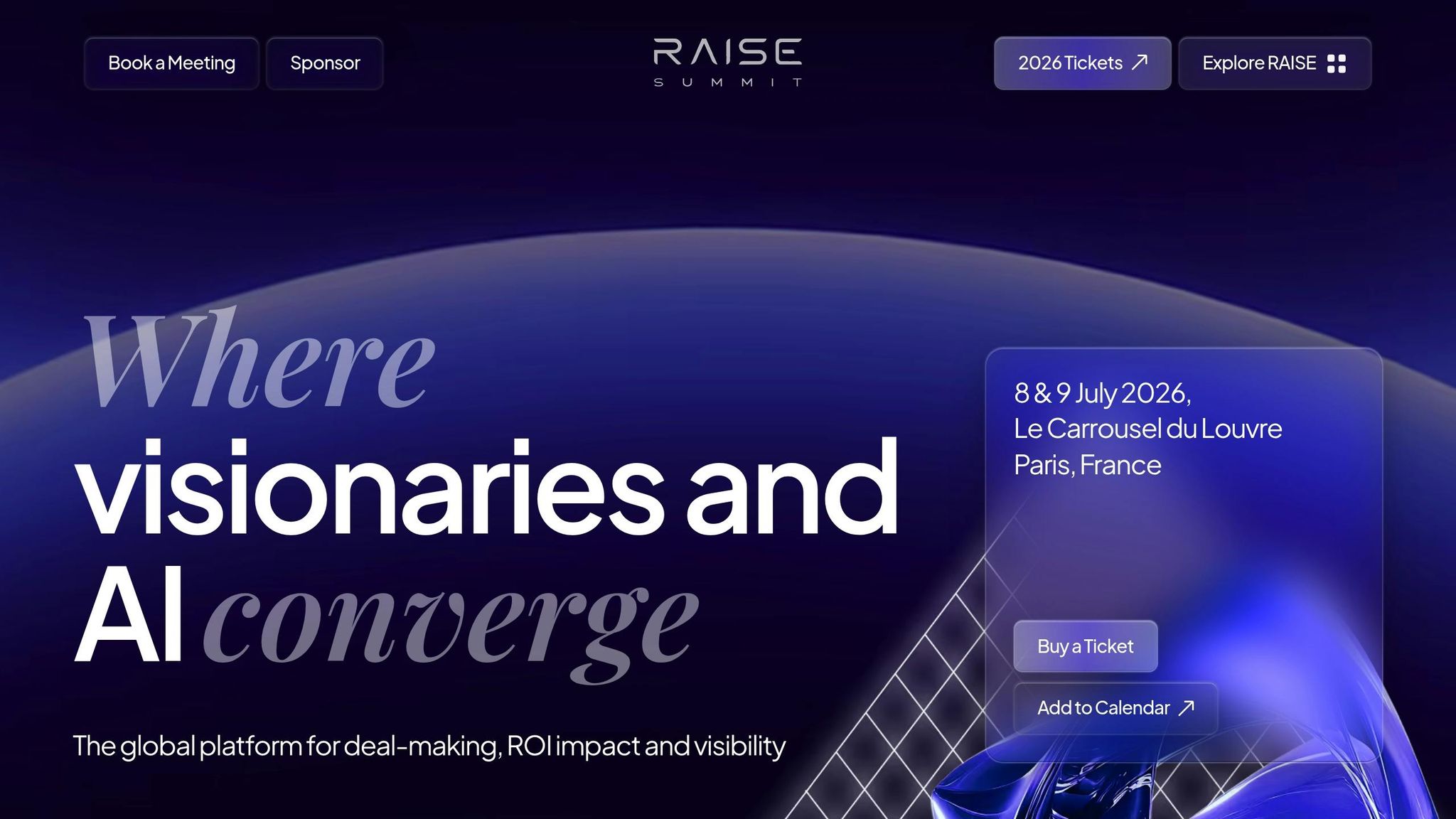
The RAISE Summit has quickly become one of the most important AI conferences in Europe. Taking place annually at the Carrousel du Louvre in Paris, the 2026 edition is expected to welcome over 9,000 attendees, representing more than 2,000 companies and featuring 350 speakers [14] [16]. Impressively, around 80% of participants are C-level executives, founders, or policymakers, making it a hotspot for strategic networking and partnerships [15] [16] [18].
"The fastest-growing AI Tech conference in Europe, and maybe in history." - Eric Schmidt, Former CEO & Chairman, Google [16] [18]
The summit is built around four central themes: Foundation, Frontier, Friction, and Future [16]. For 2026, RAISE has added an exclusive CxO Summit, designed for Fortune 1000 leaders to facilitate deal-making and pilot programmes. Other highlights include the RAISE Startup Competition, which offers a €5 million prize pool, and RAISE Your Hack, one of the largest AI hackathons globally, expecting over 8,000 participants and featuring a €200,000 prize pool [14] [16] [18].
Ticket Prices:
- PRO: €999+VAT
- VIP: €1,899+VAT
- VIP MAX (includes an exclusive dinner): €3,499+VAT [17].
These initiatives not only elevate the summit but also contribute to the broader AI ecosystem in Paris.
Other AI Conferences in Paris
In addition to RAISE, Paris is home to several specialised AI events that further its prominence in the field.
- Machina Summit: Launched in 2026, this event focuses on "Physical AI", exploring the intersection of artificial intelligence and robotics. It features live demonstrations and technical showcases [17].
- Big Data & AI Paris: This event appeals to professionals interested in data analytics and enterprise AI, offering large-scale exhibitions and hands-on workshops.
- Paris Open Source AI Summit: Aimed at promoting interoperability and transparency, this summit focuses on community-driven AI development.
A notable milestone in Paris's AI journey occurred in February 2025, when President Emmanuel Macron hosted the Paris AI Summit. This event led to the creation of Current AI, a $400 million partnership between France, Germany, Google, and Salesforce. The initiative aims to fund public-interest AI projects, with a target of reaching $2.5 billion over five years [19].
These events collectively highlight Paris as a global centre for AI innovation and collaboration.
AI Applications and Future Outlook
AI Applications in Key Industries
Paris is making waves in artificial intelligence, reshaping industries across the board. For instance, in April 2025, Mistral AI entered a €100 million partnership with CMA CGM, one of the world’s largest shipping companies. This collaboration aims to integrate AI into customer service and logistics, showcasing how Paris-based AI is modernising global supply chains [20].
Healthcare is another sector experiencing rapid transformation, thanks to the Paris Region AI Plan. This initiative allocated €1 million each to six strategic challenges, pairing leading companies with local research labs to develop AI solutions for diagnostics and treatment. A standout example? Researchers at CNRS, using AlphaFold (developed at Google DeepMind’s Paris hub), advanced cancer diagnostics and vaccine development by predicting protein structures with precision [21].
Paris’s digital ecosystem is also driving progress in financial services. BNP Paribas, for example, has invested directly in Mistral AI and is incorporating large language models into its banking workflows. Meanwhile, Mistral’s technology is streamlining software development by enabling AI-assisted coding [20].
Notably, approximately 40% of France’s R&D spending on AI is concentrated in the Paris region, underscoring its role as a national innovation leader [1].
The Future of Paris as an AI Hub
Paris is positioning itself as a long-term leader in AI, supported by a strong foundation of public and private investments. At the February 2025 Paris AI Summit, President Macron announced €109 billion in investment pledges, including €50 billion from the UAE and €20 billion from Brookfield [13]. Among these projects, Fluidstack plans to build a €10 billion AI supercomputer powered by France’s low-carbon nuclear energy, set to launch in 2026 [13].
France’s extensive nuclear infrastructure, with 57 reactors producing 61 GW, gives Paris a competitive edge by providing stable, low-carbon energy for AI’s energy-intensive training processes. This advantage is further bolstered by major data facilities like Data4’s 250 MW site in Nozay and a planned 1 GW facility in Cambrai [22].
Paris is also witnessing a reverse brain drain, as AI experts from global tech giants like Google, Meta, and OpenAI return to launch startups. With machine learning engineers earning €60,000–€90,000 annually - significantly lower than Silicon Valley salaries - Paris offers a cost-effective talent pool without compromising on expertise [4].
"Paris Region's competitive edge lies in its exceptional AI talent pool, nurtured by top-tier educational institutions." - Thomas Fauvel, Deep Tech Expert, Choose Paris Region [1]
Looking ahead, Paris is spearheading advancements in autonomous AI systems capable of handling complex workflows. The city is also at the forefront of developing open-weight models and secure, sovereign cloud infrastructures, ensuring data transparency and security for European businesses [16] [20].
Conclusion: Paris's Role in Shaping AI Development
Paris has positioned itself as a powerhouse in the AI landscape, leading Europe and ranking as the 5th global tech ecosystem. The city's strong foundation in mathematics, coupled with strategic government initiatives and cost-efficient expertise, has created fertile ground for AI advancements.
The National AI Strategy plays a crucial role in this success, offering financial incentives like the Research Tax Credit, which refunds 30% of R&D expenses. During the February 2025 AI Action Summit, investment pledges reached an impressive €109 billion, including Fluidstack's ambitious €10 billion AI supercomputer project [13].
Paris also boasts vibrant AI clusters and events such as RAISE, where professionals can connect and collaborate. Key hubs like Systematic Paris Region and Cap Digital provide access to more than 1,000 members and valuable R&D funding opportunities [1].
"Paris is a prime location in the AI race." - Vincent Simonet, Engineering Director, Google France [3]
FAQs
Why is Paris considered a major hub for AI innovation in Europe?
Paris has solidified its position as a key hub for AI development in Europe, thanks to a thriving ecosystem that blends academic strength, corporate investments, and government initiatives. The city boasts renowned institutions like CNRS, INRIA, Paris-Saclay University, and École Polytechnique, which produce top-tier talent in areas such as mathematics and computer science. This academic prowess attracts both global tech giants and ambitious startups to anchor their AI operations in the French capital.
Several major companies have also established AI research centres in Paris, working closely with local institutions to push technological boundaries. The city’s momentum is evident in its impressive growth in enterprise value and AI funding, which reached an astounding €7,8 billion last year. On top of this, the French government has taken a proactive stance, introducing initiatives to encourage innovation and simplify AI-related regulations.
These combined efforts position Paris as a driving force in shaping Europe's AI landscape, with a clear vision for the future of the industry.
How does the French government support AI innovation in Paris?
The French government is taking a central role in driving AI advancements in Paris, combining significant investments, forward-thinking policies, and targeted initiatives. President Emmanuel Macron has committed an impressive €109 billion over the coming years to bolster the country’s AI industry, attract global investments, and nurture an environment conducive to cutting-edge advancements.
Under its 'AI for Humanity' strategy, France aims to enhance AI education, encourage open data practices, and establish ethical standards for responsible AI application. One notable initiative is the Paris Charter on Artificial Intelligence in the Public Interest, which prioritizes governance rooted in societal values and active public engagement.
By streamlining regulations and investing in infrastructure, the French government is working to solidify Paris’s reputation as a leading AI hub in Europe. This approach is creating a vibrant ecosystem that welcomes researchers, startups, and international investors to collaborate and innovate.
How are AI startups in Paris transforming industries like healthcare and logistics?
AI startups in Paris are making waves in industries like healthcare and logistics, introducing solutions that boost efficiency, cut costs, and deliver better results.
In healthcare, startups based in Paris are creating cutting-edge AI tools for diagnostics, medical imaging, and automating workflows. For example, AI systems can now analyse medical images with impressive precision, speeding up the diagnostic process and improving accuracy. These advancements are helping healthcare providers streamline their operations, ultimately saving money. The French healthcare AI market is expected to see substantial growth, projected to rise from €1.81 billion in 2024 to €11.17 billion by 2035.
Meanwhile, in logistics, Parisian startups are harnessing AI to refine delivery routes, automate tasks in warehouses, and improve inventory management. AI-driven robots are revolutionising processes like picking and packing, making them more precise and reducing errors. These advancements are enabling businesses to optimise their supply chains and meet increasing demands more effectively.
With robust support from research institutions, startups, and key industry players, Paris is solidifying its role as a driving force in transforming these essential sectors.