


Europe’s AI startups are scaling faster than ever, with billion-euro unicorns emerging in record time. By 2025, AI companies in the region raised €4.6 billion in just ten months, more than doubling 2021’s figures. Startups like Mistral AI, Synthesia, and ElevenLabs are leading the charge, achieving valuations of €1 billion or more in as little as two years. What’s driving this growth? A focus on technical expertise, regulatory alignment, and partnerships with industry leaders.
Here’s what stands out:
- Faster Growth: Unicorns now emerge in two years on average, compared to seven years previously.
- Technical Leadership: 90% of European unicorn founders since 2022 have technical backgrounds.
- Regulatory Advantage: Startups leverage the EU AI Act to build trusted, compliant solutions.
- Strategic Partnerships: Collaborations with giants like ASML and Dassault Aviation fuel scaling.
For example:
- Mistral AI: Reached an €11.7 billion valuation in 29 months by focusing on efficient AI models.
- Aikido Security: Achieved €1 billion valuation in three years by simplifying cybersecurity for developers.
- Harmattan AI: Grew to €1.4 billion in two years through defence contracts and partnerships.
These companies use AI to streamline operations, reduce costs, and deliver solutions tailored to Europe’s unique market needs. Their success offers a clear roadmap for startups aiming to scale efficiently.

Europe's AI Unicorn Growth Statistics: Speed, Funding, and Key Metrics 2022-2026
How Synthesia Became One of Europe’s Fastest-growing AI Companies | Frameworks for Growth
How 4 European Unicorns Built Their Companies
Some of Europe’s latest unicorns have reached billion-euro valuations by blending smart positioning, technical breakthroughs, and strategic collaborations. Let’s dive into how these companies achieved their remarkable growth.
Aikido Security: Revolutionising Cybersecurity for Developers
Belgium-based Aikido Security hit a €1 billion valuation in January 2026, just three years after launching. This milestone followed a €60 million Series B funding round and an eye-popping 1,531% revenue growth for the fiscal year ending January 2025 [5]. What set Aikido apart? Its "developer-first" approach. Instead of catering to traditional decision-makers, the company focused on creating a unified platform that addresses developers' frustrations with fragmented security tools.
The platform combines code, cloud, supply chain, and runtime security into one seamless solution. As Madeleine Lawrence, Aikido's Chief Growth Officer, explained:
"We started it because we were developers ourselves, and we were tired of security being something that happened to us instead of something that helped us." [6]
By January 2026, Aikido had launched Aikido Attack, an AI-powered penetration testing tool designed to actively hunt vulnerabilities and automate fixes. The platform now supports over 100,000 teams worldwide, including prominent names like the Premier League and Revolut. Co-founder Willem Delbare summed it up perfectly:
"Developers just want to get back to building fun features." [6]
This focus on simplifying security has helped Aikido carve out a niche despite fierce competition from global players [5].
Cast AI: Optimising Cloud Infrastructure for AI
Lithuania’s Cast AI joined the unicorn club in January 2026, propelled by a €108 million Series C funding round in April 2025 [5]. The company capitalised on the booming AI infrastructure market by offering solutions that optimise cloud usage.
Its standout product, OMNI Compute for AI, launched in early 2026. This tool helps companies run AI workloads on fewer GPUs while overcoming regional capacity constraints. A strategic investment from Pacific Alliance Ventures further solidified its position. By reducing infrastructure costs without sacrificing performance, Cast AI has gained a competitive edge as enterprises increasingly adopt AI [5].
Harmattan AI: Building Defence Tech Through Partnerships
French defence tech startup Harmattan AI achieved a €1.4 billion valuation in January 2026, just two years after its founding in 2024 [5]. The company’s meteoric rise is tied to strategic partnerships.
In early 2026, Harmattan secured a €200 million Series B round led by Dassault Aviation. This came on the heels of agreements with the French and British ministries of defence and Ukrainian drone maker Skyeton to develop autonomous defence aircraft. These collaborations not only brought in significant funding but also boosted the company’s credibility in a highly regulated industry. By focusing on long-term autonomy for military drones via a cloud-based system, Harmattan AI has positioned itself as a strong European contender in a sector increasingly shaped by concerns over technological sovereignty [5].
Preply: Taking Edtech Global
Ukraine’s Preply, a language-learning platform, reached a €1.2 billion valuation in January 2026 after raising €150 million in a Series D round [5]. Preply’s growth has been driven by its focus on geographic expansion and AI-enhanced matching algorithms.
The company connects learners with tutors through a global network of offices in Kyiv, Barcelona, London, and New York. By refining its algorithms to personalise learning experiences while maintaining a human touch, Preply has stood out in the crowded edtech space. Its ability to keep operations running amid challenges in Ukraine has also resonated deeply with investors [5].
| Company | Country | Valuation (Jan 2026) | Key Sector | Time to Unicorn |
|---|---|---|---|---|
| Harmattan AI | France | €1.4 billion | Defence Tech / AI | 2 years |
| Preply | Ukraine | €1.2 billion | Edtech / AI | - |
| Aikido Security | Belgium | €1.0 billion | Cybersecurity | 3 years |
| Cast AI | Lithuania | €1.0+ billion | Cloud Optimisation | - |
These companies’ diverse strategies offer valuable lessons for scaling businesses, as we’ll explore further in the next section.
Frameworks for Scaling from Seed Stage to €1 Billion
The path from seed stage to unicorn status in Europe has evolved significantly. Startups are now reaching €1 billion valuations in just two years on average, thanks to strategies that emphasize fast execution, efficient use of capital, and smart market positioning. Below, we break down the key frameworks behind these successes.
How to Differentiate Your Product in Crowded Markets
In competitive markets, standing out isn’t about spending more - it’s about being smarter. Successful unicorns focus on technical precision and strategic positioning. Take Mistral AI, for instance. Instead of chasing scale for scale’s sake, they prioritized building the “strongest model for a given computational budget” [8].
Regional sovereignty has also become a major selling point. Companies like Mistral AI and Aleph Alpha market themselves as "Europe's answer to Silicon Valley", which resonates with governments and enterprises concerned about data sovereignty and compliance [1][8].
Interestingly, technical founders are leading this charge. Since 2022, 90% of European unicorn founders have technical backgrounds, compared to 80% in the US [2]. This trend fosters a culture focused on rapid action and low overhead, rather than drawn-out planning.
Revenue and Customer Growth Benchmarks
Efficient product differentiation doesn’t just help you stand out - it drives revenue growth at unprecedented speeds. AI-native startups today are reaching their first revenue three times faster and generating 5–10 times more revenue in their first year than companies launched just three years ago [2].
For example, Mistral AI, founded in April 2023, hit €8 million in revenue in its first year and reached a quarterly revenue run rate of €51 million by March 2025 - a 25-fold increase [1].
Stockholm-based Loveable scaled even faster. By December 2025, just eight months after launch, the platform had reached a €1.53 billion valuation, €85 million in annual recurring revenue, and 8 million users. The platform, led by Dr. Jim Sellmeijer, achieved this by using a multi-agent AI architecture that enabled 100,000 daily product creations [9].
| Scaling Stage | Mistral AI Benchmark | Loveable Benchmark |
|---|---|---|
| Unicorn Status | €1.7 billion (8 months) | €1.53 billion (8 months) |
| €85M+ ARR | ~€85M+ ARR (23 months) | €85M ARR (8 months) |
| Decacorn Status | €11.7 billion (29 months) | N/A |
The leap from startup to "ScaleUp" happens when a company sustains rapid annual growth - over 20% for three consecutive years [10]. At this stage, priorities shift from finding product/market fit to achieving go-to-market fit, where revenue grows exponentially with minimal additional resources.
Funding Strategies and Industry Partnerships
Once a company has differentiated its product and demonstrated revenue growth, the next step is strategic fundraising. The traditional approach of raising capital just to explore ideas is being replaced by milestone-based fundraising. For example, Mistral AI raised €353 million in a Series A only after launching a model that outperformed larger competitors [1].
Corporate partnerships are also becoming pivotal. In September 2025, Mistral AI secured €1.7 billion in a Series C round led by ASML, a Dutch semiconductor equipment giant. This deal not only valued Mistral at €11.7 billion but also gave them access to ASML’s distribution channels and industry-specific data, allowing them to integrate AI into semiconductor manufacturing [1][3].
Similarly, in February 2024, Mistral AI partnered with Microsoft, securing a €13.6 million investment. This collaboration enabled Mistral to distribute its AI models via Microsoft Azure, instantly reaching global enterprise customers and benefiting from world-class infrastructure. Another example is Munich-based Helsing, which raised €600 million in June 2025. The funding round, led by General Catalyst, included partnerships with European defense leaders like Saab [3].
For startups, targeting corporate venture arms in their industry can be a game-changer. These partnerships bring more than just funding - they validate the product, accelerate development with real-world data, and open distribution channels that would otherwise take years to establish.
sbb-itb-e314c3b
How AI Enabled These Companies to Scale
AI fueled growth by driving faster product development and streamlining operations, allowing companies to scale efficiently.
Using AI for Product Development and Market Position
Mistral AI built its success around an efficiency-first approach. Instead of developing massive models, they introduced Mistral 7B - a 7-billion-parameter model that outperformed Meta's Llama 2 13B while requiring 46% less computing power [4]. This strategy made their technology more affordable for European businesses concerned about infrastructure costs.
The company also utilized a Mixture of Experts (MoE) design in its Mixtral 8x7B model. This method activates only specific "experts" within the network for particular tasks, reducing operational costs without sacrificing performance [4]. Thanks to these innovations, Mistral AI achieved €300 million in annual recurring revenue by September 2025, just 29 months after its launch [4][12].
Their decision to open-source their models under the Apache 2.0 license attracted 10% of France's top language model experts to a compact team of 350–500 professionals [1][12]. Arthur Mensch, Mistral AI's CEO, shared his perspective on the role of generative AI:
"We should view generative AI tools as a way to augmenting productivity and creativity... a large language model and generative AI acts as a new programming language which is more abstract and controllable by human language" [13].
AI also opened doors to new market opportunities. For example, a partnership with ASML optimized semiconductor lithography, reinforcing Mistral's competitive edge. Christophe Fouquet, ASML's CEO, noted:
"The deal aims to generate clear benefits for ASML customers through innovative products and solutions enabled by AI" [11].
While product innovation played a key role in Mistral AI's growth, AI also transformed its operations to support rapid scaling.
AI for Operations and Cost Reduction
Beyond product advancements, AI-powered processes enabled Mistral AI to handle rapid growth efficiently. The company's revenue tripled in just 100 days during early 2025, a feat made possible through AI-driven automation [4]. They deployed "Agents APIs", turning standard language models into autonomous assistants capable of performing Python coding, web searches, and document management [4].
In February 2025, Orange, a leading French telecom operator, incorporated Mistral’s "Le Chat Pro" and "Codestral" models into its "Live Intelligence" suite. This move showcased how AI could scale enterprise solutions, automating customer service and technical support tasks [4]. Similarly, Mistral secured a €100 million deal with CMA CGM, a shipping giant, to integrate AI into maritime logistics, reducing manual planning and operational costs [1].
By 2026, Mistral Compute - a full-stack AI infrastructure powered by 18,000 NVIDIA Grace Blackwell chips - ensured data remained within EU jurisdiction and minimized environmental impact using low-carbon electricity [1]. Arthur Mensch highlighted the importance of this approach:
"It's important for European companies not to have too much dependency on US technology" [12].
These operational efficiencies reflect a broader European trend of leveraging AI not only for innovation but also for resilience. By focusing on model efficiency and maintaining sovereign infrastructure, Mistral AI positioned itself as a trusted partner for European enterprises needing on-premises deployment and strict data privacy. This gave them an edge over US competitors facing regulatory and trust challenges [13].
Conclusion: What Startups Can Learn from These Unicorns
Main Lessons for Scaling Your Company
Europe's fastest-growing unicorns are proving that speed and efficiency often beat sheer capital accumulation. Today, European startups can achieve billion-euro valuations in just two years, a dramatic improvement from the historical average of 7.2 years [14]. These companies focus on assembling top-tier technical teams, maintaining cost efficiency, and incorporating AI to drive rapid development.
What stands out is the emphasis on elite talent over sheer headcount. Take Mistral AI, for example: this company managed to secure 10% of France's most skilled language model experts while keeping their team size between 350 and 500 people. This approach helped them skyrocket from a €260 million seed valuation to €11.7 billion in only 29 months [1][12]. In fact, 90% of European unicorn founders since 2022 have technical backgrounds, a figure that even surpasses the U.S., where the rate stands at 80% [14]. Christoph Klink, Partner at Antler, sums it up perfectly:
"The Execution Era has begun, and Europe's founders are redefining what is possible" [14].
Another key takeaway is the focus on efficiency-first product design. This approach not only reduces costs but also appeals to budget-conscious businesses. As Anton Osika, Co-founder of Lovable, noted:
"We have focused on building in a capital efficient way that is very common to Europe but doesn't fit with the traditional US startup playbook" [14].
Strategic industrial partnerships are another game-changer. These partnerships provide startups with more than just funding - they offer market access, distribution channels, and valuable data. For instance, Mistral AI secured €1.7 billion from ASML in September 2025, with the semiconductor giant acquiring an 11% stake [1][12]. Similarly, Harmattan AI reached unicorn status after landing a contract to supply 3,000 drones to the French military [7].
These strategies not only fuel growth but also highlight the importance of networking and support systems like those offered by RAISE Summit.
How RAISE Summit Supports Growing Companies
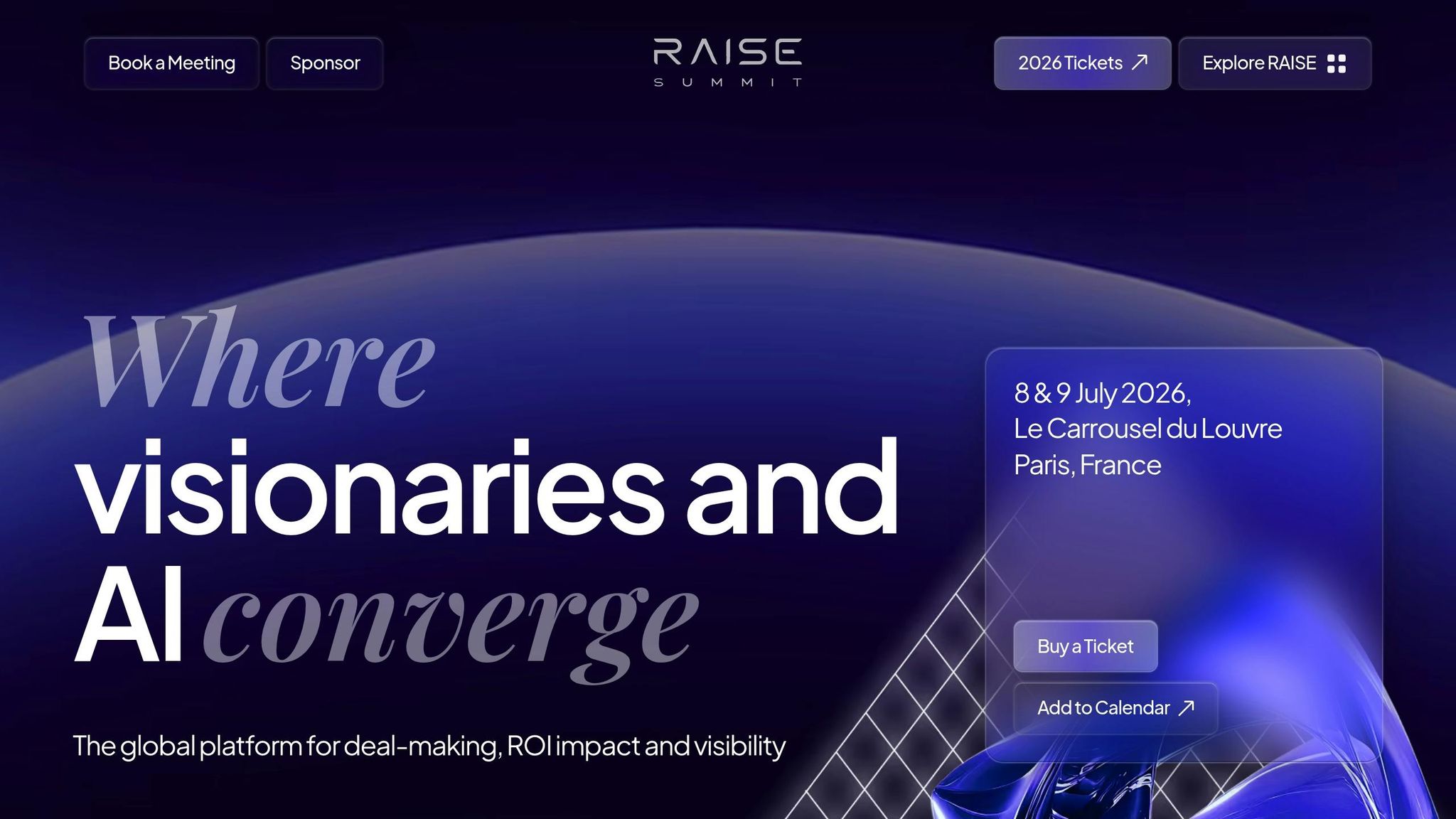
RAISE Summit, held annually at the Carrousel du Louvre in Paris, brings together over 9,000 attendees, 2,000+ companies, and 350+ speakers. It’s a hub where startups can directly connect with investors, corporate partners, and top-tier talent - the very elements that have driven Europe’s unicorn success stories. Through events like startup competitions, hackathons, and industry-specific tracks in sectors like healthcare, cybersecurity, and finance, founders gain a platform to showcase their innovations to key decision-makers.
The summit also offers a robust networking infrastructure. Tools like a dedicated app, VIP lounges, and curated experiences are designed to help founders build the strategic relationships that set high-growth startups apart. Tickets are priced to accommodate a range of participants: developers and early-stage companies (less than €5 million in funding and under four years old) can access the event starting at €599. For those seeking more exclusive opportunities, the VIP MAX pass (€3,499) includes private dinners and sessions with industry leaders shaping the future of AI in Europe.
FAQs
What are the key strategies driving the success of Europe’s AI unicorns?
European AI unicorns are experiencing rapid growth, driven by a mix of strategic funding, skilled talent, and groundbreaking advancements. Take Mistral AI, for instance. This company raised an impressive €600 million in June 2024, allowing it to scale its workforce and push forward with advanced AI solutions.
A key ingredient in this success is Europe's commitment to open-source collaboration. By embracing open-source AI models, these companies encourage community-driven progress while remaining competitive in the global market. This approach not only speeds up innovation but also fosters widespread adoption of new technologies.
Another standout factor is the rise of technical founders. Since 2022, 90% of unicorn founders in Europe have come from engineering or scientific backgrounds. This technical expertise has been crucial for faster execution and more effective problem-solving.
Finally, Europe’s growing pool of AI professionals - now exceeding 120,000 - is a game-changer. This abundance of talent, paired with a focus on capital efficiency and smart use of local resources, is helping these startups achieve billion-euro valuations and make their mark on the global stage.
How can partnerships with industry leaders help startups scale effectively?
Collaborating with well-established industry players can be a game-changer for startups, especially in the fast-evolving AI sector. These partnerships can unlock access to cutting-edge technologies, seasoned expertise, and extensive networks, all of which are crucial for speeding up product development and entering markets more swiftly. For example, teaming up with established companies can boost a startup’s credibility, open up funding opportunities, and connect them with larger customer bases.
In Europe, these alliances are particularly valuable. They help startups navigate tricky regulatory landscapes, broaden their market presence, and accelerate their growth trajectory. By tapping into the knowledge and reputation of experienced partners, startups can sharpen their competitive edge and lay the groundwork for lasting success on a global scale.
How does the EU AI Act influence the growth of European startups?
The EU AI Act is set to influence the landscape for European startups by establishing a regulatory framework for artificial intelligence. Its primary focus is on promoting safety, transparency, and accountability in AI systems. But with these goals come challenges, particularly for startups. Increased compliance costs and stricter rules for high-risk AI systems have raised concerns about potential limitations on innovation.
That said, there’s a silver lining. The Act encourages startups to integrate compliance-by-design into their operations, which can help build trust and credibility within the European market. Startups that proactively align with these regulations could position themselves as leaders in responsible AI, giving them a competitive advantage and paving the way for long-term success. While the full impact will depend on how the rules are enforced, the Act offers a path to balance innovation with ethical AI practices.