


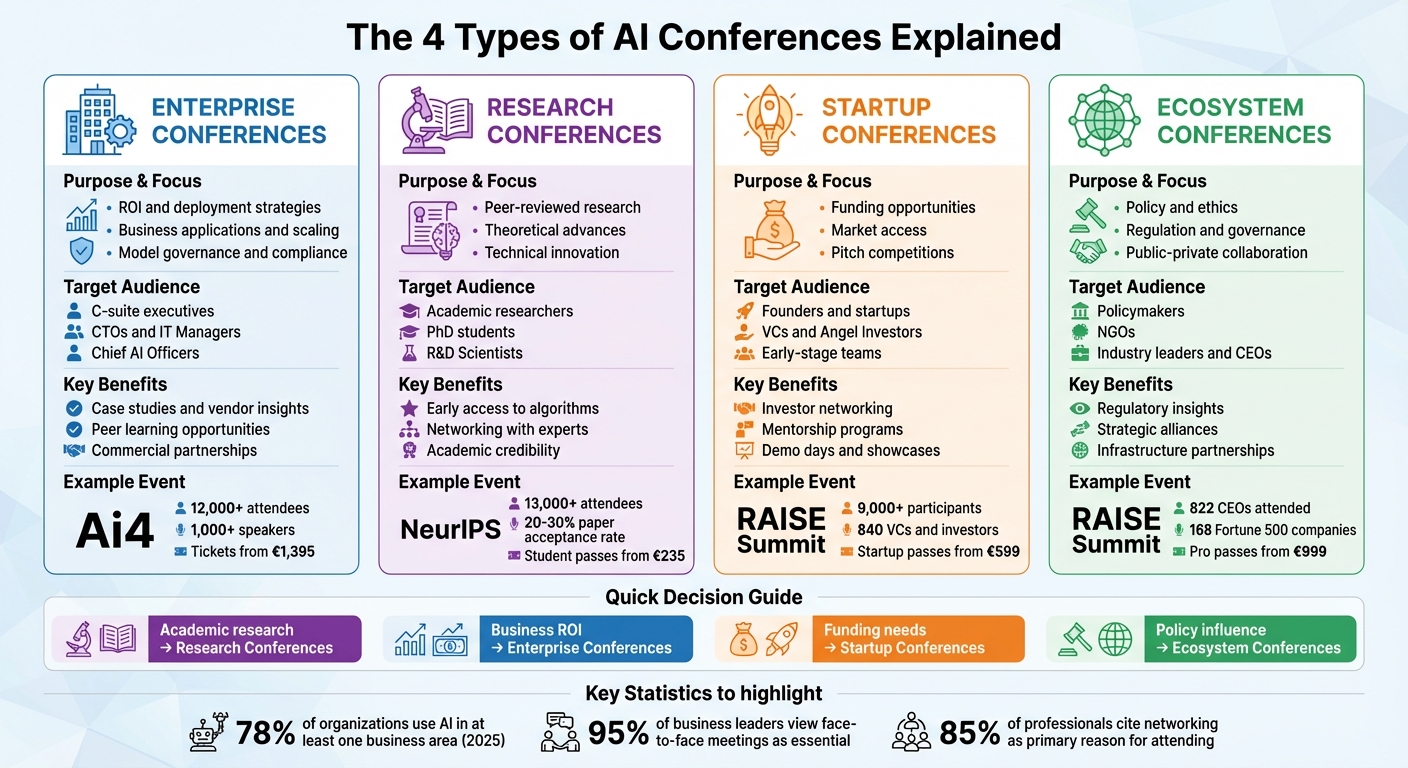
AI conferences typically fall into four categories, each serving a distinct audience and purpose:
- Enterprise Conferences: Focus on business applications, scaling AI, and ROI. Attendees include executives and IT leaders. Example: Ai4 (12,000+ participants, tickets from €1,395).
- Research Conferences: Highlight academic research and technical advancements. Ideal for researchers and PhD students. Example: NeurIPS (13,000+ attendees, paper acceptance rates of 20-30%).
- Startup Conferences: Designed for startups to connect with investors and partners. Example: RAISE Summit (9,000+ participants, startup passes from €599).
- Ecosystem Conferences: Bridge policy, funding, and innovation. Target audience includes policymakers, CEOs, and NGOs. Example: RAISE Summit (Pro passes from €999).
Each type aligns with specific professional goals, from academic insights to business networking or funding opportunities. Choose based on your career stage and objectives.
4 Types of AI Conferences: Purpose, Audience, Benefits & Pricing Comparison
1. Enterprise AI Conferences
Purpose and Focus
Enterprise AI conferences aim to connect the dots between AI's potential and tangible business outcomes. These events focus heavily on topics like model governance, regulatory compliance (including frameworks such as the EU AI Act), and the operational hurdles of scaling AI from initial pilot programs to fully operational systems [4][10].
The year 2026 marked a significant shift in how AI is approached. As Piers Grassmann, Associate Account Director at Aspectus Group, explains:
"In 2026, AI will move from experiment to expectation" [8].
This evolution means that enterprise-focused summits now prioritize discussions around AI integration into business processes rather than merely hyping its potential. Key themes include workforce adaptation and the strategic decisions boards need to make about adopting and managing AI responsibly [10][12]. A standout topic for 2026 is agentic AI - systems designed to autonomously reason through complex tasks and execute multi-step workflows [4].
These conferences naturally attract senior leaders and decision-makers who play pivotal roles in steering their organizations' AI strategies.
Target Audience
The audience at these events typically includes C-suite executives, Vice Presidents of Strategy, Chief AI Officers, and IT decision-makers from large enterprises [4][7]. Additionally, professionals from procurement, legal, compliance, and corporate development teams attend [1][5]. Industries like financial services, healthcare, manufacturing, and retail dominate the attendee list, reflecting sectors where AI adoption has both high stakes and significant regulatory considerations.
For these professionals, the conferences provide a mix of networking opportunities and actionable insights tailored to their industries.
Key Benefits
The key draw of enterprise AI conferences lies in their ability to facilitate meaningful connections and provide strategic guidance. Unlike academic events that emphasize peer-reviewed research, these gatherings focus on fostering commercial partnerships and deal-making through pre-arranged one-on-one meetings [9][10]. Attendees also benefit from case studies that highlight both successes and failures in AI implementation across various industries [10][12].
By mid-2025, 78% of organizations reported using AI in at least one area of their business, a sharp increase from 55% in 2023 [8]. These conferences have become indispensable for organizations looking to move beyond pilot programs and address practical challenges like model governance and workforce integration, ensuring their AI initiatives deliver measurable results [4][13].
Examples
Some of the most prominent enterprise AI events in 2026 include the Databricks Data + AI Summit and NVIDIA GTC, both of which anticipate over 20,000 attendees [4]. NVIDIA GTC 2026 offers a one-day pass for 1 083 € and a four-day pass for 2 172 €, with free virtual access available [4]. AI4 2026 expects more than 12,000 participants and over 1,000 speakers, with early bird tickets starting at 1 395 € [4]. HumanX 2026 provides an All Access Pass for 2 650 € and a Startup Pass for 950 € [4].
sbb-itb-e314c3b
2. Research AI Conferences
Purpose and Focus
Research AI conferences stand apart from enterprise events by prioritising technical innovation and academic exploration over commercial applications. These gatherings push the limits of AI theory, showcasing new research, technical papers, expert talks, niche workshops, and technical competitions that shape the field's future direction [14].
Unlike enterprise-focused events, research conferences are grounded in a rigorous peer-review process that ensures high-quality, in-depth content [4]. For instance, prestigious conferences like NeurIPS, ICML, and ICLR have acceptance rates ranging from 20% to 30% [4]. A prime example is AAAI-26, set to take place in Singapore from 20–27 January 2026, which anticipates over 9,000 paper submissions [4].
Transparency in peer review has become a defining feature of these events, with platforms like OpenReview making submissions, reviews, and author responses publicly accessible [14]. These conferences serve as essential meeting points for scientists, engineers, and practitioners to exchange ideas and collaborate, fostering a community deeply committed to advancing AI theory [14].
Target Audience
The audience at research AI conferences is incredibly diverse, including academic researchers, PhD students, machine learning engineers, and data scientists [14]. The "Big Three" conferences - NeurIPS, ICML, and ICLR - are widely recognised as the top venues for cutting-edge research in machine learning and deep learning [14]. For those specialising in computer vision, CVPR is considered the leading global conference [14].
In December 2025, NeurIPS in San Diego drew over 13,000 attendees from academia and industry worldwide [3]. Similarly, ICML 2025 in Vancouver welcomed around 6,000 participants focused on advancing machine learning theory and algorithms [3]. These events are also hotbeds for recruitment, with major industry players like OpenAI, Google DeepMind, and Meta actively engaging with up-and-coming talent [4].
Key Benefits
Attending research AI conferences offers much more than just access to the latest findings. One of the key advantages is the opportunity to learn about emerging techniques before they become widely adopted [11]. Publishing at these prestigious venues not only boosts academic credibility but also opens doors to roles in leading industry research labs.
For example, in February 2025, AAAI honoured Stuart J. Russell with its Award for AI for the Benefit of Humanity, which included a prize of approximately 23,500 € for his work on AI safety [3]. These conferences also feature workshops and tutorials that delve into specialised topics like explainable AI, AI safety, and reinforcement learning [4].
Registration costs vary depending on the event. Early registration for ICLR 2026 starts at around 235 € for students, while CVPR 2026 charges approximately 845 € for non-member attendees. Virtual options, such as ICLR 2026's online pass priced at about 94 €, make these events more accessible to a broader audience [4].
3. Startup AI Conferences
Purpose and Focus
Startup AI conferences are all about making connections, securing funding, and turning big ideas into actionable strategies. They provide a stage for founders to pitch their innovations to investors, gain visibility, and fast-track their entry into the market. These events are designed to transform ambitious AI concepts into practical plans with measurable business outcomes. The primary goal? To link startups with investors and policymakers, ensuring that investment aligns with technological advancements.
Expect to see pitch competitions, demo days, and startup showcases - tools to help emerging companies gain momentum. As Eric Schmidt, Former CEO & Chairman of Google, put it:
"The fastest‑growing AI Tech conference in Europe, and maybe in history" [15].
This focused environment attracts those keen on funding and forming strategic alliances.
Target Audience
Given their strategic nature, these conferences draw a mix of tech founders, early-stage teams, C-suite executives, venture capitalists, angel investors, and experienced mentors [18]. For instance, around 80% of attendees at top startup events are founders or C-level executives [23,24]. A great example is the RAISE Summit held in Paris in July 2025, which brought together 840 venture capitalists and investors, facilitating over 8,000 B2B connections among 9,000 participants [16]. These gatherings provide investors with a concentrated platform to discover emerging technologies and identify promising startups through structured events like pitch competitions and showcases [17].
Key Benefits
One of the standout advantages of attending startup AI conferences is the direct access to funding and partnership opportunities. Take the July 2025 RAISE Summit in Paris, for example. Hirundo.io, a startup specializing in machine unlearning to reduce AI hallucinations by 55% and biases by 70%, won the "RAISE the Stakes" competition, beating out over 1,100 other startups [16].
But it’s not just about the money. Founders also gain valuable insights from case studies on AI implementation, ROI strategies, and adapting their workforce to new technologies [6]. These events boost media exposure and credibility, often serving as a springboard for growth. For instance, the RAISE Summit offers a competitively priced Startup Pass at 599 €, making it accessible for budding entrepreneurs. To stand out, startups need to deliver sharp, focused pitches that showcase real-world applications and measurable ROI [13,24]. Additionally, using event-specific matchmaking tools and CRM systems can help maintain momentum and turn initial connections into long-term partnerships [9,25].
4. Ecosystem AI Conferences
Purpose and Focus
Ecosystem AI conferences are designed to connect the dots between capital, computing resources, and policy. Instead of zoning in on one specific area, these events gather builders, investors, and policymakers to turn ambitious ideas into actionable deals and pilot programs[9]. The aim? To break down silos and create spaces where organisations can step up as "architects, not just spectators"[9].
These events focus heavily on meaningful, high-level networking among top decision-makers, paving the way for impactful collaborations. As Hadrien de Cournon, Co-Founder of RAISE Summit, puts it:
"The CxO Summit exists so companies don't just talk about AI, they leave RAISE with real partnerships, pilots, and signed deals"[20].
By blending this broader approach with the more targeted efforts of enterprise, research, and startup events, ecosystem conferences complete the puzzle of AI-focused gatherings.
Target Audience
The audience for these conferences reads like a who's who of the global AI scene: C-suite leaders, founders, venture capitalists, corporate investors, and high-level policymakers[9]. Over 80% of attendees hold senior titles. For instance, the 2025 RAISE Summit in Paris brought together 822 CEOs from 168 Fortune 500 companies, along with investors managing a combined €600 billion in assets[20]. Key industries represented include finance, healthcare, retail, manufacturing, and the public sector[19].
Key Benefits
These conferences provide a direct line to the infrastructure driving AI's evolution - whether it's funding, computing power, or regulatory insights. By connecting with the right partners, organisations can address system-wide challenges like hardware shortages or fragmented data systems[21]. In fact, partnerships formed at these events have been shown to cut AI development timelines by nearly 60%[22].
Attendees also gain the chance to engage with policymakers, helping them get ahead of potential regulatory changes[9]. For those planning to attend the RAISE Summit in July 2026 at the Carrousel du Louvre in Paris, Pro passes start at €999, offering an exclusive setting to build strategic alliances[2].
The 2025 Guide to Machine Learning Conferences
Comparison of Conference Types
This section breaks down the main differences between various AI conference types, helping you identify which best suits your professional goals. AI conferences generally fall into four categories - enterprise, research, startup, and ecosystem - each tailored to distinct needs.
Enterprise conferences, like Ai4, are all about real-world application and return on investment (ROI). These events attract over 8,000 attendees and feature 600+ speakers who present practical case studies on scaling AI within large companies[3]. Research conferences, such as NeurIPS, focus on advancing theoretical knowledge. With over 13,000 participants and paper acceptance rates of just 20–30%, these events are a hub for groundbreaking ideas and peer-reviewed work[3][4]. Startup conferences cater to entrepreneurs and investors, emphasizing funding opportunities and market entry. For example, HumanX 2026 reports that more than 60% of its 6,500+ attendees hold VP-level or higher roles, and these events often include pitch competitions and investor matchmaking programs[17]. Ecosystem conferences, on the other hand, focus on the intersection of private innovation and public policy. They bring together policymakers, NGOs, and industry leaders to discuss ethics, governance, and regulatory challenges[3].
Here’s a quick comparison of these conference types, highlighting their purpose, audience, benefits, and pricing:
| Conference Type | Purpose & Focus | Target Audience | Benefits | Pricing |
|---|---|---|---|---|
| Enterprise | ROI, deployment strategies[3][4] | C-suite, CTOs, IT Managers[1] | Case studies, vendor insights, peer learning[17] | Ai4: varies; RAISE Summit: €999 (Pro)[2] |
| Research | Peer-reviewed work, theoretical advances[3][4] | Academics, PhDs, R&D Scientists[3] | Early access to new algorithms, networking with experts[17] | AAAI 2026: €675–€1,125 (full); €315–€540 (student)[17] |
| Startup | Funding, partnerships, market access[1][4] | Founders, VCs, Angel Investors[1] | Investor networking, mentorship, pitch events[4][12] | HumanX 2026: €855 (startup rate)[17] |
| Ecosystem | Policy, ethics, regulation[3][2] | Policymakers, NGOs, industry leaders[3] | Insights on regulation, public-private collaboration[3] | World Summit AI: varies; Global AI Show Riyadh: €450 (delegate)[17] |
Academic-focused conferences stand out for their rigorous standards, often reflected in high submission volumes and selective acceptance rates. Enterprise events, meanwhile, provide industry-specific insights, offering tracks tailored to sectors like healthcare, finance, and retail[3]. Startup gatherings emphasize direct opportunities to connect with investors, often through dedicated spaces like "Investor Lounges" or "Startup Villages"[1][12]. Ecosystem events, such as GITEX Global - expected to draw over 18,000 attendees for its AI sessions - serve as platforms for shaping international regulations and addressing societal challenges[3].
Choosing the right conference depends on your career goals and where you are professionally. As AI continues to move from hype to practical integration in 2026, understanding these distinctions can help you allocate your time and resources effectively for the best outcomes[12].
Conclusion
Each type of AI conference offers something tailored to specific career stages and goals. Research conferences like AAAI or NeurIPS are ideal for those seeking advanced technical knowledge. These events present peer-reviewed discoveries and cutting-edge algorithms well before they hit the commercial market[3][17]. For R&D leaders or data scientists focused on foundational advancements, these conferences are a must.
On the other hand, enterprise-focused conferences, such as Ai4, prioritize business development. They showcase practical case studies that highlight ROI and provide direct access to top-level executives. Considering that 95% of business leaders view face-to-face meetings as essential for building lasting relationships[23], these gatherings are where major purchasing decisions and partnerships often take shape.
Startup conferences shine as platforms for innovation and investment opportunities. For example, HumanX, where more than 60% of the 6,500+ attendees are VP-level or higher[17], offers dedicated programs and pitch competitions to connect startups with investors.
Ecosystem conferences serve as global meeting points for professionals across industries. These events focus on broader issues like AI ethics, governance, and regulatory challenges[3]. They’re perfect for those navigating the intersection of policy and technological innovation.
"AI conferences have evolved into mission-critical touchpoints where purchasing decisions are influenced, partnerships are forged, and market leadership is established." - Eventique[1]
Networking remains a cornerstone of these events, with 85% of professionals citing it as their primary reason for attending and 80% attributing career success to their networking efforts[23]. As AI transitions from experimental hype to widespread adoption by 2026[8][12], choosing the right conference - whether for research, business insights, funding, or policy guidance - can directly impact your professional trajectory. Aligning your career goals with the unique benefits of each conference type ensures you stay competitive and achieve meaningful growth.
FAQs
Which AI conference type fits my goals right now?
The ideal AI conference for you hinges on what you aim to achieve. For those prioritising business impact and connecting with top industry professionals, events like the RAISE Summit in Paris - an Enterprise AI conference - are a perfect fit. If your focus leans towards research and innovation, attending Research AI conferences would be more beneficial. Meanwhile, startups looking to gain visibility and attract investors should explore Startup AI conferences. The key is to align your choice with your main objective, whether that's boosting business, advancing research, or growing a startup.
What should I prepare to get real ROI from attending?
To make the most out of an AI conference and see tangible results, preparation is key. Start by defining your goals - whether it's gaining knowledge, networking, or exploring partnerships. Next, research the event's focus to ensure it aligns with what you're aiming to achieve. Once that's clear, plan your agenda by identifying the sessions and speakers most relevant to your objectives.
Don't forget the basics: have a polished elevator pitch ready and keep your contact information easily accessible. During the event, actively participate in discussions and connect with attendees. Afterward, follow up with the people you met - this is where those initial conversations can turn into real opportunities that deliver measurable benefits.
How do I choose between in-person and virtual passes?
Choosing between in-person and virtual passes comes down to what matters most to you. If you value face-to-face networking, hands-on activities, and a fully immersive experience, an in-person pass is the way to go. On the other hand, virtual passes are ideal if you need flexibility or can't travel, as they let you access content from anywhere.
Think about what suits your priorities better - making connections in person or the convenience of attending remotely. If offered, hybrid options can give you a mix of both worlds for even more adaptability.