


AI events are reshaping global conversations about technology. These gatherings are driving investments, inspiring partnerships, and influencing policies that shape how AI integrates into society. From the €237 billion in infrastructure investments triggered by the 2026 India AI Impact Summit to the New Delhi Declaration endorsed by 88 nations, these events are no longer just about discussions - they’re about action.
Key points:
- 2026 India AI Impact Summit: Attracted 500,000 attendees, led to €237 billion in commitments, and introduced the "Welfare for All" framework.
- RAISE Summit in Paris: Focused on building AI infrastructure and fostering partnerships, with €5 million in funding for startups and a 7,000-participant hackathon.
- Major Collaborations: OpenAI and Tata Group's "HyperVault" project and Infosys' partnership with Anthropic highlight the role of networking at these events.
- Policy Impact: Events like the New Delhi Summit and RAISE are shaping AI governance, balancing innovation with accountability.
These summits are no longer just conferences - they are platforms for investments, partnerships, and global cooperation that define AI's role in the future.
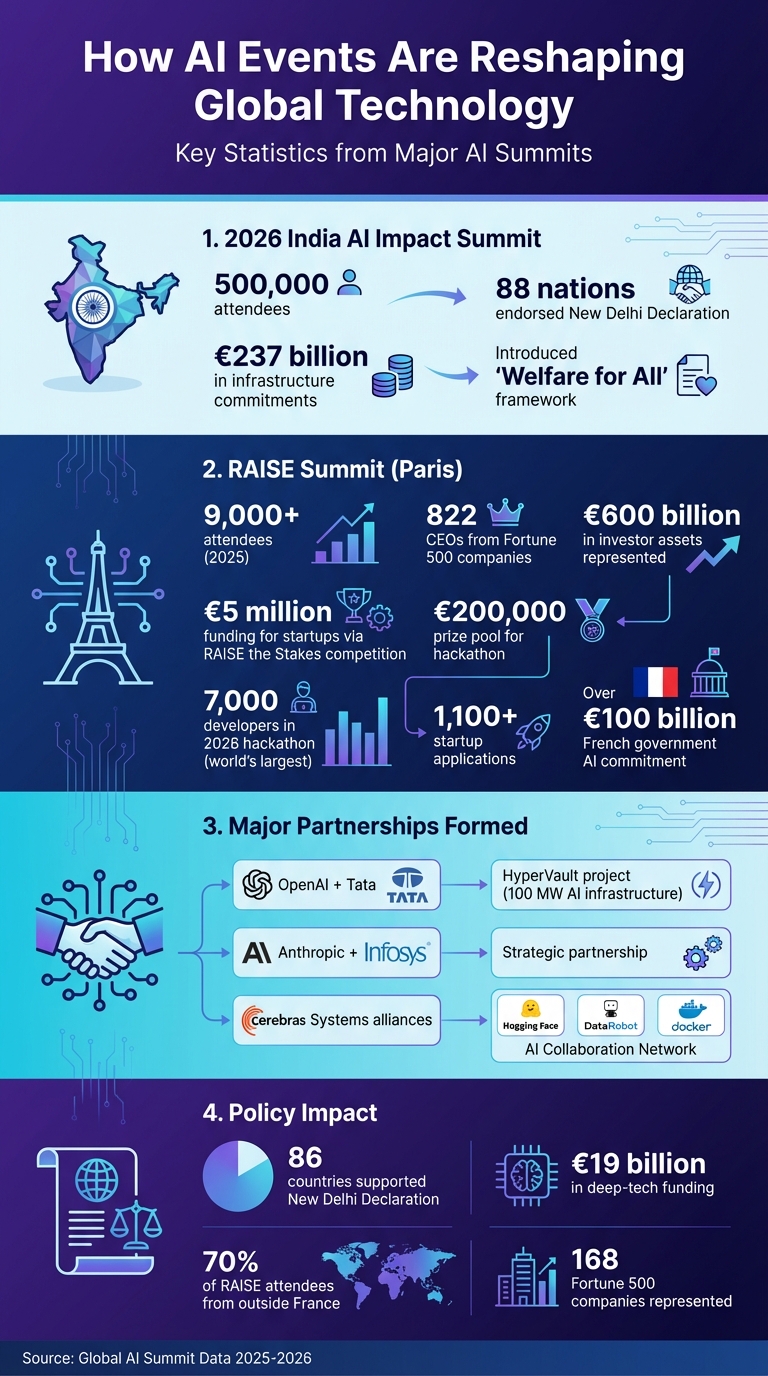
AI Summit Impact: Key Statistics and Outcomes from Major Global Events
Modi, Macron and Tech CEOs Address India's Global AI Summit | Vantage on Firstpost
How AI Events Drive Innovation and Collaboration
AI events do more than just showcase the latest advancements - they actively shape the future of technology. These gatherings bring together keynotes, partnerships, and live demonstrations, creating a dynamic space where ideas turn into action.
Knowledge Sharing Through Keynotes and Panels
Keynotes and panel discussions at AI events are powerful platforms for exchanging ideas and driving progress. Industry leaders often use these sessions to introduce new frameworks like "sovereign AI" and open-source initiatives, which challenge the dominance of a few players in the global AI infrastructure [2]. These discussions don't just present ideas - they spark debates and help build consensus on AI's future direction.
As Mark Surman, President of Mozilla, pointed out, "We saw real hunger from countries, companies, and communities to come together and build AI that is open-source, sovereign, and culturally tailored" [2].
These conversations are more than theoretical - they lay the groundwork for actionable strategies.
Networking and Building Partnerships
AI summits go beyond speeches and panels - they are fertile ground for partnerships that can redefine industries. Big deals often take shape here. For instance, OpenAI CEO Sam Altman and the Tata Group announced their "HyperVault" project, a 100 MW AI infrastructure powered by green energy, with plans for further expansion. This partnership also includes new offices and enhanced tech collaborations [5]. Similarly, Anthropic CEO Dario Amodei revealed a strategic partnership with Infosys, along with plans for a new innovation hub [5].
These collaborations, formed in the backdrop of AI events, demonstrate how networking at these gatherings can spark transformative change across the global tech ecosystem.
Showcasing New Trends and Technologies
AI events have become launchpads for turning emerging technologies into real-world applications. Take the RAISE Summit in Paris, for example. This event has shifted its focus toward practical implementation, offering exclusive programmes like the CxO Summit, designed for Fortune 1000 leaders [6]. With over 80% of the 9,000+ attendees being top-level executives, founders, and policymakers, the summit attracts the decision-makers who can drive industry-wide adoption [6].
Live demonstrations at these events bring AI applications to life, from digital twin maritime operations to advanced forecasting tools. Looking ahead, the 2026 RAISE Summit plans to host 7,000 developers in the world’s largest AI hackathon. This initiative, along with startup competitions that have drawn over 1,100 applications from cutting-edge AI companies, ensures that innovation isn’t limited to established players - it extends to emerging talent as well [6].
The RAISE Summit: A Leading Platform for AI Innovation
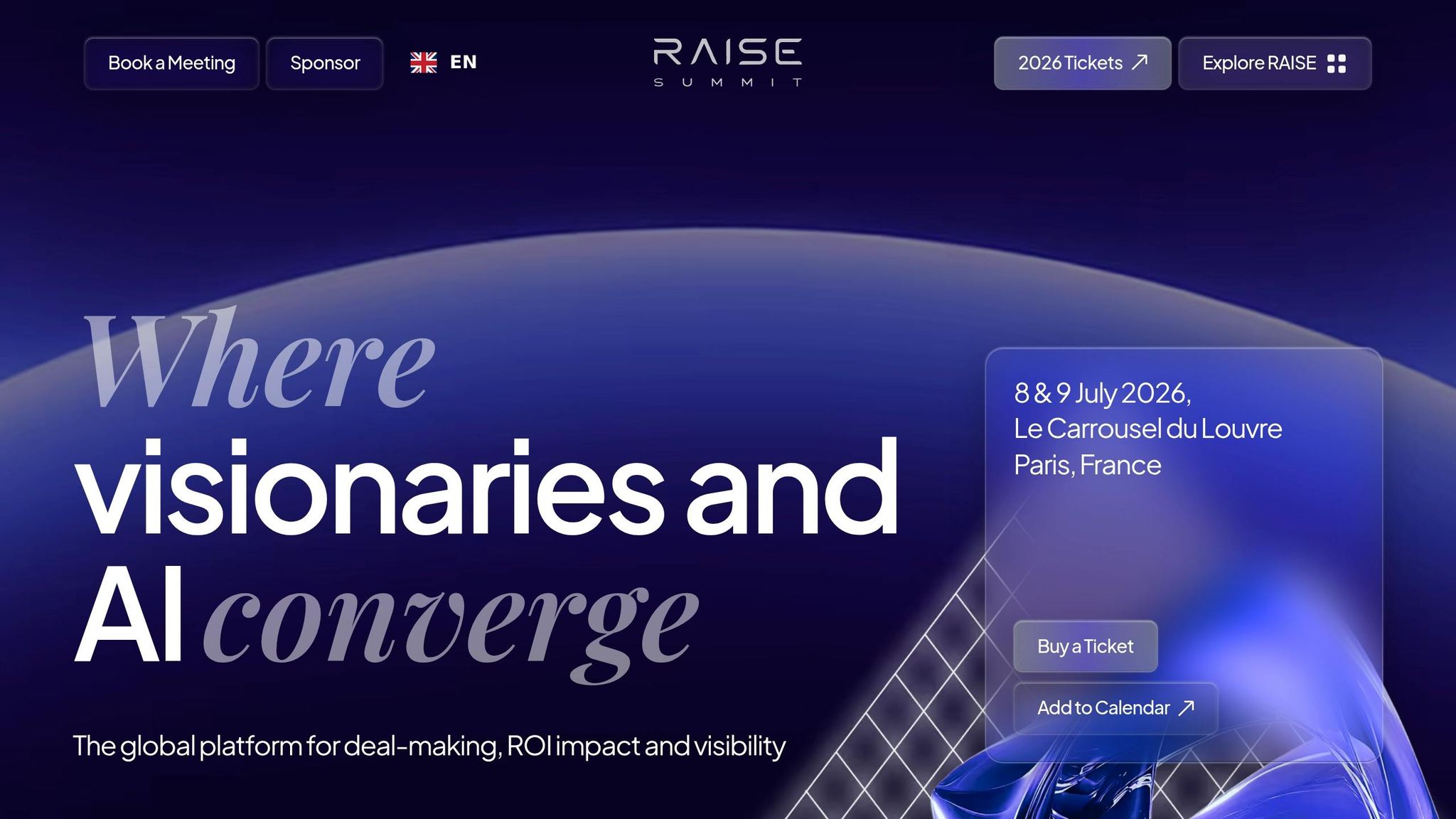
The RAISE Summit has become a central hub for advancing artificial intelligence, shaping how it's understood and applied worldwide. Hosted annually at the iconic Le Carrousel du Louvre in Paris, this event focuses on building AI infrastructure, fostering partnerships, and crafting strategic frameworks. By turning global AI trends into actionable strategies, the summit resonates deeply across the industry.
Key Features of the RAISE Summit
At the heart of the summit is the 4F Compass Framework, which organizes discussions into four strategic pillars: Foundation (covering infrastructure and funding), Frontier (highlighting transformative applications), Friction (addressing governance and return on investment), and Future (exploring AGI and long-term sustainability) [7][8]. This structured approach ensures that every critical aspect of AI development - from technical foundations to ethical dilemmas - is thoughtfully addressed.
The scale of the event is impressive. For 2026, the summit aims to attract 9,000 attendees and 2,000 companies [7]. Alongside this, the RAISE Hackathon will bring together over 8,000 participants, competing for a €200,000 prize pool, while the RAISE the Stakes startup competition offers €5 million to innovative AI ventures [7]. In 2025, the summit drew 822 CEOs, including representatives from 168 Fortune 500 companies, alongside investors managing over €600 billion in assets [6].
The summit's influence extends beyond its core event through RAISE Week, which includes MACHINA (focused on robotics and physical AI), the Versailles AI Gala at the Château de Versailles, and RAISE House, offering diverse networking opportunities at the highest levels [9]. These initiatives ensure that the summit isn't just about ideas - it’s about turning ambition into measurable outcomes.
Impact of RAISE Summit on Industry Leaders
One of the standout elements of the summit is the CxO Summit, an exclusive, invitation-only program tailored for Fortune 1000 executives. Unlike typical conference sessions, this closed-door gathering emphasizes results, helping leaders transform AI ambitions into tangible achievements.
"The CxO Summit exists so companies don't just talk about AI, they leave RAISE with real partnerships, pilots, and signed deals", said Hadrien de Cournon, Co-Founder of RAISE Summit [6].
The impact is evident. During the 2025 summit, Cerebras Systems took the spotlight on the Supernova stage, unveiling Qwen3-235B with 131K context support while announcing partnerships with Hugging Face, DataRobot, and Docker [11]. Similarly, H Company used the event to open-source "SurferH", a web-native AI agent that achieved an impressive 92.2% success rate on the WebVoyager benchmark [11].
The summit also facilitates high-value executive connections through AI-powered matching, enabling one-on-one meetings between decision-makers and innovators [6]. This environment fosters rapid formation of strategic partnerships, making the summit a catalyst for industry collaboration.
Beyond its role in fostering partnerships, the RAISE Summit plays a pivotal role in shaping France's AI ambitions.
RAISE Summit's Role in France's AI Ecosystem
The summit is a cornerstone of France's effort to position Paris as a global "AI Capital" [9][6]. By bringing together capital, computational resources, and policy discussions under one roof, the event eliminates barriers that often slow AI progress [10].
It also champions technological independence, creating a platform for Europe and France to promote responsible and sovereign AI ecosystems [12]. While around 70% of attendees come from outside France - mainly from Western Europe and the United States - the summit retains its French identity, making it an international event with local roots [12].
"RAISE is designed as a major international platform for artificial intelligence... to advance the discussion on the subject of AI: its technological advances, its challenges, the questions of European and French sovereignty", noted Hadrien de Cournon [12].
The RAISE the Stakes competition offers a glimpse into the summit's broader impact. In 2025, Hirundo.io won the competition out of more than 1,100 participants. Their machine unlearning platform reportedly reduces AI hallucinations by 55% and biases by 70%, showcasing how the summit surfaces groundbreaking solutions to critical challenges, influencing both global industry practices and policy [11].
sbb-itb-e314c3b
Influence on Policy-Making and Public Narratives
Driving Policy Discussions on AI Governance
AI-focused events are turning high-level ethical debates into actionable policy frameworks. A prime example is the New Delhi Declaration on AI Impact, supported by 86 countries during a recent summit. This declaration highlights how such gatherings foster voluntary agreements that help shape national strategies, promoting AI development that prioritises inclusivity and human-centred values[16][17]. Instead of enforcing rigid, top-down regulations, these events encourage what experts refer to as "technological statecraft" - a process where nations advocate for their own AI models while tackling real-world governance challenges.
Tech giants like OpenAI and Roblox have also stepped up with initiatives like ROOST (Repository of Robust Open Online Safety Tools). Spearheaded by Camille François, this project offers open-source safety tools designed to address online harms, including combating child sexual abuse imagery[14][15]. On a similar note, India’s Ministry of Health introduced SAHI and BODH in February 2026. These platforms integrate AI oversight into existing regulatory frameworks, providing tools for risk-based categorisation and third-party validation of AI systems[18]. Such initiatives underline the importance of merging innovation with accountability in governance.
The RAISE Summit is another key player in addressing "policy friction" - the gap between fast-paced innovation and the more measured regulatory approaches seen in France and across the EU. The summit provides a platform for comparing regulatory models directly with cutting-edge AI developers. French President Emmanuel Macron captured this balance perfectly:
"Europe is not blindly focused on regulation - Europe is a space for innovation and investment, but it is a safe space."[4]
These evolving policies are not just shaping governance but are also influencing broader public conversations about AI.
Shaping Public Perception of AI's Risks and Opportunities
AI summits are also reshaping how the public views the technology, shifting the focus from abstract fears to practical benefits. The RAISE Summit, for instance, reframes AI as a driver of economic growth and enterprise adoption. Hosting 7,000 developers at the world's largest AI hackathon, the event positions AI as a tool for innovation that is accessible to more than just elite tech circles[6].
The way these platforms communicate their goals is crucial. While earlier summits zeroed in on existential risks, recent gatherings have pivoted toward showcasing economic opportunities and aligning with national priorities. US Vice President JD Vance encapsulated this shift during a Paris summit:
"I'm not here this morning to talk about AI safety... I'm here to talk about AI opportunity."[13][15]
This change in narrative has had tangible effects on government spending. France, for example, has committed over €100 billion to AI initiatives, aiming to position Paris as a global AI hub while staying true to European values[13][14].
Conclusion: The Lasting Impact of AI Events on Technology Narratives
AI events have evolved into powerful catalysts for tangible change. Take the numbers: €237 billion invested in infrastructure and €19 billion directed toward deep-tech funding - these figures highlight the real-world momentum sparked by these gatherings[3][1].
A prime example is the RAISE Summit, which has grown into a cornerstone for setting strategies and mobilizing resources. The 2025 edition saw 822 CEOs from Fortune 500 companies in attendance, alongside investors managing assets worth over €570 billion[6].
As Eric Schmidt put it, RAISE is now "the fastest‑growing AI tech conference in Europe, and perhaps in history"[6].
Beyond the financial and strategic gains, these events are shaping policy frameworks that balance innovation and accountability. Initiatives like the New Delhi Declaration are clear indicators of how voluntary agreements can guide national AI strategies[1].
But it’s not just about boardrooms and billion-euro deals. These events are opening up AI governance to a broader audience. The 2026 New Delhi summit drew an impressive 500,000 public attendees[3], and the RAISE Hackathon brought together 7,000 developers to create practical solutions[6]. By involving such diverse groups, these platforms help bridge the trust gap and ensure that AI’s future reflects a wide range of perspectives - not just the priorities of a select few.
In this new era, AI summits have transformed from academic discussions into strategic arenas. They now influence investment, guide regulation, and foster public engagement, laying the groundwork for a collaborative approach where nations, corporations, and communities work together to ensure AI serves the collective good.
常见问题解答
How do AI events turn talks into real projects?
AI events turn conversations into actionable projects by bringing together industry leaders, policymakers, researchers, and investors. These events are more than just networking opportunities - they offer practical frameworks and hands-on workshops designed to make a real impact. For instance, tools like the 4F Compass guide organisations in evaluating their AI readiness. Additionally, curated sessions and private meetings create opportunities for partnerships and funding. This blend of resources and collaboration helps transform strategic plans into measurable results after the event.
How can smaller startups benefit from AI summits?
Startups, especially smaller ones, can gain a lot from attending events like the RAISE Summit. These gatherings provide a chance to connect with industry leaders, investors, and policymakers, opening doors to showcase their ideas, secure funding, and form strategic partnerships.
Attendees also benefit from tools such as pre-scheduled meetings and AI matchmaking, which help them build meaningful connections. These interactions often lead to mentorship opportunities and paths for growth. Additionally, competitions with large prize pools not only enhance visibility but also strengthen their reputation within the AI community.
Do AI summits influence AI laws and policy?
AI summits play a crucial role in influencing laws and regulations around artificial intelligence. These events gather government officials, industry experts, and policymakers to tackle pressing issues such as transparency, reliability, and the broader impact on society.
Outcomes from these summits often include policy updates, strategic funding initiatives, and enhanced international collaboration. For example, Europe has emerged as a leader in both AI regulation and innovation, thanks to its proactive approach in such forums. These gatherings also help lay the groundwork for global standards and governance frameworks, driving progress in the AI landscape.