


Forget mega-expos. The future of customer engagement is personal.
C-suite leaders are shifting from large-scale events to “intimacy at scale” - using AI and real-time data to create millions of personalised, meaningful customer interactions. Why? Because it works.
Here’s the reality:
- 71% of consumers expect personalisation, and 76% feel frustrated when brands fail to deliver.
- Companies excelling in personalisation generate 40% of their revenue from these efforts and grow 10% faster than competitors.
- AI-powered strategies cut customer acquisition costs by 50% and reduce churn by 28%.
Mega-expos, once the cornerstone of marketing, fall short in delivering the tailored experiences customers demand. Instead, AI enables brands to move from mass messaging to micro-relationships, treating customers as individuals.
What’s driving this shift?
- AI tools like "Next Best Experience" engines personalise interactions in real time, improving engagement and ROI.
- Unified data platforms break silos, creating a single customer view for seamless interactions.
- Privacy-first strategies ensure compliance while respecting customer preferences.
The result? Brands that embrace personalisation see higher revenue, better loyalty, and lower costs. The question is: Will your business adapt before your competitors do?
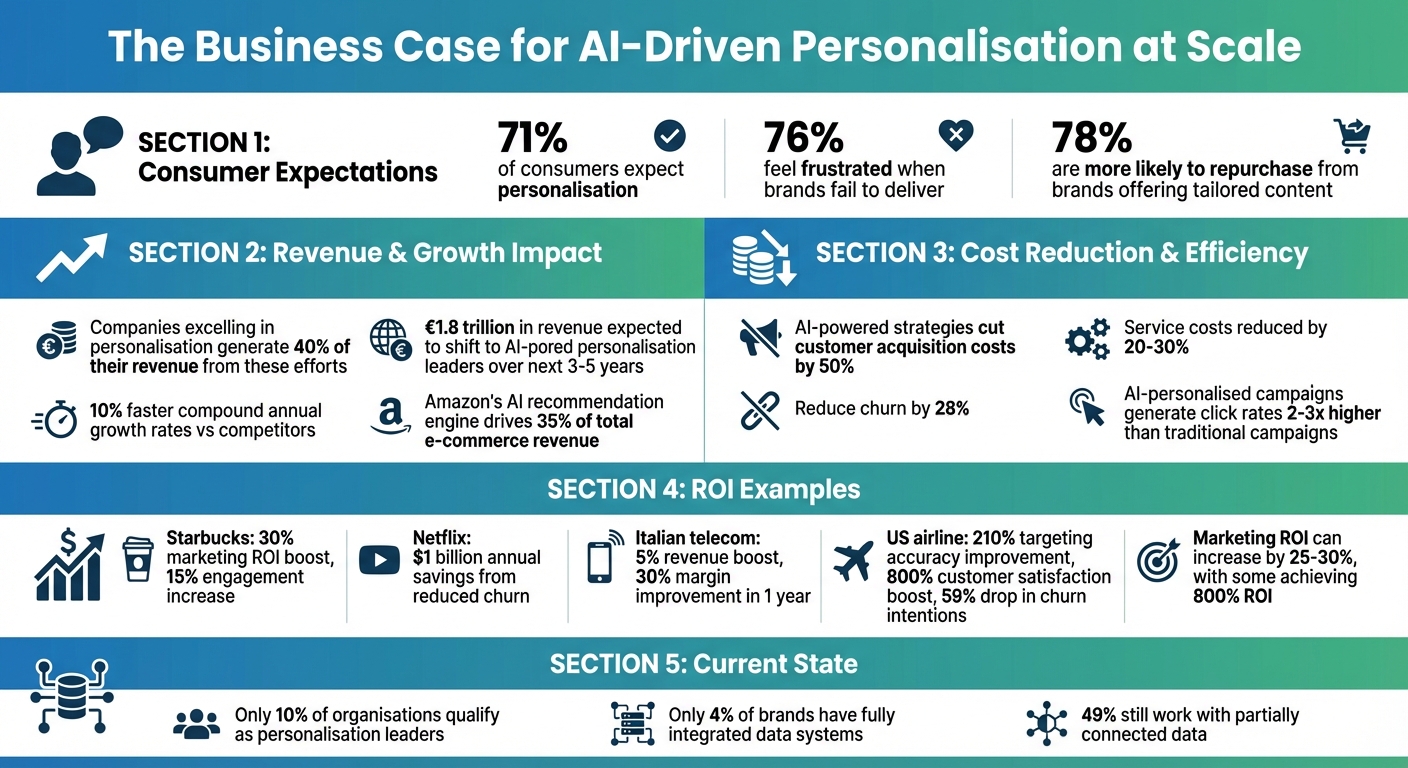
AI-Driven Personalisation vs Traditional Marketing: Key Statistics and ROI Comparison
Personalized Customer Strategy in the Age of AI: A Five-Part Framework for Driving Growth
How AI Enables Intimacy at Scale
AI has made it possible to personalise experiences on a massive scale by processing enormous amounts of data, making decisions instantly, and delivering tailored content. A key tool in this process is the "Next Best Experience" (NBE) engine, which ensures every customer interaction aligns with their current needs instead of pushing irrelevant promotions [2]. Let’s dive into how AI reshapes customer interactions at every level.
Using AI to Create Personalised Experiences
AI excels at analysing customer behaviour, preferences, and even emotions. Take Starbucks, for example. Their "Deep Brew" AI engine draws insights from 30 million loyalty members, considering factors like purchase history, local weather, and time of day. The result? Personalised recommendations that boosted their marketing ROI by 30% and customer engagement by 15% [1]. Similarly, Netflix uses AI to tailor its content for over 600 million users. This approach saves the company around $1 billion annually by reducing subscriber churn through more relevant content [1].
To achieve this level of personalisation, many companies use the 4D+M Framework:
- Data: Unified repositories for all customer information.
- Decisioning: Predictive models to anticipate customer needs.
- Design: Multiple content versions to suit different audiences.
- Distribution: Real-time delivery of content.
- Measurement: Testing for incremental impact [4].
Generative AI further accelerates this process by automating the creation of text, visuals, and videos - making content creation up to 50 times faster [4]. One example is an Italian telecommunications company that leveraged this strategy to achieve a 5% revenue boost and a 30% margin improvement within a year [2].
Connecting Data Across Platforms
For personalisation to work, brands need a complete and unified view of their customers. This means breaking down data silos and integrating information from various sources - social media, e-commerce platforms, call centres, and even in-store visits. AI-powered platforms, often called Customer 360 (C360) systems, bring together structured data (like purchase history) and unstructured data (emails, call transcripts, social interactions) to understand customer sentiment and intent [8].
A great example is the Canadian Football League (CFL). In 2025, the CFL used the Snowflake AI Data Cloud to unify over 120 data points per fan, creating a comprehensive C360 view. This approach led to a 9× increase in conversion rates and tripled their retention of marketable fans [8]. Similarly, Spotify uses engagement data from songs, podcasts, and audiobooks to craft personalised playlists. Over the past decade, this AI-driven strategy has helped grow Spotify’s user base to 600 million and its revenue to $14 billion - a 1,000% increase in both metrics [9].
The rise of Real-Time Customer Data Platforms (CDPs) is making data integration even easier. These platforms consolidate first-party data from various sources, linking it to a single customer ID for real-time use. However, only 4% of brands have fully integrated data systems, while 49% are still working with partially connected data [7]. Companies that focus on unifying their data create a "single source of truth", which powers all AI-driven personalisation efforts.
Personalisation That Respects Privacy
Personalisation and privacy can coexist, thanks to a "Privacy by Design" approach. With third-party cookies on the decline, brands are pivoting to "known-user strategies" that rely on consented first-party data and identity graphs [5]. Loyalty programmes and explicitly permitted customer profiles form the foundation of these strategies. In fact, 89% of B2B buyers are open to sharing personal information if it leads to better experiences [11].
AI systems also include built-in safeguards to ensure compliance with privacy laws like GDPR. These automated guardrails use templates to make sure all generated content adheres to legal and ethical standards [2][4]. For instance, MediaMarkt adopted automated model cards and a cross-functional review board in July 2025. This reduced their AI model approval cycles from 12 weeks to just 3 weeks, while also increasing revenue per user by 14% [10].
"Good AI governance accelerates revenue, de-risks regulatory exposure and earns stakeholder trust."
- Soumendra Kumar Sahoo, Founder, SoumendraK.com [10]
Transparency is becoming a priority. Companies now use model cards to explain data sources, performance metrics, and fallback mechanisms, making AI systems more understandable for stakeholders [10]. In November 2025, CaratLane unified data from over 270 stores, allowing sales associates to access real-time customer wish lists and loyalty details through their 'EZ Sales' app. This created a seamless omnichannel experience that balanced data utility with customer privacy [3]. Businesses with strong AI governance practices achieve 20% to 40% more value from their AI models [10].
The Business Case for AI-Driven Personalisation
ROI Comparison: Mega-Expos vs. AI-Driven Engagement
The financial benefits of AI-driven personalisation are hard to ignore. While traditional large-scale events often deliver short-term sales spikes, AI-powered strategies focus on building long-term customer value. The numbers back this up: companies using AI personalisation report revenue increases of 5% to 8%, alongside cost reductions of 20% to 30% in serving customers [2]. These results highlight the potential for deeper customer relationships. For example, AI-personalised campaigns generate click rates two to three times higher than traditional ones [2].
Real-world examples make the case even stronger. A major US airline leveraged machine learning to prioritise compensation vouchers for high-value customers during delays. The results? A 210% improvement in targeting accuracy, an 800% boost in customer satisfaction, and a 59% drop in churn intentions among at-risk customers [2]. Similarly, a telecommunications company in the Asia-Pacific region used a “next best experience” engine to personalise messages about billing changes. This approach reduced churn by 5% and delivered an ROI four times higher than previous campaigns [2].
AI systems also improve over time. By continuously refining their targeting through feedback loops, they create compounding value. For instance, an Italian telecommunications company saw a 5% revenue increase and a 30% margin improvement within just one year of adopting this approach [2].
Building Customer Loyalty Through Personalisation
The financial wins are just part of the story. AI-driven personalisation also fosters lasting customer loyalty. It shifts brands from being mere broadcasters to becoming trusted companions. This aligns with consumer expectations: 71% of people want personalised interactions, and 76% feel frustrated when brands fail to deliver them [3]. Moreover, 78% of consumers are more likely to repurchase from brands offering tailored content [1]. These personalised exchanges build trust, turning one-off transactions into long-term relationships.
The revenue impact of this trust is undeniable. Companies embracing AI personalisation generate 40% more revenue from these efforts compared to their competitors, with some leaders achieving up to 800% ROI on their marketing spend [1][3]. As seen in earlier examples, brands using AI-driven strategies not only cut costs but also significantly boost customer engagement [1][6].
"Consumers don't just want personalization, they demand it." - McKinsey [1]
First-Mover Advantages in AI Adoption
Early adopters of AI personalisation are enjoying a clear competitive edge. These leaders are growing faster, with compound annual growth rates 10% higher than companies lagging behind [5]. Over the next three to five years, an estimated €1.8 trillion in revenue is expected to shift to businesses that excel at delivering AI-powered personalised experiences [5][12]. Fast-growing companies already earn 40% more of their revenue from personalisation compared to slower-growing peers [1].
Data is the key to maintaining this advantage. For example, Amazon’s AI-driven recommendation engine is responsible for about 35% of its total e-commerce revenue [1]. Similarly, McDonald’s has seen success after acquiring an AI platform in 2019. By installing digital menu boards in 12,000 drive-thrus, they personalise suggestions based on factors like weather, time of day, and traffic patterns, leading to higher average transaction values [1]. These systems get smarter as they gather more data, creating a self-reinforcing cycle that’s tough for latecomers to compete with. This marks a shift from mass marketing to what could be called “intimacy at scale”.
sbb-itb-e314c3b
How to Implement Intimacy at Scale
Case Study: Publicis Groupe's AI-Driven Personalisation
Publicis Groupe offers a compelling example of how large organisations can weave AI into their operations. In January 2024, the company announced a €300 million investment over three years into "CoreAI", an internal platform aimed at integrating AI across functions, from insights to creative production. This initiative, led by Ray Lansigan, EVP of Corporate Strategy, builds on earlier acquisitions like Epsilon (2019) and Lotame (2025) to break down data silos and enable personalised connections on a massive scale [14].
In the same month, Publicis leveraged its "Marcel" platform alongside ChatGPT to create 100,000 customised video messages. These videos featured AI-generated twins of top executives, addressing employees by name and referencing their individual interests [13][15].
"Every single client's utopia is personalised content at scale for all their prospects and customers. AI would certainly help that." - Carla Serrano, Chief Strategy Officer, Publicis Groupe [15]
This initiative highlights how seamlessly integrated AI can fuel collaboration across departments, setting the foundation for large-scale personalisation.
Creating Cross-Functional Teams
Achieving intimacy at scale demands collaboration between various departments. Teams must align their goals and share customer insights to avoid inconsistent messaging. Bringing together data engineers, creatives, and strategists under a unified contact policy ensures a cohesive approach.
To make this work, Customer Data Platforms (CDPs) should be accessible to more than just analytics teams. Creative and strategy groups need to tap into these insights to guide their work. For example, Air France-KLM adopted this approach by 2025, running 80 generative AI projects. Among these was a digital concierge capable of providing agents with templated responses in 85 languages by searching through procedure manuals [17]. Michel Pozas Lucic, VP Customer Innovation and Care, summed it up perfectly:
"The whole philosophy here is one of innovation. No single department owns innovation." [16]
French companies have been quick to embrace such cross-functional AI initiatives. Between 2023 and 2024, generative AI usage in France shot up by 60% [17]. However, only 25% of French business leaders are planning organisation-wide training, compared to 53% focusing on specific roles [17]. This gap underscores the importance of broad-based upskilling to maximise collaboration. When done right, these efforts transform fragmented data into unified insights, enabling tailored customer experiences at scale.
Selecting the Right Technology Stack
To implement AI-driven personalisation effectively, you need a well-structured technology stack with four essential layers: a unified data foundation, a predictive decisioning engine, generative AI tools for content creation, and an integrated campaign delivery system [2].
- Unified Data Foundation: Start with a "Data Layer" that consolidates various data sources - billing records, CRM data, web analytics, and call logs - into a central repository. This creates unified customer profiles.
- Predictive Decisioning Engine: Use advanced analytics to predict customer needs. Propensity and value models help determine the "next best experience" for each individual [2].
- Generative AI for Content Creation: Tools like GPT-4 for scriptwriting or DALL-E for visual content allow for scalable, personalised assets [1][15].
- Integrated Campaign Delivery: Ensure that CRM and marketing automation systems work seamlessly to deliver messages across the right channels at the right time.
Adopt a two-speed approach to implementation. Start with small-scale "lighthouse" pilots that deliver quick returns while simultaneously building long-term capabilities, such as data lake architecture and governance models [2]. This dual strategy allows brands to unlock the full potential of AI-driven personalisation while creating systems that generate lasting value.
"The CDP is the secret unlock to be able to know how the consumer has engaged with the brand." - Ray Lansigan, EVP, Corporate Strategy, Publicis Groupe [14]
Conclusion: The Future of Customer Engagement
Turning large-scale events into tailored, AI-driven interactions has shown its worth. This isn't just a passing trend; it's a complete rethinking of how businesses connect with their audiences. Personalisation has grown far beyond a simple marketing tool - it’s now a strategic driver of measurable results. Companies excelling in personalisation generate 40% more revenue from these efforts [3] and achieve compound annual growth rates that are 10% higher than their competitors who lag behind [5]. With 71% of consumers expecting personalised experiences [3] and 76% feeling frustrated when they don’t get them [3], the demand for tailored interactions is undeniable.
AI-powered personalisation doesn't just enhance customer satisfaction - it delivers real financial benefits. Businesses leveraging "next best experience" engines report revenue increases of 5% to 8% [2] while cutting service costs by 20% to 30% [2]. Marketing ROI can leap by 25% to 30% [1], with some companies seeing returns as high as 800% on their marketing investments [3]. Despite these compelling numbers, only 10% of organisations qualify as leaders in personalisation today [5], leaving a staggering €1.8 trillion opportunity unclaimed over the next three years [5].
This shift is already influencing the strategies of market leaders.
"True personalisation empowers customers to get what they want - faster, cheaper, and/or more easily." - Mark Abraham, Senior Partner, BCG [5]
The future lies in moving beyond predictive analytics to what experts call "perceptive intelligence." This involves understanding a customer’s intent, emotions, and context in real time [3]. To achieve this, businesses must unify scattered data, build cross-functional teams, and implement governance models that treat AI as a growth driver, not just a compliance tool. Starting with small-scale, high-impact projects can deliver quick wins while laying the groundwork for sustainable success [2].
Companies that master this new approach to personalisation won’t just survive industry disruptions - they’ll lead the charge. The real question is: Will your leadership team prioritise this transformation before your competitors do? The decisions you make now could shape your place in a rapidly changing market.
FAQs
What makes 'intimacy at scale' different from traditional marketing methods?
'Intimacy at scale' is all about building personalized and meaningful connections with customers, even when addressing a large audience. Unlike traditional marketing methods - think massive expos or blanket ad campaigns - this approach leans on AI-powered tools to customize interactions, content, and offers based on individual preferences.
By tapping into real-time customer data, businesses can create experiences that feel personal and relevant. This not only strengthens emotional bonds but also encourages loyalty. Essentially, it blends the broad reach of traditional marketing with the individual care of tailored experiences, leading to higher engagement, better conversion rates, and happier customers.
How does AI help businesses create more personalized customer experiences?
AI empowers businesses to create personalized customer experiences by sifting through vast amounts of data to align interactions with individual preferences and behaviours. This allows for real-time adjustments, delivering content, recommendations, and messages that genuinely connect with each customer. The result? Stronger relationships, heightened engagement, and greater loyalty.
Beyond personalization, AI has the ability to anticipate customer needs, offering proactive solutions and smooth interactions across various platforms. By merging data from multiple touchpoints, it ensures a seamless and tailored journey. This not only helps brands establish meaningful connections but also drives measurable outcomes for their business.
How can businesses personalise customer experiences while respecting privacy?
Businesses can find the sweet spot between personalisation and privacy by prioritising transparency and trust. This means being upfront about how customer data is collected and used, while ensuring full compliance with privacy laws like the GDPR. Giving customers control over their data through clear opt-in options can go a long way in building confidence.
To personalise in a way that respects privacy, companies can leverage AI-powered tools designed to handle data securely and responsibly. The key is to collect only what’s necessary - like behavioural patterns or demographic details - and ensure teams work together to craft experiences that are both meaningful and privacy-conscious. This strategy not only fosters customer loyalty but also meets the growing demand for ethical data practices.