

Hackathons, summits, and pitch competitions are reshaping career paths in AI. These events condense months of networking, skill-building, and opportunities into just a few days, providing unmatched visibility, hands-on experience, and connections with industry leaders.
Here’s why they matter:
- Direct exposure: Meet investors, hiring managers, and decision-makers.
- Skill application: Solve challenges using cutting-edge tools like Groq APIs or Llama models.
- Career acceleration: Many participants secure jobs, funding, or mentorships shortly after events.
- Financial incentives: Prizes often exceed €10 million, with hackathons offering awards up to €200,000.
Success stories abound. Abhishek Nandy landed a top role at Red Hat after winning a hackathon, while startups like Hirundo gained funding and global recognition through competitions. These events don’t just build resumes; they launch careers and transform ideas into scalable solutions.
Want to thrive in AI? Participate, connect, and build.
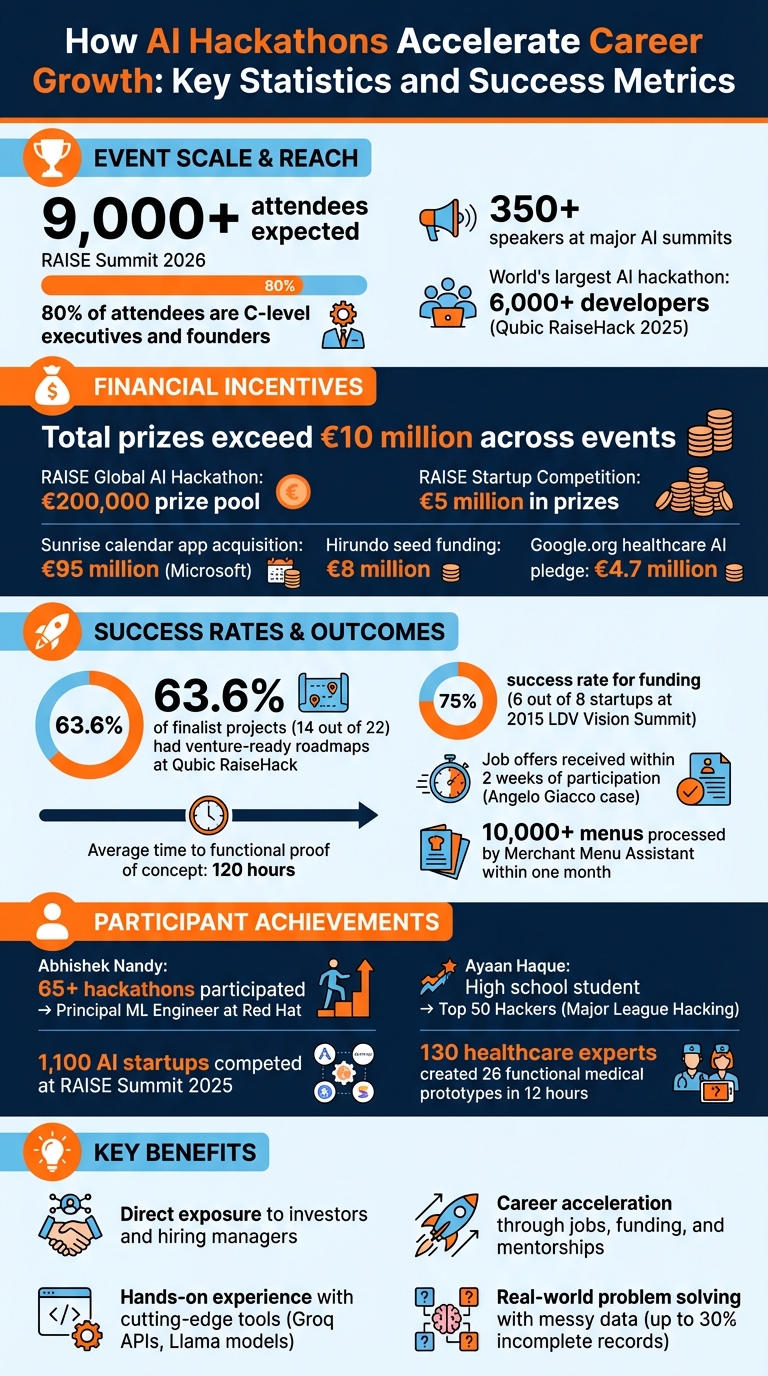
How AI Hackathons Accelerate Career Growth: Key Statistics and Success Metrics
Career Growth Through Hackathons, Summits, and Pitch Competitions
Speeding Up Career Advancement in AI
Hackathons, summits, and pitch competitions can fast-track careers in ways that traditional paths often cannot. Take Abhishek Nandy as an example. After winning the Red Hat and Intel AI Hackathon in July 2025, he landed a role as Principal ML Engineer at Red Hat. During the competition, he tackled complex challenges like optimizing molecular prediction models with PyTorch and OpenVINO, dealing with data quality issues, and integrating low-latency RAG pipelines. His journey to this success involved participating in over 65 hackathons, where he honed his skills in rapid prototyping [4].
The numbers back up the transformative potential of these events. At the 2025 Qubic RaiseHack - certified as the world's largest AI hackathon with over 6,000 developers - teams turned initial ideas into functional proofs of concept in just 120 hours on average. Among the 22 finalist projects, 14 (63.6%) had roadmaps ready for immediate venture funding [5]. This kind of validation and exposure happens at a pace that traditional career paths simply can't match.
"Hackathons turn 'what if' into 'let's build it.' They strip away barriers, fuel collaboration, and create space for rapid experimentation."
– Abhishek Nandy, Principal ML Engineer, Red Hat [4]
These events aren't just for seasoned professionals. Younger participants also see dramatic growth. Ayaan Haque, for instance, went from being a high school student with basic coding skills to one of Major League Hacking's "Top 50 Hackers." He built a skin cancer diagnosis app during a 24-hour competition, which opened doors to industry research roles by age 18 [6]. Similarly, Angelo Giacco, a graduate of Imperial College London and ETH Zurich, received a job offer within two weeks of participating in an AI hackathon organized by ElevenLabs in November 2024 [9]. These rapid advancements also prepare participants to handle the challenges of real-world AI projects with confidence.
Building Resilience and Flexibility
The benefits of these events extend beyond immediate career milestones. They cultivate critical problem-solving skills and mental agility - both essential in fast-paced AI roles. Working with real-world data, where up to 30% of records might be incomplete or missing, forces participants to think on their feet in ways that polished academic datasets never do [8]. As Aïcha, a lead developer, explains: "The pace is crazy, but the learning curve is even more intense" [5].
Modern AI hackathons now focus less on building models from scratch and more on integrating pre-built models and workflows. As Abhishek Nandy notes, the challenge is in refining prompts and designing intelligent systems under tight deadlines [4]. This mirrors the demands of industry work, where integrating AI components into full-stack applications often involves managing API failures and ensuring low-latency performance. Participants also learn to implement validation layers and fallback mechanisms to handle inaccurate model outputs, developing the reliability-focused mindset that employers seek [8].
sbb-itb-e314c3b
How Hackathons Make You a Better Software Engineer
Skill Development: Connecting Theory and Practice
Competitive events are where theoretical AI knowledge meets real-world application, sharpening both technical and teamwork skills that are crucial for career growth.
Hands-On Experience with AI Skills
Hackathons push participants to go beyond theory, requiring them to use advanced tools and techniques. Take Abhishek Nandy's experience at the Red Hat and Intel AI Hackathon, for example. He applied PyTorch with bfloat16 precision, built a low-latency RAG pipeline using Qdrant, and enhanced a molecular prediction model with Intel's OpenVINO. His project, deployed on OpenShift, connected his academic research in Bioinformatics AI with real-world production [4].
As Abhishek Nandy explains:
"Hackathons are less about building from scratch and more about orchestrating intelligence - integrating models, refining prompts, and crafting smart workflows" [4].
At the RAISE Your Hack 2025 competition, participants tackled industry-standard challenges, working with Groq APIs, Llama models, and Model Context Protocol (MCP) [11][7]. These events teach essential data engineering skills, such as cleaning messy datasets (where up to 30% of records may be incomplete), implementing validation layers for unreliable AI outputs, and designing asynchronous systems to handle slow API calls [8].
Responsible AI practices also take center stage. For instance, at the Atlassian Codegeist Hackathon, teams earned extra points for disclosing AI usage and demonstrating awareness of data privacy concerns [10].
But technical expertise isn’t the only skill set these events develop - they also build interpersonal and collaborative abilities essential for success in AI.
Soft Skills for Team Collaboration
Technical know-how alone isn’t enough. Effective communication and teamwork are just as important. During the TruEra and OpenAI Hackathon in February 2024, Team CogniSmile - composed of Mohamed Regaya, Yahya Samet, Mohamed Aziz Omezine, Aya Omezzine, and Hachicha Mohamed - divided responsibilities like data pipeline management, model integration, output processing, and system testing to create an AI-powered storytelling app. The app could generate personalized stories from children’s drawings [13].
Hackathons also teach teams to handle tight deadlines by clearly documenting API contracts, translating business needs into technical specifications, and deciding where AI adds value versus where traditional methods are more effective. As AI Developer Smahakarkar points out:
"Good AI implementation isn't about using AI everywhere - it's about using it where it adds the most value" [8].
Transparency and trust-building are equally important. Teams learn to provide confidence scores, explain system assumptions, and navigate uncertain outputs, which are critical for fostering trust in AI systems [8]. These high-pressure environments prepare participants for the challenges of professional AI teamwork, making hackathons a direct stepping stone to career advancement.
Networking Opportunities and Professional Connections
Competitive events aren’t just about skill-building - they’re also prime opportunities to forge meaningful professional connections. These gatherings bring participants face-to-face with decision-makers, mentors, and collaborators who can influence and even transform career paths.
Creating Long-Term Professional Relationships
Events like hackathons and pitch competitions condense months of networking into just a few days. A great example is Pierre Valade, co-founder of the Sunrise calendar app, who gained industry attention at a Foursquare hackathon in February 2011 by building "Agora." This experience not only led to a role at Foursquare but also set the stage for Sunrise, which Microsoft acquired for over €95 million three years later [14]. Similarly, Genevieve Patterson, a computer vision PhD candidate at Dartmouth, connected with the founder of Clarifai while organizing the LDV Vision Summit challenges. This connection ultimately secured her a position at the company [14].
These events succeed because they highlight participants’ ability to perform under pressure. As Benjamin Wolba, founder of the European Defence Tech Hub, puts it:
"Startups cannot spend as much money on LinkedIn ads or copy what Big Tech do in terms of prestige, but they can show that they're more agile, and more approachable, that they're more committed during a hackathon" [9].
The key is shifting from surface-level networking to genuine engagement. Azzedine Idir Aitsaid, who placed third on the Groq track at the RAISE Summit 2025 Hackathon with teammates he had just met, advises:
"Go to talk. Go to listen. Go to discover, to see, to hear stories, and to think alongside other people. The opportunities will follow" [3].
This kind of authentic interaction not only builds relationships but also boosts visibility within the competitive AI landscape.
Increasing Visibility in the AI Ecosystem
Participating in high-profile events can elevate credibility in ways that traditional applications simply can’t. For instance, the RAISE Summit 2026 is set to attract over 9,000 attendees and 350+ speakers, with 80% of the audience comprising C-level executives and founders [2]. This creates what organizers call "high-stakes connectivity", where builders, investors, and policymakers come together around shared AI priorities [2].
Pitch competitions, in particular, offer a unique form of validation. In July 2025, Hirundo, led by CEO Ben Luria, won first place at the RAISE Summit Startup Competition in Paris. Competing against 1,100 other AI startups, Hirundo’s "machine unlearning" technology caught the attention of judges like Laura Modiano (OpenAI), Serge Lemonde (NVIDIA), and Julien Bek (Sequoia Capital). This win provided a major "vote of confidence" and increased the company’s visibility in the global AI community [15]. Similarly, at the 2015 LDV Vision Summit, six out of eight startups that participated in the competition successfully raised funding afterward [14].
But visibility isn’t just about winning. Evan Nisselson, founder and general partner at LDV Capital, emphasizes the importance of speaking up:
"The most intriguing and brilliant questions will inspire others to come find you and talk afterwards, but if you say nothing, then it's impossible for the rest of us to know why you are brilliant" [14].
Exclusive events, such as VIP dinners and closed-door forums, provide even more opportunities to deepen connections. For instance, the RAISE Summit’s VIP Versailles Dinner brings global innovators and visionaries together at one table [2]. These intimate settings often lead to conversations and partnerships that extend far beyond the event itself.
Turning Ideas Into Practical Solutions
The real challenge lies in transforming a prototype into a solution that delivers lasting impact. Many projects born under tight deadlines evolve from weekend experiments into tools that address pressing business and societal needs.
From Prototype to Scalable Product
Creating a functioning prototype is just the beginning; turning it into a sustainable product demands clear strategies and structured support.
At the RAISE Summit Start-Up Competition in July 2025, Hirundo showcased this journey. Their machine unlearning technology, which enables companies to selectively erase unwanted data or biases from AI models without the need for full retraining, moved from concept to market-ready solution. This innovation attracted €8 million in seed funding from Maverick Ventures Israel to scale the product across billions of parameters [15][18]. CEO Ben Luria highlighted its potential:
"Wider AI adoption will be empowered by helping AI forget bad behaviours and data. We're proud to pave the way as the first machine unlearning solution on the market." [15]
Not every project relies on venture capital to grow. RAGGENIE, created in just five days during the Falcon Hackathon (Lablab.ai, September 2024), chose a community-driven, open-source approach. Developed by Ashmil Hussain and Sajo, the platform uses FastAPI and Retrieval-Augmented Generation to link structured databases like MySQL and BigQuery with document sources such as Google Drive and SharePoint. As Ashmil Hussain explained:
"One of the key lessons we learned from the hackathon is that community-driven development is a powerful force. That's why we decided to make RAGGENIE an open-source project." [17]
In healthcare, the path to implementation often involves additional validation. Winners of the AI for Glioblastoma hackathon benefited from three months of extended support from partners like Owkin, Servier, and AWS. This backing helped teams refine their prototypes into practical biomarkers and candidate targets [16], ensuring their solutions met clinical standards.
These examples illustrate how prototypes can evolve into solutions that deliver measurable benefits to both businesses and society.
Commercial and Societal Impact
Some innovations have already proven their value in practical applications. During GrabathonX in January 2024, a team called "Grabosaurus-rex-v2" developed the Merchant Menu Assistant, a generative AI tool that enables small businesses to create digital menus from photos. By the same month, the tool had processed over 10,000 menus for internal operations [21].
In healthcare, POIG (Precision Oncology Interface Gemma) emerged from a 12-hour Google France hackathon in early 2026. Created by Arun Nadarasa and Jonas Gottal, the system leverages Google's Gemma models to assist with complex decision-making in oncology. It won first place among 26 teams and was recognised as a scalable solution for personalised cancer treatment planning [19][20]. Following the event, Google.org pledged €4.7 million to support European initiatives using AI to enhance healthcare systems [19].
Industrial sectors are also reaping the benefits of hackathon-driven innovations. At the RAISE Summit 2025, the AG Solution team, led by Juri Krivoruchko, developed an "On-Prem AI Unified Namespace for OT Automation." This system uses AI to map plant documentation to live operational data in a secure, air-gapped environment, enabling operators to issue natural language commands without risking data security. The project earned the "Best Use of Snowflake" award at Europe's largest AI hackathon [22]. Reflecting on the achievement, Juri Krivoruchko remarked:
"We wanted to demonstrate that AI doesn't have to be complex or cloud-dependent to be powerful. Sometimes the most innovative approach is making advanced technology work within real-world constraints." [22]
These projects highlight the tangible impact of turning ideas into practical, scalable solutions that address real-world challenges.
Industry-Specific Career Paths in AI
Opportunities Across Different Industries
As AI continues to evolve, it’s creating specialized career paths tailored to various industries. Competitive events are a major driver of this trend, offering professionals a chance to demonstrate their expertise in specific applications while gaining experience with tools and frameworks unique to their fields.
Healthcare stands out as a particularly active sector for AI careers. In early 2026, Google France organized a 12-hour healthcare hackathon in Paris, attracting 130 experts who developed 26 functional medical prototypes [19]. One standout project was an oncology decision-making system built with Google's Gemma models [19]. Other teams created tools such as the AURA Triage Assistant, which uses MedGemma and Vertex AI for instant triage insights, and IGT Assist, a voice-controlled system that lets surgeons manipulate medical images hands-free [19]. Following this event, Google.org pledged €4.7 million to support European initiatives using AI to improve healthcare [19].
AI is also reshaping pharmaceuticals and life sciences, particularly in drug discovery and research. For example, in July 2025, Abhishek Nandy won the Grand Prize at the Red Hat and Intel AI Hackathon by developing a drug discovery solution using PyTorch and OpenVINO on OpenShift. This achievement led to his appointment as Principal ML Engineer at Red Hat [4]. As Joelle Barral, Senior Director of Research & Engineering at Google DeepMind, explained:
"From improving clinical trials to easing administrative workloads, AI is already changing what's possible in healthcare" [20].
The rise of enterprise automation and HR technology is another exciting development. At the RAISE Summit 2025, the team Unmask won first place in a Vultr-sponsored agentic AI hackathon. Their project focused on helping HR teams verify resumes and interview data, a solution that highlights how AI is streamlining hiring processes [12]. Events like the Machina Summit also provide hands-on insights into autonomy and manufacturing, complementing advancements in HR tech such as the Unmask solution [2].
These events don’t just showcase innovation - they also act as recruitment hubs. For instance, in November 2024, Angelo Giacco, an Imperial College London graduate, participated in an AI hackathon organized by ElevenLabs. Within two weeks, he received a job offer as an engineer [9]. Zoe Qin, Vice President at Dawn Capital, emphasized the importance of these events, stating:
"Hackathons are a viable way for hot AI startups to compete with Big Tech for a top talent pool" [9].
With over 80% of attendees at major AI summits like RAISE being C-level executives or founders, participants gain direct access to industry leaders who can open doors to specialized career opportunities [2]. These experiences not only help professionals build niche skills but also create unique career paths aligned with specific industry needs.
Conclusion: Using Competitive Events for Career Success
Hackathons, summits, and pitch competitions offer a fast track for advancing AI careers. They provide four key benefits: direct recruitment opportunities, hands-on experience with advanced tools, meaningful connections with industry leaders, and the chance to turn prototypes into practical solutions. Success stories from these events highlight their impact, with the RAISE Summit standing out as a prime example.
The RAISE Summit is a standout platform for connecting with AI decision-makers. In 2026, it expects over 9,000 attendees, with more than 80% being C-level executives and founders. This event combines three major elements: the RAISE Global AI Hackathon, featuring a €200,000 prize pool for over 8,000 participants; the RAISE Startup Competition, offering €5 million in prizes; and curated networking sessions designed to facilitate high-value interactions [1][2].
In July 2025, the Israeli startup Hirundo emerged victorious in the RAISE Startup Competition, beating out 1,100 other startups. CEO Ben Luria reflected on the win:
"The prize is a huge vote of confidence that strengthens our message to the world: that wider AI adoption will be empowered by helping AI forget bad behaviors and data" [18].
Similarly, Azzedine Idir Aitsaid and his team earned third place in the Groq track, which opened doors to direct conversations with representatives from Intel, FlexAI, and Windsurf [3].
These success stories underscore the value of participating in such events. For professionals looking to grow their careers, the advice is straightforward: tackle real-world challenges, seek expert feedback to refine your solutions, and build genuine connections with industry leaders. By combining skill-building, exposure to top professionals, and practical problem-solving, events like the RAISE Summit can be transformative. As Abhishek Nandy aptly puts it:
"Hackathons turn 'what if' into 'let's build it'" [4].
FAQs
How can hackathons help advance your career in AI?
Hackathons offer an incredible chance to boost your career in AI. They provide a hands-on environment where you can tackle practical challenges, refine your skills, and gain confidence. Through these events, you get to work on meaningful projects, collaborate with people from different backgrounds, and try out the latest technologies - all of which help sharpen your expertise.
But it doesn’t stop there. Hackathons are also fantastic for networking. They bring together mentors, industry experts, and like-minded peers, opening doors to internships, job opportunities, or even future collaborations. Plus, the competitive atmosphere encourages innovative thinking and sharpens your problem-solving abilities - traits that are highly sought after in the AI world. In short, hackathons combine learning, exposure, and connection-building to give your career a strong edge in this ever-evolving field.
What are the key skills I can develop by joining AI pitch competitions?
Participating in AI pitch competitions is a fantastic way to develop a variety of key skills that can help you grow in the industry. For starters, you'll hone your communication and presentation abilities by learning how to explain complex AI concepts in a clear and engaging way. These skills are critical when working with teams, pitching to investors, or connecting with other stakeholders.
You'll also sharpen your strategic thinking and problem-solving as you work through real-world challenges, often with tight deadlines. On top of that, these events push you to deepen your technical knowledge by using advanced tools like AI models and APIs. At the same time, you'll pick up entrepreneurial skills, such as crafting business plans and analysing markets - essential for turning innovative ideas into scalable projects.
And it’s not just about skills. These competitions are a great way to network and make connections within the AI community. The visibility you gain can lead to collaborations, partnerships, or even new career opportunities.
How does networking at summits help you find job opportunities in AI?
Networking at events like the RAISE Summit can open doors to exciting opportunities in the AI world. These gatherings bring together a mix of professionals - industry leaders, investors, and technical experts - creating the perfect environment to build meaningful connections. By engaging in thoughtful conversations and showcasing what you bring to the table, you might catch the eye of decision-makers who could influence hiring or even recommend you for future roles.
Getting involved in activities like pitch competitions or hackathons during the summit is another great way to shine. These events give you a stage to show off your skills, share creative ideas, and demonstrate your problem-solving abilities directly to potential employers or collaborators. With the summit’s focus on building relationships and its high-profile setting, it’s a fantastic chance to grow your career and make a name for yourself in the AI community.

.jpg)