

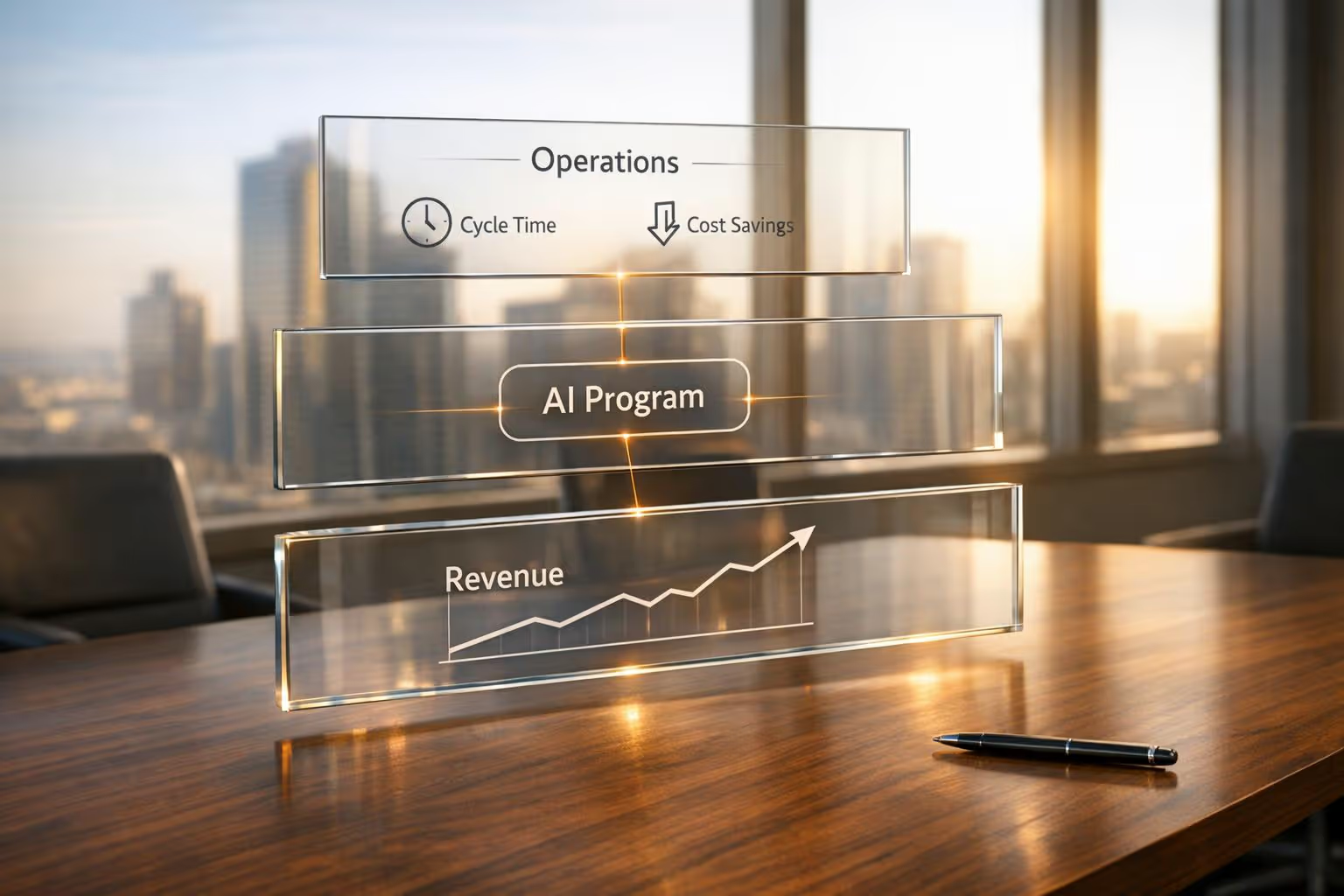
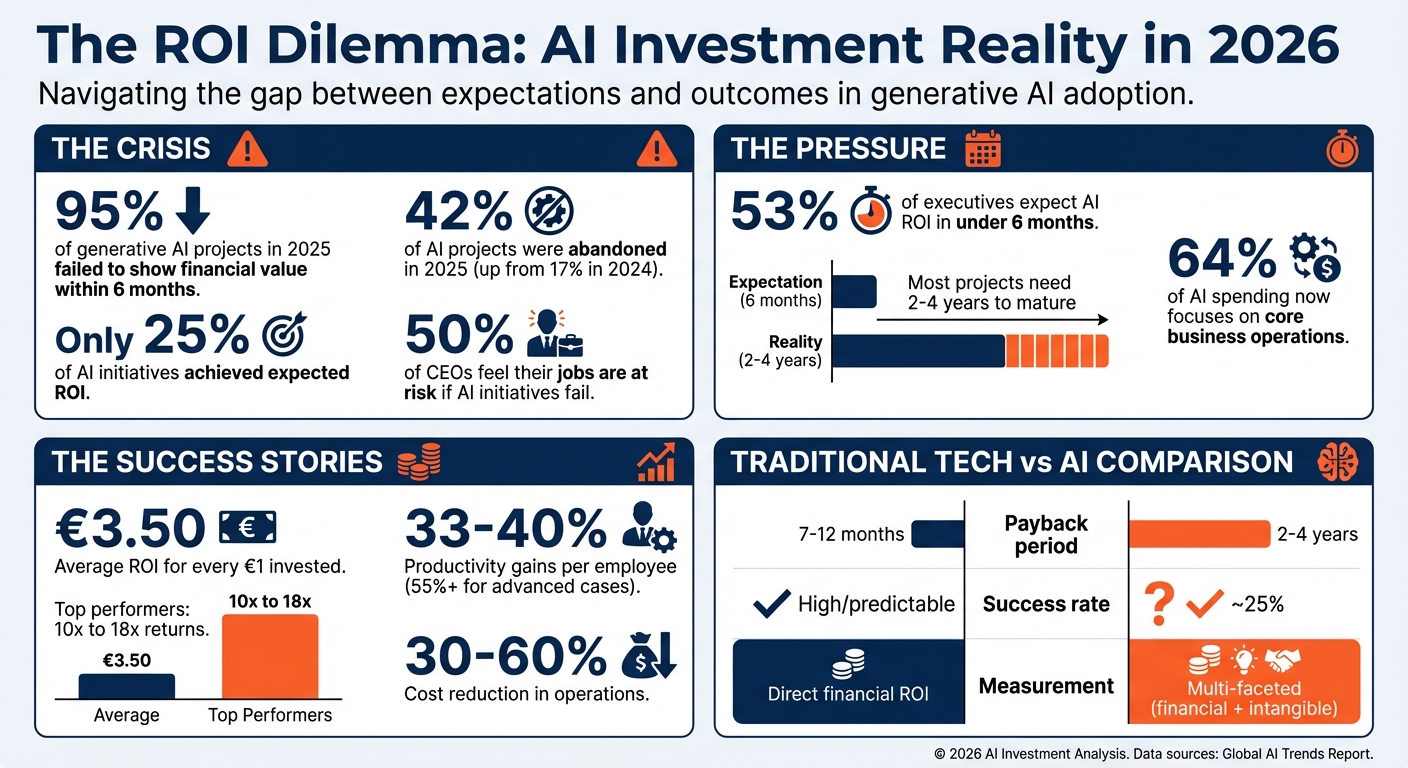
AI investments in 2026 are under intense scrutiny. With corporate AI spending expected to double, leaders are being pushed to deliver measurable returns - fast. Why? Because 95% of generative AI projects in 2025 failed to show financial value within six months, and half of all CEOs now feel their jobs are at risk if AI initiatives flop. The challenge lies in aligning AI’s long-term potential with the demand for short-term results.
Key takeaways:
- ROI Pressure: 53% of executives expect AI to deliver ROI in under six months, but most projects need 2–4 years to mature.
- High Abandonment Rates: 42% of AI projects were dropped in 2025 due to unclear returns.
- Shifting Budgets: 64% of AI spending now focuses on core business operations over peripheral tasks.
- ROI Success Stories: Top-performing companies achieve €3.50 for every €1 invested, with some seeing 10x to 18x returns.
To succeed, companies are adopting new ROI frameworks, tracking both financial and non-financial impacts, and using tools like SAP AI Value Calculator and IBM’s watsonx. The focus is shifting from vague metrics like model accuracy to clear business outcomes like cost savings, revenue growth, and productivity gains.
Bottom line: AI is no longer just a tech experiment - it’s a strategic investment. Companies that prioritize measurable business value and align AI initiatives with clear financial goals will lead in this competitive landscape.
AI ROI Statistics 2026: Key Metrics and Benchmarks for Fortune 500 Companies
Randy Bean on AI Investment ROI and Data Leadership in 2026
sbb-itb-e314c3b
Main Obstacles in Calculating AI ROI
Fortune 500 companies are hitting a tough reality: 42% abandoned most of their AI projects in 2025, a sharp rise from 17% the year before [12]. Even with increased investments, only 25% of AI initiatives in the last three years achieved the ROI CEOs had anticipated [9]. On top of that, 97% of organisations are struggling to show clear business value from their early Generative AI efforts [12]. The problem isn’t the technology itself - it’s the difficulty in measuring its success.
Why Standard Metrics Don't Work for AI
Traditional ROI models assume a return within 7–12 months, but AI projects often need 2–4 years to deliver measurable outcomes [2][5]. This disconnect creates friction between what boards expect and what AI can realistically provide.
Adding to the complexity, AI’s benefits are often intertwined with other initiatives like digital transformations or team restructuring. As an executive from an Energy, Resources & Industrials company pointed out, "We only managed to get a ballpark estimate of the benefits because it was hard to separate the gains from AI initiatives from those of other initiatives, like operational excellence, team reorganisation or changing roles" [2].
Scaling AI projects introduces another layer of difficulty. While early pilots in 2023 showed returns as high as 31%, these dropped to 7% during full-scale implementation - falling below the standard 10% cost of capital hurdle rate [9]. Additionally, intangible benefits like improved vendor relationships, employee morale, and brand trust are crucial but nearly impossible to quantify [2][7]. When AI works alongside human teams, organisations also face "attribution complexity", making it hard to determine how much of a productivity boost comes from AI versus human collaboration [7][8].
| Traditional Tech Investment | AI Initiative |
|---|---|
| 7–12 month payback period | 2–4 year payback period |
| Focus on efficiency and automation | Focus on transformation and reimagining processes |
| Direct financial ROI measurement | Multi-faceted measurement (financial + intangible) |
| High, predictable success rates | ~25% meet expectations |
Beyond measurement hurdles, rising operational costs make AI ROI calculations even trickier.
High Costs and Implementation Complexity
AI projects come with financial challenges that extend far beyond development. Unlike traditional SaaS platforms, which are costly to build but have minimal ongoing costs, AI systems are relatively cheap to develop but rack up substantial operational expenses [10]. These include inference fees, data labelling, prompt engineering, monitoring, and change management.
About 25% of executives cite poor infrastructure and data quality as major financial hurdles, delaying results and inflating initial investments [6][4]. On top of that, human oversight adds to the cost. Maintaining accuracy and preventing errors often demands 10–20% of the time equivalent of the original human task [7]. While this oversight is vital, it reduces the perceived efficiency gains from AI.
These hidden costs, combined with unclear returns, lead many projects to be shelved prematurely.
Abandoned Projects Due to Unclear Returns
The inability to measure AI’s impact directly influences investment decisions, leading to project cancellations - even when more time might yield success.
The focus has also shifted. Companies are moving AI budgets away from simpler, peripheral tasks to core business functions. Currently, 64% of AI budgets are allocated to core operations [9]. However, as the IBM Institute for Business Value notes, "Working at the core is much more complicated than grabbing low-hanging fruit around the periphery, which may help explain why the pivot to core functions is concurrent with a decrease in ROI" [9].
Agentic AI, or autonomous systems managing complex workflows, presents an even steeper challenge. While 57% of organisations use Agentic AI, only 10% are seeing meaningful ROI from these investments [2][4]. The complexity of these systems often stretches implementation timelines, with one-third of users expecting ROI to take three to five years [2][5]. That’s a long wait when stakeholders are pushing for immediate results.
How Fortune 500 Leaders Measure AI ROI
Fortune 500 leaders have moved away from relying on a single metric to assess the value of AI. Instead, they use a four-pillar framework that evaluates Efficiency Gains, Revenue Generation, Risk Mitigation, and Business Agility. This approach reflects AI's diverse impact, moving beyond simple cost-cutting measures [14]. These methods address earlier challenges in measurement, offering a more rounded view of AI's contributions.
In 2026, the average return on AI investments is €3.50 for every euro spent, with top-performing companies achieving returns as high as 10x to 18x their initial investments [14]. These organisations diligently track both financial and operational outcomes, using tools like impact chaining to map how a single AI-driven change can ripple through the business [10]. This shift in measurement strategies allows for deeper financial and operational insights.
"I tell executives to stop asking 'what is the model's accuracy' and start with 'what changed in the business once this shipped'"
- Salome Mikadze, Co-founder of Movadex [10]
This focus on business outcomes, rather than technical metrics, is what sets leading organisations apart in their approach to measuring AI's value.
Financial Performance Indicators
Financial metrics remain central to evaluating AI's impact. Companies now assess the Total Cost of Ownership (TCO), which includes expenses for infrastructure, data engineering, talent, model upkeep, and ongoing operations [14]. Yet, many still underestimate the total costs of AI projects.
For example, ServiceNow reported generating €325 million in annualised value by deploying AI productivity tools across its operations [14]. Similarly, NIB Health Insurance saved €20.8 million and reduced customer service costs by 60% with AI-powered digital assistants [14].
Top organisations are also adopting Risk-Adjusted ROI models. These adjust gross benefits by factoring in safety and reliability metrics, such as hallucination rates, guardrail interventions, and model drift. This approach provides a more realistic view of AI's financial contributions.
Revenue growth is now just as important as cost reduction. Metrics like deal win rates, new revenue streams from AI-driven personalisation, and faster product development cycles are becoming standard [14][2]. By 2026, corporate AI spending is expected to account for 1.7% of total revenues, highlighting confidence in AI's ability to drive growth [3].
A newer trend is outcome-based pricing, where organisations pay based on what an AI system accomplishes - such as €1.40 per case resolution - instead of traditional licensing fees [10].
| Metric Category | 2026 Benchmark | Top Performer Range |
|---|---|---|
| Average ROI | €3.50 per €1 invested | 10x - 18x return |
| Productivity Gains | 33% - 40% per employee | 55%+ for advanced cases |
| Cost Reduction | 30% - 60% in operations | Up to 60% (Customer Service) |
| Payback Period | 6 - 18 months | 3 - 6 months (Pilots) |
| Time-to-Value | 3 - 12 months | Weeks for "quick wins" |
While financial metrics highlight monetary results, operational improvements provide a clearer picture of AI's broader influence.
People and Process Indicators
AI's impact isn't just about numbers; it's also about operational changes that eventually lead to financial benefits. Currently, 72% of organisations formally track Generative AI ROI, with a primary focus on productivity improvements [15].
One way to calculate time savings is through the formula: Hours Saved × Hourly Rate × Utilisation. The utilisation factor, which typically ranges from 25% to 90%, accounts for the fact that not all saved time translates into productive output. This is often referred to as the "Productivity Leak" [14].
Real-world examples illustrate these gains. In 2025, Microsoft streamlined its supply chain processes, cutting manual planning by 50% and improving on-time planning by 75% [13]. Nestlé eliminated 100% of manual expense management tasks, tripling efficiency in report creation using AI tools within SAP Concur [13]. Chobani’s finance team reduced time spent on expense-related tasks by 75%, enabling a stronger focus on strategic priorities [13].
Operational metrics also measure accuracy and cost avoidance. For instance, SA Power Networks used AI to identify deteriorating infrastructure, achieving a 99% success rate and saving €945,000 in one year [13].
"AI can definitely make work faster, but faster doesn't mean ROI. We try to measure it the same way we do with human output: by whether it drives real results like traffic, qualified leads, and conversions."
- Agustina Branz, Senior Marketing Manager, Source86 [10]
To ensure accurate attribution, advanced organisations use "tagging frameworks" to distinguish between machine-generated, human-verified, and human-enhanced phases of workflows [10]. Delta Airlines, for instance, aligned its AI initiatives with employee development through SAP SuccessFactors, successfully filling nearly 50% of managerial roles with customer-facing employees - improving both customer satisfaction and shareholder value [13].
The rise of Agentic AI - autonomous systems managing complex workflows - has introduced new metrics like "value-realisation speed", which measures how quickly benefits appear within the first 90 days of deployment [10]. While nearly all CEOs expect these systems to deliver measurable returns by 2026, only 10% currently see meaningful ROI from such investments [2][4].
Leaders are also exploring softer metrics like employee sentiment, AI fluency, and user adoption. These are seen as early indicators of long-term financial success. For example, when 73% of employees report improved productivity, it fosters a cycle of greater AI adoption, eventually leading to tangible results [10]. In fact, 40% of top AI-performing organisations now mandate AI training for their workforce, recognising it as a critical skill for the future [4].
Frameworks Fortune 500 Companies Use to Assess AI Value
Fortune 500 companies are turning to structured frameworks to consistently evaluate the value of their AI investments. These frameworks are designed to address the challenges of measuring AI's return on investment (ROI) and provide a clear way to track impact and accountability. This shift is critical, as a staggering 95% of AI investments currently yield no measurable return - often due to difficulties in measurement rather than a lack of potential value [16].
Integrated Frameworks for Comprehensive Assessment
Top companies are now using frameworks that examine AI's impact across financial, operational, and workforce dimensions. For instance, PwC's AI Benchmarking Framework evaluates five key areas:
- Financial: Balancing costs against revenue.
- Operating: Improving cycle times.
- Functional: Assessing department-specific use cases.
- Trust: Ensuring accuracy and resilience.
- Workforce: Addressing upskilling and readiness [17].
Similarly, Deloitte's AI ROI Performance Index calculates a composite score by analyzing financial returns, revenue growth, operational savings, and the speed of results [2].
Interestingly, 85% of companies leading in AI ROI use distinct frameworks for Generative AI and Agentic AI, recognizing that these technologies require different evaluation methods [2]. This approach highlights a growing sophistication in how AI's value is assessed.
IBM's Approach to Assessing AI Investments
IBM has developed a systematic process to evaluate potential AI investments before committing significant resources. The process begins with mapping workflows to identify areas where AI can have the most impact. Teams then prioritize around five key capabilities, guided by feasibility and financial projections, with an initial accuracy target of 50% to 60%.
Next, an MVP (Minimum Viable Product) is selected using an impact-versus-feasibility matrix. This visual tool helps focus on opportunities that promise both quick wins and meaningful returns. IBM emphasizes iterative implementation and multidisciplinary collaboration to minimize risks while leveraging user data to uncover high-value opportunities [11].
Teams that adopt these iterative practices report a median ROI of 55%, far exceeding the enterprise-wide median of just 5.9% [11]. Before launching any AI initiative, IBM advises setting an 8- to 12-week baseline with key metrics to establish a reliable comparison point [16].
Shifting Accountability to Business Leaders
The responsibility for AI ROI is increasingly being placed on senior executives. In fact, 10% of organizations now have their CEO leading the AI agenda to ensure its strategic importance [2]. At the same time, ROI metrics are tracked by individual team leaders to ensure relevance to specific business functions.
"Measurement should occur at multiple levels of the company and be consistently reported. However... metrics should really be governed by the leaders of the individual teams and tracked at that level."
- Molly Lebowitz, Propeller Managing Director, Tech Industry [19]
To maintain focus, companies conduct quarterly reviews to refine ROI goals, decide which projects to scale, and identify those to discontinue [19]. Many have also introduced AI councils and intake systems to categorize projects as either "Trending ROI" (early progress indicators) or "Realized ROI" (quantifiable outcomes) [19].
Some organizations are experimenting with outcome-based pricing models, where payments are tied to specific results - like €1.50 per case resolution - rather than traditional licensing fees [18]. This approach emphasizes accountability and encourages detailed workflow analysis to identify high-impact opportunities.
Leveraging Workflow Analysis for Maximum Impact
Analyzing workflows is a proven way to pinpoint areas where AI can deliver measurable results quickly. By using impact chaining, organizations can directly connect AI outputs to business outcomes, mapping these processes to their financial value [18]. This method sets clear pre-AI ROI expectations while aligning projects with broader business objectives.
Currently, 64% of AI budgets are being reallocated to core business operations to ensure alignment with financial goals [9]. Companies are also adopting a long-term perspective, modeling ROI over three to five years, as many benefits take two to four years to fully materialize [2][13].
To accurately attribute value, a tagging framework is often used. This framework categorizes workflow stages as machine-generated, human-verified, or human-enhanced, providing clarity on AI's contribution at each step [18].
Fortune 500 Companies with Proven AI ROI Results
Several Fortune 500 companies have shown clear returns on their AI investments by moving beyond hype and embracing accountability. These businesses have adopted frameworks where every euro spent is tied to measurable outcomes, ensuring that AI delivers real value [20].
Asana's Cross-Department Reporting Approach
Asana has implemented a structured AI reporting system that directly links departmental goals to measurable results. Instead of focusing solely on metrics like usage stats or employee satisfaction, Asana evaluates tangible productivity improvements. For example, they measure time saved per task, the number of completed projects, and workflow bottlenecks eliminated. By tracking these specific outcomes, the company ties AI usage directly to operational efficiency, offering a clear picture of its return on investment [20][18].
Kyndryl's Fast-Track Implementation Method

Kyndryl took a phased approach to AI adoption, aligning initiatives with executive priorities to ensure faster returns. Rather than attempting a sweeping transformation, the company rolled out AI projects in small, iterative steps. This approach allowed teams to experiment, learn, and refine strategies quickly. A key focus was on bridging the "proficiency gap" - the difference between deploying AI tools and ensuring users are skilled enough to maximize their potential. By identifying areas where additional support was needed, Kyndryl was able to enhance user efficiency and achieve higher ROI [20].
These examples highlight how aligning AI efforts with business objectives and focusing on measurable outcomes can drive meaningful results.
Connect AI Projects to Business Objectives at RAISE Summit
The gap between AI investments and measurable outcomes remains a pressing issue, with many initiatives failing to deliver clear returns. For executives, the need for actionable strategies, rather than abstract theories, has never been more urgent. The RAISE Summit steps in to address these challenges with practical, peer-driven insights.
Sessions on AI Strategy and ROI Measurement
Taking place on 8–9 July 2026 at Le Carrousel du Louvre, Paris, the RAISE Summit directly confronts the issue of AI project ROI through its Friction track. This track dives into "The ROI Dilemma", offering sessions on topics like ROI measurement, AI adoption frameworks, and governance for enterprise-level deployment. These sessions are designed to deliver practical, immediately applicable takeaways.
The Frontier track complements this with discussions such as "AI Adoption Frameworks: From Pilots to Production" and "Governance at Scale", which are crucial for organisations aiming to move beyond experimental phases and adopt AI on a larger scale. These sessions build on structured ROI frameworks, transitioning from theoretical discussions to live, interactive applications.
"The era of vibe-based AI spending is over. Enterprises invested billions based on vendor promises and competitive pressure. Now executives demand proof."
– Jim Larrison, Larridin [20]
The summit also introduces the 4F Compass framework - Foundation, Frontier, Friction, and Future - a step-by-step guide to aligning AI initiatives with core business goals. This framework directly tackles the ongoing accountability issues that many AI projects face, setting the stage for focused, results-oriented discussions [21].
VIP Access and Networking Benefits
In addition to its technical sessions, the RAISE Summit provides exclusive networking opportunities to deepen the conversation around actionable AI strategies. VIP passes are available in two tiers:
- VIP MAX (€3 499): Includes access to an exclusive dinner in Paris, a private VIP lounge, and priority networking opportunities.
- VIP (€1 899): Offers high-level dialogues on AI strategy and priority access to connect with over 350 speakers and representatives from 2 000+ companies.
These passes are tailored for executives like CFOs, CIOs, and strategy leaders, enabling them to exchange insights on accountability frameworks and successful AI implementations. The summit's Book a Meeting system further enhances networking by facilitating one-on-one discussions with builders, investors, and regulators. This system allows attendees to dive into specific ROI strategies that go beyond the scope of standard conference interactions [21].
Tools and Methods for Tracking AI ROI in 2026
AI ROI Tool Comparison
Tracking the return on investment (ROI) for AI projects has become more efficient thanks to advanced tools and streamlined methods. Despite this progress, 85% of large enterprises still lack dedicated tools for monitoring AI ROI, often relying on integrated platforms that automate data collection and connect with core systems [19].
One standout tool is the SAP AI Value Calculator, which excels in integrating with ERP systems and customer experience platforms. It has delivered impressive ROI figures, ranging from 214% to 761% over five years [13]. For instance, Nestlé adopted AI-powered expense management tools via SAP Concur in 2025, completely eliminating manual, paper-based processes and tripling employee efficiency in generating expense reports [22]. Similarly, SA Power Networks used SAP’s AI solutions to manage aging infrastructure, achieving a 99% success rate in identifying corroded assets and saving approximately €945,000 [13].
On the infrastructure side, Aerospike’s Real-time Data Platform focuses on metrics like transaction latency and fraud reduction. A Forrester study reported ROI figures between 446% and 574%, with PayPal leveraging the platform to process millions of transactions per second with sub-millisecond latency, enabling real-time fraud detection [15].
For development teams, IBM watsonx is tailored to improve code generation speed and bug detection. It has shown a median ROI of 55% for product development teams, using feedback loops to identify new use cases and optimize existing processes [11].
A different approach is seen with Zendesk AI Agents, which tie costs directly to outcomes. Instead of traditional pricing models, they charge €1.40 per successful case resolution, aligning expenses with measurable results [18].
Here’s a comparison of some key tools and their ROI metrics:
| Tool/Platform | Primary Metrics Tracked | Documented ROI Results |
|---|---|---|
| SAP AI Value Calculator | CX/ERP integration, deal size, processing times | 214% to 761% ROI over five years [13] |
| Aerospike Real-time Data Platform | Transaction latency, infrastructure costs, fraud reduction | 446% to 574% ROI [15] |
| IBM watsonx | Code generation speed, bug detection, feedback loops | 55% median ROI for product development teams [11] |
| Zendesk AI Agents | Automated case resolution | €1.40 per case resolution [18] |
| Larridin Framework | Utilization, proficiency, business value | Targets reduction of the 72% value-waste gap [20] |
These tools highlight how companies can measure AI ROI effectively while addressing specific operational needs.
Fast Prototyping and Short Development Cycles
To achieve measurable returns quickly, many organizations are moving away from extended development cycles in favor of rapid prototyping. This approach ensures that operational AI projects deliver results within two fiscal quarters, keeping teams motivated and allowing for swift adjustments based on user feedback [18][11].
Although 72% of business leaders have structured processes for measuring AI ROI, nearly half still struggle to demonstrate the value of generative AI [20]. Short development cycles help bridge this gap by providing tangible outcomes that maintain stakeholder confidence.
The focus is on validating Minimum Viable Products (MVPs) with clearly defined success metrics before scaling up. Instead of building complete systems from the outset, companies start with limited prototypes, measure their effectiveness through A/B testing against human-only workflows, and refine based on actual performance data [18].
"An unused model has zero ROI." – Salome Mikadze, Co-founder, Movadex [18]
Conclusion: Applying These AI ROI Lessons in Your Organization
To make AI investments truly pay off, focus on aligning them with clear business objectives - whether that's cutting costs, boosting revenue, or improving customer retention. It’s not about chasing the latest tech; it’s about measurable outcomes. Start by documenting your current performance metrics. Without baseline data like processing times, error rates, or revenue per transaction, any ROI claims will lack credibility [13][20].
Tie your AI investments directly to your profit and loss (P&L) targets. Matt Marze, CIO at New York Life Group Benefit Solutions, puts it perfectly:
"We want to be nimble and move with urgency, but we also want to do things the right way. And because we fund our investments out of our P&L, we think about spending. We have that P&L mindset" [1].
To ensure success, assign a dedicated business owner and build cross-functional teams. This approach helps link AI initiatives to measurable outcomes, following the frameworks discussed earlier. It’s worth noting that 95% of enterprise generative AI projects fail to show measurable returns within six months, and by 2025, 72% of enterprise AI investments may actually destroy value due to poor accountability [1][20].
Use tools like impact chaining to map each AI process to its downstream value [10]. Calculate risk-adjusted returns by subtracting total cost of ownership (TCO) from gross benefits, factoring in safety signals. Model ROI over a three- to five-year horizon, focusing on high-value use cases. These structured steps are essential for achieving meaningful AI ROI [10][13].
Accountability is non-negotiable. As Jim Larrison from Larridin warns:
"The biggest AI risk is not security breaches; it is spending millions without measurable ROI" [20].
With corporate AI spending expected to double by 2026 - reaching about 1.7% of total revenues [3] - the organizations that focus on productivity gains and financial returns, rather than just adoption metrics, will set themselves apart.
FAQs
What’s a realistic AI payback period in 2026?
In 2026, the time it takes for AI investments to pay off usually ranges between 1 and 3 years. This timeframe depends on several factors, including how closely the AI initiative aligns with a company's business objectives, the quality of its available data, and its overall investment strategy. Achieving success demands careful planning and a clear focus on measurable results to ensure AI projects deliver returns within this period.
How do we calculate AI Total Cost of Ownership (TCO)?
Understanding the Total Cost of Ownership (TCO) for AI systems means looking beyond the obvious expenses. It’s not just about upfront costs like hardware, software, and licensing fees. You also need to factor in indirect costs, such as training employees, integrating the system into existing workflows, and ongoing maintenance.
But here’s the tricky part: there are often hidden costs. Think about potential productivity losses during the adjustment phase or risks tied to compliance issues. These can significantly impact the overall investment.
By carefully analysing both initial and recurring expenses, organisations can get a clearer picture of what they’re committing to. This kind of detailed evaluation ensures decisions are aligned with long-term goals and helps avoid unexpected financial surprises.
Which metrics prove AI ROI beyond model accuracy?
AI's return on investment (ROI) isn't just about how accurate a model is - it’s about the bigger picture. You can measure it through financial benefits like increased revenue or reduced costs, operational performance indicators, and business-focused metrics such as advancements in innovation or improved customer satisfaction. Additionally, strategic impact scores help assess how well AI initiatives align with and drive organisational objectives forward.